×

Turkmenistan🇹🇲 | best national parksExplore the 10 Best national parks in Turkmenistan

National parks in Turkmenistan are mostly state-run zapovedniks, strict nature reserves inherited from the Soviet system, alongside a smaller number of national parks and sanctuaries. Most of the country is the Karakum Desert, so protected land splits between desert plains, the Kopet Dag mountains along the Iranian border, and the river valleys of the east. Access depends on permits, and visits are usually arranged through a licensed agency, with a guide and driver. Costs are higher than in neighboring Central Asia, and crowds are essentially absent. Independent travel is possible within the visa rules, but remote areas need a vehicle and arrangements made in advance.

By Johan Kruseman 🇳🇱 | Updated November 18, 2026
Explore the best hikes in Turkmenistan

Why go?Understanding Their Importance

Turkmenistan is a geographic outlier for national parks. Around 70 percent of the territory is desert, so protected areas concentrate on the few places where water, relief or isolation created distinct habitats: mountain ranges, desert wetlands and the Amu Darya floodplain. The result is biological variety in a small number of sites, including species that have become rare elsewhere in Central Asia.

The Soviet legacy matters. Reserves were set up for scientific research rather than recreation, so many have minimal visitor infrastructure: few marked trails, limited signage, basic or no lodging, and little printed information. Rangers and scientists are often the main source of knowledge on site.

The political context shapes every trip. Turkmenistan is among the most closed countries in the … read more 👉
Turkmenistan is a geographic outlier for national parks. Around 70 percent of the territory is desert, so protected areas concentrate on the few places where water, relief or isolation created distinct habitats: mountain ranges, desert wetlands and the Amu Darya floodplain. The result is biological variety in a small number of sites, including species that have become rare elsewhere in Central Asia.

The Soviet legacy matters. Reserves were set up for scientific research rather than recreation, so many have minimal visitor infrastructure: few marked trails, limited signage, basic or no lodging, and little printed information. Rangers and scientists are often the main source of knowledge on site.

The political context shapes every trip. Turkmenistan is among the most closed countries in the world. Visas are tightly controlled, most tourists travel on a guided tour or transit visa, and border zones need separate permits. Some parks lie near sensitive frontier areas, which can affect access without warning.

Travelers should expect long drives on rough roads, a strong dependence on agencies, and facilities that vary from simple guesthouses to camping. Wildlife viewing is rarely guaranteed. The appeal here is solitude, geology and landscape on a scale that is hard to find elsewhere, not polished visitor services.
Our Approach to Ranking
The list of best national parks in Turkmenistan is created based on landscapes, wildlife, adventure opportunities, facilities, and overall experience. If you feel a national park is missing in this list, please let us know.

When to go?When to Plan Your Trip

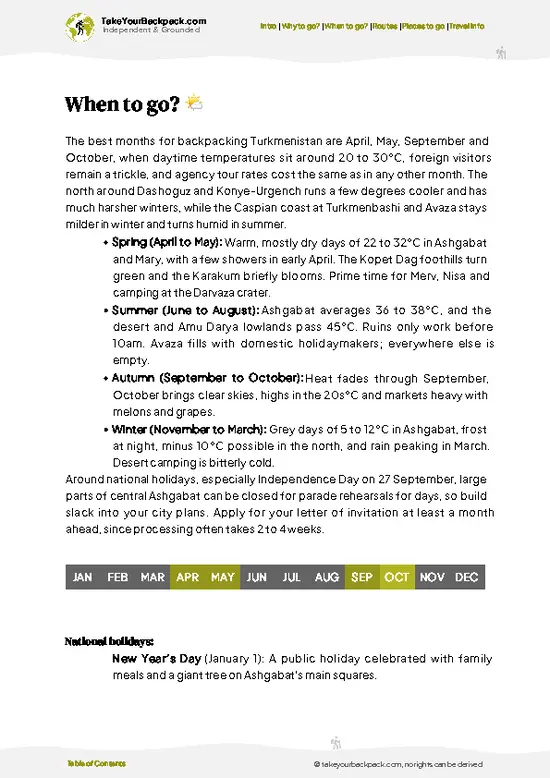
Best months: The best months are April to May and late September to October, when daytime temperatures in most of the country sit between roughly 18 and 30°C and the desert is neither scorching nor freezing. Spring also brings green grass and wildflowers to the foothills.
Summer: June to August is hard going in the Karakum and the south. Daytime highs often exceed 40°C, and ground temperatures are higher still. Outdoor activity is realistic only at dawn and in the evening. The Kopet Dag and higher ground are cooler, usually 25 to 35°C, so mountain areas remain workable in July, but even there the heat is serious.
Winter: November to March is cool to cold. Daytime temperatures run about 5 to 12°C in much of the country, with nights below freezing, and the north near the Aral Sea basin is colder … read more 👉
Best months: The best months are April to May and late September to October, when daytime temperatures in most of the country sit between roughly 18 and 30°C and the desert is neither scorching nor freezing. Spring also brings green grass and wildflowers to the foothills.
Summer: June to August is hard going in the Karakum and the south. Daytime highs often exceed 40°C, and ground temperatures are higher still. Outdoor activity is realistic only at dawn and in the evening. The Kopet Dag and higher ground are cooler, usually 25 to 35°C, so mountain areas remain workable in July, but even there the heat is serious.
Winter: November to March is cool to cold. Daytime temperatures run about 5 to 12°C in much of the country, with nights below freezing, and the north near the Aral Sea basin is colder still. Most rain and snow falls between December and March, and annual rainfall is low, from under 100 mm in the desert to 300 mm or more in the mountains. Wet weather can make dirt tracks impassable.
Crowds and prices: Crowds do not drive timing here, as visitor numbers are very low all year. Tour and guide prices vary little by season, though availability of drivers and permits is easiest in spring and autumn. Agencies often need several weeks of lead time for permits, so book well before the chosen window.

national park hoppingSuggested Travel Strategies

How many days: A trip combining several national parks in Turkmenistan needs 10 to 14 days, including time for the visa and the permit process. The distances are large and roads are slow, so the number of stops depends on driving hours, not on how much there is to see.
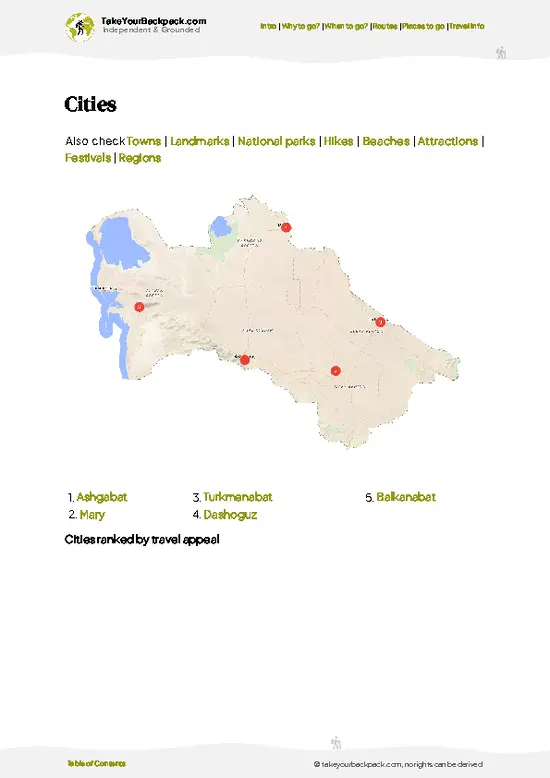
Regional clusters: The country splits into three practical clusters. The southwest, reached from Ashgabat, covers the Kopet Dag and the Balkan region toward the Caspian coast. The east, around Turkmenabat and the Amu Darya valley, is a separate trip, as is the north near Dashoguz. Ashgabat is the natural hub, with the main airport and most agency offices.
Direction and timing: Start in the Ashgabat area and then move outward in one loop, finishing in the region with the longest return drive or a different exit airport. Allow one … read more 👉
How many days: A trip combining several national parks in Turkmenistan needs 10 to 14 days, including time for the visa and the permit process. The distances are large and roads are slow, so the number of stops depends on driving hours, not on how much there is to see.
Regional clusters: The country splits into three practical clusters. The southwest, reached from Ashgabat, covers the Kopet Dag and the Balkan region toward the Caspian coast. The east, around Turkmenabat and the Amu Darya valley, is a separate trip, as is the north near Dashoguz. Ashgabat is the natural hub, with the main airport and most agency offices.
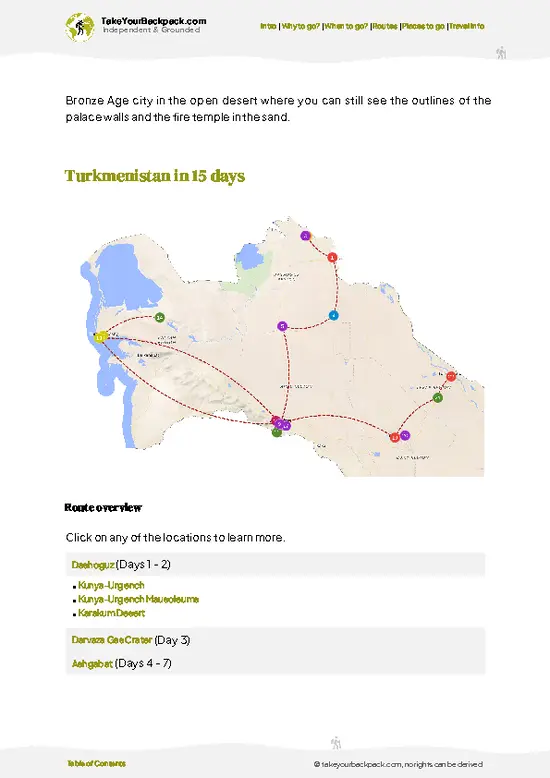
Direction and timing: Start in the Ashgabat area and then move outward in one loop, finishing in the region with the longest return drive or a different exit airport. Allow one to two nights per stop, since field access takes most of a day. Typical road times are 3 to 5 hours between nearby areas, and 8 to 10 hours or more between Ashgabat and the far east or north. Domestic flights and the Ashgabat to Turkmenabat train can replace the longest overland stretches.
Common planning mistakes: Travelers often underestimate drive times and pack too many stops. Plan no more than 4 to 6 hours of driving per day. Another error is arranging permits late and ending up with locked-out areas. Apply for all regions together at the outset, and leave one buffer day for weather or checkpoint delays.

The ListThe Best national parks of Turkmenistan

1 Yangykala Canyon

Banded clay cliffs, rim camping, fossil shells, desert-plain track

Camp on the rim of a canyon of pink, rust and cream cliffs, and watch the colors shift from dusk to first light.

2 Köpetdag Nature Reserve

Bezoar goat slopes, limestone gorges, juniper stands, Persian leopard tracks

Hike dry gorges and juniper hillsides along the Iranian frontier, glassing steep ledges at dawn for bezoar goat, urial and circling vultures.

3 Köýtendag

Dinosaur plateau, Kaptarhana cave, Ayrybaba peak, Kugitang canyons

Combine fossil trackways, an underground cave lake and rugged gorges beneath Turkmenistan's highest summit, with a guide for the rougher ridges.

4 Repetek

Research station museum, saxaul woodland, Karakum sand ridges, desert reptiles

Start at the station museum, then follow a guide over fragile dune ridges to read lizard, gerbil and tortoise signs in the sand.

5 Badhyz State Nature Reserve

Kulan herds, wild pistachio hills, Afghan border steppe, Eroylanduz

Bounce along gravel tracks in a 4x4 to spot wild kulan grazing open steppe, with pistachio groves and long border horizons around you.

6 Gaplaňgyr Nature Reserve

Kaplankyr plateau, limestone escarpments, kulan and mouflon, Sarykamysh views

Scan a remote limestone tableland and its eroded cliff edges for kulan herds and gazelles, with the salty Sarykamysh Lake to the east.

7 Bereketli Garagum Nature Reserve

Karakum dunes, saxaul scrub, takyr clay pans, dark night sky

Walk wind-rippled sand ridges and firm clay flats, then watch tortoises, lizard tracks and a clear Milky Way once the desert cools.

8 Syunt-Hasardag Nature Reserve

Limestone massif, archa juniper forest, Kopet Dag gorges, leopard country

Climb unmarked tracks through juniper toward a high limestone crest, with eagles overhead and wild goat ledges across the gorges.

turkmenistan-national-park-syunt-hasardag-nature-reserve
© Google |

9 Amudarya Nature Reserve

Tugai floodplain forest, Amu Darya banks, Bukhara deer tracks, reed channels

Follow sandy tracks through riverside poplar and tamarisk thickets to the muddy banks of the Amu Darya, watching for deer prints and waterbirds.

turkmenistan-national-park-amudarya-nature-reserve
© Google |

10 Esenguly Nature Reserve

Caspian shore, Etrek delta reeds, wintering waterfowl, flamingos

Stroll a flat, reedy Caspian coastline to scan shallow bays for swans, flamingos and pelicans, with jackal tracks in the sand behind.

Loading the map 🌍

Expert viewInsights from Locals and Experts

How many parks to visit: I advise three to four parks on a single trip. Distances are long, each protected area requires a permit, and a car with a driver usually spends most of the day getting there. More than four turns the trip into a drive with short stops. Fewer than three wastes the cost of getting in and the expense of the guide.
Choosing by travel style: Hikers and photographers should prioritize mountain reserves, where walking is possible and the terrain changes within a few hours. Travelers with limited time are better served by parks near Ashgabat, which cut driving costs. Those interested in geology and wide horizons should favor desert and plateau sites, and bird or wildlife enthusiasts should look at the river and wetland reserves in spring or autumn. Expect to give up spontaneity: … read more 👉
How many parks to visit: I advise three to four parks on a single trip. Distances are long, each protected area requires a permit, and a car with a driver usually spends most of the day getting there. More than four turns the trip into a drive with short stops. Fewer than three wastes the cost of getting in and the expense of the guide.
Choosing by travel style: Hikers and photographers should prioritize mountain reserves, where walking is possible and the terrain changes within a few hours. Travelers with limited time are better served by parks near Ashgabat, which cut driving costs. Those interested in geology and wide horizons should favor desert and plateau sites, and bird or wildlife enthusiasts should look at the river and wetland reserves in spring or autumn. Expect to give up spontaneity: nearly everything is agency-arranged.
Budget: Plan on US$100 to 200 a day for a guided independent trip, much of which is the vehicle and guide. Typical components: a driver and car at US$60 to 120 a day, a guide at US$40 to 80 a day, and park or permit fees from about US$5 to 30 per person per visit, with extra for special permits. Simple guesthouses or tents cost roughly US$20 to 50 a night, and hotels in cities more. Meals cost US$8 to 20. Costs fall per person in a group of three or four sharing a vehicle. Foreign cards are rarely accepted, so bring clean US dollar bills and exchange at the official rate or through your agency.
Safety and conduct: The main hazards are heat, remote driving and water. Carry at least 3 to 4 liters of water per person per day in summer, travel in a 4x4 with a spare tire, and keep fuel high, since stations are sparse outside towns. Mobile signal is patchy and internet is restricted and slow, so download offline maps beforehand.
Border zones are sensitive. Do not photograph military sites, checkpoints or officials, and stay on approved routes. Rangers and guides expect to be told your plans, and travel registration rules apply. Dress modestly in villages, ask before photographing people, and avoid political topics. A short note at a checkpoint costs nothing, and quiet cooperation avoids most delays. Pack a basic first-aid kit, since clinics are far from the parks.

✈️ The backpacker research shortcutTurkmenistan Travel Guide

What the free pages can't give you: ready-made routes, every place ranked, and it works offline. All in 1 guide.
example page 0 from our offline Travel Guide for Turkmenistan
example page 1 from our offline Travel Guide for Turkmenistan
example page 2 from our offline Travel Guide for Turkmenistan
example page 3 from our offline Travel Guide for Turkmenistan
example page 4 from our offline Travel Guide for Turkmenistan
example page 5 from our offline Travel Guide for Turkmenistan
example page 6 from our offline Travel Guide for Turkmenistan
example page 7 from our offline Travel Guide for Turkmenistan
The digital guide (153 pages) contains:-page digital guide:
✅ Ready-made 5, 10 & 15-day routes
✅ All 41 places ranked, so you skip the overrated ones
✅ Works offline, all in 1 guide
✅ Cities, national parks, landmarks, beaches
✅ How to get around
👉 Click to see all 30+ guide features

📅 Plan smarter in minutes, not weeks
✅ Month by month travel advice
✅ Festivals & national holidays
✅ Budget expectations

🗺️ Go to the right places, skip the overrated ones
✅ Honest pros & cons of destinations
✅ Top hikes, parks & viewpoints
✅ Lesser-known places most travelers miss
✅ Clear “worth it vs skip it” guidance

🛏️ Travel smoothly without rookie mistakes
✅ Best areas to stay
✅ Transport systems explained simply
✅ Common scams & safety advice
✅ SIM cards, money & practical tips

🌍 Understand the country, not just visit it
✅ Culture & traditions
✅ 52 Essential phrases & customs
✅ Festivals worth planning around
✅ Traveler-friendly historical context
✅ Insights that make places more meaningful

📱 Built for real travel conditions
✅ Fully downloadable PDF
✅ Works completely offline
✅ Optimized for phone use
✅ Useful in remote areas & buses
✅ All in 1 guide
Stop searching, start planning
Get instant access to your full guide. 30‑day money-back guarantee.


By proceeding you agree to our terms.
Sent to your inbox immediately after payment • 100% Secure Checkout
Best Backpacking Travel Advisor 2025 tourism awardBest Backpacking
Travel Advisor
2025
What others say about Take Your Backpack Guides:
⭐⭐⭐⭐⭐
Fantastic, amazing amount of information!
⭐⭐⭐⭐⭐
My goodness this is amazing, it's what I've been looking for hats off too you!
⭐⭐⭐⭐⭐
I think this is absolutely BRILLIANT
⭐⭐⭐⭐
Very complete and informative. It's still missing places, but I gotta to commend you
⭐⭐⭐⭐⭐
This is truly amazing, thank you, can't wait to explore it with my kids!
⭐⭐⭐⭐⭐
Awesome resource, thank you!
⭐⭐⭐⭐⭐
This is amazing! Can't wait to explore the ones I haven't seen
⭐⭐⭐⭐
I love this! Well done, great idea.
⭐⭐⭐⭐⭐
Thanks for taking the time to make this gem!
⭐⭐⭐⭐⭐
This might be the best website I've ever seen.
⭐⭐⭐⭐⭐
Congratulations, and thank you so much for your work; it's incredibly valuable.
⭐⭐⭐⭐
In all seriousness I think you did a great job pointing out the important spots
⭐⭐⭐⭐⭐
10/10 very good
⭐⭐⭐⭐⭐
As someone who's only just starting to visit regularly this is awesome, thank you.
⭐⭐⭐⭐
Thank you very much! I'm going to visit my dad, it's going to be very useful!
⭐⭐⭐⭐⭐
This is really cool! We'll be travelling for the first time and this definitely come in handy.
⭐⭐⭐⭐⭐
You are now our minister of culture, congratulations 👨‍💼
⭐⭐⭐⭐⭐
Just wanted to tell you that this is a pearl! Going to follow your recommendations.
⭐⭐⭐⭐⭐
This is so cool. I'll definitely be using the resource for my travels soon.
⭐⭐⭐⭐⭐
This is very impressive! Good work.
⭐⭐⭐⭐⭐
This is an amazing and informative site. Very well done!

🛏️ Where to stay?Where to Stay in Turkmenistan

Turkmenistan has no real hostel scene, because foreign visitors must stay in registered hotels (usually booked through the agency that sponsors your visa), so budget travel here means plain Soviet-era hotels at roughly US$30 to 60 a night rather than dorm beds. In Ashgabat, the older city center around the Russian Bazaar has the cheapest rooms and puts you within walking distance of markets, cafés and the few bars, while the white-marble Berzengi district to the south has larger, pricier hotels that are very quiet and very safe but need a taxi to reach anything, and evening life citywide winds down by about 11 pm. Outside the capital, Mary (the base for Merv) and Turkmenbashi have a handful … read more 👉
Turkmenistan has no real hostel scene, because foreign visitors must stay in registered hotels (usually booked through the agency that sponsors your visa), so budget travel here means plain Soviet-era hotels at roughly US$30 to 60 a night rather than dorm beds. In Ashgabat, the older city center around the Russian Bazaar has the cheapest rooms and puts you within walking distance of markets, cafés and the few bars, while the white-marble Berzengi district to the south has larger, pricier hotels that are very quiet and very safe but need a taxi to reach anything, and evening life citywide winds down by about 11 pm. Outside the capital, Mary (the base for Merv) and Turkmenbashi have a handful of basic central hotels, with the resort strip at Awaza offering seaside rooms that sit about 12 km from town.

If you enjoy meeting fellow travelers, consider choosing hostels with high ratings for atmosphere. On the other hand, if you prefer having your own space, a hotel might be a better option.

TurkmenistanMore of Turkmenistan

👋 Meet the founderWho’s Behind Take Your Backpack?

Johan, backpacker and founder of TakeYourBackpackHi, I’m Johan (Netherlands 🇳🇱), the creator of TakeYourBackpack. Over the past 30 years, I’ve backpacked through 88 countries across six continents, gaining extensive experience with independent travel, long-term trips, and overland routes.

This site is built on a combination of firsthand travel experience and carefully curated insights from other backpackers. Many guides are based on places I’ve personally visited, while others bring together tips, observations, and practical advice shared by trusted travelers I’ve met along the way.

The goal is to provide realistic, experience-driven guidance — not generic itineraries — so you can explore destinations with better context, clearer expectations, and more confidence.