×

Tuvalu🇹🇻 | festivalsTuvalu Cultural FestivalCompeting fatele groups, te ano ball game, pulaka feast, woven mats | things to do and best time to go

Explore Funafuti DayExplore Tuvalu Independence Day

Backpacking in Tuvalu Cultural
👍 Recommendedfestival ranked #2
By Johan Kruseman 🇳🇱 | Updated October 15, 2026

Tuvalu held its first national cultural festival, the five-day Fakaapo Tuvalu Arts Festival, in Funafuti in late August 2026, and the welcome is local first. The Tuvalu Cultural Festival takes place in Tuvalu, with the capital atoll of Funafuti as the usual stage. Expect fatele singing and dancing, mat weaving, island food and a very relaxed crowd of families, officials and the odd outsider. Flights into Tuvalu run only a few times a week, so book them before you fix festival dates, and arrive a day early so one delay does not eat your trip. Pack cash, since card machines are rare and there is little to withdraw from. Ask your guesthouse about the schedule in person, because posted times slide. Your first day could be a slow walk to the meeting house, a seat near the back and a plate of whatever is offered.

Discover everything you want to know in the 📖 Tuvalu Travel Guide.


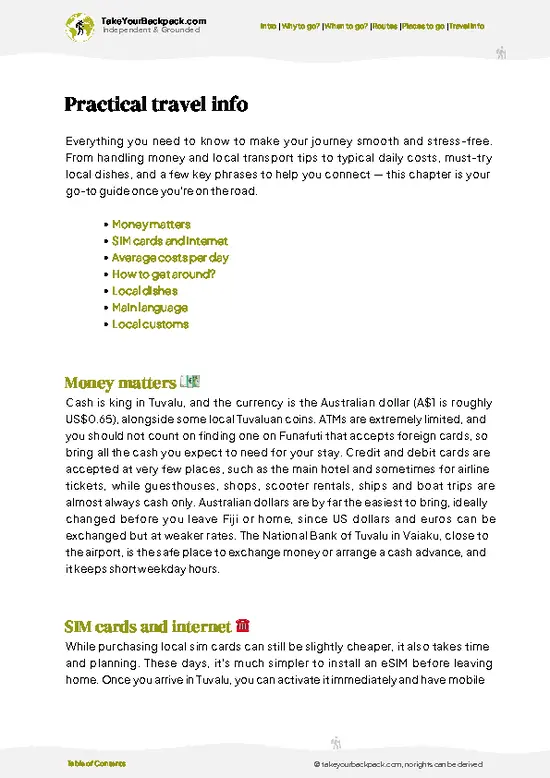
example page 0 from our offline Travel Guide for Tuvalu
example page 1 from our offline Travel Guide for Tuvalu
example page 2 from our offline Travel Guide for Tuvalu
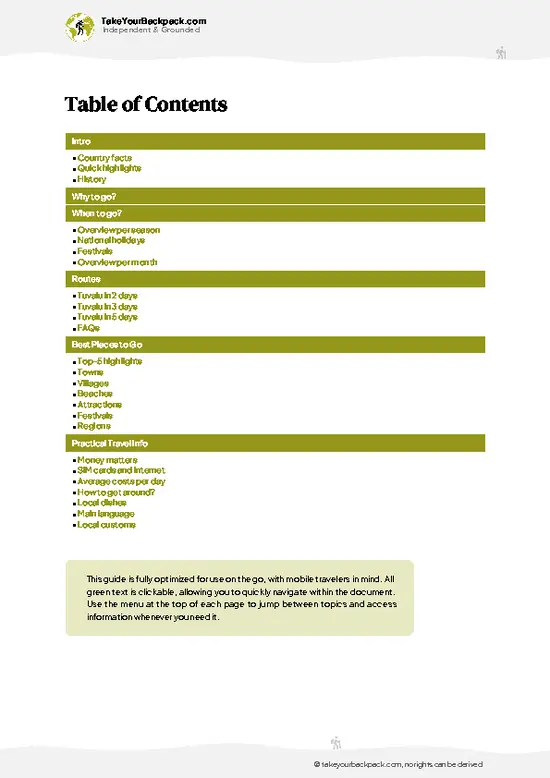
example page 3 from our offline Travel Guide for Tuvalu
example page 4 from our offline Travel Guide for Tuvalu
example page 5 from our offline Travel Guide for Tuvalu
example page 6 from our offline Travel Guide for Tuvalu
example page 7 from our offline Travel Guide for Tuvalu
Loading the map 🌍
CLICK TO FILTER
towns
villages
beaches
attractions
festivals
regions
SHOW COUNTRY’S BESTSHOW ALL

✨ Why go?
Ranked #2 festival in Tuvalu
The unique appeal for travelers

Backpackers build routes around this because Tuvalu rarely gives you a crowd to join. Visitor numbers are tiny, so a festival here is one of the few moments when the whole community is in one place and has a reason to welcome you. You don’t watch from behind a barrier. You sit on a pandanus mat in the maneapa, the open meeting house, and someone usually hands you food or pulls you into a song. That is cultural access you can’t buy on a tour.

It also fits a Pacific loop. Most travelers reach Tuvalu from Fiji, so a festival gives you a reason to stay beyond a quick look and to connect with kava-and-coconut island life in a way a normal stopover never would. Because the event is community run, there is no ticketed gate and no festival wristband economy, and your spending goes to guesthouses, … read more 👉
Backpackers build routes around this because Tuvalu rarely gives you a crowd to join. Visitor numbers are tiny, so a festival here is one of the few moments when the whole community is in one place and has a reason to welcome you. You don’t watch from behind a barrier. You sit on a pandanus mat in the maneapa, the open meeting house, and someone usually hands you food or pulls you into a song. That is cultural access you can’t buy on a tour.

It also fits a Pacific loop. Most travelers reach Tuvalu from Fiji, so a festival gives you a reason to stay beyond a quick look and to connect with kava-and-coconut island life in a way a normal stopover never would. Because the event is community run, there is no ticketed gate and no festival wristband economy, and your spending goes to guesthouses, home cooks and craft makers. Pair it with fatele nights for the most atmosphere, and treat everything else as unhurried island time.

💡 HighlightsMust-see experiences and standout moments

  1. Fatele performances: The festival’s heart is the fatele, a call-and-response song and dance where groups from different communities compete with rhythm, clapping and wooden-box drumming. It usually runs late into the evening in the meeting house, and onlookers often get pulled in.
  2. The Maneapa meeting house: This large open-sided hall with a high thatched roof is where gatherings, speeches and dancing take place. Sit low on the mat floor, as standing over seated elders is considered rude.
  3. Community feast: Expect pulaka (swamp taro), coconut cream, grilled and raw fish and breadfruit, laid out for the whole group. Eating alongside local families is the best way to meet people, and a small contribution of food or goods is appreciated.
  4. Te ano ball game: This traditional ball game is played between
… read more 👉
  1. Fatele performances: The festival’s heart is the fatele, a call-and-response song and dance where groups from different communities compete with rhythm, clapping and wooden-box drumming. It usually runs late into the evening in the meeting house, and onlookers often get pulled in.
  2. The Maneapa meeting house: This large open-sided hall with a high thatched roof is where gatherings, speeches and dancing take place. Sit low on the mat floor, as standing over seated elders is considered rude.
  3. Community feast: Expect pulaka (swamp taro), coconut cream, grilled and raw fish and breadfruit, laid out for the whole group. Eating alongside local families is the best way to meet people, and a small contribution of food or goods is appreciated.
  4. Te ano ball game: This traditional ball game is played between two teams using two woven pandanus balls. It is noisy, tactical and surprisingly physical, and spectators are welcome to cheer along.
  5. Handicraft displays: Women from island groups show fala mats, woven fans, shell necklaces and baskets. Buy directly from the maker, ask about the pattern and carry cash in small notes.
If time is short, skip the handicraft stalls and put your hours into an evening of fatele.
Spotted a mistake or missing something? Contact us.

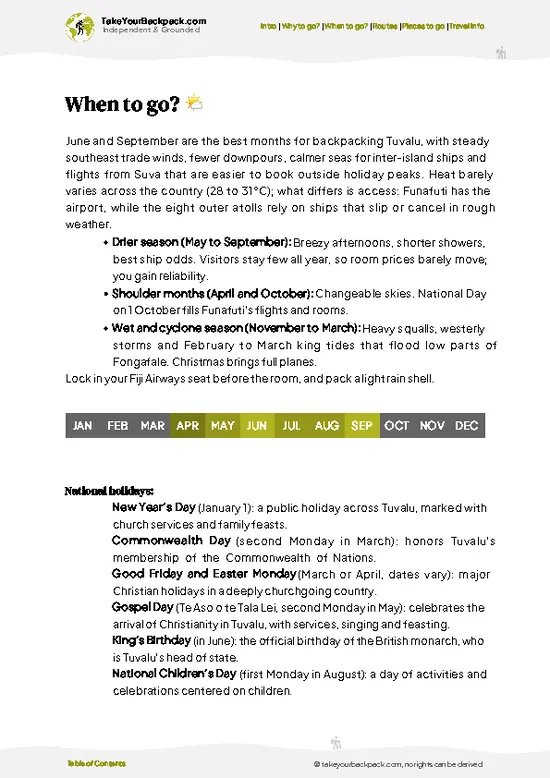
🌤️ When to go?When is the celebration of Tuvalu Cultural Festival?

The Tuvalu Cultural Festival is not a fixed-date event, so check the date with the Tuvalu Tourism Office before booking; the gatherings centered on Funafuti, around the Vaiaku area and the Funafuti Maneapa, usually run for a few days.
  • Best day: Go on the main performance day, when island groups present fatele dances and songs in matching outfits. Quieter days are better for talking with weavers and carvers.
  • Weather: Expect 28 to 31°C (82 to 88°F) with humid air, sudden showers and about 12 hours of daylight. Bring a sun hat, reef-safe sunscreen, a light rain jacket and sandals you can take off easily.
  • Booking: Funafuti has very few beds and flights are limited, so reserve a room and your seat on the Fiji Airways flight several weeks ahead. Rooms can rise by 10 to 20 percent around the event.
  • Arrival
… read more 👉
The Tuvalu Cultural Festival is not a fixed-date event, so check the date with the Tuvalu Tourism Office before booking; the gatherings centered on Funafuti, around the Vaiaku area and the Funafuti Maneapa, usually run for a few days.
  • Best day: Go on the main performance day, when island groups present fatele dances and songs in matching outfits. Quieter days are better for talking with weavers and carvers.
  • Weather: Expect 28 to 31°C (82 to 88°F) with humid air, sudden showers and about 12 hours of daylight. Bring a sun hat, reef-safe sunscreen, a light rain jacket and sandals you can take off easily.
  • Booking: Funafuti has very few beds and flights are limited, so reserve a room and your seat on the Fiji Airways flight several weeks ahead. Rooms can rise by 10 to 20 percent around the event.
  • Arrival and departure: The airstrip road is the main route and it is short, so traffic is light. Flights run only a few times a week, so build in a spare day on either side.
Confirm the flight schedule first, then lock in your accommodation around it.


source: climatestotravel.comJANJanuary: not recommended for travelingFEBFebruary: not recommended for travelingMARMarch: not recommended for travelingAPRApril: not recommended for travelingMAYMay: excellent for travelingJUNJune: not recommended for travelingJULJuly: not recommended for travelingAUGAugust: not recommended for travelingSEPSeptember: not recommended for travelingOCTOctober: not recommended for travelingNOVNovember: not recommended for travelingDECDecember: not recommended for traveling

✈️ The backpacker research shortcutTuvalu Travel Guide

An offline-friendly backpacking guide with optimized travel routes, ranked highlights, transport advice, and the best areas to stay.
example page 0 from our offline Travel Guide for Tuvalu
example page 1 from our offline Travel Guide for Tuvalu
example page 2 from our offline Travel Guide for Tuvalu
example page 3 from our offline Travel Guide for Tuvalu
example page 4 from our offline Travel Guide for Tuvalu
example page 5 from our offline Travel Guide for Tuvalu
example page 6 from our offline Travel Guide for Tuvalu
example page 7 from our offline Travel Guide for Tuvalu
The digital guide (97 pages) contains:
✅ 20 highlights, ranked by travel appeal
✅ Optimized 2, 3 & 5-day travel routes
✅ Cities, national parks, landmarks, beaches
✅ How to get around
✅ Offline-friendly for travel without Wi-Fi
👉 Click to see all 30+ guide features

📅 Plan smarter in minutes, not weeks
✅ Month by month travel advice
✅ Festivals & national holidays
✅ Budget expectations

🗺️ Go to the right places, skip the overrated ones
✅ Honest pros & cons of destinations
✅ Top hikes, parks & viewpoints
✅ Lesser-known places most travelers miss
✅ Clear “worth it vs skip it” guidance

🛏️ Travel smoothly without rookie mistakes
✅ Best areas to stay
✅ Transport systems explained simply
✅ Common scams & safety advice
✅ SIM cards, money & practical tips

🌍 Understand the country, not just visit it
✅ Culture & traditions
✅ 52 Essential phrases & customs
✅ Festivals worth planning around
✅ Traveler-friendly historical context
✅ Insights that make places more meaningful

📱 Built for real travel conditions
✅ Fully downloadable PDF
✅ Works completely offline
✅ Optimized for phone use
✅ Useful in remote areas & buses
✅ Everything in one place
Stop searching, start planning
Get instant access to your full guide. 30‑day money-back guarantee.
+ Add another guide for just

By proceeding you agree to our terms.
Sent to your inbox immediately after payment • 100% Secure Checkout
Best Backpacking Travel Advisor 2025 tourism awardBest Backpacking
Travel Advisor
2025
What others say about Take Your Backpack Guides:
⭐⭐⭐⭐⭐
Fantastic, amazing amount of information!
⭐⭐⭐⭐⭐
My goodness this is amazing, it's what I've been looking for hats off too you!
⭐⭐⭐⭐⭐
I think this is absolutely BRILLIANT
⭐⭐⭐⭐
Very complete and informative. It's still missing places, but I gotta to commend you
⭐⭐⭐⭐⭐
This is truly amazing, thank you, can't wait to explore it with my kids!
⭐⭐⭐⭐⭐
Awesome resource, thank you!
⭐⭐⭐⭐⭐
This is amazing! Can't wait to explore the ones I haven't seen
⭐⭐⭐⭐
I love this! Well done, great idea.
⭐⭐⭐⭐⭐
Thanks for taking the time to make this gem!
⭐⭐⭐⭐⭐
This might be the best website I've ever seen.
⭐⭐⭐⭐⭐
Congratulations, and thank you so much for your work; it's incredibly valuable.
⭐⭐⭐⭐
In all seriousness I think you did a great job pointing out the important spots
⭐⭐⭐⭐⭐
10/10 very good
⭐⭐⭐⭐⭐
As someone who's only just starting to visit regularly this is awesome, thank you.
⭐⭐⭐⭐
Thank you very much! I'm going to visit my dad, it's going to be very useful!
⭐⭐⭐⭐⭐
This is really cool! We'll be travelling for the first time and this definitely come in handy.
⭐⭐⭐⭐⭐
You are now our minister of culture, congratulations 👨‍💼
⭐⭐⭐⭐⭐
Just wanted to tell you that this is a pearl! Going to follow your recommendations.
⭐⭐⭐⭐⭐
This is so cool. I'll definitely be using the resource for my travels soon.
⭐⭐⭐⭐⭐
This is very impressive! Good work.
⭐⭐⭐⭐⭐
This is an amazing and informative site. Very well done!

🛏️ Where to stay?Best areas to stay in Tuvalu

Stay in Vaiaku, the central village on Funafuti, because the festival, the government buildings, the airport and most guesthouses sit within a few kilometers of each other. You can walk or hire a motorbike for the whole trip.
The stretch of Vaiaku between the airstrip terminal and the Funafuti Maneapa is the most practical base. You are close to the shops, the small restaurants and the lagoon side, and you will hear drums and singing from your room when practice sessions start. It is safe at night by any standard, and locals greet visitors on the road.
Social life here is low-key. Budget travelers … read more 👉
Stay in Vaiaku, the central village on Funafuti, because the festival, the government buildings, the airport and most guesthouses sit within a few kilometers of each other. You can walk or hire a motorbike for the whole trip.
The stretch of Vaiaku between the airstrip terminal and the Funafuti Maneapa is the most practical base. You are close to the shops, the small restaurants and the lagoon side, and you will hear drums and singing from your room when practice sessions start. It is safe at night by any standard, and locals greet visitors on the road.
Social life here is low-key. Budget travelers are few, so you meet other guests mostly at shared breakfast tables, on the lagoon beach at sunset or at community events. Choose a family-run guesthouse over a larger one if you want conversation and local tips.
The northern end of the island, toward Fongafale and the quieter lagoon beaches, suits you if you prefer silence and swimming. It is a motorbike ride from the festival venue, so you will need to arrange transport for evening events, and lighting on the roads is limited.
Avoid staying on the outer islets unless you have confirmed boat transfers. Schedules are irregular and weather can cancel them.

👛 Costs (as of 15 October 2026)What things cost and how to budget

Budget about US$80 to 163 a day for the Tuvalu Cultural Festival in Funafuti, with the festival itself free or close to it and most of your money going to a bed and flights.
CategoryBudget RangeLocal Reality
Festival ticketsUS$0 to 10Performances on the reclaimed land in Funafuti are community events, and entry is expected to be free or very low. Keep a few small notes for craft stalls and any special sessions.
AccommodationUS$50 to 90Funafuti has only a handful of guesthouses and small hotels, so rooms fill fast once outer-island delegations arrive. Expect a simple double with fan or air-conditioning at the upper end. Book months ahead.
Local transportUS$2 to 8Most things sit along one road on a narrow island. Renting a motorbike for the day costs roughly US$10 to 15 if you want to ride the length
… read more 👉
Budget about US$80 to 163 a day for the Tuvalu Cultural Festival in Funafuti, with the festival itself free or close to it and most of your money going to a bed and flights.
CategoryBudget RangeLocal Reality
Festival ticketsUS$0 to 10Performances on the reclaimed land in Funafuti are community events, and entry is expected to be free or very low. Keep a few small notes for craft stalls and any special sessions.
AccommodationUS$50 to 90Funafuti has only a handful of guesthouses and small hotels, so rooms fill fast once outer-island delegations arrive. Expect a simple double with fan or air-conditioning at the upper end. Book months ahead.
Local transportUS$2 to 8Most things sit along one road on a narrow island. Renting a motorbike for the day costs roughly US$10 to 15 if you want to ride the length of it. Walking and short taxi hops cover the rest.
Food & drinksUS$20 to 35Small local cafés serve fish, rice and taro for roughly US$5 to 10 a plate. Imported goods are pricey, and festival stalls sell fresh coconut, grilled fish and pulaka dishes. Bottled water adds up, so refill where you can.
Miscellaneous expensesUS$8 to 20Handwoven mats, shell jewelry and fans from outer-island craftspeople make the best souvenirs at roughly US$5 to 40 each. Sunscreen, mobile data and a rain jacket are also worth budgeting for. Pay in Australian dollars, which Tuvalu uses alongside its own coins.
Total Daily BudgetUS$80 to 163Per person, per day, in high season.
⚠️ Prices can change and everyone travels differently, so take this as a rough guide. Hope it helps you plan your adventure!

🍲 FoodEating & Drinking in Tuvalu Cultural

Food at the festival is community food, served on trays and in woven baskets rather than from commercial stalls. Expect pulaka (giant swamp taro) cooked in coconut cream, fresh tuna grilled or served raw in coconut milk, and reef fish baked in leaves.
Try fekei, a pudding of pulaka or breadfruit with coconut cream, and pisupo (canned corned beef) dishes, a staple that tells you a lot about island life. Coconut crab shows up at bigger feasts. If someone offers you toddy or kaleve, the sweet sap from coconut trees, say yes. The fresh version is mild and sweet, while the fermented version is stronger.
Feasts are shared. Visitors are often invited to eat after the performances, and it is polite to accept a small portion, wait until elders have begun and keep your right hand for eating. Bring your … read more 👉
Food at the festival is community food, served on trays and in woven baskets rather than from commercial stalls. Expect pulaka (giant swamp taro) cooked in coconut cream, fresh tuna grilled or served raw in coconut milk, and reef fish baked in leaves.
Try fekei, a pudding of pulaka or breadfruit with coconut cream, and pisupo (canned corned beef) dishes, a staple that tells you a lot about island life. Coconut crab shows up at bigger feasts. If someone offers you toddy or kaleve, the sweet sap from coconut trees, say yes. The fresh version is mild and sweet, while the fermented version is stronger.
Feasts are shared. Visitors are often invited to eat after the performances, and it is polite to accept a small portion, wait until elders have begun and keep your right hand for eating. Bring your own bottle of water because heat and humidity are heavy.
Cash is the rule. Carry small Australian dollar notes, which Tuvalu uses alongside its own coins, because cards are rarely accepted and change can be hard to find. Imported food is expensive, so stalls and community plates stay modest in size and price. Join the line patiently and let the elders and children go first.

FAQTraveler FAQ

The festival has no fixed date and usually runs for a few days on Funafuti, centered around Vaiaku and the Funafuti Maneapa. Confirm the dates with the Tuvalu Tourism Office before booking. Flights from Suva, Fiji arrive only a few times a week, so plan to arrive at least a day early.
Budget about A$110 to 200 (US$75 to 134) per day, mostly for a guesthouse room at A$70 to 120 and meals at A$25 to 40. Attending the performances is free or costs a small donation, up to about A$10. Flights to Funafuti are the largest expense and are not included.
Tickets are usually not required, since most festival events are community gatherings open to visitors. Your flight and room are what you must book early, ideally several weeks ahead, because Funafuti has very few beds and only a handful of weekly flights from Fiji. Carry small cash for donations or craft purchases.
⚠️ Things can change over time, so always validate details locally before you go.

Other Tuvaluan festivals near Tuvalu Cultural

Explore more nearby:


💡 Not sure where to go next?
Create a personalized itinerary for Tuvalu including Tuvalu Cultural and the places that fit your trip.

Generate my itinerary

👉 Discover all festivals

Or checkout all Tuvalu has to offer (think cities, towns, villages, national parks, hikes, beaches, festivals)
Country photo of Tuvalu

We 💚 feedbackSumming up the experience

Treat the festival as the anchor and build the rest of your Pacific trip around it, with a few days in Fiji before and after, since flights to Tuvalu are limited. Once in Funafuti, add a lagoon swim or a motorbike loop along the thin airstrip road. I would bring a modest sarong or long shorts, and wear them to every evening event.

✍️ Help improve this page!
The information on this page is based on in-depth research, insights shared by experienced travelers, and feedback from the local travel community in Tuvalu. While every effort is made to keep the information accurate and current, conditions can change — so if you spot anything incorrect or outdated, please get in touch.


🙋‍♂️ Give feedback

👋 Meet the founderWho’s Behind Take Your Backpack?

Johan, backpacker and founder of TakeYourBackpackHi, I’m Johan (Netherlands 🇳🇱), the creator of TakeYourBackpack. Over the past 3 decades, I’ve backpacked through 90+ countries across six continents, gaining extensive experience with independent travel, long-term trips, and overland routes.

This site is built on a combination of firsthand travel experience and carefully curated insights from other backpackers. Many guides are based on places I’ve personally visited, while others bring together tips, observations, and practical advice shared by trusted travelers I’ve met along the way.

The goal is to provide realistic, experience-driven guidance — not generic itineraries — so you can explore destinations with better context, clearer expectations, and more confidence.