×

Tuvalu🇹🇻 | festivalsTuvalu Independence DayFlag-raising at Vaiaku, kilikiti matches, canoe contests, fatele nights | things to do and best time to go

Explore Tuvalu Cultural FestivalExplore Niutao

Backpacking in Tuvalu Independence Day
🏆 Top pickfestival ranked #1
By Johan Kruseman 🇳🇱 | Updated October 15, 2026

Years ago Independence Day in Tuvalu was a local affair, a flag-raising and a feast that visitors rarely heard about. Today it is still small, but a handful of travelers now time their stay around it. The celebrations happen on Funafuti, Tuvalu’s capital atoll, on and around 1 October, with the action centered on the Vaiaku area near the airstrip and the government buildings. Expect a few days of events: marching, church singing, fatele dance nights in the maneapa, canoe and sports contests, and long shared meals of fish, pulaka and coconut. The streets are one sandy-edged road, so you walk everywhere and end up at whichever hall is loudest. Arrive a day early, because rooms are few and locals know where the evening’s dancing is. Sit near the elders and you get the best view and the best food. It suits curious, patient travelers who like community events over polished shows. Anyone wanting nightlife, big stages or tight schedules will be bored.

Discover everything you want to know in the 📖 Tuvalu Travel Guide.


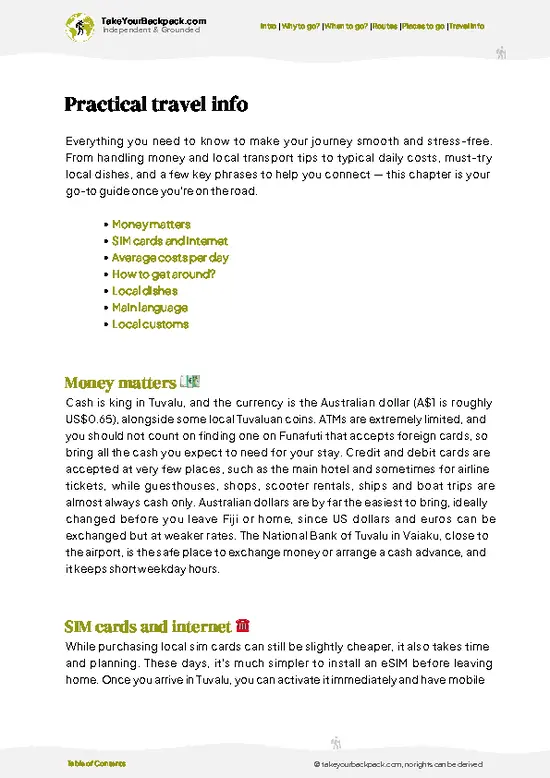
example page 0 from our offline Travel Guide for Tuvalu
example page 1 from our offline Travel Guide for Tuvalu
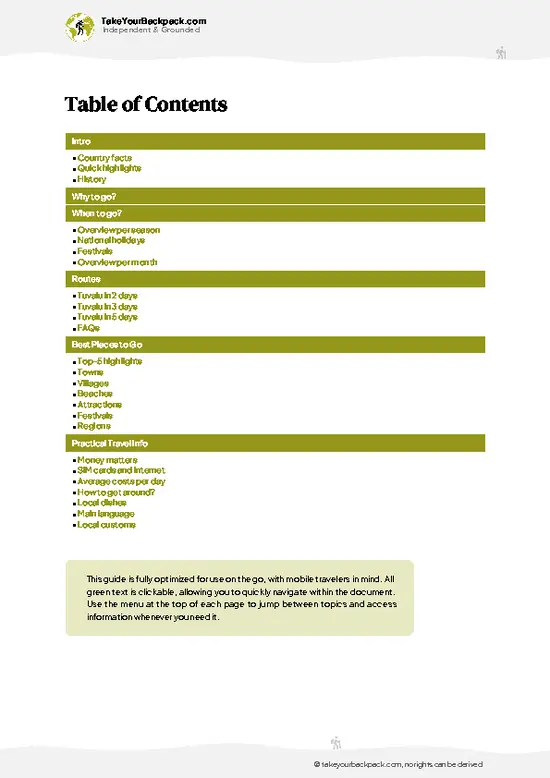
example page 2 from our offline Travel Guide for Tuvalu
example page 3 from our offline Travel Guide for Tuvalu
example page 4 from our offline Travel Guide for Tuvalu
example page 5 from our offline Travel Guide for Tuvalu
example page 6 from our offline Travel Guide for Tuvalu
example page 7 from our offline Travel Guide for Tuvalu
Loading the map 🌍
CLICK TO FILTER
towns
villages
beaches
attractions
festivals
regions
SHOW COUNTRY’S BESTSHOW ALL

✨ Why go?
Ranked #1 festival in Tuvalu
Why visitors keep coming back

Backpackers plan around this because Funafuti is a place most people never reach, and the national holiday is when the whole atoll comes out at once. Flights are infrequent, so one trip has to count, and 1 October gives you a reason to land when the community is gathering rather than going about quiet weekdays. The social side is the draw. There is no ticket gate, no wristband and no separation between audience and performers. Neighbors, families and church groups prepare fatele dance and song items, and visitors are often pulled into the circle, handed a plate or asked where they are from. Within a day you know faces and get greeted by name along the main road.

It also fits a longer Pacific route. Many travelers combine Tuvalu with Fiji, since the main flights connect through Suva, and a … read more 👉
Backpackers plan around this because Funafuti is a place most people never reach, and the national holiday is when the whole atoll comes out at once. Flights are infrequent, so one trip has to count, and 1 October gives you a reason to land when the community is gathering rather than going about quiet weekdays. The social side is the draw. There is no ticket gate, no wristband and no separation between audience and performers. Neighbors, families and church groups prepare fatele dance and song items, and visitors are often pulled into the circle, handed a plate or asked where they are from. Within a day you know faces and get greeted by name along the main road.

It also fits a longer Pacific route. Many travelers combine Tuvalu with Fiji, since the main flights connect through Suva, and a festival date helps you plan around the thin schedule. Compared with big island festivals elsewhere in the Pacific, this one is intimate and inexpensive to join, because the events are free and meals are shared.

💡 HighlightsDon't-miss highlights and experiences

  1. Flag-raising and official ceremony: The morning opens with speeches, the Tuvaluan flag and anthem, and uniformed groups near the government area in Vaiaku. It is short, formal and gives you the sense of national pride that the rest of the day relaxes into.
  2. Fatele dance nights: Fatele is Tuvalu’s signature performance, with rhythmic singing, drumming on a wooden box or mat, and dancing in rows. Village groups compete and perform in the maneapa, and the closeness to the dancers makes it the best evening of the festival.
  3. Community feasts: Tables carry fresh reef fish, pulaka (swamp taro), coconut crab when available, and coconut-cream dishes. Feasts are shared, so accept a plate and eat what is offered.
  4. Church singing: Congregations on Funafuti are known for strong harmonies, and services and special
… read more 👉
  1. Flag-raising and official ceremony: The morning opens with speeches, the Tuvaluan flag and anthem, and uniformed groups near the government area in Vaiaku. It is short, formal and gives you the sense of national pride that the rest of the day relaxes into.
  2. Fatele dance nights: Fatele is Tuvalu’s signature performance, with rhythmic singing, drumming on a wooden box or mat, and dancing in rows. Village groups compete and perform in the maneapa, and the closeness to the dancers makes it the best evening of the festival.
  3. Community feasts: Tables carry fresh reef fish, pulaka (swamp taro), coconut crab when available, and coconut-cream dishes. Feasts are shared, so accept a plate and eat what is offered.
  4. Church singing: Congregations on Funafuti are known for strong harmonies, and services and special items add a different, calmer layer to the celebration. Stand at the back, listen to the voices carry over the lagoon and stay quiet during prayers.
  5. Sports and canoe contests: Games such as volleyball, kilikiti (the local cricket-like game with a three-sided bat) and traditional canoe activities bring families out to the field and shoreline. Kilikiti is chaotic and noisy, with team songs, and visitors are often encouraged to try.
If time is short, skip the sports contests and keep your hours for the fatele night.
Spotted a mistake or missing something? Contact us.

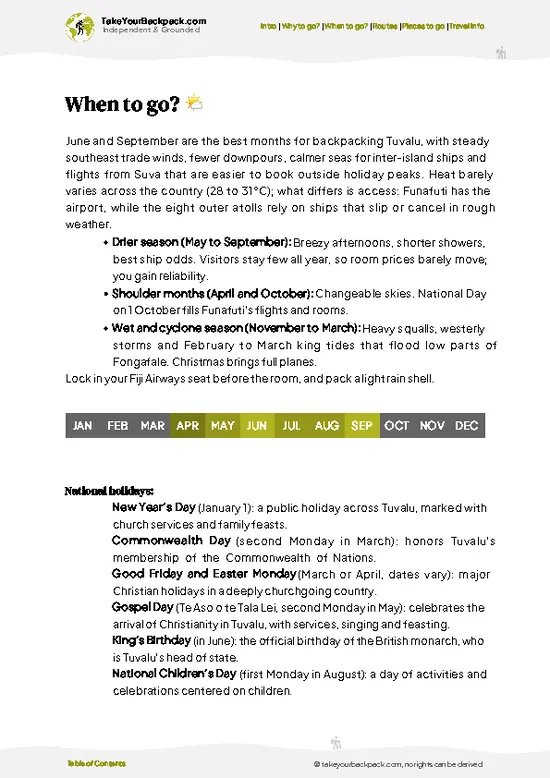
🌤️ When to go?When is the celebration of Tuvalu Independence Day?

Tuvalu Independence Day is held on October 1 (with celebrations often running October 1 and 2), and the main events take place on Funafuti atoll, centered on the government grounds and the Tuvalu Sports Ground near the airstrip, with the date fixed every year.
  • Best day: October 1 itself. Expect the official ceremony, marching, and speeches in the morning, then song and dance (fatele) performances by island groups, which are the part I would not miss.
  • Weather: Roughly 28 to 31°C (82 to 88°F), humid, with a chance of short showers. Daylight runs about 6am to 6pm. Bring a hat, reef-safe sunscreen, a light rain shell, and a sarong or knee-length shorts, since modest dress is the norm.
  • Booking: Reserve your bed and your Fiji Airways flight to Funafuti two to three months ahead. Flights are few each
… read more 👉
Tuvalu Independence Day is held on October 1 (with celebrations often running October 1 and 2), and the main events take place on Funafuti atoll, centered on the government grounds and the Tuvalu Sports Ground near the airstrip, with the date fixed every year.
  • Best day: October 1 itself. Expect the official ceremony, marching, and speeches in the morning, then song and dance (fatele) performances by island groups, which are the part I would not miss.
  • Weather: Roughly 28 to 31°C (82 to 88°F), humid, with a chance of short showers. Daylight runs about 6am to 6pm. Bring a hat, reef-safe sunscreen, a light rain shell, and a sarong or knee-length shorts, since modest dress is the norm.
  • Booking: Reserve your bed and your Fiji Airways flight to Funafuti two to three months ahead. Flights are few each week, and rooms are limited, so prices can rise by 20 to 30 percent.
  • Arrival and departure: Land at least two days before. The island has one main road, so everything is a short walk or scooter ride, and the airstrip doubles as a gathering space, so check flight times locally.
Arrive by September 29 to catch the rehearsals and preparations, which are as fun as the day itself.


source: climatestotravel.comJANJanuary: not recommended for travelingFEBFebruary: not recommended for travelingMARMarch: not recommended for travelingAPRApril: not recommended for travelingMAYMay: not recommended for travelingJUNJune: not recommended for travelingJULJuly: not recommended for travelingAUGAugust: not recommended for travelingSEPSeptember: not recommended for travelingOCTOctober: excellent for travelingNOVNovember: not recommended for travelingDECDecember: not recommended for traveling

✈️ The backpacker research shortcutTuvalu Travel Guide

An offline-friendly backpacking guide with optimized travel routes, ranked highlights, transport advice, and the best areas to stay.
example page 0 from our offline Travel Guide for Tuvalu
example page 1 from our offline Travel Guide for Tuvalu
example page 2 from our offline Travel Guide for Tuvalu
example page 3 from our offline Travel Guide for Tuvalu
example page 4 from our offline Travel Guide for Tuvalu
example page 5 from our offline Travel Guide for Tuvalu
example page 6 from our offline Travel Guide for Tuvalu
example page 7 from our offline Travel Guide for Tuvalu
The digital guide (97 pages) contains:
✅ 20 highlights, ranked by travel appeal
✅ Optimized 2, 3 & 5-day travel routes
✅ Cities, national parks, landmarks, beaches
✅ How to get around
✅ Offline-friendly for travel without Wi-Fi
👉 Click to see all 30+ guide features

📅 Plan smarter in minutes, not weeks
✅ Month by month travel advice
✅ Festivals & national holidays
✅ Budget expectations

🗺️ Go to the right places, skip the overrated ones
✅ Honest pros & cons of destinations
✅ Top hikes, parks & viewpoints
✅ Lesser-known places most travelers miss
✅ Clear “worth it vs skip it” guidance

🛏️ Travel smoothly without rookie mistakes
✅ Best areas to stay
✅ Transport systems explained simply
✅ Common scams & safety advice
✅ SIM cards, money & practical tips

🌍 Understand the country, not just visit it
✅ Culture & traditions
✅ 52 Essential phrases & customs
✅ Festivals worth planning around
✅ Traveler-friendly historical context
✅ Insights that make places more meaningful

📱 Built for real travel conditions
✅ Fully downloadable PDF
✅ Works completely offline
✅ Optimized for phone use
✅ Useful in remote areas & buses
✅ Everything in one place
Stop searching, start planning
Get instant access to your full guide. 30‑day money-back guarantee.
+ Add another guide for just

By proceeding you agree to our terms.
Sent to your inbox immediately after payment • 100% Secure Checkout
Best Backpacking Travel Advisor 2025 tourism awardBest Backpacking
Travel Advisor
2025
What others say about Take Your Backpack Guides:
⭐⭐⭐⭐⭐
Fantastic, amazing amount of information!
⭐⭐⭐⭐⭐
My goodness this is amazing, it's what I've been looking for hats off too you!
⭐⭐⭐⭐⭐
I think this is absolutely BRILLIANT
⭐⭐⭐⭐
Very complete and informative. It's still missing places, but I gotta to commend you
⭐⭐⭐⭐⭐
This is truly amazing, thank you, can't wait to explore it with my kids!
⭐⭐⭐⭐⭐
Awesome resource, thank you!
⭐⭐⭐⭐⭐
This is amazing! Can't wait to explore the ones I haven't seen
⭐⭐⭐⭐
I love this! Well done, great idea.
⭐⭐⭐⭐⭐
Thanks for taking the time to make this gem!
⭐⭐⭐⭐⭐
This might be the best website I've ever seen.
⭐⭐⭐⭐⭐
Congratulations, and thank you so much for your work; it's incredibly valuable.
⭐⭐⭐⭐
In all seriousness I think you did a great job pointing out the important spots
⭐⭐⭐⭐⭐
10/10 very good
⭐⭐⭐⭐⭐
As someone who's only just starting to visit regularly this is awesome, thank you.
⭐⭐⭐⭐
Thank you very much! I'm going to visit my dad, it's going to be very useful!
⭐⭐⭐⭐⭐
This is really cool! We'll be travelling for the first time and this definitely come in handy.
⭐⭐⭐⭐⭐
You are now our minister of culture, congratulations 👨‍💼
⭐⭐⭐⭐⭐
Just wanted to tell you that this is a pearl! Going to follow your recommendations.
⭐⭐⭐⭐⭐
This is so cool. I'll definitely be using the resource for my travels soon.
⭐⭐⭐⭐⭐
This is very impressive! Good work.
⭐⭐⭐⭐⭐
This is an amazing and informative site. Very well done!

🛏️ Where to stay?Best areas and accommodation options

Stay on the main Funafuti strip between the airport and the government area, because that is where nearly everything happens. Tuvalu has no hostel scene, so your choices are small guesthouses and a couple of lodges, and the area matters more than the building.
The best base is the central stretch around Vaiaku, near the government buildings, the post office, and the main lagoon-side road. You can walk to the ceremony grounds in minutes, the shops and small cafés are close, and you will meet other visitors (aid workers, officials, a few independent travelers) at the same few places. It is also safe. … read more 👉
Stay on the main Funafuti strip between the airport and the government area, because that is where nearly everything happens. Tuvalu has no hostel scene, so your choices are small guesthouses and a couple of lodges, and the area matters more than the building.
The best base is the central stretch around Vaiaku, near the government buildings, the post office, and the main lagoon-side road. You can walk to the ceremony grounds in minutes, the shops and small cafés are close, and you will meet other visitors (aid workers, officials, a few independent travelers) at the same few places. It is also safe. Crime is very low, and walking at night is normal, though you should carry a flashlight because streetlights are sparse.
The area closer to the airport suits you if you have an early flight, and the noise is limited to the occasional plane and scooter. Rooms toward the lagoon side catch the breeze, which matters in October humidity.
The northern end of the island, towards Funafuti Conservation Area boat departures and the quieter villages, gives a more local feel and cheaper family guesthouses, but you will need a scooter or lift to reach events. Since solo travelers are so few, ask your host about sharing rides. Book early, as festival week fills everything.

👛 Costs (as of 15 October 2026)Travel costs and budget guide for Tuvalu Independence Day

Expect to spend about US$110 to 190 a day to attend Tuvalu Independence Day, with accommodation and flights being the main costs. Tuvalu uses the Australian dollar, so figures below are given in USD for comparison.
CategoryBudget RangeLocal Reality
Festival ticketsUS$0Ceremonies, marches, and dance performances are free and open to the public.
AccommodationUS$60 to 110Guesthouses and small lodges in Funafuti, with air conditioning at the upper end. Prices rise during festival week.
Local transportUS$5 to 15Most things are walkable. Scooter rental or a taxi-style lift costs a few dollars per trip.
Food & drinksUS$30 to 50Simple meals at small restaurants cost US$8 to 15. Imported goods are pricey, while fish and local produce are cheaper.
Miscellaneous expensesUS$15Crafts, SIM card, and a small gift
… read more 👉
Expect to spend about US$110 to 190 a day to attend Tuvalu Independence Day, with accommodation and flights being the main costs. Tuvalu uses the Australian dollar, so figures below are given in USD for comparison.
CategoryBudget RangeLocal Reality
Festival ticketsUS$0Ceremonies, marches, and dance performances are free and open to the public.
AccommodationUS$60 to 110Guesthouses and small lodges in Funafuti, with air conditioning at the upper end. Prices rise during festival week.
Local transportUS$5 to 15Most things are walkable. Scooter rental or a taxi-style lift costs a few dollars per trip.
Food & drinksUS$30 to 50Simple meals at small restaurants cost US$8 to 15. Imported goods are pricey, while fish and local produce are cheaper.
Miscellaneous expensesUS$15Crafts, SIM card, and a small gift for hosts. ATMs are scarce, so bring cash.
Total Daily BudgetUS$110 to 190Excludes flights from Fiji, which are a major additional cost.
⚠️ Prices can change and everyone travels differently, so take this as a rough guide. Hope it helps you plan your adventure!

🍲 FoodWhat to Eat & Drink

Food at Independence Day is a community affair, and the best of it is island feasts rather than restaurant meals. Each island group and village shares tables of local dishes during the celebrations, and visitors are often welcomed to eat.
Look for fresh tuna and reef fish, grilled, raw in coconut cream, or fried. Pulaka, a giant swamp taro grown in pits, is the staple, often baked or boiled with coconut cream. Try fekei, a pulaka and coconut pudding, and breadfruit when in season. Pork is a feast centerpiece, and coconut crab turns up occasionally. Drinks are fresh drinking coconuts, tea, and imported soft drinks. Alcohol is available in town, but the public mood is relaxed and modest, so drink quietly.
Etiquette is simple. Wait to be invited, take small portions first, and accept seconds, since … read more 👉
Food at Independence Day is a community affair, and the best of it is island feasts rather than restaurant meals. Each island group and village shares tables of local dishes during the celebrations, and visitors are often welcomed to eat.
Look for fresh tuna and reef fish, grilled, raw in coconut cream, or fried. Pulaka, a giant swamp taro grown in pits, is the staple, often baked or boiled with coconut cream. Try fekei, a pulaka and coconut pudding, and breadfruit when in season. Pork is a feast centerpiece, and coconut crab turns up occasionally. Drinks are fresh drinking coconuts, tea, and imported soft drinks. Alcohol is available in town, but the public mood is relaxed and modest, so drink quietly.
Etiquette is simple. Wait to be invited, take small portions first, and accept seconds, since refusing food can seem rude. Sharing is normal, and a small contribution, such as a bag of rice or fruit, goes down well if you are a guest at a gathering. Lines are informal, and elders and officials usually eat first.
Bring cash in Australian dollars, since Tuvalu uses Australian currency, and small notes are best. Cards are rarely accepted outside a few shops and hotels. Supplies on the island are limited, so festival week stalls can sell out by mid-afternoon.

FAQCommon questions from travelers

Tuvalu Independence Day is celebrated on October 1, with festivities often continuing into October 2. The main events take place on Funafuti atoll, around the government area and the sports ground near the airstrip. The date is fixed each year, so you can plan your flights from Fiji well in advance. Arriving by September 29 lets you catch the rehearsals.
Attending is free, since the ceremony, marches, and dance performances have no entry charge. Your real costs are lodging, at roughly US$60 to 110 a night, and food at US$30 to 50 a day. Budget around US$110 to 190 a day in total, plus the flight from Suva, Fiji.
No tickets are needed because the events are open to everyone and free. What you must book ahead is your flight to Funafuti and your bed, ideally two to three months before October 1. Flights from Suva run only a few times a week, and guesthouse rooms are limited in festival week.
⚠️ Things can change over time, so always validate details locally before you go.

Other Tuvaluan festivals near Tuvalu Independence Day

Explore more nearby:


💡 Not sure where to go next?
Create a personalized itinerary for Tuvalu including Tuvalu Independence Day and the places that fit your trip.

Generate my itinerary

👉 Discover all festivals

Or checkout all Tuvalu has to offer (think cities, towns, villages, national parks, hikes, beaches, festivals)
Country photo of Tuvalu

We 💚 feedbackParting advice and final tips

Go for the evening of the main day, when heat fades and the maneapa fills with singing. Arrive early to get a place near the dancers, wear modest clothes that can handle sitting on mats and bring a small gift such as tea or biscuits for your host. I would book lodging well ahead and stay a few days past the date, because the quiet afterglow on the lagoon is lovely.

✍️ Help improve this page!
The information on this page is based on in-depth research, insights shared by experienced travelers, and feedback from the local travel community in Tuvalu. While every effort is made to keep the information accurate and current, conditions can change — so if you spot anything incorrect or outdated, please get in touch.


🙋‍♂️ Give feedback

👋 Meet the founderWho’s Behind Take Your Backpack?

Johan, backpacker and founder of TakeYourBackpackHi, I’m Johan (Netherlands 🇳🇱), the creator of TakeYourBackpack. Over the past 3 decades, I’ve backpacked through 90+ countries across six continents, gaining extensive experience with independent travel, long-term trips, and overland routes.

This site is built on a combination of firsthand travel experience and carefully curated insights from other backpackers. Many guides are based on places I’ve personally visited, while others bring together tips, observations, and practical advice shared by trusted travelers I’ve met along the way.

The goal is to provide realistic, experience-driven guidance — not generic itineraries — so you can explore destinations with better context, clearer expectations, and more confidence.