×

United States Virgin Islands🇻🇮 | national parksSalt River Bay National Historical ParkUnderwater archaeology trail, mangrove channels, Taino sites, St. Croix north coast | things to do and best time to go

Explore Hurricane HoleExplore Sandy Point National Wildlife Refuge

Backpacking in Salt River Bay National Historical Park
🏆 Top picknational park ranked #1
By Johan Kruseman 🇳🇱 | Updated October 22, 2026

Columbus’s men reportedly skirmished with Carib people at this shoreline in 1493, and a marker near the Columbus Landing site on the west side of the bay records the encounter. Salt River Bay National Historical Park lies on the north shore of St. Croix in the United States Virgin Islands, a short drive east of Cane Bay. It protects the island’s largest mangrove forest, a submarine canyon, and Taino and Carib sites that span centuries. The hiking is modest, a few short, flat walks, and wildlife means herons, hermit crabs and the occasional iguana rather than anything dramatic. Crowds are thin, which suits the quiet mood. Some facilities are limited, so a visit to the Salt River unit is easy to botch. Kayak outfitters run the water side, so book those yourself instead of showing up at an unmarked shore. Pack water and bug spray, since shade is patchy and mosquitoes are relentless at dusk. Check the visitor center’s current hours before driving out.

Discover everything you want to know in the 📖 United States Virgin Islands Travel Guide.


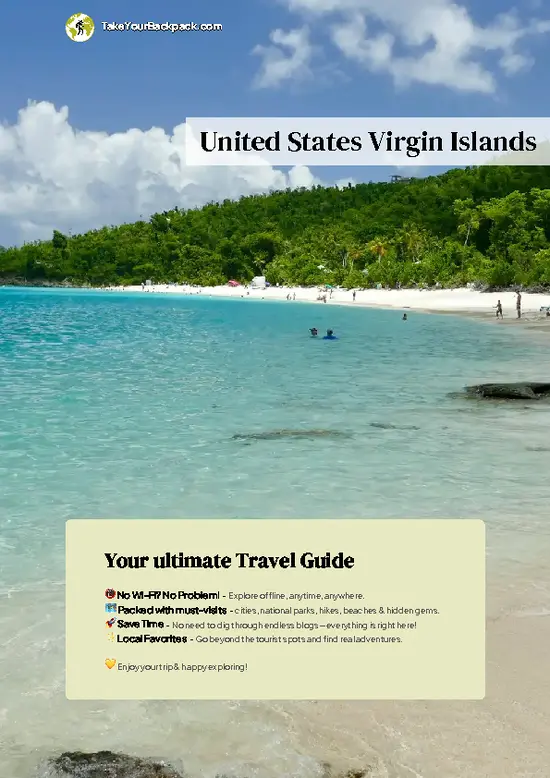
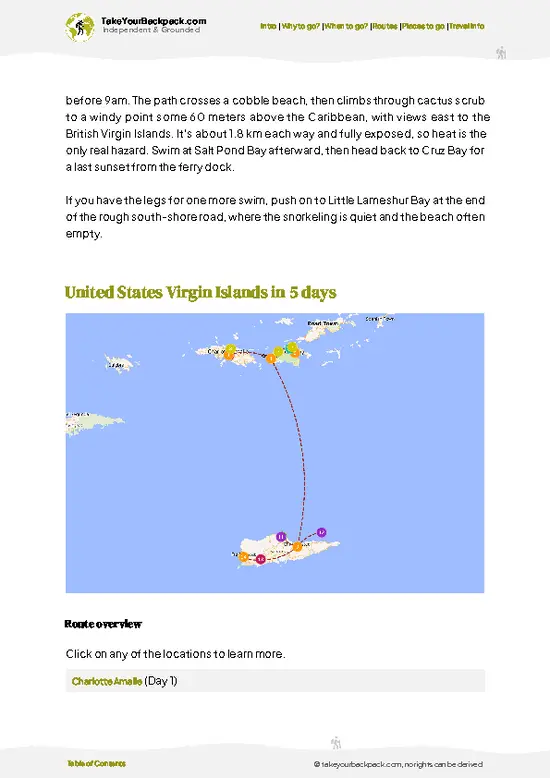
example page 0 from our offline Travel Guide for United States Virgin Islands
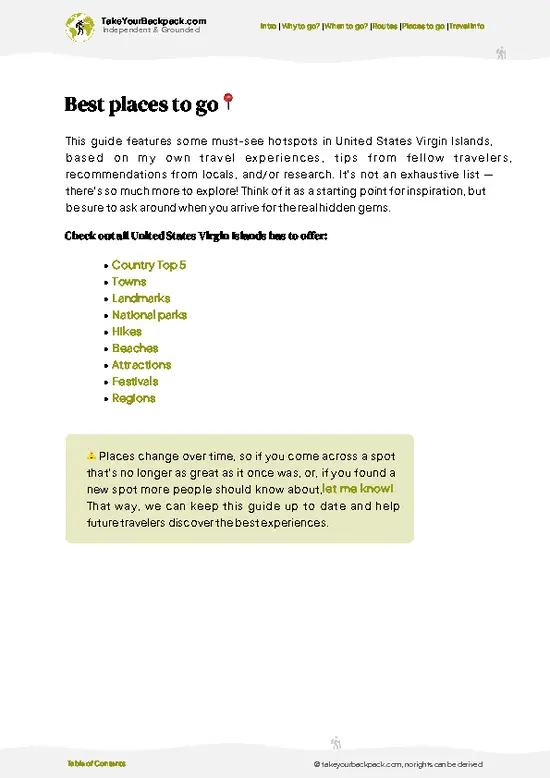
example page 1 from our offline Travel Guide for United States Virgin Islands
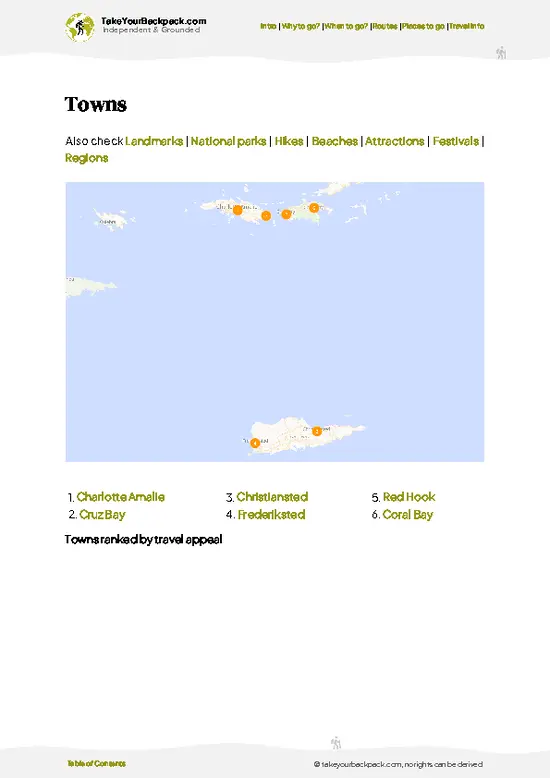
example page 2 from our offline Travel Guide for United States Virgin Islands
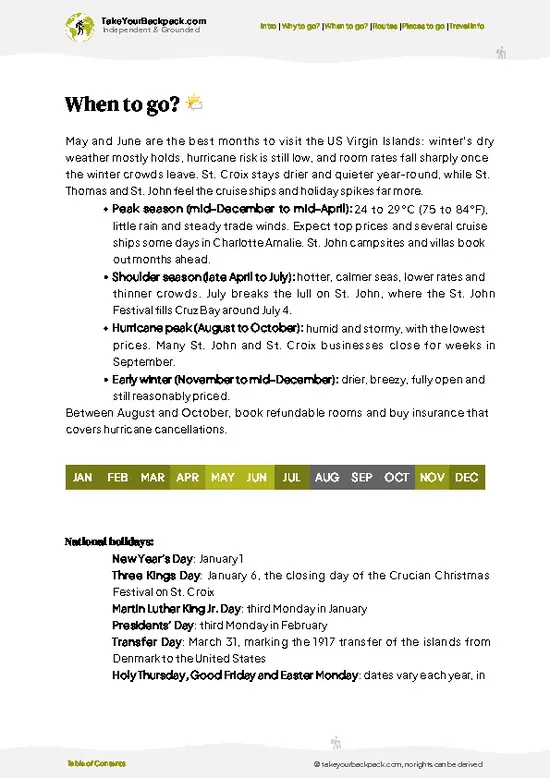
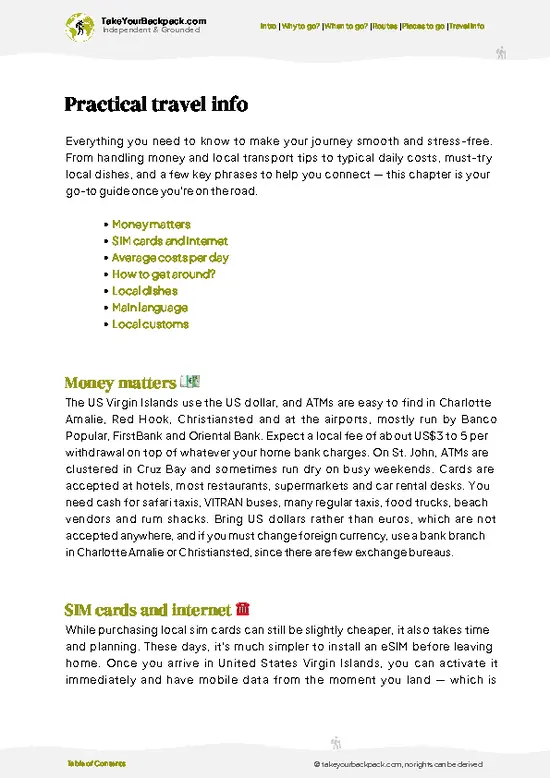
example page 3 from our offline Travel Guide for United States Virgin Islands
example page 4 from our offline Travel Guide for United States Virgin Islands
example page 5 from our offline Travel Guide for United States Virgin Islands
example page 6 from our offline Travel Guide for United States Virgin Islands
example page 7 from our offline Travel Guide for United States Virgin Islands
Loading the map 🌍
CLICK TO FILTER
towns
landmarks
national parks
hikes
beaches
attractions
festivals
regions
SHOW COUNTRY’S BESTSHOW ALL

✨ Why go?
Ranked #1 national park in United States Virgin Islands
Reasons people choose to explore here

Salt River Bay National Historical Park suits backpackers who like to piece a place together on their own. Nothing here is gated behind a tour, and the main draw is the mangrove lagoon, which you can paddle with a rented kayak or on a guided trip. The park’s history reaches back to the Taino, and it is the only site in the United States Virgin Islands where Columbus’s expedition is known to have come ashore. That gives a wander through the Columbus Landing site more weight than the modest marker suggests. Divers also come for the Salt River Canyon, a steep underwater drop right off the bay with walls covered in coral and sponges, which draws a different crowd from the usual beach-hopping set. You can combine the walking, paddling and snorkel or dive time into a relaxed day or two without needing … read more 👉
Salt River Bay National Historical Park suits backpackers who like to piece a place together on their own. Nothing here is gated behind a tour, and the main draw is the mangrove lagoon, which you can paddle with a rented kayak or on a guided trip. The park’s history reaches back to the Taino, and it is the only site in the United States Virgin Islands where Columbus’s expedition is known to have come ashore. That gives a wander through the Columbus Landing site more weight than the modest marker suggests. Divers also come for the Salt River Canyon, a steep underwater drop right off the bay with walls covered in coral and sponges, which draws a different crowd from the usual beach-hopping set. You can combine the walking, paddling and snorkel or dive time into a relaxed day or two without needing a rental car for every stop, though one helps. Expect to self-organize, carry your own snacks, and enjoy a park that rewards curiosity more than a checklist.

💡 HighlightsKey sights and experiences for travelers

  1. Columbus Landing Site: The best-known stop, on the west side of the bay, marks where Columbus’s fleet reportedly landed in 1493 and fought with Carib people. A simple marker and a quiet shoreline do the talking.
  2. Salt River Mangrove Lagoon: The largest remaining mangrove forest in the Virgin Islands. Channels of red mangrove are best seen by kayak, with herons, egrets and juvenile fish in the shallows.
  3. Salt River Canyon: An underwater canyon dropping steeply from the bay mouth. Divers go for coral-covered walls, sponges and schooling fish, and snorkelers can see the shallower edges.
  4. Ceremonial Ball Court: Remains of a Taino ball court, part of a settlement that was occupied for centuries before European contact. It is a low, grassy site, so go for context rather than spectacle.
  5. Fort Sale: Earthwork
… read more 👉
  1. Columbus Landing Site: The best-known stop, on the west side of the bay, marks where Columbus’s fleet reportedly landed in 1493 and fought with Carib people. A simple marker and a quiet shoreline do the talking.
  2. Salt River Mangrove Lagoon: The largest remaining mangrove forest in the Virgin Islands. Channels of red mangrove are best seen by kayak, with herons, egrets and juvenile fish in the shallows.
  3. Salt River Canyon: An underwater canyon dropping steeply from the bay mouth. Divers go for coral-covered walls, sponges and schooling fish, and snorkelers can see the shallower edges.
  4. Ceremonial Ball Court: Remains of a Taino ball court, part of a settlement that was occupied for centuries before European contact. It is a low, grassy site, so go for context rather than spectacle.
  5. Fort Sale: Earthwork remains from a 17th-century fort begun by the English and finished by the Dutch, later named by the French. Mounds and ditches are what survive.
  6. Bioluminescent Bay Paddles: On dark nights, evening kayak tours paddle through the bay, where the water glows with microscopic organisms when disturbed. Moonless nights are best.
  7. Salt River Bay Shoreline Walks: Short, flat paths along the water give views of the lagoon, mangrove edges and the bay opening toward the Caribbean. Expect hermit crabs, pelicans and breezy, exposed stretches.
Salt River Bay National Historical Park charges no entry fee, but kayak tours, bioluminescent paddles and diving trips with outside operators need to be booked ahead.
Spotted a mistake or missing something? Contact us.

🌤️ When to go?Best time to explore Salt River Bay National Historical Park

The best window for Salt River Bay National Historical Park is December through April, when rain is lightest and the trade winds keep the heat bearable.
  • Dry Season (December to April): Days run 27 to 30°C (81 to 86°F), nights 22 to 24°C (72 to 75°F). Paddling the bay and its mangrove lagoon is easiest, and the sea is calm for snorkeling. This is also when cruise ships and winter visitors fill St. Croix, and lodging costs the most.
  • Shoulder Months (May to June): Highs reach 30 to 32°C (86 to 90°F) with more humidity and short showers. Crowds thin and room rates drop noticeably.
  • Hurricane Season (June to November): Hot, 31 to 33°C (88 to 91°F), with the wettest weather in September and October. Storms can close trails and the water turns murky after heavy rain. Rates are lowest, but some small
… read more 👉
The best window for Salt River Bay National Historical Park is December through April, when rain is lightest and the trade winds keep the heat bearable.
  • Dry Season (December to April): Days run 27 to 30°C (81 to 86°F), nights 22 to 24°C (72 to 75°F). Paddling the bay and its mangrove lagoon is easiest, and the sea is calm for snorkeling. This is also when cruise ships and winter visitors fill St. Croix, and lodging costs the most.
  • Shoulder Months (May to June): Highs reach 30 to 32°C (86 to 90°F) with more humidity and short showers. Crowds thin and room rates drop noticeably.
  • Hurricane Season (June to November): Hot, 31 to 33°C (88 to 91°F), with the wettest weather in September and October. Storms can close trails and the water turns murky after heavy rain. Rates are lowest, but some small businesses shut for weeks.
  • Daylight: Days last about 11 hours in December and about 13 hours in June, so hikes fit easily either way.
  • Bioluminescence: The glowing bay is best on moonless nights, which can fall in any season.
Book a kayak tour around the new moon and aim for late April or early May for dry weather and lower prices.


source: climatestotravel.comJANJanuary: excellent for travelingFEBFebruary: excellent for travelingMARMarch: excellent for travelingAPRApril: highly recommended for travelingMAYMay: highly recommended for travelingJUNJune: good for travelingJULJuly: good for travelingAUGAugust: good for travelingSEPSeptember: fair for travelingOCTOctober: fair for travelingNOVNovember: highly recommended for travelingDECDecember: excellent for traveling
united-states-virgin-islands-national-park-salt-river-bay-national-historical-park
© Google | Randy Tiddark

✈️ The backpacker research shortcutUnited States Virgin Islands Travel Guide

An offline-friendly backpacking guide with optimized travel routes, ranked highlights, transport advice, and the best areas to stay.
example page 0 from our offline Travel Guide for United States Virgin Islands
example page 1 from our offline Travel Guide for United States Virgin Islands
example page 2 from our offline Travel Guide for United States Virgin Islands
example page 3 from our offline Travel Guide for United States Virgin Islands
example page 4 from our offline Travel Guide for United States Virgin Islands
example page 5 from our offline Travel Guide for United States Virgin Islands
example page 6 from our offline Travel Guide for United States Virgin Islands
example page 7 from our offline Travel Guide for United States Virgin Islands
The digital guide (144 pages) contains:
✅ 35 highlights, ranked by travel appeal
✅ Optimized 2, 3 & 5-day travel routes
✅ Cities, national parks, landmarks, beaches
✅ How to get around
✅ Offline-friendly for travel without Wi-Fi
👉 Click to see all 30+ guide features

📅 Plan smarter in minutes, not weeks
✅ Month by month travel advice
✅ Festivals & national holidays
✅ Budget expectations

🗺️ Go to the right places, skip the overrated ones
✅ Honest pros & cons of destinations
✅ Top hikes, parks & viewpoints
✅ Lesser-known places most travelers miss
✅ Clear “worth it vs skip it” guidance

🛏️ Travel smoothly without rookie mistakes
✅ Best areas to stay
✅ Transport systems explained simply
✅ Common scams & safety advice
✅ SIM cards, money & practical tips

🌍 Understand the country, not just visit it
✅ Culture & traditions
✅ Local customs
✅ Festivals worth planning around
✅ Traveler-friendly historical context
✅ Insights that make places more meaningful

📱 Built for real travel conditions
✅ Fully downloadable PDF
✅ Works completely offline
✅ Optimized for phone use
✅ Useful in remote areas & buses
✅ Everything in one place
Stop searching, start planning
Get instant access to your full guide. 30‑day money-back guarantee.
+ Add another guide for just

By proceeding you agree to our terms.
Sent to your inbox immediately after payment • 100% Secure Checkout
Best Backpacking Travel Advisor 2025 tourism awardBest Backpacking
Travel Advisor
2025
What others say about Take Your Backpack Guides:
⭐⭐⭐⭐⭐
Fantastic, amazing amount of information!
⭐⭐⭐⭐⭐
My goodness this is amazing, it's what I've been looking for hats off too you!
⭐⭐⭐⭐⭐
I think this is absolutely BRILLIANT
⭐⭐⭐⭐
Very complete and informative. It's still missing places, but I gotta to commend you
⭐⭐⭐⭐⭐
This is truly amazing, thank you, can't wait to explore it with my kids!
⭐⭐⭐⭐⭐
Awesome resource, thank you!
⭐⭐⭐⭐⭐
This is amazing! Can't wait to explore the ones I haven't seen
⭐⭐⭐⭐
I love this! Well done, great idea.
⭐⭐⭐⭐⭐
Thanks for taking the time to make this gem!
⭐⭐⭐⭐⭐
This might be the best website I've ever seen.
⭐⭐⭐⭐⭐
Congratulations, and thank you so much for your work; it's incredibly valuable.
⭐⭐⭐⭐
In all seriousness I think you did a great job pointing out the important spots
⭐⭐⭐⭐⭐
10/10 very good
⭐⭐⭐⭐⭐
As someone who's only just starting to visit regularly this is awesome, thank you.
⭐⭐⭐⭐
Thank you very much! I'm going to visit my dad, it's going to be very useful!
⭐⭐⭐⭐⭐
This is really cool! We'll be travelling for the first time and this definitely come in handy.
⭐⭐⭐⭐⭐
You are now our minister of culture, congratulations 👨‍💼
⭐⭐⭐⭐⭐
Just wanted to tell you that this is a pearl! Going to follow your recommendations.
⭐⭐⭐⭐⭐
This is so cool. I'll definitely be using the resource for my travels soon.
⭐⭐⭐⭐⭐
This is very impressive! Good work.
⭐⭐⭐⭐⭐
This is an amazing and informative site. Very well done!

🛏️ Where to stay?How to pick the right area

There is no lodging inside Salt River Bay National Historical Park, so your bed will be in Christiansted, about 10 minutes away by car, or in the quieter north-shore area near Salt River itself.
Christiansted is the best base for backpackers. It has the widest choice of guesthouses, small inns and apartment rentals, plus restaurants, a waterfront boardwalk and the island’s main bus stops. Expect basic rooms at roughly US$80 to 130 a night in high season. True hostels are rare on St. Croix, so budget travelers often share a rental apartment or book a simple room with a kitchenette.
Cane Bay and the … read more 👉
There is no lodging inside Salt River Bay National Historical Park, so your bed will be in Christiansted, about 10 minutes away by car, or in the quieter north-shore area near Salt River itself.
Christiansted is the best base for backpackers. It has the widest choice of guesthouses, small inns and apartment rentals, plus restaurants, a waterfront boardwalk and the island’s main bus stops. Expect basic rooms at roughly US$80 to 130 a night in high season. True hostels are rare on St. Croix, so budget travelers often share a rental apartment or book a simple room with a kitchenette.
Cane Bay and the northwest coast sit about 10 to 15 minutes west. They suit divers and snorkelers, with small villas and inns above the water, though rates are higher at roughly US$130 to 220. Frederiksted, on the west end, is about 30 minutes away. It is quiet, cheaper in low season and good for sunsets and the pier.
A few cottages and vacation rentals sit right near the bay on the north shore, handy for dawn paddling but with few places to eat nearby. Stock up on groceries in Christiansted first.
Book early from December to April. A rental car makes any of these bases workable, since public buses are infrequent.

👛 Costs (as of 22 October 2026)What things cost and how to budget

A day at Salt River Bay National Historical Park typically costs about US$175 to 355 for a backpacker, most of it going to a bed and a rental car.
CategoryBudget RangeLocal Reality
Entrance feesUS$0The park itself charges no entry fee for walking the trails and the visitor area.
Accommodation (high season)US$80 to 150Guesthouse rooms and small rentals in Christiansted. Rates fall 20 to 30 percent in summer.
Local transportUS$50 to 80Rental cars run about US$50 to 80 a day, and the park is a short drive from Christiansted. Taxis cost US$15 to 25 one way. Public buses are cheap but infrequent.
Food and suppliesUS$30 to 55Groceries are pricey because everything is imported. Casual lunches cost US$12 to 20, and dinners at local restaurants US$20 to 35.
ActivitiesUS$15 to 70Guided kayak tours of the
… read more 👉
A day at Salt River Bay National Historical Park typically costs about US$175 to 355 for a backpacker, most of it going to a bed and a rental car.
CategoryBudget RangeLocal Reality
Entrance feesUS$0The park itself charges no entry fee for walking the trails and the visitor area.
Accommodation (high season)US$80 to 150Guesthouse rooms and small rentals in Christiansted. Rates fall 20 to 30 percent in summer.
Local transportUS$50 to 80Rental cars run about US$50 to 80 a day, and the park is a short drive from Christiansted. Taxis cost US$15 to 25 one way. Public buses are cheap but infrequent.
Food and suppliesUS$30 to 55Groceries are pricey because everything is imported. Casual lunches cost US$12 to 20, and dinners at local restaurants US$20 to 35.
ActivitiesUS$15 to 70Guided kayak tours of the bay and bioluminescence trips usually cost US$50 to 100. Self-guided trail walks cost nothing, so mix them in.
Total Daily BudgetUS$175 to 355Lower end assumes a basic room, groceries and free trails. Add a guided paddle for the upper end.


source: nps.gov
⚠️ Prices can change and everyone travels differently, so take this as a rough guide. Hope it helps you plan your adventure!

🥾 TrailsWhere to hike in Salt River Bay National Historical Park: trails for every level

Salt River Bay National Historical Park is a place for short, easy walks and paddling rather than long-distance hiking. Terrain is flat and coastal, with dry scrub, open grassy ground, mangrove edges and rocky shoreline. Shade is patchy, so the heat feels stronger than the distances suggest.
  • Columbus Landing Area: A short, flat walk on the western side of the bay to the commemorative marker and shoreline. Allow 30 to 60 minutes, easy, with sea views and sun exposure.
  • Ball Court and Fort Sale Area: A gentle stroll across grassy ground to Taino and colonial earthworks. Allow about an hour, easy, with
… read more 👉
Salt River Bay National Historical Park is a place for short, easy walks and paddling rather than long-distance hiking. Terrain is flat and coastal, with dry scrub, open grassy ground, mangrove edges and rocky shoreline. Shade is patchy, so the heat feels stronger than the distances suggest.
  • Columbus Landing Area: A short, flat walk on the western side of the bay to the commemorative marker and shoreline. Allow 30 to 60 minutes, easy, with sea views and sun exposure.
  • Ball Court and Fort Sale Area: A gentle stroll across grassy ground to Taino and colonial earthworks. Allow about an hour, easy, with little signage beyond the basics.
  • Mangrove Shoreline: Informal paths and boardwalk-style stretches skirt the lagoon edge, where you may see herons, crabs, pelicans and the odd iguana. Allow 30 to 60 minutes, easy, with mosquitoes at dawn and dusk.
  • Paddling the Lagoon: Not a walk, but the best way to see the mangroves. Tours or rentals through local operators typically run one to two hours. Calm water, easy, with some wind on the open bay.
The trails here have no formal names, and the distances are short enough that you can combine all of them in a morning. Keep to marked ground around archaeological features, since the earthworks are fragile and easy to damage by walking on them.
Access is simplest by rental car or taxi from Christiansted or Frederiksted, as public transport is limited and infrequent. The park is rarely crowded, and you may have stretches of shoreline entirely to yourself. There is no entrance fee, though outfitters charge for tours and rentals. Bring water, sun protection and insect repellent, and wear closed shoes for uneven ground.
⚠️ Hiking info can sometimes be outdated or inaccurate. Before you hit the trail, check the latest conditions with locals. If you do spot anything that's off, I'd love to hear from you, so I can update it for fellow travelers.

🛡️ SafetySafety Tips and Common Scams in Salt River Bay National Historical Park

Salt River Bay National Historical Park is straightforward and low-risk, with short, mostly flat trails and no serious wildlife concerns.
Heat and sun are the main issues. Walk early or late, wear a hat, and carry at least 1.5 liters of water per person, since there is little shade on the open ridges and shoreline. The dirt paths turn slick and muddy after rain, so shoes with grip matter more than boots. Mosquitoes and sand flies swarm near the mangroves at dusk, so bring repellent.
No dangerous large animals live here. Watch for manchineel trees along the shore: the apple-like fruit and the sap irritate skin badly, and rain dripping from the leaves can burn. Stay out from under them and never touch the fruit.
Kayak tours are the best way onto the water. Currents can pick up at the bay mouth, … read more 👉
Salt River Bay National Historical Park is straightforward and low-risk, with short, mostly flat trails and no serious wildlife concerns.
Heat and sun are the main issues. Walk early or late, wear a hat, and carry at least 1.5 liters of water per person, since there is little shade on the open ridges and shoreline. The dirt paths turn slick and muddy after rain, so shoes with grip matter more than boots. Mosquitoes and sand flies swarm near the mangroves at dusk, so bring repellent.
No dangerous large animals live here. Watch for manchineel trees along the shore: the apple-like fruit and the sap irritate skin badly, and rain dripping from the leaves can burn. Stay out from under them and never touch the fruit.
Kayak tours are the best way onto the water. Currents can pick up at the bay mouth, so go with a guide, especially at night. Keep valuables out of parked cars at trailheads, as petty theft from vehicles happens across the island.

FAQTraveler FAQ

Half a day is enough for Salt River Bay National Historical Park, though a full day lets you add a guided kayak trip. The trails and the visitor area take about 2 to 3 hours, and a paddle through the mangrove lagoon adds another 2 hours. If you want to see the bioluminescence, plan an evening tour as well.
Getting to Salt River Bay National Historical Park without a car is possible but slow. It lies about 10 minutes by car from Christiansted, so a taxi costs roughly US$15 to 25 each way, and many kayak operators include pickup from nearby lodging. Public buses on the north side are infrequent, so a rental car at about US$50 to 80 a day is much easier.
Salt River Bay National Historical Park has no entrance fee for the trails and the visitor area, and no permit is needed for walking. You pay only for extras such as guided kayak tours, which generally cost US$50 to 100, or for a rental. Check the park’s official page for current hours before you go.
⚠️ Things can change over time, so always validate details locally before you go.

Other Virgin Islander national parks near Salt River Bay National Historical Park

Explore more nearby:


💡 Not sure where to go next?
Create a personalized itinerary for United States Virgin Islands including Salt River Bay National Historical Park and the places that fit your trip.

Generate my itinerary

👉 Discover all national parks

Or checkout all United States Virgin Islands has to offer (think cities, towns, villages, national parks, hikes, beaches, festivals)
Country photo of United States Virgin Islands

We 💚 feedbackParting advice and final tips

Salt River Bay National Historical Park deserves half a day, a full day at most, and that is plenty for the landing site, the earthworks and a paddle. I would spend the evening on a bioluminescent kayak tour, then sleep elsewhere on the island. Bring bug spray and book the paddle before you arrive.

✍️ Help improve this page!
The information on this page is based on in-depth research, insights shared by experienced travelers, and feedback from the local travel community in United States Virgin Islands. While every effort is made to keep the information accurate and current, conditions can change — so if you spot anything incorrect or outdated, please get in touch.


🙋‍♂️ Give feedback

👋 Meet the founderWho’s Behind Take Your Backpack?

Johan, backpacker and founder of TakeYourBackpackHi, I’m Johan (Netherlands 🇳🇱), the creator of TakeYourBackpack. Over the past 3 decades, I’ve backpacked through 90+ countries across six continents, gaining extensive experience with independent travel, long-term trips, and overland routes.

This site is built on a combination of firsthand travel experience and carefully curated insights from other backpackers. Many guides are based on places I’ve personally visited, while others bring together tips, observations, and practical advice shared by trusted travelers I’ve met along the way.

The goal is to provide realistic, experience-driven guidance — not generic itineraries — so you can explore destinations with better context, clearer expectations, and more confidence.