×

United States Virgin Islands🇻🇮 | regionsWater IslandHoneymoon Beach, WWII tunnels, Flag Hill sunsets, residential lanes | things to do and best time to go

Explore St. Croix East End Marine ParkExplore Charlotte Amalie

Backpacking in Water Island
🏆 Top pickregion ranked #1
By Johan Kruseman 🇳🇱 | Updated October 22, 2026

Water Island is a short ferry hop from Crown Bay on St. Thomas, which makes it the easiest day escape in the territory. It sits just south of Charlotte Amalie harbor in the United States Virgin Islands, the smallest of the four main islands, with a few hundred residents and no resort towers. The ferry lands at Phillips Landing, and from there a single loop road climbs past private houses, scrub hills and old military ground. You can reach a calm beach within minutes, and from the ridge you see St. Thomas sprawl across the water. Honeymoon Beach is the busy corner, with beach bars, kayaks and paddleboards, and it fills when cruise ships are in. Away from it, the island is quiet, a little rough around the edges, and mostly residential. There are no hostels and hardly any shops, so planning matters. It suits walkers, snorkelers and anyone who wants an easy, low-key day. It will disappoint those wanting nightlife, big sights or a packed itinerary.

Discover everything you want to know in the 📖 United States Virgin Islands Travel Guide.


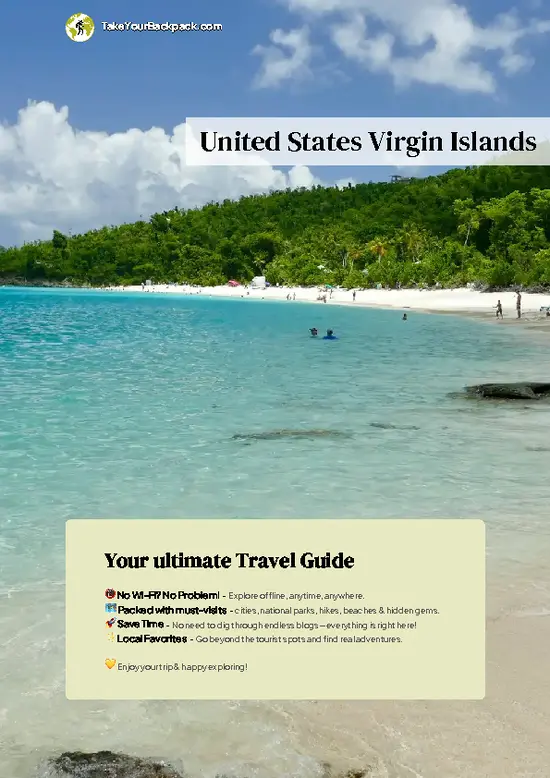
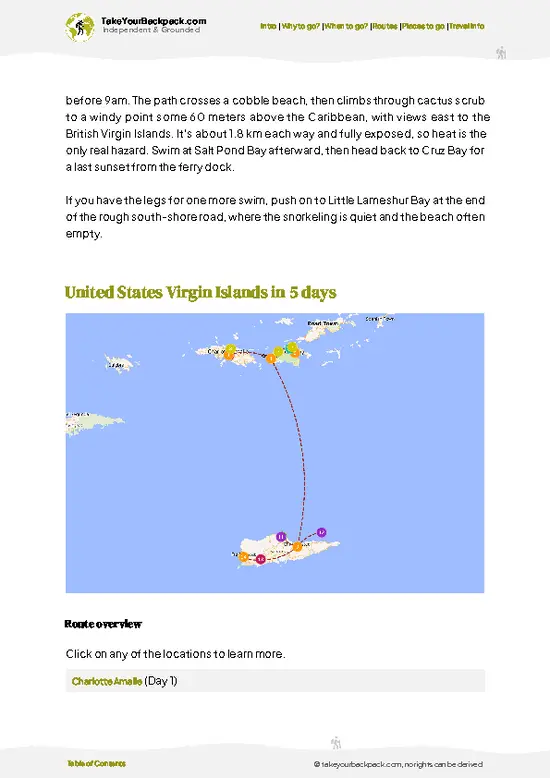
example page 0 from our offline Travel Guide for United States Virgin Islands
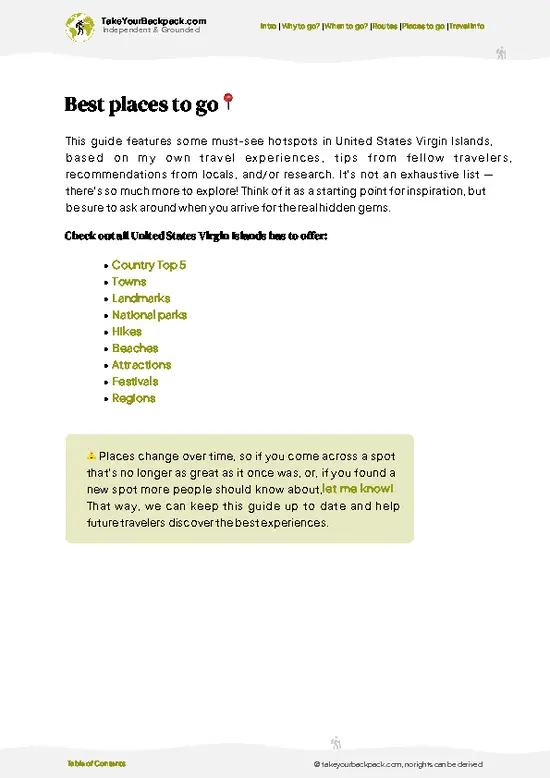
example page 1 from our offline Travel Guide for United States Virgin Islands
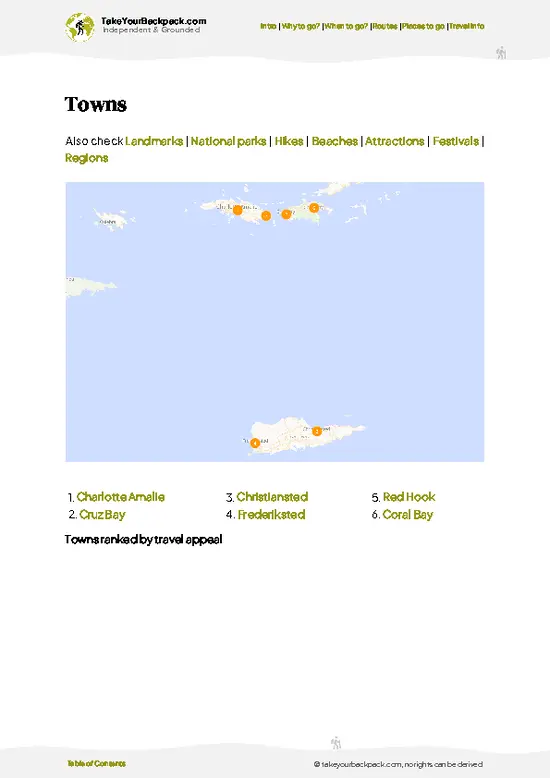
example page 2 from our offline Travel Guide for United States Virgin Islands
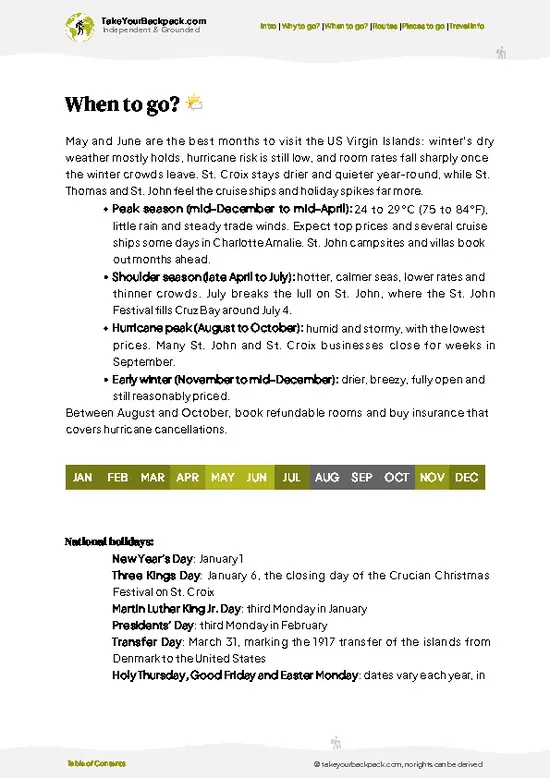
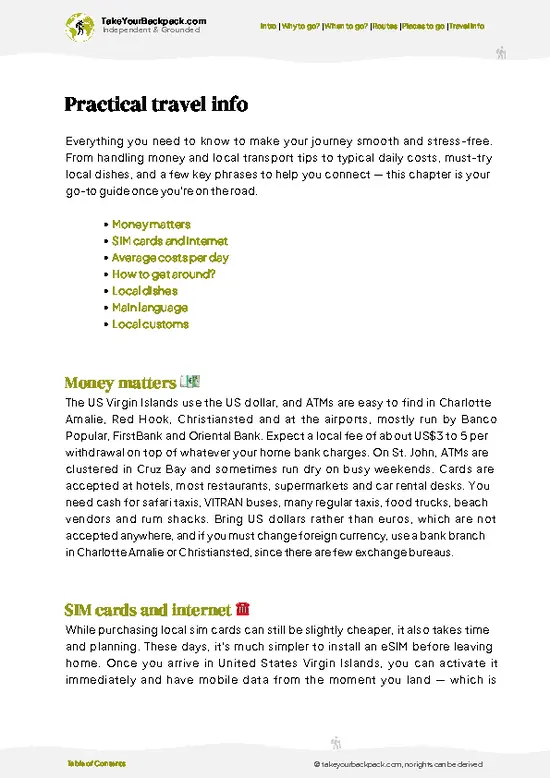
example page 3 from our offline Travel Guide for United States Virgin Islands
example page 4 from our offline Travel Guide for United States Virgin Islands
example page 5 from our offline Travel Guide for United States Virgin Islands
example page 6 from our offline Travel Guide for United States Virgin Islands
example page 7 from our offline Travel Guide for United States Virgin Islands
Loading the map 🌍
CLICK TO FILTER
towns
landmarks
national parks
hikes
beaches
attractions
festivals
regions
SHOW COUNTRY’S BESTSHOW ALL

✨ Why go?
Ranked #1 region in United States Virgin Islands
What sets this place apart

Water Island is the smallest of the four main U.S. Virgin Islands, and that is exactly what makes it useful. Less than 1 square mile of hills and coves sit a short ferry hop from Charlotte Amalie on St. Thomas, so you can sleep on the mainland and still spend whole days here without repacking a bag.

The island has no cars to speak of beyond golf carts and a few jeeps, which sets the pace. You can rent a golf cart and loop the single main road in an afternoon, stopping wherever a beach looks good. Honeymoon Beach is the social one, with a beach bar, kayaks and paddleboards for rent, and shallow water that suits a first snorkel. Heading uphill rewards you with views back across the harbor and out toward the British Virgin Islands.

Culture sits close to the nature here. Fort Segarra, a World … read more 👉
Water Island is the smallest of the four main U.S. Virgin Islands, and that is exactly what makes it useful. Less than 1 square mile of hills and coves sit a short ferry hop from Charlotte Amalie on St. Thomas, so you can sleep on the mainland and still spend whole days here without repacking a bag.

The island has no cars to speak of beyond golf carts and a few jeeps, which sets the pace. You can rent a golf cart and loop the single main road in an afternoon, stopping wherever a beach looks good. Honeymoon Beach is the social one, with a beach bar, kayaks and paddleboards for rent, and shallow water that suits a first snorkel. Heading uphill rewards you with views back across the harbor and out toward the British Virgin Islands.

Culture sits close to the nature here. Fort Segarra, a World War II-era gun emplacement, is reached on foot through scrub and cactus, and the island’s small year-round community gives the place a residential, unhurried feel that Charlotte Amalie’s cruise-ship docks lack. For backpackers, that contrast is the draw: a quiet day of beaches, ruins and a cold drink, then a ferry back to the livelier side of St. Thomas by evening.

💡 HighlightsTop highlights of Water Island

  1. Honeymoon Beach: The island’s main beach, a sheltered curve of pale sand with calm water and shade from sea grape trees. You can rent kayaks and paddleboards here, and snorkeling along the rocky edges is easy for beginners.
  2. Fort Segarra: Ruined World War II gun emplacements and bunkers on a hillside, built when the U.S. Army used the island for coastal defense. Allow time for the climb, which ends in views across the water to St. Thomas.
  3. Dinghy’s Beach Bar: A beachfront bar at Honeymoon Beach where boaters and day-trippers gather for cold drinks and burgers. It is the island’s social center, so expect company in the afternoon.
  4. Phillips Landing: The ferry dock and the island’s arrival point. It is small and unfussy, and the loop road begins here, so it is a good place to get oriented before choosing
… read more 👉
  1. Honeymoon Beach: The island’s main beach, a sheltered curve of pale sand with calm water and shade from sea grape trees. You can rent kayaks and paddleboards here, and snorkeling along the rocky edges is easy for beginners.
  2. Fort Segarra: Ruined World War II gun emplacements and bunkers on a hillside, built when the U.S. Army used the island for coastal defense. Allow time for the climb, which ends in views across the water to St. Thomas.
  3. Dinghy’s Beach Bar: A beachfront bar at Honeymoon Beach where boaters and day-trippers gather for cold drinks and burgers. It is the island’s social center, so expect company in the afternoon.
  4. Phillips Landing: The ferry dock and the island’s arrival point. It is small and unfussy, and the loop road begins here, so it is a good place to get oriented before choosing a direction.
  5. Sprat Bay: The quiet water beside the landing, where small boats moor and you can watch the harbor traffic. It is a good place to wait for the return ferry.
  6. The loop road by golf cart: A rented golf cart is the standard way to see the island. The road climbs and dips past private homes, with sudden views of bays and of the Charlotte Amalie waterfront.
  7. The ridge viewpoints: Several turnouts on the island’s higher ground look back over the harbor and the cruise ship docks. They are lightly used and make a good stop at the end of the day.
Water Island can be covered in a relaxed half day, and a full day gives you time for the fort, a swim and a long lunch.
Spotted a mistake or missing something? Contact us.

Things to do around Water Island

Ratings based on Tripadvisor reviews. When you book through this link, you support our work at no extra cost to you.

⌛️ 5 daysA smart one-week plan

Day 1: Phillips Landing: Coffee, a short ferry hop and a slow walk off the dock make this a wide-open morning with nothing scheduled. Water Island sits just across the harbor from Charlotte Amalie, and the small passenger ferry from Crown Bay is the island's only regular link, so the day is built around its timetable. Arrive early, drop your pack at your lodging, and rent a golf cart at the landing. Roads are narrow and few, which is why a cart beats walking for covering the loop.

Day 2: Honeymoon Beach: Spend the day on the sand at Honeymoon Beach, the island's main beach on Druif Bay. Snorkel the rocky edges, then eat at the beach bar. Because ferries thin out in the evening, I would stay put until mid-afternoon rather than rushing around. The pace here is set by the boat, not by your ambition. … read more 👉
Day 1: Phillips Landing: Coffee, a short ferry hop and a slow walk off the dock make this a wide-open morning with nothing scheduled. Water Island sits just across the harbor from Charlotte Amalie, and the small passenger ferry from Crown Bay is the island's only regular link, so the day is built around its timetable. Arrive early, drop your pack at your lodging, and rent a golf cart at the landing. Roads are narrow and few, which is why a cart beats walking for covering the loop.

Day 2: Honeymoon Beach: Spend the day on the sand at Honeymoon Beach, the island's main beach on Druif Bay. Snorkel the rocky edges, then eat at the beach bar. Because ferries thin out in the evening, I would stay put until mid-afternoon rather than rushing around. The pace here is set by the boat, not by your ambition.

Day 3: Heimie's Hill and Fort Segarra: Walk or drive up toward the old military ruins on the island's high ground. Fort Segarra is a concrete remnant of the island's days as an Army installation, and the climb gives you views across the harbor to St. Thomas and out to the cays. Go in the cooler morning, then spend the afternoon at a quieter cove on the south side. This is the day for the island's history.

Day 4: Detour to Hassel Island: Kayak or paddle with a rental from the beach toward neighboring shores, or ride the ferry back and take a short hop to Hassel Island, part of the national park, where Danish-era ruins sit in thick scrub. It adds a layer of history without wrecking your schedule, since the ferry still gets you home. Check return times before you set off, and pack water.

Day 5: The long swim and the last ferry: Keep the final day loose. Do a last snorkel at Honeymoon Beach, then catch an afternoon boat back to Crown Bay with time to spare for onward connections.

If one day justifies the trip, make it Day 2. The beach, the clear water and the lack of crowds on a weekday are the whole argument for coming here.

🌤️ When to go?Weather, crowds, and seasonal trade-offs

The best time to visit Water Island is December to April, when days are dry, breezy and 77 to 85°F (25 to 29°C).
  • Peak Season (December to April): Lows near 72°F (22°C), highs around 84°F (29°C), steady trade winds and clear water for snorkeling at Honeymoon Beach. Daylight runs roughly 11 to 12 hours. Rooms on nearby St. Thomas cost the most, often US$250 to 450 a night for mid-range, and the island’s one beach bar gets busy when cruise passengers arrive.
  • Shoulder Months (May to June, November): Highs of 85 to 88°F (29 to 31°C), more humidity, short showers and thinner crowds. Prices drop by about 20 to 30 percent.
  • Hot and Wet Season (July to October): Highs of 88 to 91°F (31 to 33°C), heavy humidity and the busiest rain of the year. This is also hurricane season, with the highest risk from August
… read more 👉
The best time to visit Water Island is December to April, when days are dry, breezy and 77 to 85°F (25 to 29°C).
  • Peak Season (December to April): Lows near 72°F (22°C), highs around 84°F (29°C), steady trade winds and clear water for snorkeling at Honeymoon Beach. Daylight runs roughly 11 to 12 hours. Rooms on nearby St. Thomas cost the most, often US$250 to 450 a night for mid-range, and the island’s one beach bar gets busy when cruise passengers arrive.
  • Shoulder Months (May to June, November): Highs of 85 to 88°F (29 to 31°C), more humidity, short showers and thinner crowds. Prices drop by about 20 to 30 percent.
  • Hot and Wet Season (July to October): Highs of 88 to 91°F (31 to 33°C), heavy humidity and the busiest rain of the year. This is also hurricane season, with the highest risk from August to October. Many businesses shorten hours and lodging is cheapest, but flights and ferries can be disrupted.
Go in early May or late November to get calm water and lower rates without the hurricane peak.


source: climatestotravel.comJANJanuary: excellent for travelingFEBFebruary: excellent for travelingMARMarch: excellent for travelingAPRApril: highly recommended for travelingMAYMay: highly recommended for travelingJUNJune: fair for travelingJULJuly: fair for travelingAUGAugust: fair for travelingSEPSeptember: below average for travelingOCTOctober: fair for travelingNOVNovember: highly recommended for travelingDECDecember: excellent for traveling
when-to-go

✈️ The backpacker research shortcutUnited States Virgin Islands Travel Guide

An offline-friendly backpacking guide with optimized travel routes, ranked highlights, transport advice, and the best areas to stay.
example page 0 from our offline Travel Guide for United States Virgin Islands
example page 1 from our offline Travel Guide for United States Virgin Islands
example page 2 from our offline Travel Guide for United States Virgin Islands
example page 3 from our offline Travel Guide for United States Virgin Islands
example page 4 from our offline Travel Guide for United States Virgin Islands
example page 5 from our offline Travel Guide for United States Virgin Islands
example page 6 from our offline Travel Guide for United States Virgin Islands
example page 7 from our offline Travel Guide for United States Virgin Islands
The digital guide (144 pages) contains:
✅ 35 highlights, ranked by travel appeal
✅ Optimized 2, 3 & 5-day travel routes
✅ Cities, national parks, landmarks, beaches
✅ How to get around
✅ Offline-friendly for travel without Wi-Fi
👉 Click to see all 30+ guide features

📅 Plan smarter in minutes, not weeks
✅ Month by month travel advice
✅ Festivals & national holidays
✅ Budget expectations

🗺️ Go to the right places, skip the overrated ones
✅ Honest pros & cons of destinations
✅ Top hikes, parks & viewpoints
✅ Lesser-known places most travelers miss
✅ Clear “worth it vs skip it” guidance

🛏️ Travel smoothly without rookie mistakes
✅ Best areas to stay
✅ Transport systems explained simply
✅ Common scams & safety advice
✅ SIM cards, money & practical tips

🌍 Understand the country, not just visit it
✅ Culture & traditions
✅ Local customs
✅ Festivals worth planning around
✅ Traveler-friendly historical context
✅ Insights that make places more meaningful

📱 Built for real travel conditions
✅ Fully downloadable PDF
✅ Works completely offline
✅ Optimized for phone use
✅ Useful in remote areas & buses
✅ Everything in one place
Stop searching, start planning
Get instant access to your full guide. 30‑day money-back guarantee.
+ Add another guide for just

By proceeding you agree to our terms.
Sent to your inbox immediately after payment • 100% Secure Checkout
Best Backpacking Travel Advisor 2025 tourism awardBest Backpacking
Travel Advisor
2025
What others say about Take Your Backpack Guides:
⭐⭐⭐⭐⭐
Fantastic, amazing amount of information!
⭐⭐⭐⭐⭐
My goodness this is amazing, it's what I've been looking for hats off too you!
⭐⭐⭐⭐⭐
I think this is absolutely BRILLIANT
⭐⭐⭐⭐
Very complete and informative. It's still missing places, but I gotta to commend you
⭐⭐⭐⭐⭐
This is truly amazing, thank you, can't wait to explore it with my kids!
⭐⭐⭐⭐⭐
Awesome resource, thank you!
⭐⭐⭐⭐⭐
This is amazing! Can't wait to explore the ones I haven't seen
⭐⭐⭐⭐
I love this! Well done, great idea.
⭐⭐⭐⭐⭐
Thanks for taking the time to make this gem!
⭐⭐⭐⭐⭐
This might be the best website I've ever seen.
⭐⭐⭐⭐⭐
Congratulations, and thank you so much for your work; it's incredibly valuable.
⭐⭐⭐⭐
In all seriousness I think you did a great job pointing out the important spots
⭐⭐⭐⭐⭐
10/10 very good
⭐⭐⭐⭐⭐
As someone who's only just starting to visit regularly this is awesome, thank you.
⭐⭐⭐⭐
Thank you very much! I'm going to visit my dad, it's going to be very useful!
⭐⭐⭐⭐⭐
This is really cool! We'll be travelling for the first time and this definitely come in handy.
⭐⭐⭐⭐⭐
You are now our minister of culture, congratulations 👨‍💼
⭐⭐⭐⭐⭐
Just wanted to tell you that this is a pearl! Going to follow your recommendations.
⭐⭐⭐⭐⭐
This is so cool. I'll definitely be using the resource for my travels soon.
⭐⭐⭐⭐⭐
This is very impressive! Good work.
⭐⭐⭐⭐⭐
This is an amazing and informative site. Very well done!

🛏️ Where to stay?Choosing the right base

Water Island itself has only a few small guesthouses and rentals, so most backpackers sleep on St. Thomas and visit by ferry. Red Hook on the east end is the social pick, with a compact waterfront, casual bars, and the ferries to St. John and the British Virgin Islands. Expect US$100 to 200 a night for simple rooms or shared rentals, and no dorm beds. Meeting other travelers is easy here at the open-air bars and dive shops, and it is easy to organize snorkel days or boat rides.

Charlotte Amalie, the main town, suits anyone who wants cheaper food, markets and the VITRAN bus. Rooms run about US$90 … read more 👉
Water Island itself has only a few small guesthouses and rentals, so most backpackers sleep on St. Thomas and visit by ferry. Red Hook on the east end is the social pick, with a compact waterfront, casual bars, and the ferries to St. John and the British Virgin Islands. Expect US$100 to 200 a night for simple rooms or shared rentals, and no dorm beds. Meeting other travelers is easy here at the open-air bars and dive shops, and it is easy to organize snorkel days or boat rides.

Charlotte Amalie, the main town, suits anyone who wants cheaper food, markets and the VITRAN bus. Rooms run about US$90 to 180. It is lively by day and quiet at night, and streets near the waterfront are fine but should be avoided after dark on foot. Crown Bay, close to the Water Island ferry, is practical for early starts, with a marina, a few restaurants and short rides to the dock.

Staying on Water Island makes sense only if you want silence. Rentals there cost roughly US$150 to 300 a night, book out early in winter, and there is little nightlife. Most travelers choose Red Hook for company and make Water Island a day trip.

🚌 Getting aroundHow to get around Water Island

A shared open-air taxi or the passenger ferry from Crown Bay costs about US$5 to 8 one way, paid in cash to the driver or at the dock. Water Island is small, roughly 2.5 miles long, and nearly everything on it is reached by one paved loop road and a few dirt spurs. Most backpackers arrive by ferry from St. Thomas and then walk or ride a short distance. It is reliable in daytime, thin after dark.
  • Passenger Ferry: A short 10 to 15 minute crossing from Crown Bay Marina on St. Thomas to the Phillips Landing dock, about US$5 to 8 each way, running roughly hourly in the day. You sit in the open air and watch freighters and cruise ships slide past, then step off beside the island’s small cluster of shops and a dock lined with dinghies.
  • Island Taxi: Open-air vans meet most ferries and cost US$5 to 10
… read more 👉
A shared open-air taxi or the passenger ferry from Crown Bay costs about US$5 to 8 one way, paid in cash to the driver or at the dock. Water Island is small, roughly 2.5 miles long, and nearly everything on it is reached by one paved loop road and a few dirt spurs. Most backpackers arrive by ferry from St. Thomas and then walk or ride a short distance. It is reliable in daytime, thin after dark.
  • Passenger Ferry: A short 10 to 15 minute crossing from Crown Bay Marina on St. Thomas to the Phillips Landing dock, about US$5 to 8 each way, running roughly hourly in the day. You sit in the open air and watch freighters and cruise ships slide past, then step off beside the island’s small cluster of shops and a dock lined with dinghies.
  • Island Taxi: Open-air vans meet most ferries and cost US$5 to 10 per person to Honeymoon Beach or other points on the loop. The driver usually talks you through the island on the way, and you arrive at the sand with no hot walk behind you.
  • Walking: The loop road is hilly but short, and the beach and fort ruins are 20 to 40 minutes on foot from the dock. Shade is patchy, so carry water. The reward is the view over Druif Bay and quiet stretches where goats and iguanas outnumber people.
  • Golf Cart or Bike Rental: Electric golf carts rent for about US$75 to 110 a day and bikes for US$25 to 40. Carts handle the hills without sweat, and a loop of the island takes under an hour, leaving time for a swim at an empty cove.
  • Mainland Link (Taxi and Bus): To reach Crown Bay from the St. Thomas airport, a shared taxi costs about US$10 to 15 per person, and the VITRAN bus is US$2. Bus service stops by early evening, so a late arrival means a taxi.
Check the last ferry back before you head out for the day, since the final departures leave early in the evening and a missed boat means a costly water taxi.

🍲 FoodLocal Flavors for Backpackers

Water Island eats like the rest of the Virgin Islands, built around fresh fish, conch and johnnycakes. Mahi-mahi and wahoo come grilled, blackened or in a fried basket with plantains, and the conch stew is peppery and slightly briny. Rum is the local drink, and the rum punch and the Caribbean painkiller arrive cold, sweet with fruit and dusted with nutmeg. Expect to pay US$12 to 25 for a plate and US$8 to 12 for a cocktail.

The island is small, so eating means the beach bar and grill at Honeymoon Beach, a few casual cafés near the dock and your own picnic. Many backpackers buy cheap staples at the supermarkets near Crown Bay and carry them over, which saves money since island prices run higher. On St. Thomas, roadside stands sell fried fish and callaloo, and local pates, fried pastry pockets … read more 👉
Water Island eats like the rest of the Virgin Islands, built around fresh fish, conch and johnnycakes. Mahi-mahi and wahoo come grilled, blackened or in a fried basket with plantains, and the conch stew is peppery and slightly briny. Rum is the local drink, and the rum punch and the Caribbean painkiller arrive cold, sweet with fruit and dusted with nutmeg. Expect to pay US$12 to 25 for a plate and US$8 to 12 for a cocktail.

The island is small, so eating means the beach bar and grill at Honeymoon Beach, a few casual cafés near the dock and your own picnic. Many backpackers buy cheap staples at the supermarkets near Crown Bay and carry them over, which saves money since island prices run higher. On St. Thomas, roadside stands sell fried fish and callaloo, and local pates, fried pastry pockets filled with beef or saltfish, cost about US$3 to 5 and are the best cheap snack around.

Pay in US dollars, and tip 15 to 20 percent unless service is already added. Service is unhurried, so settle in. Kitchens close early, often by 8 or 9 p.m., and you should carry water and cash because card machines on the island sometimes fail.

FAQFrequently asked questions about Water Island

One day is enough for Water Island, though a second lets you slow down. A morning ferry from Crown Bay takes 10 to 15 minutes, leaving time for Honeymoon Beach, the fort ruins and a loop of the island on foot or by golf cart. Most backpackers pair it with two or three days on St. Thomas and St. John.
Walking, island taxis and the passenger ferry cover everything. The ferry from Crown Bay costs about US$5 to 8 each way, and taxis to the beach run US$5 to 10 per person. Electric golf carts rent for US$75 to 110 a day if you want to cover the whole loop road, which takes under an hour.
Water Island is known for Honeymoon Beach, a calm, white-sand cove with snorkeling and a beach bar, and for being the fourth largest of the US Virgin Islands. It is small, car-light and quiet, with old Fort Segarra ruins and roaming iguanas. A day trip from St. Thomas costs about US$10 to 16 for ferry fares alone.
⚠️ Things can change over time, so always validate details locally before you go.

Other destinations worth considering

Water Island isn’t the only highlight in United States Virgin Islands. Explore all what United States Virgin Islands has to offer.
Country photo of United States Virgin Islands

We 💚 feedbackSumming up the experience

Water Island is best on a weekday, and most visitors make the mistake of arriving on the busiest ferry with no plan. Skip the noon rush at Honeymoon Beach, take an early boat, and head for the fort first. Bring cash, water and your own snorkel mask, because the island has few places to buy anything once you leave the beach.

✍️ Help improve this page!
The information on this page is based on in-depth research, insights shared by experienced travelers, and feedback from the local travel community in United States Virgin Islands. While every effort is made to keep the information accurate and current, conditions can change — so if you spot anything incorrect or outdated, please get in touch.


🙋‍♂️ Give feedback

👋 Meet the founderWho’s Behind Take Your Backpack?

Johan, backpacker and founder of TakeYourBackpackHi, I’m Johan (Netherlands 🇳🇱), the creator of TakeYourBackpack. Over the past 3 decades, I’ve backpacked through 90+ countries across six continents, gaining extensive experience with independent travel, long-term trips, and overland routes.

This site is built on a combination of firsthand travel experience and carefully curated insights from other backpackers. Many guides are based on places I’ve personally visited, while others bring together tips, observations, and practical advice shared by trusted travelers I’ve met along the way.

The goal is to provide realistic, experience-driven guidance — not generic itineraries — so you can explore destinations with better context, clearer expectations, and more confidence.