×

Vanuatu🇻🇺 | best festivalsWhere to Find the 3 Best festivals in Vanuatu

Festivals in Vanuatu are village-run ceremonies, not ticketed events. Expect kastom dances, kava, pigs and fire, with crowds measured in hundreds, not thousands. Tanna and Pentecost demand flights and rough rides, while Efate and Santo stay easy. Independent travelers who arrange village stays and bring small cash get the closest seats. Pick your island first, then chase the drumbeat.

By Johan Kruseman 🇳🇱 | Updated October 18, 2026
Explore the best regions in Vanuatu

Why go?Understanding Their Importance

Vanuatu packs over 100 languages into about 80 islands, and each island guards its own kastom, the inherited law of dance, exchange and ritual. That fragmentation means celebrations stay local, tied to yam harvests, chiefly rank and village calendars, so they feel unstaged. Missionary pressure did not erase them; communities on Tanna, Pentecost and Malekula kept them alive and still run them on their own terms.

The flip side is infrastructure. Domestic flights are limited, boats run on loose schedules, and dates often shift with the moon, the harvest or a chief’s decision. Confirm timing through a local host or the island’s tourism office before you commit. Expect to pay village entry fees and to follow dress and photo rules. Treat it as an invitation, not a performance.
Our Approach to Ranking
The list of best festivals in Vanuatu is created based on energy, traditions, crowd experience, activities, and overall excitement. If you feel a festival is missing in this list, please let us know.

When to go?Optimal Periods for Travel

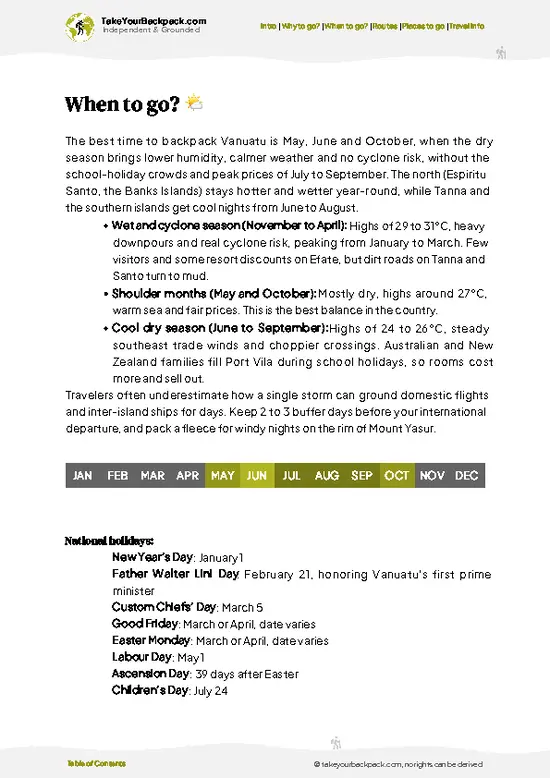
Best months and seasons: The best months are May to October, the dry season, when days run 24 to 28°C, roads stay passable and flights depart on time. Rainfall drops to roughly 80 to 150 mm a month in the south, so dirt tracks on Tanna and Pentecost stay driveable and grass airstrips stay open.
Shoulder and wet season: April and November sit between seasons, with warming air and fewer visitors. December to March brings heat of 28 to 32°C, humidity, rainfall of 250 to 400 mm a month and cyclone risk, especially January to March. Flights get canceled, rivers swell and boats stay in harbor. Prices dip a little, but delays cost more than the savings.
Peak periods: July to September is the busiest stretch, with cruise ships crowding Port Vila and Tanna. Book domestic flights and bungalows a month … read more 👉
Best months and seasons: The best months are May to October, the dry season, when days run 24 to 28°C, roads stay passable and flights depart on time. Rainfall drops to roughly 80 to 150 mm a month in the south, so dirt tracks on Tanna and Pentecost stay driveable and grass airstrips stay open.
Shoulder and wet season: April and November sit between seasons, with warming air and fewer visitors. December to March brings heat of 28 to 32°C, humidity, rainfall of 250 to 400 mm a month and cyclone risk, especially January to March. Flights get canceled, rivers swell and boats stay in harbor. Prices dip a little, but delays cost more than the savings.
Peak periods: July to September is the busiest stretch, with cruise ships crowding Port Vila and Tanna. Book domestic flights and bungalows a month or more ahead then. The northern islands, such as Santo and Malekula, stay a touch wetter than the south year round.

festival hoppingHow to Combine festivals Into One Trip

How long you need: A trip linking several festivals in Vanuatu needs 12 to 18 days, because island hops eat time. Plan 2 to 4 days per stop, so you arrive early, join the build-up and still have a buffer.
Direction of travel: Fly into Port Vila on Efate, the hub for nearly every domestic flight. Group the south (Tanna, with 1 hour flights) together, then loop north to Santo via Luganville, and reach Malekula or Pentecost from there by small plane or boat. Working south to north, or the reverse, beats zigzagging. Flights to Tanna take about 1 hour, Port Vila to Santo 1 to 1.5 hours, and Santo to Pentecost or Malekula 30 to 60 minutes.
Planning mistakes: The classic error is tight connections. Flights get bumped and boats leave when full, so keep 1 to 2 spare days. Others: assuming fixed dates … read more 👉
How long you need: A trip linking several festivals in Vanuatu needs 12 to 18 days, because island hops eat time. Plan 2 to 4 days per stop, so you arrive early, join the build-up and still have a buffer.
Direction of travel: Fly into Port Vila on Efate, the hub for nearly every domestic flight. Group the south (Tanna, with 1 hour flights) together, then loop north to Santo via Luganville, and reach Malekula or Pentecost from there by small plane or boat. Working south to north, or the reverse, beats zigzagging. Flights to Tanna take about 1 hour, Port Vila to Santo 1 to 1.5 hours, and Santo to Pentecost or Malekula 30 to 60 minutes.
Planning mistakes: The classic error is tight connections. Flights get bumped and boats leave when full, so keep 1 to 2 spare days. Others: assuming fixed dates and skipping a local confirmation, and stacking three islands in one week. Do fewer, slower stops instead.

The ListMust-Visit festivals in Vanuatu

1 Nagol

Pentecost land diving, liana vines, timber towers, April to June

Watch Pentecost men and boys leap headfirst from hand-lashed towers, ankles tied with vines, while chanting dancers stamp below.

2 Fest’Napuan

String band and reggae, Bislama singalongs, Port Vila waterfront, open-fire food stalls

Catch homegrown string band and reggae sets in Port Vila, then slip off to a nearby nakamal for kava between evening acts.

3 Toka Festival

Tanna exchange ceremony, pigs and kava, firelit dancing, Yakel area

Join a village-hosted gathering on Tanna where painted dancers circle the ground, pigs and kava change hands, and singing runs past dark.

Loading the map 🌍

Expert viewInsights from Locals and Experts

How many to visit: Two or three festivals make a trip. That number leaves room for flight delays, a spare day when a ceremony shifts, and the long evenings of kava and conversation that make a village stay worth the journey. Cramming more turns you into a spectator on a schedule.
Choosing your kind: First-timers and short trips suit easy-access, tourism-friendly events on Tanna and Efate, where hosts handle logistics and you get clear viewing. Experienced travelers with two or more weeks should choose a remote, community-run gathering on Pentecost, Malekula or Ambrym, where you sleep in a village guesthouse, eat with your hosts and watch ceremonies unfold at village pace. Culture seekers get more from the quieter ones. Photographers want the dramatic, fire-lit ones.
What it costs: Budget US$40 … read more 👉
How many to visit: Two or three festivals make a trip. That number leaves room for flight delays, a spare day when a ceremony shifts, and the long evenings of kava and conversation that make a village stay worth the journey. Cramming more turns you into a spectator on a schedule.
Choosing your kind: First-timers and short trips suit easy-access, tourism-friendly events on Tanna and Efate, where hosts handle logistics and you get clear viewing. Experienced travelers with two or more weeks should choose a remote, community-run gathering on Pentecost, Malekula or Ambrym, where you sleep in a village guesthouse, eat with your hosts and watch ceremonies unfold at village pace. Culture seekers get more from the quieter ones. Photographers want the dramatic, fire-lit ones.
What it costs: Budget US$40 to 80 a day including food, bungalow beds (US$15 to 35) and local transport. Village or ceremony entry typically runs 2,000 to 10,000 vatu (roughly US$17 to 85) per person, plus a guide at 3,000 to 8,000 vatu a day, and internal flights from 12,000 to 30,000 vatu each way. Carry small notes in vatu, since villages rarely have change or card readers.
Safety and respect: Ask your host or chief before photographing, and wait for the answer; some dances, sacred grounds and taboo areas are off limits. Dress modestly, with shoulders and knees covered, and skip alcohol, as kava is the local drink. Never wander off alone on dirt tracks after dark. Malaria is present, so bring repellent and ask a clinic about prophylaxis. Pack a headlamp, rain jacket and sturdy sandals for muddy paths. You walk away with invitations, shared kava and a seat at a fire few outsiders see.

✈️ The backpacker research shortcutVanuatu Travel Guide

An offline-friendly backpacking guide with optimized travel routes, ranked highlights, transport advice, and the best areas to stay.
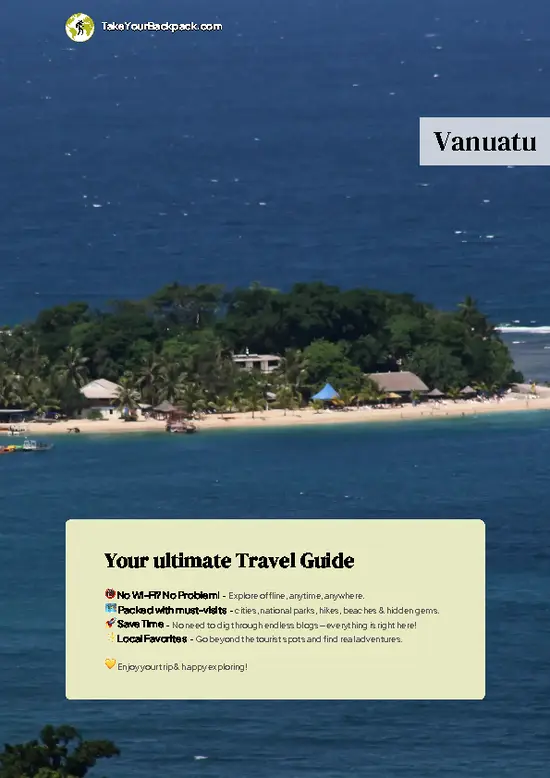
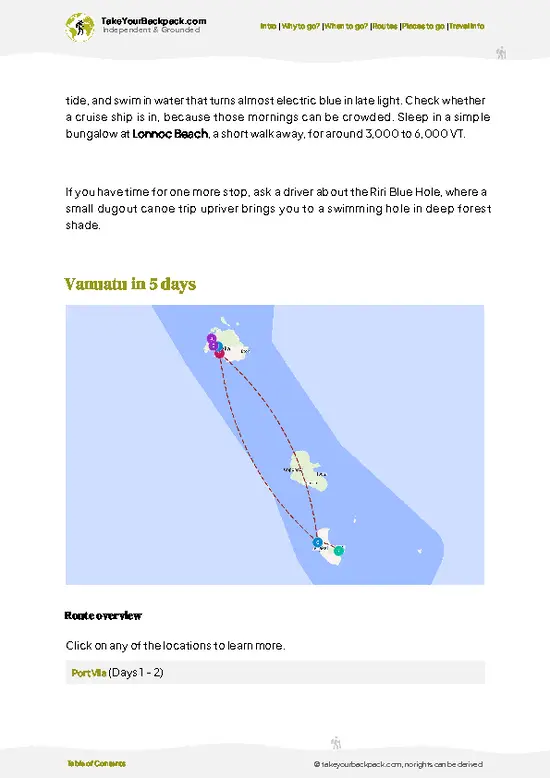
example page 0 from our offline Travel Guide for Vanuatu
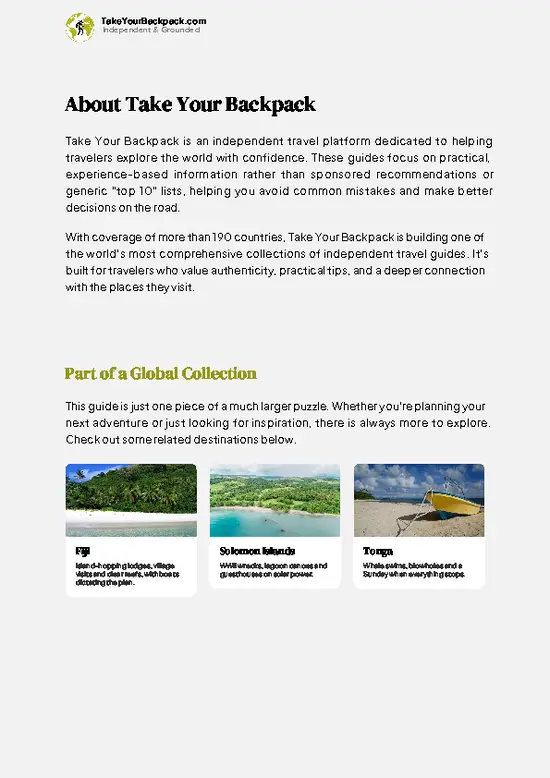
example page 1 from our offline Travel Guide for Vanuatu
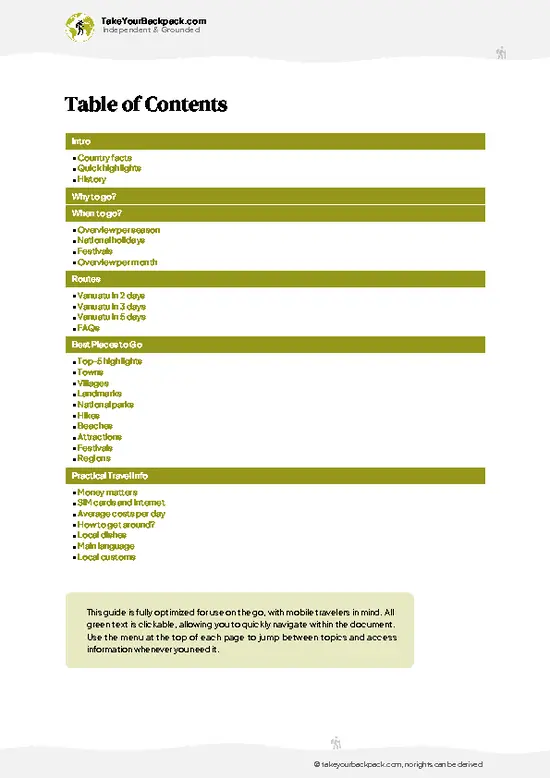
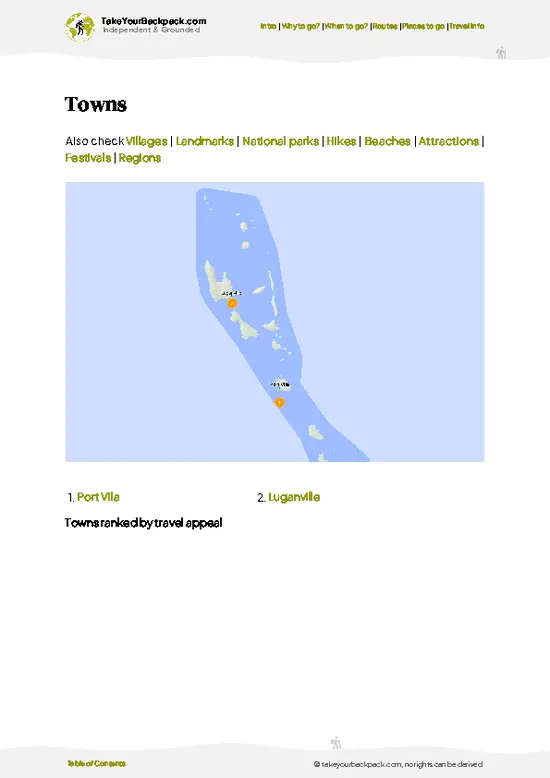
example page 2 from our offline Travel Guide for Vanuatu
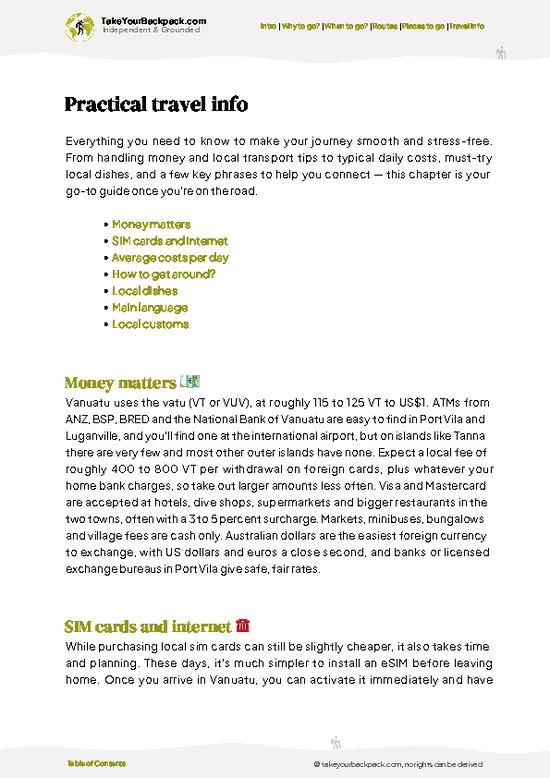
example page 3 from our offline Travel Guide for Vanuatu
example page 4 from our offline Travel Guide for Vanuatu
example page 5 from our offline Travel Guide for Vanuatu
example page 6 from our offline Travel Guide for Vanuatu
example page 7 from our offline Travel Guide for Vanuatu
The digital guide (134 pages) contains:
✅ 34 highlights, ranked by travel appeal
✅ Optimized 2, 3 & 5-day travel routes
✅ Cities, national parks, landmarks, beaches
✅ How to get around
✅ Offline-friendly for travel without Wi-Fi
👉 Click to see all 30+ guide features

📅 Plan smarter in minutes, not weeks
✅ Month by month travel advice
✅ Festivals & national holidays
✅ Budget expectations

🗺️ Go to the right places, skip the overrated ones
✅ Honest pros & cons of destinations
✅ Top hikes, parks & viewpoints
✅ Lesser-known places most travelers miss
✅ Clear “worth it vs skip it” guidance

🛏️ Travel smoothly without rookie mistakes
✅ Best areas to stay
✅ Transport systems explained simply
✅ Common scams & safety advice
✅ SIM cards, money & practical tips

🌍 Understand the country, not just visit it
✅ Culture & traditions
✅ 52 Essential phrases & customs
✅ Festivals worth planning around
✅ Traveler-friendly historical context
✅ Insights that make places more meaningful

📱 Built for real travel conditions
✅ Fully downloadable PDF
✅ Works completely offline
✅ Optimized for phone use
✅ Useful in remote areas & buses
✅ Everything in one place
Stop searching, start planning
Get instant access to your full guide. 30‑day money-back guarantee.
+ Add another guide for just

By proceeding you agree to our terms.
Sent to your inbox immediately after payment • 100% Secure Checkout
Best Backpacking Travel Advisor 2025 tourism awardBest Backpacking
Travel Advisor
2025
What others say about Take Your Backpack Guides:
⭐⭐⭐⭐⭐
Fantastic, amazing amount of information!
⭐⭐⭐⭐⭐
My goodness this is amazing, it's what I've been looking for hats off too you!
⭐⭐⭐⭐⭐
I think this is absolutely BRILLIANT
⭐⭐⭐⭐
Very complete and informative. It's still missing places, but I gotta to commend you
⭐⭐⭐⭐⭐
This is truly amazing, thank you, can't wait to explore it with my kids!
⭐⭐⭐⭐⭐
Awesome resource, thank you!
⭐⭐⭐⭐⭐
This is amazing! Can't wait to explore the ones I haven't seen
⭐⭐⭐⭐
I love this! Well done, great idea.
⭐⭐⭐⭐⭐
Thanks for taking the time to make this gem!
⭐⭐⭐⭐⭐
This might be the best website I've ever seen.
⭐⭐⭐⭐⭐
Congratulations, and thank you so much for your work; it's incredibly valuable.
⭐⭐⭐⭐
In all seriousness I think you did a great job pointing out the important spots
⭐⭐⭐⭐⭐
10/10 very good
⭐⭐⭐⭐⭐
As someone who's only just starting to visit regularly this is awesome, thank you.
⭐⭐⭐⭐
Thank you very much! I'm going to visit my dad, it's going to be very useful!
⭐⭐⭐⭐⭐
This is really cool! We'll be travelling for the first time and this definitely come in handy.
⭐⭐⭐⭐⭐
You are now our minister of culture, congratulations 👨‍💼
⭐⭐⭐⭐⭐
Just wanted to tell you that this is a pearl! Going to follow your recommendations.
⭐⭐⭐⭐⭐
This is so cool. I'll definitely be using the resource for my travels soon.
⭐⭐⭐⭐⭐
This is very impressive! Good work.
⭐⭐⭐⭐⭐
This is an amazing and informative site. Very well done!

🛏️ Where to stay?Top Areas to Stay

Vanuatu has only a handful of true hostels, with dorm beds at about 2,500 to 4,500 vatu (US$20 to 38), but family-run guesthouses and bungalows fill the gap on most islands. In Port Vila, the downtown waterfront puts you within walking distance of the market, cafes and the few bars, though it gets noisy and you should take a taxi after dark, while Nambatu and the Erakor Lagoon side are quieter and greener but leave you reliant on minibuses. Outside the capital, Luganville on Espiritu Santo is a practical base for dive sites and blue holes with little nightlife, and on Tanna simple bungalows near Mount Yasur trade comfort and electricity for being steps from the volcano.

If you enjoy meeting fellow … read more 👉
Vanuatu has only a handful of true hostels, with dorm beds at about 2,500 to 4,500 vatu (US$20 to 38), but family-run guesthouses and bungalows fill the gap on most islands. In Port Vila, the downtown waterfront puts you within walking distance of the market, cafes and the few bars, though it gets noisy and you should take a taxi after dark, while Nambatu and the Erakor Lagoon side are quieter and greener but leave you reliant on minibuses. Outside the capital, Luganville on Espiritu Santo is a practical base for dive sites and blue holes with little nightlife, and on Tanna simple bungalows near Mount Yasur trade comfort and electricity for being steps from the volcano.

If you enjoy meeting fellow travelers, consider choosing hostels with high ratings for atmosphere. On the other hand, if you prefer having your own space, a hotel might be a better option.

VanuatuDiscover the Country

👋 Meet the founderWho’s Behind Take Your Backpack?

Johan, backpacker and founder of TakeYourBackpackHi, I’m Johan (Netherlands 🇳🇱), the creator of TakeYourBackpack. Over the past 3 decades, I’ve backpacked through 90+ countries across six continents, gaining extensive experience with independent travel, long-term trips, and overland routes.

This site is built on a combination of firsthand travel experience and carefully curated insights from other backpackers. Many guides are based on places I’ve personally visited, while others bring together tips, observations, and practical advice shared by trusted travelers I’ve met along the way.

The goal is to provide realistic, experience-driven guidance — not generic itineraries — so you can explore destinations with better context, clearer expectations, and more confidence.