×

Vanuatu🇻🇺 | best regionsWhere to Find the 8 Best regions in Vanuatu

Vanuatu stretches across 80-odd islands, and each region plays by its own rules. Efate hands you flights, markets and easy logistics, while the outer islands trade comforts for volcanoes, village stays and living custom. Costs climb with distance, crowds thin out fast, and transport turns into part of the adventure. Pick your region by appetite, and backpacking here gets wonderfully personal.

By Johan Kruseman 🇳🇱 | Updated October 9, 2026
Explore the best cities in Vanuatu

Why go?Understanding Their Importance

Vanuatu rewards regional thinking because the country is a scattered volcanic chain of islands, not one connected landmass. Over 100 languages survive among roughly 300,000 people, and kastom, the living system of custom and land ownership, still shapes daily life far from the capital. That means every island group has its own dances, food, rules and pace.

Infrastructure is thin outside the main hubs. Domestic flights on small planes, cargo boats, bush bungalows and cash-only villages are the norm, so flexibility matters more than a tight plan. Cyclones, active volcanoes and weather-delayed flights can reshuffle your days.

Before committing, know that you pay village fees and guide costs to cross land that belongs to families. Go curious, bring small bills, and let the islands set the tempo.
Behind the Scenes of Selection
The list of best regions in Vanuatu is created based on landscapes, local culture, attractions, vibes, and overall appeal. If you feel a region is missing in this list, please let us know.

When to go?Optimal Periods for Travel

Best months and weather: May to October is the best window, because the dry season brings 22 to 28°C days, lower humidity and far fewer rain-soaked flight cancellations. Seas calm down, trails firm up, and volcano viewing turns reliable.
Shoulder and wet season: April and November work well, with fewer visitors and lighter bookings. From December to March, expect 27 to 32°C heat, heavy downpours, muddy tracks and cyclone risk, peaking January to March. Domestic flights get bumped often, so build slack in.
Crowds and prices: July to September is the busiest stretch, especially around school holidays, when Port Vila flights and resort rooms fill and rates rise roughly 10 to 25 percent. Outer-island bungalows keep fixed prices year-round, but book small-plane seats early. Southern islands like … read more 👉
Best months and weather: May to October is the best window, because the dry season brings 22 to 28°C days, lower humidity and far fewer rain-soaked flight cancellations. Seas calm down, trails firm up, and volcano viewing turns reliable.
Shoulder and wet season: April and November work well, with fewer visitors and lighter bookings. From December to March, expect 27 to 32°C heat, heavy downpours, muddy tracks and cyclone risk, peaking January to March. Domestic flights get bumped often, so build slack in.
Crowds and prices: July to September is the busiest stretch, especially around school holidays, when Port Vila flights and resort rooms fill and rates rise roughly 10 to 25 percent. Outer-island bungalows keep fixed prices year-round, but book small-plane seats early. Southern islands like Tanna run slightly cooler, around 18 to 24°C, in July and August.

region hoppingHow to Combine regions Into One Trip

Days needed and direction: A trip combining several regions in Vanuatu needs 10 to 21 days, because every hop depends on small planes or boats. Start in Port Vila on Efate, the main international gateway, then fly outward. Pair regions that share an Air Vanuatu corridor, such as Vila to Tanna or Vila to Santo, and finish back at a hub so your international flight is protected.
Time per stop and transfers: Allow three to five days per outer island, since arrivals, village greetings and treks eat time. Domestic flights run roughly 45 to 90 minutes, while inter-island boats can take 6 to 24 hours or more.
Planning mistakes: Cramming four islands into a week is the classic error. Schedule buffer days before departure, avoid back-to-back flights with tight connections, and confirm bookings by phone a day ahead.

The ListMust-Visit regions in Vanuatu

1 Efate

Port Vila base, Mele Cascades, nakamal dusk, island loop

Rent a car or scooter to loop from the capital’s market and museum to waterfalls, blue lagoons, reef sanctuaries and UNESCO chief’s sites.

2 Tanna Island

Yasur crater rim, John Frum Fridays, Yakel kastom, Yaohnanen horses

Stand at dusk on an active crater rim, then ride shared trucks to custom villages, coffee slopes and hot springs by the sea.

vanuatu-region-tanna-island
© Google | Fred Natonga

3 Rugged Coastline of Santo

Blue holes, Champagne Beach, Port Olry, east coast truck road

Ride a dirt road past plantations to cold spring-fed pools, wreck-strewn shallows and quiet bays, with a small island for seafood.

4 Pentecost Island

Naghol towers, Saturday jumps, kastom villages, Pangi bungalows

Watch men dive from wooden towers with vines on their ankles in season, then settle into west coast beaches and gardens.

5 Aore Island

President Coolidge wreck, Segond Channel, plantation lanes, five-minute boat hop

Dive or snorkel the sunken troopship, then walk flat shoreline tracks past coconut groves and villages with Luganville’s lights across the water.

6 Bokissa Island

Adults-only resort islet, house reef, western sunsets, one-night splurge

Step off the boat transfer onto white sand, snorkel the coral a few kicks from shore and circle the whole island on foot.

7 Nguna Island

Taputaora cone, turtle bays, Taloa homestays, marine protected reef

Climb through village gardens to a ridge above Efate, then snorkel community-protected reef where green turtles graze in calm shallows.

vanuatu-region-nguna-island
© Google |

8 Havannah Harbour

Mangrove inlet, Roy Mata sites, Mangaliliu, rough coast road

Paddle or boat across glassy water to caves, burial islands and villages where local guides tell the story of a chief’s domain.

Loading the map 🌍

Expert viewInsights from Locals and Experts

How many regions to pick: Two or three regions suit most backpackers, and two is ideal on a trip under two weeks. Flights get canceled, villages deserve more than a one-night stop, and the best moments, like a kava circle at dusk, need unhurried time. The reward is depth instead of airports.
Choosing by travel style: If comfort and nightlife matter, favor the hub regions with markets, reef snorkeling and a choice of hostels. If you crave raw adventure, prioritize volcano and village islands where you hike ash plains, sleep in thatched bungalows and eat laplap cooked in earth ovens. Divers lean toward wreck and reef areas, and culture seekers lean toward islands famous for ceremonies and kastom villages. Mixing one easy region with one remote region gives you both a soft landing and a story. … read more 👉
How many regions to pick: Two or three regions suit most backpackers, and two is ideal on a trip under two weeks. Flights get canceled, villages deserve more than a one-night stop, and the best moments, like a kava circle at dusk, need unhurried time. The reward is depth instead of airports.
Choosing by travel style: If comfort and nightlife matter, favor the hub regions with markets, reef snorkeling and a choice of hostels. If you crave raw adventure, prioritize volcano and village islands where you hike ash plains, sleep in thatched bungalows and eat laplap cooked in earth ovens. Divers lean toward wreck and reef areas, and culture seekers lean toward islands famous for ceremonies and kastom villages. Mixing one easy region with one remote region gives you both a soft landing and a story.
What it costs: Budget US$45 to 80 a day (roughly 5,500 to 9,500 vatu) on outer islands, covering bungalows at US$15 to 35, village meals at US$5 to 10 and local transport. Hub areas run US$60 to 110 with hostels and activities. Expect village or land access fees of about US$5 to 25, guides at US$15 to 50 for a day, volcano or cultural site entry at US$30 to 80 on the high end, and domestic flights from US$100 to 250 per leg. Carry cash in small vatu notes, because ATMs vanish beyond the main towns.
Safety and respect: Always ask permission before walking, photographing or fishing, and pay fees to the landowner. Dress modestly in villages, with shoulders and knees covered, and do not photograph ceremonies without being invited. Follow guide instructions near volcano rims and heed alert levels. Malaria exists in parts of the country, so get medical advice, and expect basic clinics only. Treat water and carry a first-aid kit. Slow down, say tankyu, and the welcome you get will be the highlight.

✈️ The backpacker research shortcutVanuatu Travel Guide

An offline-friendly backpacking guide with optimized travel routes, ranked highlights, transport advice, and the best areas to stay.
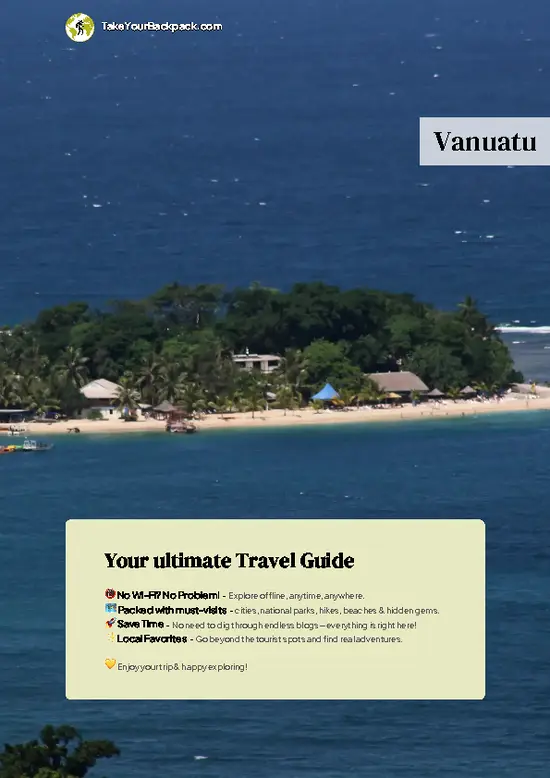
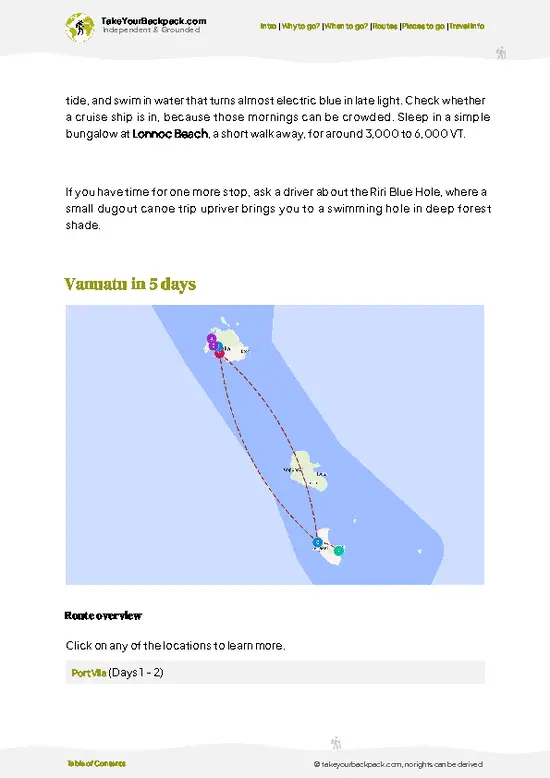
example page 0 from our offline Travel Guide for Vanuatu
example page 1 from our offline Travel Guide for Vanuatu
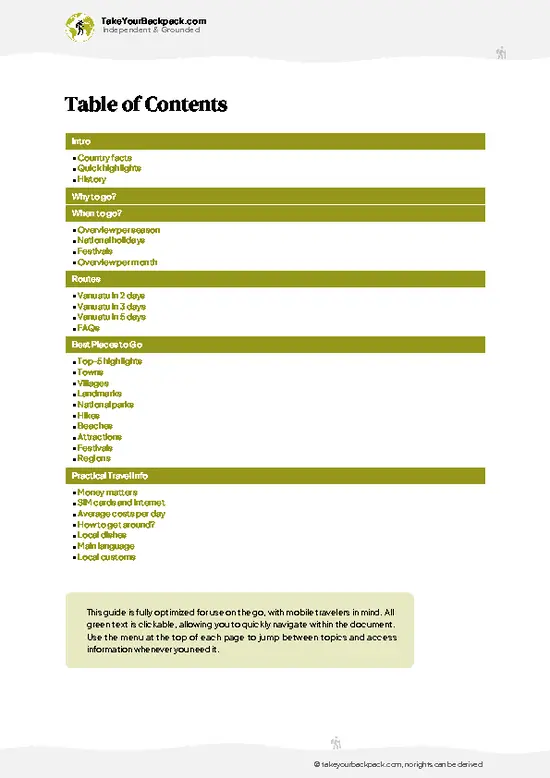
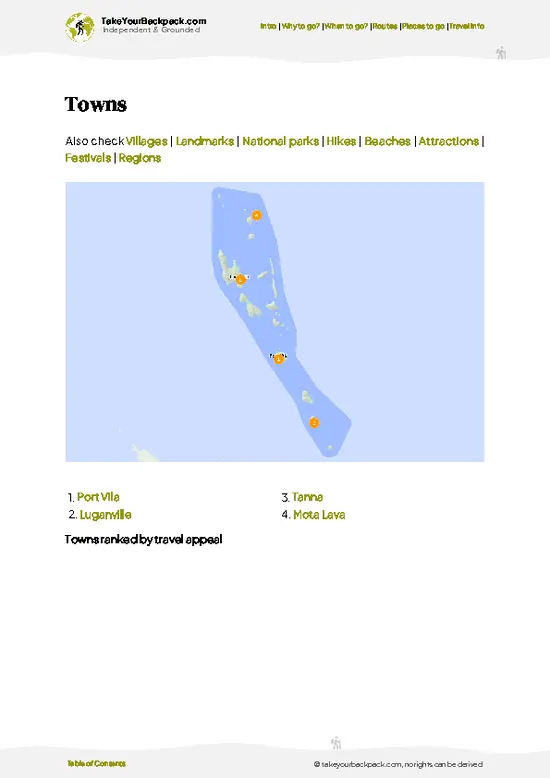
example page 2 from our offline Travel Guide for Vanuatu
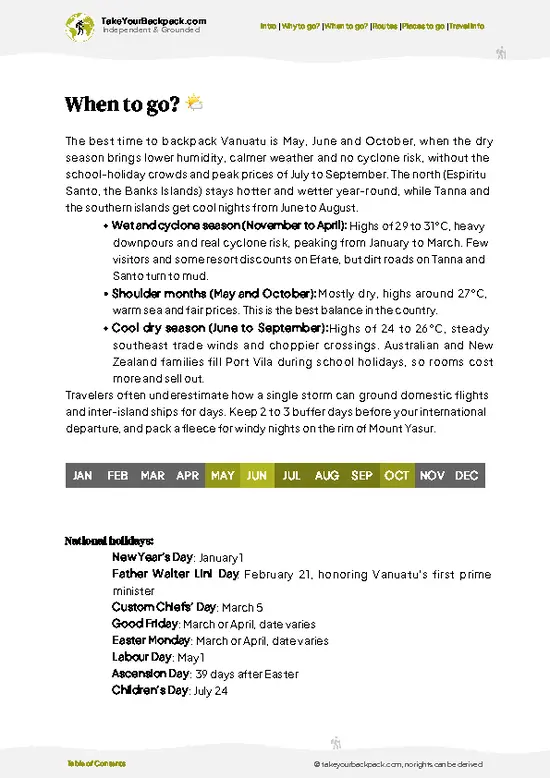
example page 3 from our offline Travel Guide for Vanuatu
example page 4 from our offline Travel Guide for Vanuatu
example page 5 from our offline Travel Guide for Vanuatu
example page 6 from our offline Travel Guide for Vanuatu
example page 7 from our offline Travel Guide for Vanuatu
The digital guide (149 pages) contains:
✅ 41 highlights, ranked by travel appeal
✅ Optimized 2, 3 & 5-day travel routes
✅ Cities, national parks, landmarks, beaches
✅ How to get around
✅ Offline-friendly for travel without Wi-Fi
👉 Click to see all 30+ guide features

📅 Plan smarter in minutes, not weeks
✅ Month by month travel advice
✅ Festivals & national holidays
✅ Budget expectations

🗺️ Go to the right places, skip the overrated ones
✅ Honest pros & cons of destinations
✅ Top hikes, parks & viewpoints
✅ Lesser-known places most travelers miss
✅ Clear “worth it vs skip it” guidance

🛏️ Travel smoothly without rookie mistakes
✅ Best areas to stay
✅ Transport systems explained simply
✅ Common scams & safety advice
✅ SIM cards, money & practical tips

🌍 Understand the country, not just visit it
✅ Culture & traditions
✅ 52 Essential phrases & customs
✅ Festivals worth planning around
✅ Traveler-friendly historical context
✅ Insights that make places more meaningful

📱 Built for real travel conditions
✅ Fully downloadable PDF
✅ Works completely offline
✅ Optimized for phone use
✅ Useful in remote areas & buses
✅ Everything in one place
Save weeks of stressful planning
Get instant access to your full guide. 30‑day money-back guarantee.
+ Add another guide for just

By proceeding you agree to our terms.
Sent to your inbox immediately after payment • 100% Secure Checkout
Best Backpacking Travel Advisor 2025 tourism awardBest Backpacking
Travel Advisor
2025
What others say about Take Your Backpack Guides:
⭐⭐⭐⭐⭐
Fantastic, amazing amount of information!
⭐⭐⭐⭐⭐
My goodness this is amazing, it's what I've been looking for hats off too you!
⭐⭐⭐⭐⭐
I think this is absolutely BRILLIANT
⭐⭐⭐⭐
Very complete and informative. It's still missing places, but I gotta to commend you
⭐⭐⭐⭐⭐
This is truly amazing, thank you, can't wait to explore it with my kids!
⭐⭐⭐⭐⭐
Awesome resource, thank you!
⭐⭐⭐⭐⭐
This is amazing! Can't wait to explore the ones I haven't seen
⭐⭐⭐⭐
I love this! Well done, great idea.
⭐⭐⭐⭐⭐
Thanks for taking the time to make this gem!
⭐⭐⭐⭐⭐
This might be the best website I've ever seen.
⭐⭐⭐⭐⭐
Congratulations, and thank you so much for your work; it's incredibly valuable.
⭐⭐⭐⭐
In all seriousness I think you did a great job pointing out the important spots
⭐⭐⭐⭐⭐
10/10 very good
⭐⭐⭐⭐⭐
As someone who's only just starting to visit regularly this is awesome, thank you.
⭐⭐⭐⭐
Thank you very much! I'm going to visit my dad, it's going to be very useful!
⭐⭐⭐⭐⭐
This is really cool! We'll be travelling for the first time and this definitely come in handy.
⭐⭐⭐⭐⭐
You are now our minister of culture, congratulations 👨‍💼
⭐⭐⭐⭐⭐
Just wanted to tell you that this is a pearl! Going to follow your recommendations.
⭐⭐⭐⭐⭐
This is so cool. I'll definitely be using the resource for my travels soon.
⭐⭐⭐⭐⭐
This is very impressive! Good work.
⭐⭐⭐⭐⭐
This is an amazing and informative site. Very well done!

🛏️ Where to stay?Where to Stay: Vanuatu Edition

Vanuatu has only a handful of true hostels, but budget guesthouses, backpacker lodges and simple island bungalows are easy to find, typically at 2,500 to 6,000 VT (about US$20 to 50) a night. In Port Vila, downtown and the seafront put you within walking distance of the market, restaurants and the limited nightlife, though it can be noisy and is best avoided on foot late at night. The Elluk and Nambatu areas are quieter but need a minibus ride. Luganville on Santo is low-key and practical for dive trips, while Tanna’s family-run bungalows near Mt Yasur trade electricity and comforts for being close to the volcano.

If you enjoy meeting fellow travelers, consider choosing hostels with high ratings … read more 👉
Vanuatu has only a handful of true hostels, but budget guesthouses, backpacker lodges and simple island bungalows are easy to find, typically at 2,500 to 6,000 VT (about US$20 to 50) a night. In Port Vila, downtown and the seafront put you within walking distance of the market, restaurants and the limited nightlife, though it can be noisy and is best avoided on foot late at night. The Elluk and Nambatu areas are quieter but need a minibus ride. Luganville on Santo is low-key and practical for dive trips, while Tanna’s family-run bungalows near Mt Yasur trade electricity and comforts for being close to the volcano.

If you enjoy meeting fellow travelers, consider choosing hostels with high ratings for atmosphere. On the other hand, if you prefer having your own space, a hotel might be a better option.

VanuatuExplore Beyond This Category

👋 Meet the founderWho’s Behind Take Your Backpack?

Johan, backpacker and founder of TakeYourBackpackHi, I’m Johan (Netherlands 🇳🇱), the creator of TakeYourBackpack. Over the past 3 decades, I’ve backpacked through 90+ countries across six continents, gaining extensive experience with independent travel, long-term trips, and overland routes.

This site is built on a combination of firsthand travel experience and carefully curated insights from other backpackers. Many guides are based on places I’ve personally visited, while others bring together tips, observations, and practical advice shared by trusted travelers I’ve met along the way.

The goal is to provide realistic, experience-driven guidance — not generic itineraries — so you can explore destinations with better context, clearer expectations, and more confidence.