×

Venezuela🇻🇪 | attractionsMuseo de Arte Contemporáneo de Caracas Armando ReverónSoto and Cruz-Diez, Picasso and Warhol, Parque Central galleries, kinetic color | things to do and best time to go

Explore Parque Zoológico y Botánico BararidaExplore Museo de Bellas Artes de Caracas

Backpacking in Museo de Arte Contemporáneo de Caracas Armando Reverón
🏆 Top pickattraction ranked #4
By Johan Kruseman 🇳🇱 | Updated October 19, 2026

The big draw is the permanent collection, with names like Picasso, Miró, Léger and Warhol hanging in a capital where you would not expect them, alongside Venezuelan heavyweights Jesús Soto and Cruz-Diez. What gets overlooked is the setting: the museum sits in the Parque Central complex, a cluster of concrete towers, and the surrounding blocks need street smarts after dark. It stands in central Caracas, Venezuela’s capital, a short ride west of Plaza Altamira. Crowds are thin, often just school groups and a few locals, and entry has been cheap or free. Skip it if modern art bores you; the building itself is plain. Go for the kinetic works and the quiet galleries, where you can stand alone with a canvas for minutes. Unlike the nearby Galería de Arte Nacional, which centers on Venezuelan history and older work, this museum leans international and modern.

Discover everything you want to know in the 📖 Venezuela Travel Guide.
Safety warning

The current risk level for Venezuela is high. Check the advice before going.


example page 0 from our offline Travel Guide for Venezuela
example page 1 from our offline Travel Guide for Venezuela
example page 2 from our offline Travel Guide for Venezuela
example page 3 from our offline Travel Guide for Venezuela
example page 4 from our offline Travel Guide for Venezuela
example page 5 from our offline Travel Guide for Venezuela
example page 6 from our offline Travel Guide for Venezuela
example page 7 from our offline Travel Guide for Venezuela
Loading the map 🌍
CLICK TO FILTER
cities
towns
villages
landmarks
national parks
hikes
beaches
attractions
festivals
regions
SHOW COUNTRY’S BESTSHOW ALL

✨ Why go?
Ranked #4 attraction in Venezuela
Reasons people choose to visit here

Museo de Arte Contemporáneo de Caracas gives you a rare chance to see European modernists and Latin American kinetic art under one roof, without queues or timed tickets. That alone justifies the trip if you care about art at all.
The second reason is the country’s artistic story. Venezuela produced Jesús Soto and Carlos Cruz-Diez, and their optical and kinetic pieces make more sense here than in any textbook. Seeing how color shifts as you walk past a work is something a photo cannot do.
The museum also works as a milestone on a Caracas route. Pair it with nearby cultural sites and you understand how oil money once funded serious collecting and public art. The 1970s ambition behind the collection still shows in the galleries, even where upkeep is thin. For a backpacker, it is a calm, low-risk … read more 👉
Museo de Arte Contemporáneo de Caracas gives you a rare chance to see European modernists and Latin American kinetic art under one roof, without queues or timed tickets. That alone justifies the trip if you care about art at all.
The second reason is the country’s artistic story. Venezuela produced Jesús Soto and Carlos Cruz-Diez, and their optical and kinetic pieces make more sense here than in any textbook. Seeing how color shifts as you walk past a work is something a photo cannot do.
The museum also works as a milestone on a Caracas route. Pair it with nearby cultural sites and you understand how oil money once funded serious collecting and public art. The 1970s ambition behind the collection still shows in the galleries, even where upkeep is thin. For a backpacker, it is a calm, low-risk indoor stop in a city that can be intense, and a way to see a side of Venezuela that headlines never mention.

💡 HighlightsPlaces and moments you shouldn't skip

  1. Permanent international collection: Works by Picasso, Miró, Léger and Warhol sit in Caracas, which surprises almost everyone. Take your time with each room.
  2. Jesús Soto pieces: Soto’s vibrating, nylon-thread and rod works play with your movement. Step side to side and the surface seems to shimmer.
  3. Carlos Cruz-Diez color works: His chromatic experiments use stripes and shifting hues that change as you walk. They explain why Venezuela is famous in kinetic art.
  4. Latin American modern painting: Regional artists give context to the European names, and the contrast is the most educational part of the visit.
  5. Temporary exhibitions: Rotating shows bring in current Venezuelan artists, so check what is on when you arrive. They are often the liveliest rooms.
  6. Sculpture galleries: Three-dimensional pieces let
… read more 👉
  1. Permanent international collection: Works by Picasso, Miró, Léger and Warhol sit in Caracas, which surprises almost everyone. Take your time with each room.
  2. Jesús Soto pieces: Soto’s vibrating, nylon-thread and rod works play with your movement. Step side to side and the surface seems to shimmer.
  3. Carlos Cruz-Diez color works: His chromatic experiments use stripes and shifting hues that change as you walk. They explain why Venezuela is famous in kinetic art.
  4. Latin American modern painting: Regional artists give context to the European names, and the contrast is the most educational part of the visit.
  5. Temporary exhibitions: Rotating shows bring in current Venezuelan artists, so check what is on when you arrive. They are often the liveliest rooms.
  6. Sculpture galleries: Three-dimensional pieces let you circle the work, which suits slow, unhurried viewing in the quiet halls.
  7. Parque Central surroundings: The towers and plazas around the museum show Caracas modernist planning at its most ambitious, and they are worth a short daytime look.
The sculpture galleries are the room most visitors rush past on the way out, yet they are where you can be completely alone with the work.
Spotted a mistake or missing something? Contact us.

🌤️ When to go?Weather, crowds, and seasonal trade-offs

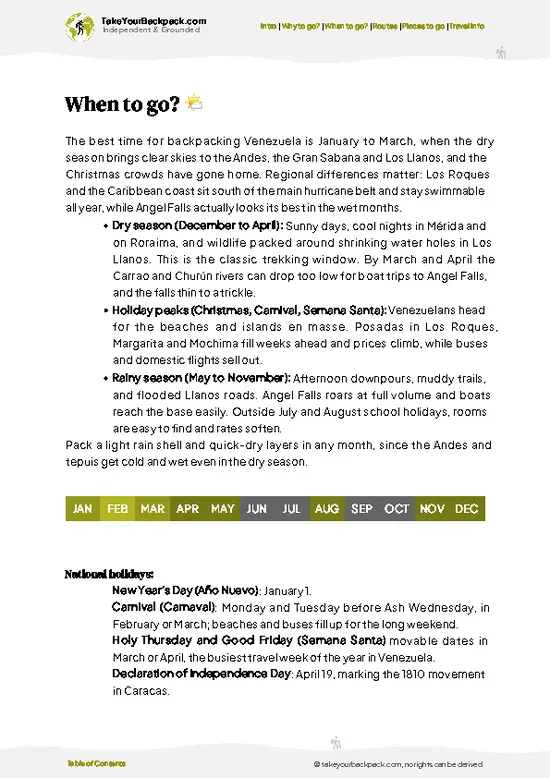
The museum is best visited between December and April, when Caracas stays dry and the walk through Parque Los Caobos and along Avenida México happens under clear skies.
  • Dry Season (December to April): Days run 26 to 30°C (79 to 86°F), nights 16 to 19°C (61 to 66°F). Rain is rare, and daylight lasts roughly 11 to 12 hours. Carnival and Easter weeks bring local crowds to the city, though the galleries stay quiet.
  • Rainy Season (May to November): Expect 25 to 29°C (77 to 84°F) with afternoon downpours, most intense from July to September. Mornings are usually clear, so go early. Galleries are nearly empty on weekdays.
  • Weekdays vs. Weekends: Weekdays are calmest. Exhibitions change through the year, and openings usually draw a livelier, more local crowd.
  • Prices: Lodging and transport costs barely shift
… read more 👉
The museum is best visited between December and April, when Caracas stays dry and the walk through Parque Los Caobos and along Avenida México happens under clear skies.
  • Dry Season (December to April): Days run 26 to 30°C (79 to 86°F), nights 16 to 19°C (61 to 66°F). Rain is rare, and daylight lasts roughly 11 to 12 hours. Carnival and Easter weeks bring local crowds to the city, though the galleries stay quiet.
  • Rainy Season (May to November): Expect 25 to 29°C (77 to 84°F) with afternoon downpours, most intense from July to September. Mornings are usually clear, so go early. Galleries are nearly empty on weekdays.
  • Weekdays vs. Weekends: Weekdays are calmest. Exhibitions change through the year, and openings usually draw a livelier, more local crowd.
  • Prices: Lodging and transport costs barely shift by season. Flights spike around Christmas and Easter.
Arrive before noon, since the area around Plaza Venezuela is easier to walk in daylight.


source: climatestotravel.comJANJanuary: highly recommended for travelingFEBFebruary: highly recommended for travelingMARMarch: excellent for travelingAPRApril: excellent for travelingMAYMay: fair for travelingJUNJune: fair for travelingJULJuly: fair for travelingAUGAugust: fair for travelingSEPSeptember: fair for travelingOCTOctober: fair for travelingNOVNovember: good for travelingDECDecember: highly recommended for traveling
venezuela-attraction-museo-de-arte-contemporaneo-de-caracas-armando-reveron
© Google |

✈️ The backpacker research shortcutVenezuela Travel Guide

An offline-friendly backpacking guide with optimized travel routes, ranked highlights, transport advice, and the best areas to stay.
example page 0 from our offline Travel Guide for Venezuela
example page 1 from our offline Travel Guide for Venezuela
example page 2 from our offline Travel Guide for Venezuela
example page 3 from our offline Travel Guide for Venezuela
example page 4 from our offline Travel Guide for Venezuela
example page 5 from our offline Travel Guide for Venezuela
example page 6 from our offline Travel Guide for Venezuela
example page 7 from our offline Travel Guide for Venezuela
The digital guide (290 pages) contains:
✅ 91 highlights, ranked by travel appeal
✅ Optimized 5, 10 & 15-day travel routes
✅ Cities, national parks, landmarks, beaches
✅ How to get around
✅ Offline-friendly for travel without Wi-Fi
👉 Click to see all 30+ guide features

📅 Plan smarter in minutes, not weeks
✅ Month by month travel advice
✅ Festivals & national holidays
✅ Budget expectations

🗺️ Go to the right places, skip the overrated ones
✅ Honest pros & cons of destinations
✅ Top hikes, parks & viewpoints
✅ Lesser-known places most travelers miss
✅ Clear “worth it vs skip it” guidance

🛏️ Travel smoothly without rookie mistakes
✅ Best areas to stay
✅ Transport systems explained simply
✅ Common scams & safety advice
✅ SIM cards, money & practical tips

🌍 Understand the country, not just visit it
✅ Culture & traditions
✅ 52 Essential phrases & customs
✅ Festivals worth planning around
✅ Traveler-friendly historical context
✅ Insights that make places more meaningful

📱 Built for real travel conditions
✅ Fully downloadable PDF
✅ Works completely offline
✅ Optimized for phone use
✅ Useful in remote areas & buses
✅ Everything in one place
Stop searching, start planning
Get instant access to your full guide. 30‑day money-back guarantee.
+ Add another guide for just

By proceeding you agree to our terms.
Sent to your inbox immediately after payment • 100% Secure Checkout
Best Backpacking Travel Advisor 2025 tourism awardBest Backpacking
Travel Advisor
2025
What others say about Take Your Backpack Guides:
⭐⭐⭐⭐⭐
Fantastic, amazing amount of information!
⭐⭐⭐⭐⭐
My goodness this is amazing, it's what I've been looking for hats off too you!
⭐⭐⭐⭐⭐
I think this is absolutely BRILLIANT
⭐⭐⭐⭐
Very complete and informative. It's still missing places, but I gotta to commend you
⭐⭐⭐⭐⭐
This is truly amazing, thank you, can't wait to explore it with my kids!
⭐⭐⭐⭐⭐
Awesome resource, thank you!
⭐⭐⭐⭐⭐
This is amazing! Can't wait to explore the ones I haven't seen
⭐⭐⭐⭐
I love this! Well done, great idea.
⭐⭐⭐⭐⭐
Thanks for taking the time to make this gem!
⭐⭐⭐⭐⭐
This might be the best website I've ever seen.
⭐⭐⭐⭐⭐
Congratulations, and thank you so much for your work; it's incredibly valuable.
⭐⭐⭐⭐
In all seriousness I think you did a great job pointing out the important spots
⭐⭐⭐⭐⭐
10/10 very good
⭐⭐⭐⭐⭐
As someone who's only just starting to visit regularly this is awesome, thank you.
⭐⭐⭐⭐
Thank you very much! I'm going to visit my dad, it's going to be very useful!
⭐⭐⭐⭐⭐
This is really cool! We'll be travelling for the first time and this definitely come in handy.
⭐⭐⭐⭐⭐
You are now our minister of culture, congratulations 👨‍💼
⭐⭐⭐⭐⭐
Just wanted to tell you that this is a pearl! Going to follow your recommendations.
⭐⭐⭐⭐⭐
This is so cool. I'll definitely be using the resource for my travels soon.
⭐⭐⭐⭐⭐
This is very impressive! Good work.
⭐⭐⭐⭐⭐
This is an amazing and informative site. Very well done!

🛏️ Where to stay?Best areas to stay in Venezuela

Chacaíto and Sabana Grande put you within three or four metro stops of the museum, and they are the most practical bases for backpackers. Sabana Grande has a long pedestrian boulevard lined with cheap eateries, bakeries and shops. It is busy and loud in daytime, and the metro line runs right under it, so you can reach most of the city quickly. Stay on streets close to the boulevard and avoid walking around after dark.

Chacaíto is a little calmer, with a large commercial center, restaurants and easy transit. It suits solo travelers who want convenience over atmosphere, and the metro stop connects … read more 👉
Chacaíto and Sabana Grande put you within three or four metro stops of the museum, and they are the most practical bases for backpackers. Sabana Grande has a long pedestrian boulevard lined with cheap eateries, bakeries and shops. It is busy and loud in daytime, and the metro line runs right under it, so you can reach most of the city quickly. Stay on streets close to the boulevard and avoid walking around after dark.

Chacaíto is a little calmer, with a large commercial center, restaurants and easy transit. It suits solo travelers who want convenience over atmosphere, and the metro stop connects directly toward the museum area.

Los Caobos and the streets near Plaza Venezuela put you next to the museum itself and the park, but options there are limited and evenings are quiet. Altamira and Los Palos Grandes, to the east, are the safer, leafier choice if you want cafes, nightlife and a more social crowd. They need a short metro ride, and many travelers favor them for the night-time comfort.

Whatever you choose, take taxis or ride-hailing after dark and keep valuables out of sight.

👛 Costs (as of 19 October 2026)What things cost and how to budget

A day around the Museo de Arte Contemporáneo de Caracas costs roughly US$0 to 2 for a backpacker, with a total daily budget of about US$46 in high season.
CategoryBudget RangeLocal Reality
Museum entryUS$0 to 2Admission has historically been free or very low, with donations welcome at some exhibitions.
Accommodation (high season)US$15 to 25Dorm beds or basic private rooms in Sabana Grande or Chacaíto, around US$20 on average. Low season is often US$12 to 20.
FoodUS$6 to 12Set lunches (menú ejecutivo) and arepas at local counters cost US$3 to 5. Dinner is a bit more.
Local transportUS$0.50 to 5The metro fare is very low. Taxis or ride-hailing after dark run US$3 to 6 across town.
ExtrasUS$2 to 5Coffee, a cold drink or a snack in Parque Los Caobos or nearby cafes.
Total Daily BudgetUS$46Based on the
… read more 👉
A day around the Museo de Arte Contemporáneo de Caracas costs roughly US$0 to 2 for a backpacker, with a total daily budget of about US$46 in high season.
CategoryBudget RangeLocal Reality
Museum entryUS$0 to 2Admission has historically been free or very low, with donations welcome at some exhibitions.
Accommodation (high season)US$15 to 25Dorm beds or basic private rooms in Sabana Grande or Chacaíto, around US$20 on average. Low season is often US$12 to 20.
FoodUS$6 to 12Set lunches (menú ejecutivo) and arepas at local counters cost US$3 to 5. Dinner is a bit more.
Local transportUS$0.50 to 5The metro fare is very low. Taxis or ride-hailing after dark run US$3 to 6 across town.
ExtrasUS$2 to 5Coffee, a cold drink or a snack in Parque Los Caobos or nearby cafes.
Total Daily BudgetUS$46Based on the high-season accommodation row, with mid-range figures for the other rows. Dollars are widely used, and bolivars are accepted for small items.
⚠️ Prices can change and everyone travels differently, so take this as a rough guide. Hope it helps you plan your adventure!

FAQCommon questions from travelers

Plan on one to two hours at Museo de Arte Contemporáneo de Caracas, which is enough to see the main exhibition halls. Add another hour if you want to walk through neighboring Parque Los Caobos or visit the nearby Teresa Carreño Theater area. Mornings on weekdays are the quietest time.
Museo de Arte Contemporáneo de Caracas has historically charged little or nothing, typically US$0 to 2, so the cost is rarely a concern. Its collection includes major Latin American and international modern artists, and exhibitions change regularly. For art lovers it is one of the best-value stops in Caracas, and it pairs well with a walk through Parque Los Caobos.
Take the Caracas metro to Bellas Artes station, a short walk from Museo de Arte Contemporáneo de Caracas, for a fare of well under US$1. From Sabana Grande it is three stops. A taxi from Altamira takes roughly 20 to 40 minutes depending on traffic and costs around US$4 to 8.
⚠️ Things can change over time, so always validate details locally before you go.

Other Venezuelan attractions near Museo de Arte Contemporáneo de Caracas Armando Reverón

Explore more nearby:


💡 Not sure where to go next?
Create a personalized itinerary for Venezuela including Museo de Arte Contemporáneo de Caracas Armando Reverón and the places that fit your trip.

Generate my itinerary

👉 Discover all attractions

Or checkout all Venezuela has to offer (think cities, towns, villages, national parks, hikes, beaches, festivals)
Country photo of Venezuela

We 💚 feedbackParting advice and final tips

Go on a weekday morning, when the galleries are almost empty and the light is easiest on the kinetic works. Leave before the afternoon and head back to your lodging by taxi rather than walking around Parque Central. Museo de Arte Contemporáneo de Caracas is best treated as a quiet, unhurried half-day.

✍️ Help improve this page!
The information on this page is based on in-depth research, insights shared by experienced travelers, and feedback from the local travel community in Venezuela. While every effort is made to keep the information accurate and current, conditions can change — so if you spot anything incorrect or outdated, please get in touch.


🙋‍♂️ Give feedback

👋 Meet the founderWho’s Behind Take Your Backpack?

Johan, backpacker and founder of TakeYourBackpackHi, I’m Johan (Netherlands 🇳🇱), the creator of TakeYourBackpack. Over the past 3 decades, I’ve backpacked through 90+ countries across six continents, gaining extensive experience with independent travel, long-term trips, and overland routes.

This site is built on a combination of firsthand travel experience and carefully curated insights from other backpackers. Many guides are based on places I’ve personally visited, while others bring together tips, observations, and practical advice shared by trusted travelers I’ve met along the way.

The goal is to provide realistic, experience-driven guidance — not generic itineraries — so you can explore destinations with better context, clearer expectations, and more confidence.