×

Venezuela🇻🇪 | best attractionsEssential 10 attractions to Explore in Venezuela

Attractions in Venezuela are mostly natural: tepui mountains, Caribbean cays, Andean peaks and Llanos wetlands. Museums and monuments are few and rarely worth a dedicated trip. Costs are low by regional standards, but most sights need a guide or tour operator, so independent travel here means arranging logistics early. The Andes around Mérida are the easiest and most backpacker-friendly. The Guiana Highlands in the southeast are the most spectacular and the priciest. The coast is uneven: Morrocoy and Los Roques are beautiful, while much of the central shoreline is crowded and rough. Crowds are thin nearly everywhere, which helps, but services can be patchy.

By Johan Kruseman 🇳🇱 | Updated October 20, 2026
Explore the best festivals in Venezuela

Why go?What Makes Them Special

Venezuela’s attractions are unusual because the country packs four distinct landscapes into one border: Caribbean coast, Andes, Llanos plains and the Guiana Shield, whose tabletop mountains are among the oldest rock formations on Earth. That variety is real, and few neighbors match it for natural drama. Tourism infrastructure, though, has never matched the geography. Roads are poorly maintained in places, fuel supply can be erratic, domestic flights are limited and change often, and signage at remote sites is minimal. Cultural attractions are secondary: colonial towns exist, but they are modest compared with Colombia or Peru, so they are not a reason to come.

Before choosing Venezuela, accept that planning matters more than spontaneity. The best sights sit far from each other, and reaching … read more 👉
Venezuela’s attractions are unusual because the country packs four distinct landscapes into one border: Caribbean coast, Andes, Llanos plains and the Guiana Shield, whose tabletop mountains are among the oldest rock formations on Earth. That variety is real, and few neighbors match it for natural drama. Tourism infrastructure, though, has never matched the geography. Roads are poorly maintained in places, fuel supply can be erratic, domestic flights are limited and change often, and signage at remote sites is minimal. Cultural attractions are secondary: colonial towns exist, but they are modest compared with Colombia or Peru, so they are not a reason to come.

Before choosing Venezuela, accept that planning matters more than spontaneity. The best sights sit far from each other, and reaching them usually means paying a local operator or arranging a driver. The economy is dollarized in practice, so US dollars in small, clean bills are widely used for tours, lodging and meals, while cards and ATMs are unreliable. Prices for guided trips are not rock-bottom, because remote logistics are expensive. In return, you get places with very few other visitors and a welcome that tends to be warm. Check your government’s current travel advice and local conditions before booking anything.
Behind the Scenes of Selection
The list of best attractions in Venezuela is created based on cultural significance or entertainment value. If you feel a attraction is missing in this list, please let us know.

When to go?Best Time to Visit Venezuela for attractions

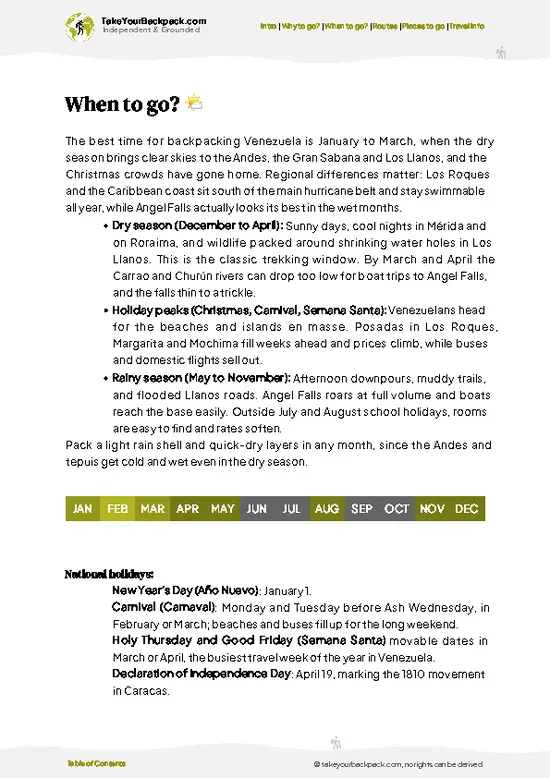
Best months for attractions: The best months are December to April, the dry season, when trails are firm, rivers are crossable, skies over the Andes and the coast are clear and boat trips run reliably. Daytime temperatures sit around 28 to 33°C on the coast and in the lowlands, 10 to 20°C in Mérida at altitude, and near freezing on the highest Andean summits at night.
Rainy season and shoulders: The wet season runs roughly May to November, with rainfall often 100 to 250 mm a month in many regions and heavier in the Guiana Highlands. Do not skip the south in these months, because waterfalls are at their fullest, but expect flooded river access, cancelled flights and cloud hiding the tepui summits. The Llanos change most: in the wet months much of the plain floods, making overland travel slow, … read more 👉
Best months for attractions: The best months are December to April, the dry season, when trails are firm, rivers are crossable, skies over the Andes and the coast are clear and boat trips run reliably. Daytime temperatures sit around 28 to 33°C on the coast and in the lowlands, 10 to 20°C in Mérida at altitude, and near freezing on the highest Andean summits at night.
Rainy season and shoulders: The wet season runs roughly May to November, with rainfall often 100 to 250 mm a month in many regions and heavier in the Guiana Highlands. Do not skip the south in these months, because waterfalls are at their fullest, but expect flooded river access, cancelled flights and cloud hiding the tepui summits. The Llanos change most: in the wet months much of the plain floods, making overland travel slow, while the dry season concentrates wildlife around shrinking water. Shoulder months, November and May, offer a decent balance of lower prices and still-manageable weather.
Peak periods and prices: Crowds only change plans around Christmas, Carnival (February or March) and Holy Week, when Venezuelans travel and beach lodging fills quickly. Prices on the coast can rise 20 to 50 percent at those times. Book early, or pick a midweek date outside those windows.

attraction hoppingTips for Visiting Multiple Destinations

How many days to allow: A trip combining several attractions in Venezuela needs 14 to 21 days, and less than 12 means spending most of it in transit. Group by region: the Andes around Mérida, the Guiana Highlands reached via Ciudad Bolívar or Puerto Ordaz, the Llanos, and the Caribbean coast and islands near Caracas and Puerto La Cruz.
Direction and timing: Start in Caracas and work in one loop rather than doubling back. Going west to the Andes, then south or east to the Guiana Highlands, and ending at the coast works well, since beaches make a restful finish. Plan 3 to 4 days for the Andes, 4 to 6 days for the Highlands, 2 to 3 days for the Llanos, and 3 to 5 days on the coast. Caracas to Mérida by road takes about 12 to 14 hours overnight, and Caracas to Ciudad Bolívar roughly 8 to 10 hours. … read more 👉
How many days to allow: A trip combining several attractions in Venezuela needs 14 to 21 days, and less than 12 means spending most of it in transit. Group by region: the Andes around Mérida, the Guiana Highlands reached via Ciudad Bolívar or Puerto Ordaz, the Llanos, and the Caribbean coast and islands near Caracas and Puerto La Cruz.
Direction and timing: Start in Caracas and work in one loop rather than doubling back. Going west to the Andes, then south or east to the Guiana Highlands, and ending at the coast works well, since beaches make a restful finish. Plan 3 to 4 days for the Andes, 4 to 6 days for the Highlands, 2 to 3 days for the Llanos, and 3 to 5 days on the coast. Caracas to Mérida by road takes about 12 to 14 hours overnight, and Caracas to Ciudad Bolívar roughly 8 to 10 hours. Domestic flights save a day but get rescheduled or cancelled with little warning.
Common planning mistakes: The main error is squeezing too many stops in and treating Venezuelan distances like European ones. Roads are slow, and breakdowns and fuel shortages add hours. Leave a spare day before any international flight. Another mistake is arranging Highlands trips on arrival: book operators before you travel, and keep wet-season buffers for river crossings.

The ListTop attractions of Venezuela

1 Teleférico de Mérida

Five-station cable car, 4,765 meters, Pico Bolívar views, frailejón páramo

Ride from Mérida’s streets through cloud forest to bare rock and cold air, with the Sierra Nevada’s peaks lined up on clear mornings.

venezuela-attraction-teleferico-de-merida
© Google |

2 Teatro Teresa Carreño

Brutalist concrete, 2,400-seat hall, El Sistema orchestra, national ballet

Book a concert or ballet in one of Latin America’s biggest halls, arriving by metro and strolling the skylit foyers before curtain.

3 Museo de Bellas Artes de Caracas

Villanueva concrete, Egyptian objects, cubism, Parque Los Caobos

Circle a 1976 concrete landmark, then move through galleries of Egyptian art, European ceramics, cubist canvases and Latin American modernism in a calm, uncrowded setting.

venezuela-attraction-museo-de-bellas-artes-de-caracas
© Google |

4 Museo de Arte Contemporáneo de Caracas Armando Reverón

Soto and Cruz-Diez, Picasso and Warhol, Parque Central galleries, kinetic color

Step side to side before vibrating thread works and shifting stripes, then compare them with European modern masters in quiet halls.

venezuela-attraction-museo-de-arte-contemporaneo-de-caracas-armando-reveron
© Google |

5 Museo de Arte Moderno Jesús Soto

Walk-in Penetrables, vibrating rods, Villanueva concrete, Ciudad Bolívar

Push through hanging tubes and watch rod-and-stripe panels tremble, in a modernist building devoted to the kinetic artist born in town.

6 Museo Marino de Margarita

Shell cases, pearl-diving history, sea turtles, Boca del Río waterfront

Learn to name the shells, fish and turtles of the Caribbean, and trace Margarita’s pearl past, with the real coast just outside.

venezuela-attraction-museo-marino-de-margarita
© Google |

7 Museo de Arte Contemporáneo del Zulia

Skylit halls, installation rooms, Zulia campus, prints and photography

Walk through large open galleries where paintings, sculpture and installations have room to breathe, then cool off before wandering the shaded university paths outside.

8 Museo de Arte Colonial Quinta de Anauco

Colonial country house, guided rooms, baroque weekends, mango-shaded patio

Follow a guide through 18th-century rooms, a small chapel and the old kitchen, then sit in the shaded courtyard beneath the Ávila.

venezuela-attraction-museo-de-arte-colonial-quinta-de-anauco
© Google |

9 Museo de Ciencias de Caracas

Mounted fauna, fossils, Plaza de los Museos, old-style cases

Wander high-ceilinged halls of stuffed wildlife and rock displays, then step outside to a square of neighboring museums.

venezuela-attraction-museo-de-ciencias-de-caracas
© Google |

10 Parque Zoológico y Botánico Bararida

Barquisimeto city zoo, native cats and caimans, botanical paths, shady lawns

Meet jaguars, capybaras and macaws on a morning loop, then cool off along labeled garden paths where local families picnic.

venezuela-attraction-parque-zoologico-y-botanico-bararida
© Google |

11 Museo de Arte de Coro

Coro old center, iron-window house, adobe lanes, colonial galleries

Pair an hour of Venezuelan art with a walk past the cathedral, merchant houses and the pedestrian Paseo Alameda.

12 Museo Sacro de Caracas

Cathedral annex, carved saints, church silver, Plaza Bolívar

Study gilded altarpieces, chalices and embroidered vestments beside the cathedral, ideally with a guide, in the old heart of the capital.

13 Teatro Baralt

Columned portico, Maracaibo stage, Plaza Baralt, lakefront breezes

Photograph the neoclassical front, catch a regional concert if one is on, then walk to the waterfront for relief from the heat.

14 Teatro Juares

Horseshoe balconies, painted dome, Plaza Bolívar, compact opera house

Look up at allegorical ceiling figures in a red-and-gold hall, then take the short tour and rest on the plaza.

15 Museo de Arte Valencia

Venezuelan modernism, geometric abstraction, Valencia galleries, rotating regional shows

Trace how local artists absorbed cubism and abstraction, then see newer work on city life and identity before returning to the heat.

16 Parque Zoológico Caricuao

Spectacled bears, hillside enclosures, hillside mist, family picnics

Climb forested slopes past jaguars, tapirs and howler monkeys, with cloud often drifting through the trees by afternoon.

Think you know Venezuela?

Prove you’re a true local — uncover 6 lesser-known attractions in Venezuela that locals tend to keep to themselves.
Loading the map 🌍

Expert viewInsights from Locals and Experts

How many attractions to aim for: Aim for three or four major attractions in a two to three week trip. Distances are big, transport is unpredictable, and the best sights each need two to five days including access. Adding a fifth usually means rushing through one, and the reasons you came get lost to bus stations.
Choosing by travel style: Hikers and climbers should put the Andes and the Guiana Highlands first, because those offer the longest and most distinctive trekking. Wildlife seekers should prioritize the Llanos in the dry season. Beach travelers get the best value from the Caribbean cays and islands, but should skip crowded mainland resort strips, which are loud, litter-prone and not worth the transit time. Colonial towns and museums are fine filler between bigger stops, not destinations … read more 👉
How many attractions to aim for: Aim for three or four major attractions in a two to three week trip. Distances are big, transport is unpredictable, and the best sights each need two to five days including access. Adding a fifth usually means rushing through one, and the reasons you came get lost to bus stations.
Choosing by travel style: Hikers and climbers should put the Andes and the Guiana Highlands first, because those offer the longest and most distinctive trekking. Wildlife seekers should prioritize the Llanos in the dry season. Beach travelers get the best value from the Caribbean cays and islands, but should skip crowded mainland resort strips, which are loud, litter-prone and not worth the transit time. Colonial towns and museums are fine filler between bigger stops, not destinations in themselves.
What it costs: A frugal backpacker can manage on US$30 to 50 a day in the Andes and Llanos covering hostel or posada, meals and local buses. In the Highlands and islands, budget US$60 to 120 a day because guides, boats and flights drive costs up. Typical per-visit costs: national park entry US$1 to 10, multi-day guided tepui or waterfall trips US$150 to 400 or more, Llanos safari packages US$80 to 150 a day including food, island boat transfers US$30 to 100. Bring small US dollar bills, since change is often unavailable, and carry enough cash for the whole stretch, because ATMs and card terminals frequently fail. Never rely on a foreign card.
Mistakes that cost money: Paying a tour in full upfront to an unknown operator is the most costly error. Use agencies with established reputations, ask for a written itinerary, and pay a deposit only. Skipping a guide to save US$20 to 40 a day on remote trails is false economy: trails are poorly marked, and many areas require a licensed guide anyway. Domestic flights are frequently delayed or cancelled, so never book a tight connection to an international departure. Buy fuel, water and food in advance before remote stretches, because supplies there are thin.
Safety and cultural considerations: Crime is a real concern in Caracas and other large cities, so travel in daylight, avoid displaying phones and cameras, and use registered taxis arranged by your lodging. Attractions in rural and mountain areas are generally calmer, but road checkpoints are common: carry a passport copy and stay polite. Border regions, especially near Colombia, carry serious risks, so avoid them and check current government advice before booking. Photographing military sites, police or protests is a bad idea. Indigenous communities in the south, such as the Pemón, set their own access rules, so ask your guide before photographing people or entering villages. Dress modestly in small towns, and avoid discussing politics loudly with strangers. Pack travel insurance that covers medical evacuation, since remote clinics are limited.

✈️ The backpacker research shortcutVenezuela Travel Guide

An offline-friendly backpacking guide with optimized travel routes, ranked highlights, transport advice, and the best areas to stay.
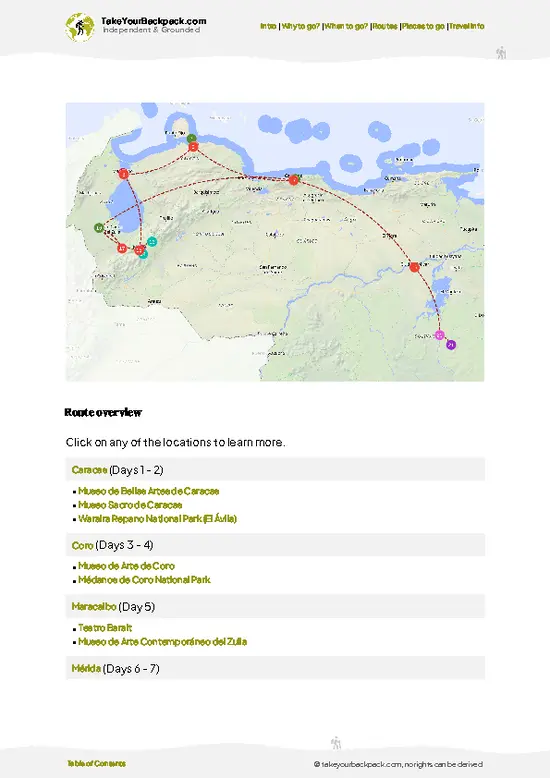
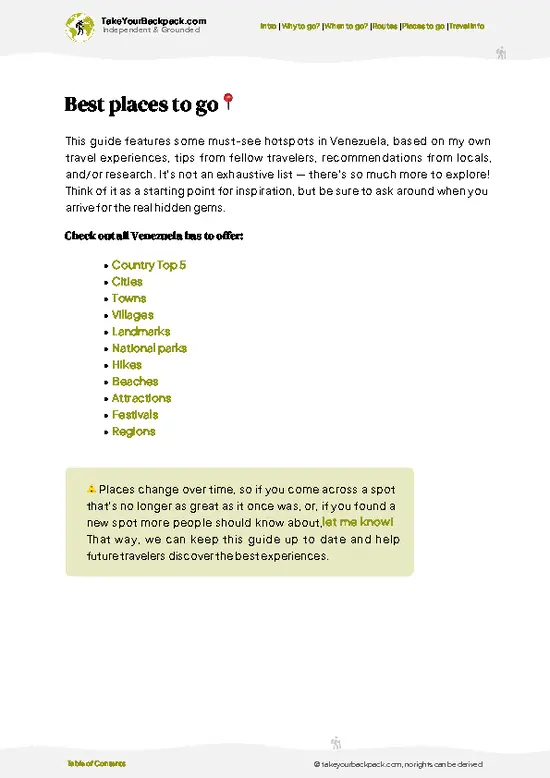
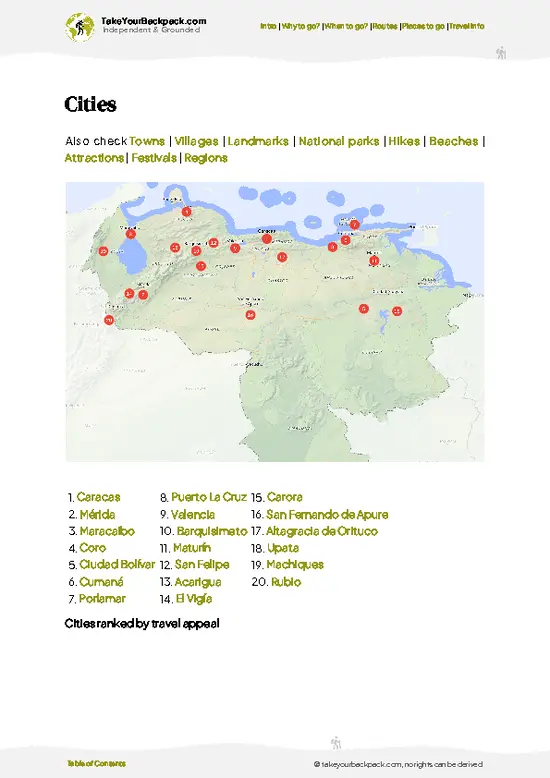
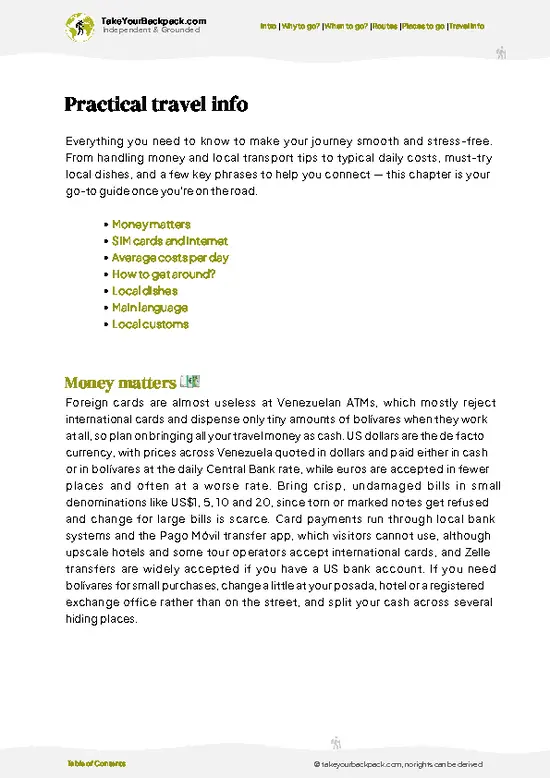
example page 0 from our offline Travel Guide for Venezuela
example page 1 from our offline Travel Guide for Venezuela
example page 2 from our offline Travel Guide for Venezuela
example page 3 from our offline Travel Guide for Venezuela
example page 4 from our offline Travel Guide for Venezuela
example page 5 from our offline Travel Guide for Venezuela
example page 6 from our offline Travel Guide for Venezuela
example page 7 from our offline Travel Guide for Venezuela
The digital guide (290 pages) contains:
✅ 91 highlights, ranked by travel appeal
✅ Optimized 5, 10 & 15-day travel routes
✅ Cities, national parks, landmarks, beaches
✅ How to get around
✅ Offline-friendly for travel without Wi-Fi
👉 Click to see all 30+ guide features

📅 Plan smarter in minutes, not weeks
✅ Month by month travel advice
✅ Festivals & national holidays
✅ Budget expectations

🗺️ Go to the right places, skip the overrated ones
✅ Honest pros & cons of destinations
✅ Top hikes, parks & viewpoints
✅ Lesser-known places most travelers miss
✅ Clear “worth it vs skip it” guidance

🛏️ Travel smoothly without rookie mistakes
✅ Best areas to stay
✅ Transport systems explained simply
✅ Common scams & safety advice
✅ SIM cards, money & practical tips

🌍 Understand the country, not just visit it
✅ Culture & traditions
✅ 52 Essential phrases & customs
✅ Festivals worth planning around
✅ Traveler-friendly historical context
✅ Insights that make places more meaningful

📱 Built for real travel conditions
✅ Fully downloadable PDF
✅ Works completely offline
✅ Optimized for phone use
✅ Useful in remote areas & buses
✅ Everything in one place
Stop searching, start planning
Get instant access to your full guide. 30‑day money-back guarantee.
+ Add another guide for just

By proceeding you agree to our terms.
Sent to your inbox immediately after payment • 100% Secure Checkout
Best Backpacking Travel Advisor 2025 tourism awardBest Backpacking
Travel Advisor
2025
What others say about Take Your Backpack Guides:
⭐⭐⭐⭐⭐
Fantastic, amazing amount of information!
⭐⭐⭐⭐⭐
My goodness this is amazing, it's what I've been looking for hats off too you!
⭐⭐⭐⭐⭐
I think this is absolutely BRILLIANT
⭐⭐⭐⭐
Very complete and informative. It's still missing places, but I gotta to commend you
⭐⭐⭐⭐⭐
This is truly amazing, thank you, can't wait to explore it with my kids!
⭐⭐⭐⭐⭐
Awesome resource, thank you!
⭐⭐⭐⭐⭐
This is amazing! Can't wait to explore the ones I haven't seen
⭐⭐⭐⭐
I love this! Well done, great idea.
⭐⭐⭐⭐⭐
Thanks for taking the time to make this gem!
⭐⭐⭐⭐⭐
This might be the best website I've ever seen.
⭐⭐⭐⭐⭐
Congratulations, and thank you so much for your work; it's incredibly valuable.
⭐⭐⭐⭐
In all seriousness I think you did a great job pointing out the important spots
⭐⭐⭐⭐⭐
10/10 very good
⭐⭐⭐⭐⭐
As someone who's only just starting to visit regularly this is awesome, thank you.
⭐⭐⭐⭐
Thank you very much! I'm going to visit my dad, it's going to be very useful!
⭐⭐⭐⭐⭐
This is really cool! We'll be travelling for the first time and this definitely come in handy.
⭐⭐⭐⭐⭐
You are now our minister of culture, congratulations 👨‍💼
⭐⭐⭐⭐⭐
Just wanted to tell you that this is a pearl! Going to follow your recommendations.
⭐⭐⭐⭐⭐
This is so cool. I'll definitely be using the resource for my travels soon.
⭐⭐⭐⭐⭐
This is very impressive! Good work.
⭐⭐⭐⭐⭐
This is an amazing and informative site. Very well done!

🛏️ Where to stay?Best Places to Stay in Venezuela

Backpacking Venezuela means sleeping mostly in family-run posadas rather than dorm hostels, with private doubles typically around US$15 to 40 a night and only a handful of true dorms, mostly in the Andes and on the coast. In Caracas, Chacao, Altamira and Los Palos Grandes have the most options plus the city’s safest streets, walkable cafés and its best nightlife, though prices run higher and the historic center is a metro ride away. Mérida has the cheapest, most traveler-friendly posadas, clustered around the center near Plaza Bolívar close to tour agencies and the cable car, while beach towns like Choroní and the islands of Los Roques offer quiet posadas with little nightlife, and Los Roques … read more 👉
Backpacking Venezuela means sleeping mostly in family-run posadas rather than dorm hostels, with private doubles typically around US$15 to 40 a night and only a handful of true dorms, mostly in the Andes and on the coast. In Caracas, Chacao, Altamira and Los Palos Grandes have the most options plus the city’s safest streets, walkable cafés and its best nightlife, though prices run higher and the historic center is a metro ride away. Mérida has the cheapest, most traveler-friendly posadas, clustered around the center near Plaza Bolívar close to tour agencies and the cable car, while beach towns like Choroní and the islands of Los Roques offer quiet posadas with little nightlife, and Los Roques costs far more.

If you enjoy meeting fellow travelers, consider choosing hostels with high ratings for atmosphere. On the other hand, if you prefer having your own space, a hotel might be a better option.

VenezuelaExplore Venezuela

👋 Meet the founderWho’s Behind Take Your Backpack?

Johan, backpacker and founder of TakeYourBackpackHi, I’m Johan (Netherlands 🇳🇱), the creator of TakeYourBackpack. Over the past 3 decades, I’ve backpacked through 90+ countries across six continents, gaining extensive experience with independent travel, long-term trips, and overland routes.

This site is built on a combination of firsthand travel experience and carefully curated insights from other backpackers. Many guides are based on places I’ve personally visited, while others bring together tips, observations, and practical advice shared by trusted travelers I’ve met along the way.

The goal is to provide realistic, experience-driven guidance — not generic itineraries — so you can explore destinations with better context, clearer expectations, and more confidence.