×

Zimbabwe🇿🇼 | festivalsChimanimani Arts Festival
mountain setting, community theatre, local music acts | things to do and best time to go

Explore MutokoExplore HIFA

Backpacking in Chimanimani Arts
🌟 Highlightfestival ranked #5
By Johan Kruseman 🇳🇱 | Updated April 19, 2026

Here’s the trick nobody tells you: if you arrive early at the Chimanimani Arts Festival, you can actually camp right on the edge of the action—no scrambling for a spot, no last-minute price hikes, just you, your tent, and the pulse of the mountains. Chimanimani sits in Zimbabwe’s eastern highlands, a stone’s throw from the Mozambique border, where mist clings to granite peaks and the air tastes like rain. The festival itself is a kinetic surge of Zimbabwean and regional music—think mbira, reggae, Afro-jazz, and the kind of late-night drum circles that pull you in whether you planned to dance or not. The crowd is a wild mix: local families, Harare artists, backpackers with battered boots, and a few old-school hippies who never left. It’s raw, communal, and gloriously unpredictable—three days of music, poetry, and art installations that feel more like a shared adventure than a packaged event. If you want glossy, skip it. If you want real, this is your ticket.

Discover everything you want to know in the 📖 Zimbabwe Travel Guide.
Loading the map 🌍
CLICK TO FILTER
city
town
unique site
national park
hike
beach
attraction
festival
region
SHOW COUNTRY‘S BESTSHOW ALL

✨ Why go?
Ranked #5 festival in Zimbabwe
Reasons people choose to celebrate the here

Backpackers flock to the Chimanimani Arts Festival in Zimbabwe for a reason: it’s a cultural explosion that transforms the landscape into a vibrant hub of social energy. This isn’t just a festival; it’s a temporary community where you can connect with locals and fellow travelers alike, sharing stories and laughter over traditional music and art.

The festival offers a unique chance for cultural immersion that’s hard to find elsewhere. You’ll experience authentic Zimbabwean culture while enjoying performances that resonate with the soul of the region. Plus, it’s surprisingly affordable compared to similar events around the globe, allowing you to stretch your budget without sacrificing experience.

Planning your route around the festival means you’re not just hitting a destination; you’re … read more 👉
Backpackers flock to the Chimanimani Arts Festival in Zimbabwe for a reason: it’s a cultural explosion that transforms the landscape into a vibrant hub of social energy. This isn’t just a festival; it’s a temporary community where you can connect with locals and fellow travelers alike, sharing stories and laughter over traditional music and art.

The festival offers a unique chance for cultural immersion that’s hard to find elsewhere. You’ll experience authentic Zimbabwean culture while enjoying performances that resonate with the soul of the region. Plus, it’s surprisingly affordable compared to similar events around the globe, allowing you to stretch your budget without sacrificing experience.

Planning your route around the festival means you’re not just hitting a destination; you’re weaving it into a larger travel narrative. It’s a perfect pit stop on a journey through Zimbabwe’s stunning landscapes, ensuring your adventure is as rich as the experiences you gather. Don’t miss this chance to fuel your travels with unforgettable moments that matter.
Get the complete Travel Guide for Zimbabwe
Everything organized for offline planning — routes, highlights, costs & tips

See what’s inside 👉

Get the Travel Guide -

💡 HighlightsPlaces and moments you shouldn't skip

  • Chimanimani Mountains and site-specific outdoor art — The festival is set against those jagged, misty peaks, so a big part of the draw is art that actually uses the landscape: trails with pop-up sculptures, installations tucked into gullies, or sunrise performances on ridgelines. It turns a simple walk into an art hunt and gives you views you won’t forget. Great for cheap thrills—pack a daypack and go.
  • Intimate live music and campfire sessions — Instead of giant stages, expect small, close-up sets where traditional mbira, chimurenga, folk and experimental players mix. At night the programmed gigs often spill into informal jam circles around fires. It’s raw, communal and sometimes spine-tingling; a lot of the best moments happen between official shows. (Personal favorite.)
  • Hands-on community
read more 👉
  • Chimanimani Mountains and site-specific outdoor art — The festival is set against those jagged, misty peaks, so a big part of the draw is art that actually uses the landscape: trails with pop-up sculptures, installations tucked into gullies, or sunrise performances on ridgelines. It turns a simple walk into an art hunt and gives you views you won’t forget. Great for cheap thrills—pack a daypack and go.
  • Intimate live music and campfire sessions — Instead of giant stages, expect small, close-up sets where traditional mbira, chimurenga, folk and experimental players mix. At night the programmed gigs often spill into informal jam circles around fires. It’s raw, communal and sometimes spine-tingling; a lot of the best moments happen between official shows. (Personal favorite.)
  • Hands-on community workshops — The festival emphasizes participation: printmaking, beadwork, storytelling, dance classes, even community mural days. These are run by local artists and are usually low-cost or pay-what-you-can. You leave with something you made and a better feel for local craft traditions.
  • Local visual art, open studios and pop-up galleries — Galleries may be small but packed with personality, from painting and sculpture to photography documenting mountain life. Many artists open their studios or do live demos, so you can ask questions, see techniques, and buy directly—supporting creators without the middleman markup.
  • Food stalls, craft market and village cultural exchange — The market is where the festival becomes a real village: cheap, honest street food, locally made crafts, and elders telling stories. It’s practical and social—perfect for budget travelers who want flavorful meals, affordable souvenirs, and real conversations with locals.
Spotted a mistake or missing something? Contact us.

🌤️ When to go?When is the celebration of Chimanimani Arts Festival?


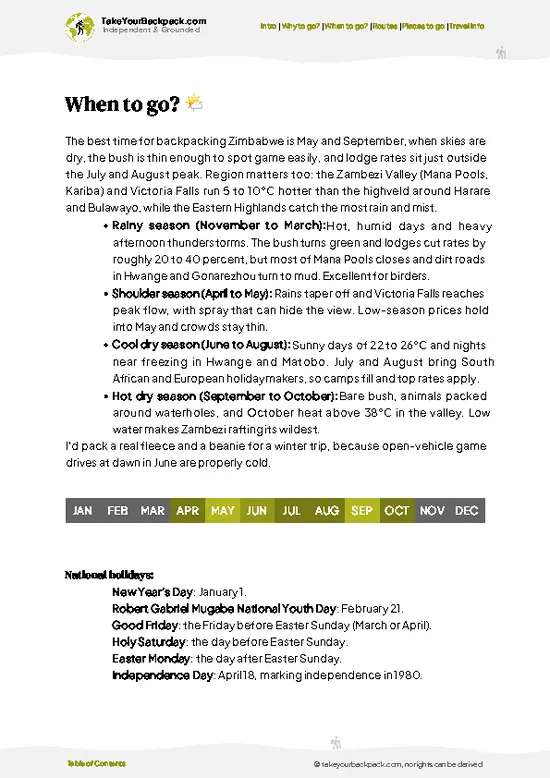
  • Topic: Weather – The Chimanimani Arts Festival thrives in Zimbabwe’s dry season, from May to October. Expect crisp, clear days with temperatures ranging from 15°C to 25°C (59°F to 77°F). Avoid the wet season (November to April), when heavy rains can turn trails into mud traps and dampen outdoor events.

  • Topic: Temperature – Daytime warmth is perfect for hiking and open-air performances, but nights can dip to 5°C (41°F). Pack layers to stay comfortable from sunup to sundown.

  • Topic: Daylight Hours – With roughly 11 to 12 hours of daylight during the festival months, you get ample time to explore the mountains and soak in the arts without rushing.

  • Topic: Crowds – The festival draws a modest crowd, but visiting early in the dry season means fewer tourists and more breathing room on trails
read more 👉

  • Topic: Weather – The Chimanimani Arts Festival thrives in Zimbabwe’s dry season, from May to October. Expect crisp, clear days with temperatures ranging from 15°C to 25°C (59°F to 77°F). Avoid the wet season (November to April), when heavy rains can turn trails into mud traps and dampen outdoor events.

  • Topic: Temperature – Daytime warmth is perfect for hiking and open-air performances, but nights can dip to 5°C (41°F). Pack layers to stay comfortable from sunup to sundown.

  • Topic: Daylight Hours – With roughly 11 to 12 hours of daylight during the festival months, you get ample time to explore the mountains and soak in the arts without rushing.

  • Topic: Crowds – The festival draws a modest crowd, but visiting early in the dry season means fewer tourists and more breathing room on trails and at events.

  • Topic: Seasonal Activities – Dry months open up hiking, birdwatching, and outdoor workshops. The festival’s timing aligns with peak activity, so you won’t miss out on the best local experiences.

  • Topic: Price Fluctuations – Accommodation and transport costs spike during the dry season’s peak (July-August). Booking early or aiming for shoulder months (May, September) can save you cash without sacrificing weather quality.


Pro-tip: Time your visit for late May or early September to dodge crowds and price hikes while still catching perfect weather and full festival energy.


source: climatestotravel.comJANJanuary: not recommended for travelingFEBFebruary: not recommended for travelingMARMarch: not recommended for travelingAPRApril: not recommended for travelingMAYMay: excellent for travelingJUNJune: not recommended for travelingJULJuly: not recommended for travelingAUGAugust: not recommended for travelingSEPSeptember: not recommended for travelingOCTOctober: not recommended for travelingNOVNovember: not recommended for travelingDECDecember: not recommended for traveling

✈️ The backpacker research shortcutZimbabwe Travel Guide

An offline-friendly backpacking guide with optimized travel routes, ranked highlights, transport advice, and the best areas to stay.
example page 0 from our offline Travel Guide for Zimbabweexample page 1 from our offline Travel Guide for Zimbabweexample page 2 from our offline Travel Guide for Zimbabweexample page 3 from our offline Travel Guide for Zimbabweexample page 4 from our offline Travel Guide for Zimbabweexample page 5 from our offline Travel Guide for Zimbabwe
The digital guide (307 pages) contains:
90 highlights, ranked by travel appeal
Optimized 5, 10 & 15-day travel routes
Best neighborhoods to stay
How to get around
Offline-friendly for travel without Wi-Fi
👉 See all 30+ guide features

📅 Plan smarter in minutes, not weeks
Month by month travel advice
Festivals & national holidays
Budget expectations

🗺️ Go to the right places, skip the overrated ones
Honest pros & cons of destinations
Top hikes, parks & viewpoints
Lesser-known places most travelers miss
Clear “worth it vs skip it” guidance

🛏️ Travel smoothly without rookie mistakes
Best areas to stay
Transport systems explained simply
Common scams & safety advice
SIM cards, money & practical tips

🌍 Understand the country, not just visit it
Culture & traditions
52 Essential phrases & customs
Festivals worth planning around
Traveler-friendly historical context
Insights that make places more meaningful

📱 Built for real travel conditions
Fully downloadable PDF
Works completely offline
Optimized for phone use
Useful in remote areas & buses
Everything in one place
Save weeks of stressful planning
Get instant access to the full guide directly. 30-day money-back guarantee.


Sent to your inbox immediately after payment • 100% Secure Checkout
Best Backpacking Travel Advisor 2025 tourism awardBest Backpacking
Travel Advisor
2025
What others say about Take Your Backpack Guides:
⭐⭐⭐⭐⭐
Fantastic, amazing amount of information!
⭐⭐⭐⭐⭐
My goodness this is amazing, it's what I've been looking for hats off too you!
⭐⭐⭐⭐⭐
I think this is absolutely BRILLIANT
⭐⭐⭐⭐
Very complete and informative. It's still missing places, but I gotta to commend you
⭐⭐⭐⭐⭐
This is truly amazing, thank you, can't wait to explore it with my kids!
⭐⭐⭐⭐⭐
Awesome resource, thank you!
⭐⭐⭐⭐⭐
This is amazing! Can't wait to explore the ones I haven't seen
⭐⭐⭐⭐
I love this! Well done, great idea.
⭐⭐⭐⭐⭐
Thanks for taking the time to make this gem!
⭐⭐⭐⭐⭐
This might be the best website I've ever seen.
⭐⭐⭐⭐⭐
Congratulations, and thank you so much for your work; it's incredibly valuable.
⭐⭐⭐⭐
In all seriousness I think you did a great job pointing out the important spots
⭐⭐⭐⭐⭐
10/10 very good
⭐⭐⭐⭐⭐
As someone who's only just starting to visit regularly this is awesome, thank you.
⭐⭐⭐⭐
Thank you very much! I'm going to visit my dad, it's going to be very useful!
⭐⭐⭐⭐⭐
This is really cool! We'll be travelling for the first time and this definitely come in handy.
⭐⭐⭐⭐⭐
You are now our minister of culture, congratulations 👨‍💼
⭐⭐⭐⭐⭐
Just wanted to tell you that this is a pearl! Going to follow your recommendations.
⭐⭐⭐⭐⭐
This is so cool. I'll definitely be using the resource for my travels soon.
⭐⭐⭐⭐⭐
This is very impressive! Good work.
⭐⭐⭐⭐⭐
This is an amazing and informative site. Very well done!

🛏️ Where to stay?Choosing the right base

When you’re gearing up for the Chimanimani Arts Festival, your choice of stay can make or break your experience. Head to the heart of Chimanimani village. It’s buzzing with energy, and you’ll find fellow travelers eager to share stories. The local vibe is welcoming, making it easy to connect with others.

Consider the areas near the festival grounds. You’ll find basic lodgings that keep your budget intact while offering a social atmosphere. Look for spots with communal spaces; they’re perfect for swapping tips or planning your next adventure.

Safety is key. Stick to well-trodden paths and areas … read more 👉
When you’re gearing up for the Chimanimani Arts Festival, your choice of stay can make or break your experience. Head to the heart of Chimanimani village. It’s buzzing with energy, and you’ll find fellow travelers eager to share stories. The local vibe is welcoming, making it easy to connect with others.

Consider the areas near the festival grounds. You’ll find basic lodgings that keep your budget intact while offering a social atmosphere. Look for spots with communal spaces; they’re perfect for swapping tips or planning your next adventure.

Safety is key. Stick to well-trodden paths and areas frequented by backpackers. The village is generally safe, but staying close to the festival means you can easily return after a night of music and art without worrying about getting lost.

Don’t overlook the outskirts of Chimanimani. Some hidden spots offer a more tranquil experience, with stunning views of the mountains. Just ensure you have reliable transport options to get back to the festival. This balance of social energy and peaceful retreat will keep your spirits high and your budget low.

👛 Costs (as of 15 June 2025)Travel costs and budget guide for Chimanimani Arts

The Chimanimani Arts Festival in Zimbabwe is a vibrant celebration, but navigating the costs can be tricky. Here’s a breakdown to keep your budget intact while you soak in the creativity.
  • Festival Tickets: Expect to pay around $10 to $30 for a day pass. Prices can vary based on the lineup and special events. Grab your tickets early to avoid last-minute price hikes.
  • Accommodation: Options range from budget hostels at about $15 per night to mid-range lodges costing $50 to $100. If you want a unique experience, consider camping, which can be as low as $5. Book ahead, especially during the festival.
  • Local Transport: Budget around $5 to $15 for public transport or shared taxis to get around. If you’re feeling adventurous, hitchhiking is common and can save you cash, but always prioritize
read more 👉
The Chimanimani Arts Festival in Zimbabwe is a vibrant celebration, but navigating the costs can be tricky. Here’s a breakdown to keep your budget intact while you soak in the creativity.
  • Festival Tickets: Expect to pay around $10 to $30 for a day pass. Prices can vary based on the lineup and special events. Grab your tickets early to avoid last-minute price hikes.
  • Accommodation: Options range from budget hostels at about $15 per night to mid-range lodges costing $50 to $100. If you want a unique experience, consider camping, which can be as low as $5. Book ahead, especially during the festival.
  • Local Transport: Budget around $5 to $15 for public transport or shared taxis to get around. If you’re feeling adventurous, hitchhiking is common and can save you cash, but always prioritize safety.
  • Food & Drinks: Street food is your friend here. You can feast on local dishes for $2 to $5 per meal. Restaurants will set you back about $10 to $20 for a decent meal. Don’t forget to try the local brews, usually around $2 to $4.
  • Miscellaneous Expenses: Set aside $20 to $50 for souvenirs, tips, or unexpected costs. This cushion will help you enjoy spontaneous experiences without stress.

Keep these figures in mind, and you’ll be ready to dive into the festival without breaking the bank.


source: zimbabwetourism.net
⚠️ Prices can change and everyone travels differently, so take this as a rough guide. Hope it helps you plan your adventure!

🍲 FoodWhat to Eat & Drink

At the Chimanimani Arts Festival, food and drinks are as much a part of the experience as the art itself. You’ll find stalls brimming with local specialties like sadza, a staple maize dish that pairs perfectly with savory stews. Don’t miss the nyama choma—grilled meat that’s smoky and tender, often served with a side of fresh vegetables.

For drinks, sample the local brews. The Chibuku shake shake, a traditional sorghum beer, is a must-try. It’s thick, slightly sour, and a real crowd-pleaser. If you prefer something lighter, grab a ginger beer; it’s refreshing and packs a punch.

When diving into the festival food scene, embrace the sharing culture. It’s common to swap bites with fellow festival-goers, so don’t hesitate to ask for a taste. Lines can get long, especially for the most popular … read more 👉
At the Chimanimani Arts Festival, food and drinks are as much a part of the experience as the art itself. You’ll find stalls brimming with local specialties like sadza, a staple maize dish that pairs perfectly with savory stews. Don’t miss the nyama choma—grilled meat that’s smoky and tender, often served with a side of fresh vegetables.

For drinks, sample the local brews. The Chibuku shake shake, a traditional sorghum beer, is a must-try. It’s thick, slightly sour, and a real crowd-pleaser. If you prefer something lighter, grab a ginger beer; it’s refreshing and packs a punch.

When diving into the festival food scene, embrace the sharing culture. It’s common to swap bites with fellow festival-goers, so don’t hesitate to ask for a taste. Lines can get long, especially for the most popular stalls, so plan accordingly. Bring cash; while some vendors may accept cards, many rely on cash transactions. Serving sizes can vary, so be prepared to adjust your order based on your appetite.

This festival isn’t just about eating; it’s about connecting with the vibrant community around you. Enjoy every bite!

Other Zimbabwean festivals near Chimanimani Arts

Explore more nearby:


👉 Discover all festivals

Or checkout all Zimbabwe has to offer (think cities, towns, villages, national parks, hikes, beaches, festivals)
Country photo of Zimbabwe

We 💚 feedbackParting advice and final tips

Chimanimani is a pulse of creativity, where local artists ignite the landscape with their passion. You’ll feel that energy in every beat of the festival. But be ready for the rugged terrain; it can be a workout. Bring sturdy shoes and a sense of adventure. Embrace the challenge, and you’ll find the real magic in the connections you make and the stories you gather along the way.

✈️ When did I visit Zimbabwe?
I have backpacked Zimbabwe all the way back in 2001.

✍️ Help improve this page!
The information on this page is based on my own backpacking experience in Zimbabwe, supplemented with up-to-date research and feedback from other travelers. Travel details can change, so if you notice anything outdated or incomplete, feel free to let me know.


🙋‍♂️ Give feedback

👋 Meet the founderWho’s Behind Take Your Backpack?

Johan, backpacker and founder of TakeYourBackpackHi, I’m Johan (Netherlands 🇳🇱), the creator of TakeYourBackpack. Over the past decade, I’ve backpacked through 80+ countries across six continents, gaining extensive experience with independent travel, long-term trips, and overland routes.

This site is built on a combination of firsthand travel experience and carefully curated insights from other backpackers. Many guides are based on places I’ve personally visited, while others bring together tips, observations, and practical advice shared by trusted travelers I’ve met along the way.

The goal is to provide realistic, experience-driven guidance — not generic itineraries — so you can explore destinations with better context, clearer expectations, and more confidence.

Get Full Country Guide |
Instant download • 90 highlights • Full Offline guide