×

American Samoa🇦🇸 | best villagesDiscover the 5 Best villages Across American Samoa

Villages in American Samoa are fa’a Samoa communities strung along coastal roads, each with open-sided fales, a white church and a village council that sets the rules. Tutuila is easy and cheap to reach by bus, while Manu’a is remote and quiet. Independent travelers get the best welcome by arriving mid-morning, on foot or by aiga bus, and asking first.

By Johan Kruseman 🇳🇱 | Updated October 17, 2026
Explore the best landmarks in American Samoa

Why go?Key Factors That Shape the Experience

American Samoa keeps fa’a Samoa, the traditional way of life, more intact than most places with a US flag. Land is communally owned and run by matai (chiefs), so villages stay compact and tightly governed instead of spreading into suburbs. Steep volcanic ridges push settlement onto narrow coastal strips, which is why nearly everything sits along one road.

Before you choose it, know the ground rules. Many villages hold a Sa, a sacred evening prayer around dusk when you should stop, sit and keep quiet. Sundays are for church and family lunches, so shops close and swimming is often discouraged. Tourism infrastructure is thin: few guesthouses, little signage, no beach resorts. The reward is real hospitality, where a polite request gets you a seat in a fale and a conversation.
Why These Made the Cut
The list of best villages in American Samoa is created based on authenticity, scenic beauty, community spirit, traditions, and overall character. If you feel a village is missing in this list, please let us know.

When to go?Best Time to Visit American Samoa for villages

Best months and weather: May to September is best for villages in American Samoa, because it is the drier season with lower humidity and less road-flooding. Days sit around 28 to 30°C (82 to 86°F), and monthly rainfall drops to roughly 100 to 200 mm, against 300 mm or more in the wet months.
Shoulder seasons and timing tips: October to November and April are good shoulder months, with fewer crowds and slightly warmer, stickier air. December to March is cyclone season, with heavy downpours and occasional flight disruptions, though prices rarely change much. Mid-year brings Flag Day in early April and Teuila-style events in the Samoan region, but American Samoa’s crowds stay small year-round. Visit Manu’a in the dry months, since small planes and boats cancel readily in rough weather. Keep Sundays … read more 👉
Best months and weather: May to September is best for villages in American Samoa, because it is the drier season with lower humidity and less road-flooding. Days sit around 28 to 30°C (82 to 86°F), and monthly rainfall drops to roughly 100 to 200 mm, against 300 mm or more in the wet months.
Shoulder seasons and timing tips: October to November and April are good shoulder months, with fewer crowds and slightly warmer, stickier air. December to March is cyclone season, with heavy downpours and occasional flight disruptions, though prices rarely change much. Mid-year brings Flag Day in early April and Teuila-style events in the Samoan region, but American Samoa’s crowds stay small year-round. Visit Manu’a in the dry months, since small planes and boats cancel readily in rough weather. Keep Sundays free, since shops and transport mostly pause.

village hoppingOptimizing Your Multi-Stop Itinerary

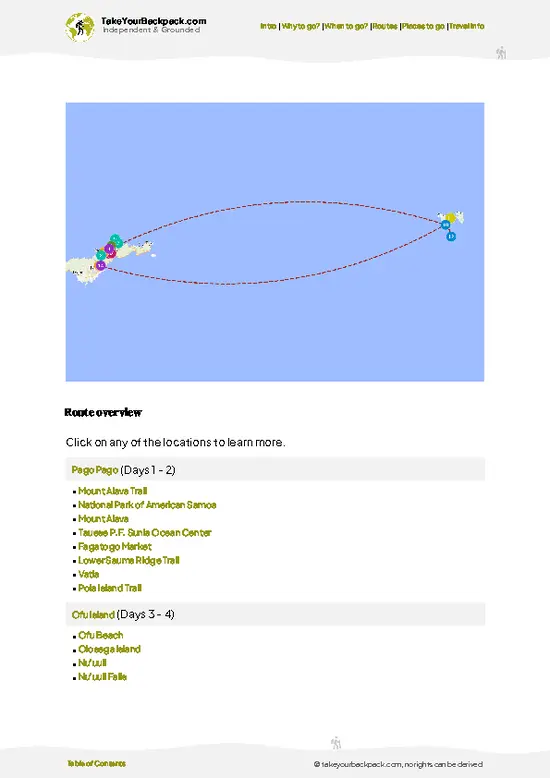
How many days to plan: A trip linking several villages in American Samoa works best over 4 to 7 days on Tutuila, plus 3 to 4 more if you add Manu’a. Group the island by coast: the east and west ends are each a half day apart, with Pago Pago harbor as your hub.
Pacing and transport: Allow 2 to 3 hours per stop, including a chat with the host. Drives between ends of the island run about 1 to 1.5 hours, and aiga buses are slow, irregular and thin on Sundays. Travel east to west or the reverse, but stay in one base for several nights instead of moving daily. The classic mistake is cramming three villages into one day, which leaves no time for the invitations that make visits worthwhile. Another is relying on buses after mid-afternoon, when they thin out. Rent a car for flexibility, and book Manu’a … read more 👉
How many days to plan: A trip linking several villages in American Samoa works best over 4 to 7 days on Tutuila, plus 3 to 4 more if you add Manu’a. Group the island by coast: the east and west ends are each a half day apart, with Pago Pago harbor as your hub.
Pacing and transport: Allow 2 to 3 hours per stop, including a chat with the host. Drives between ends of the island run about 1 to 1.5 hours, and aiga buses are slow, irregular and thin on Sundays. Travel east to west or the reverse, but stay in one base for several nights instead of moving daily. The classic mistake is cramming three villages into one day, which leaves no time for the invitations that make visits worthwhile. Another is relying on buses after mid-afternoon, when they thin out. Rent a car for flexibility, and book Manu’a flights well ahead, with a buffer day built in.

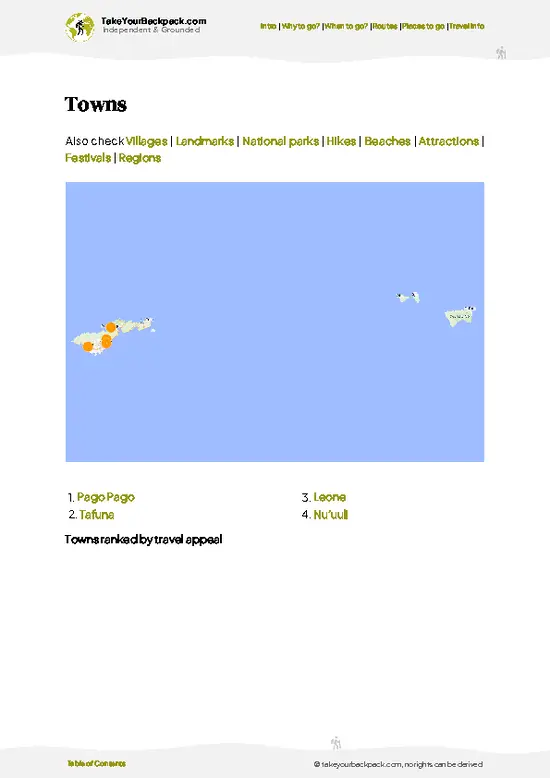
The ListTop villages of American Samoa

1 Vatia

Pola sea stack, north-coast bay, rainforest trail, fruit bats

Drive the winding road north to a sheltered bay facing a sheer rock stack, then climb a muddy forest trail into the park.

2 Aunu’u

Car-free island, red crater lake, quicksand swamp, lava coast

Walk footpaths through taro plots to a rust-tinted lake and a soft-ground swamp, then follow the rocky south shore back.

american-samoa-city-aunuu
© Google | Mark G

3 Fagatogo

Saturday market, harbor front, Samoan museum, ceremonial green

Start early at the market stalls for palusami and oka, then browse tapa cloth and war clubs in the harbor-facing museum.

4 Tula

Eastern headland, first light, reef shelves, Sunday hymns

Reach Matatula Point at dawn to watch surf hit black lava rock, then walk the reef edge at low tide.

5 Amouli

nearby Aunu’u boat landing, fishing boats, channel views, road’s end

Catch the morning crossing to Aunu’u from a small harbor, watching fishermen sort their catch before sunrise light settles on the cliffs across the water.

Loading the map 🌍

Expert viewExpert Commentary on villages

How many to visit: I advise three to five villages in total. That is enough to compare coasts and meet people properly without turning each stop into a quick photo.
Which kind to prioritize: Pick Tutuila’s accessible villages for budget, easy transport and guesthouses. Choose Manu’a’s remote communities if you want quiet and real isolation, accepting limited food, power and cell coverage, plus weather-dependent flights. Slow travelers should lean to the quieter ends; culture seekers should time visits around a Sunday service.
Costs: Budget about US$60 to 110 a day, with guesthouses at US$50 to 90 a night, local meals at US$6 to 15 and aiga buses at US$1 to 3 per ride. A rental car runs roughly US$60 to 100 a day. Villages rarely charge entry, but a small gift or donation of US$5 to 20, or a … read more 👉
How many to visit: I advise three to five villages in total. That is enough to compare coasts and meet people properly without turning each stop into a quick photo.
Which kind to prioritize: Pick Tutuila’s accessible villages for budget, easy transport and guesthouses. Choose Manu’a’s remote communities if you want quiet and real isolation, accepting limited food, power and cell coverage, plus weather-dependent flights. Slow travelers should lean to the quieter ends; culture seekers should time visits around a Sunday service.
Costs: Budget about US$60 to 110 a day, with guesthouses at US$50 to 90 a night, local meals at US$6 to 15 and aiga buses at US$1 to 3 per ride. A rental car runs roughly US$60 to 100 a day. Villages rarely charge entry, but a small gift or donation of US$5 to 20, or a bag of food, is appreciated. Guides for hikes or reef access typically cost US$30 to 80. Manu’a flights are pricier, usually US$150 to 250 round trip.
Cultural rules: Ask permission from the pastor or a chief before swimming, hiking or photographing. Dress modestly, with shoulders and knees covered, and wear a lavalava (wraparound skirt) if offered. Remove shoes before entering a fale and sit cross-legged, never pointing your feet at someone. Stop when the evening Sa begins. Avoid arriving or walking around on Sundays during church hours.
Safety: Crime is low, but stray dogs are common, so carry a stick on walks. Rip currents and sharp reef make swimming risky, so ask locals before you enter the water. Bring cash, since ATMs vanish outside Pago Pago.

✈️ The backpacker research shortcutAmerican Samoa Travel Guide

An offline-friendly backpacking guide with optimized travel routes, ranked highlights, transport advice, and the best areas to stay.
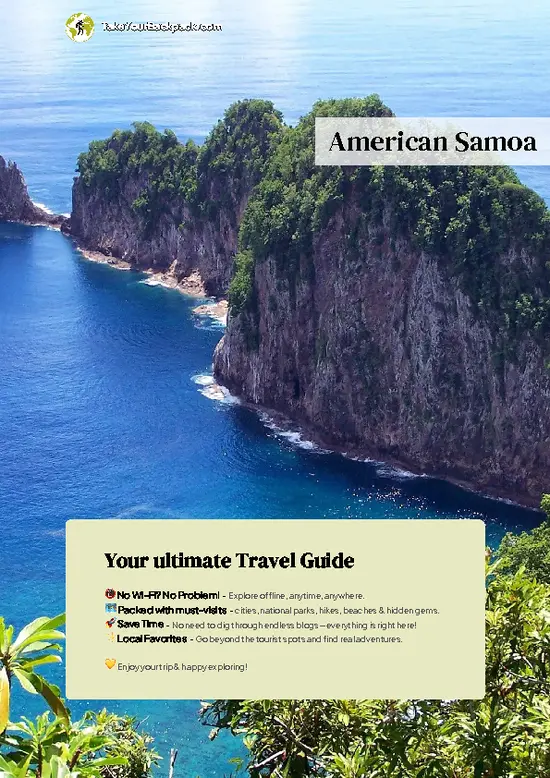
example page 0 from our offline Travel Guide for American Samoa
example page 1 from our offline Travel Guide for American Samoa
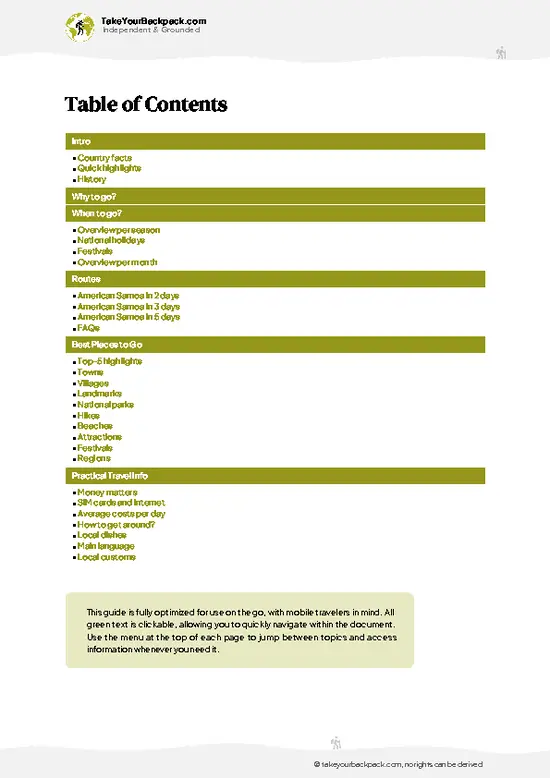
example page 2 from our offline Travel Guide for American Samoa
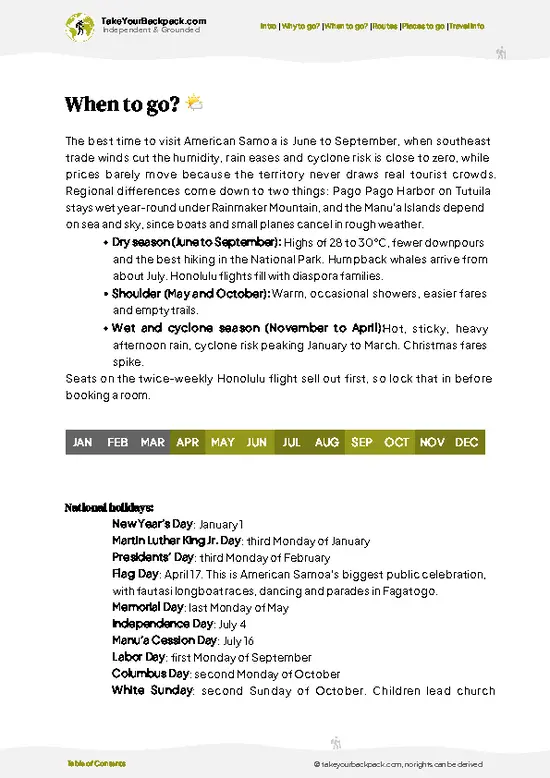
example page 3 from our offline Travel Guide for American Samoa
example page 4 from our offline Travel Guide for American Samoa
example page 5 from our offline Travel Guide for American Samoa
example page 6 from our offline Travel Guide for American Samoa
example page 7 from our offline Travel Guide for American Samoa
The digital guide (141 pages) contains:
✅ 36 highlights, ranked by travel appeal
✅ Optimized 2, 3 & 5-day travel routes
✅ Cities, national parks, landmarks, beaches
✅ How to get around
✅ Offline-friendly for travel without Wi-Fi
👉 Click to see all 30+ guide features

📅 Plan smarter in minutes, not weeks
✅ Month by month travel advice
✅ Festivals & national holidays
✅ Budget expectations

🗺️ Go to the right places, skip the overrated ones
✅ Honest pros & cons of destinations
✅ Top hikes, parks & viewpoints
✅ Lesser-known places most travelers miss
✅ Clear “worth it vs skip it” guidance

🛏️ Travel smoothly without rookie mistakes
✅ Best areas to stay
✅ Transport systems explained simply
✅ Common scams & safety advice
✅ SIM cards, money & practical tips

🌍 Understand the country, not just visit it
✅ Culture & traditions
✅ 52 Essential phrases & customs
✅ Festivals worth planning around
✅ Traveler-friendly historical context
✅ Insights that make places more meaningful

📱 Built for real travel conditions
✅ Fully downloadable PDF
✅ Works completely offline
✅ Optimized for phone use
✅ Useful in remote areas & buses
✅ Everything in one place
Stop searching, start planning
Get instant access to your full guide. 30‑day money-back guarantee.
+ Add another guide for just

By proceeding you agree to our terms.
Sent to your inbox immediately after payment • 100% Secure Checkout
Best Backpacking Travel Advisor 2025 tourism awardBest Backpacking
Travel Advisor
2025
What others say about Take Your Backpack Guides:
⭐⭐⭐⭐⭐
Fantastic, amazing amount of information!
⭐⭐⭐⭐⭐
My goodness this is amazing, it's what I've been looking for hats off too you!
⭐⭐⭐⭐⭐
I think this is absolutely BRILLIANT
⭐⭐⭐⭐
Very complete and informative. It's still missing places, but I gotta to commend you
⭐⭐⭐⭐⭐
This is truly amazing, thank you, can't wait to explore it with my kids!
⭐⭐⭐⭐⭐
Awesome resource, thank you!
⭐⭐⭐⭐⭐
This is amazing! Can't wait to explore the ones I haven't seen
⭐⭐⭐⭐
I love this! Well done, great idea.
⭐⭐⭐⭐⭐
Thanks for taking the time to make this gem!
⭐⭐⭐⭐⭐
This might be the best website I've ever seen.
⭐⭐⭐⭐⭐
Congratulations, and thank you so much for your work; it's incredibly valuable.
⭐⭐⭐⭐
In all seriousness I think you did a great job pointing out the important spots
⭐⭐⭐⭐⭐
10/10 very good
⭐⭐⭐⭐⭐
As someone who's only just starting to visit regularly this is awesome, thank you.
⭐⭐⭐⭐
Thank you very much! I'm going to visit my dad, it's going to be very useful!
⭐⭐⭐⭐⭐
This is really cool! We'll be travelling for the first time and this definitely come in handy.
⭐⭐⭐⭐⭐
You are now our minister of culture, congratulations 👨‍💼
⭐⭐⭐⭐⭐
Just wanted to tell you that this is a pearl! Going to follow your recommendations.
⭐⭐⭐⭐⭐
This is so cool. I'll definitely be using the resource for my travels soon.
⭐⭐⭐⭐⭐
This is very impressive! Good work.
⭐⭐⭐⭐⭐
This is an amazing and informative site. Very well done!

🛏️ Where to stay?Best Places to Stay in American Samoa

American Samoa has no true hostels, so budget travelers rely on small family-run guesthouses, motels and private rentals, with simple rooms typically running US$80 to 150 a night. Most options cluster around the harbor at Pago Pago, Fagatogo and Utulei, which keeps you close to the harbor-side restaurants, the market bus terminal and the trailheads toward the national park, though it is the busiest and noisiest stretch of Tutuila and nightlife amounts to a few bars and hotel lounges. The flatter Tafuna and Nu’uuli area near the airport has more supermarkets and casual eateries plus a quieter residential feel, while the Manu’a Islands offer only a handful of very basic guesthouses that you should … read more 👉
American Samoa has no true hostels, so budget travelers rely on small family-run guesthouses, motels and private rentals, with simple rooms typically running US$80 to 150 a night. Most options cluster around the harbor at Pago Pago, Fagatogo and Utulei, which keeps you close to the harbor-side restaurants, the market bus terminal and the trailheads toward the national park, though it is the busiest and noisiest stretch of Tutuila and nightlife amounts to a few bars and hotel lounges. The flatter Tafuna and Nu’uuli area near the airport has more supermarkets and casual eateries plus a quieter residential feel, while the Manu’a Islands offer only a handful of very basic guesthouses that you should book well before flying over.

If you enjoy meeting fellow travelers, consider choosing hostels with high ratings for atmosphere. On the other hand, if you prefer having your own space, a hotel might be a better option.

American SamoaExplore American Samoa

👋 Meet the founderWho’s Behind Take Your Backpack?

Johan, backpacker and founder of TakeYourBackpackHi, I’m Johan (Netherlands 🇳🇱), the creator of TakeYourBackpack. Over the past 3 decades, I’ve backpacked through 90+ countries across six continents, gaining extensive experience with independent travel, long-term trips, and overland routes.

This site is built on a combination of firsthand travel experience and carefully curated insights from other backpackers. Many guides are based on places I’ve personally visited, while others bring together tips, observations, and practical advice shared by trusted travelers I’ve met along the way.

The goal is to provide realistic, experience-driven guidance — not generic itineraries — so you can explore destinations with better context, clearer expectations, and more confidence.