×

American Samoa🇦🇸 | landmarksNu’uuli FallsVillage taro path, shallow plunge pool, rain-fed cascade, stream hops | things to do and best time to go

Explore Mount AlavaExplore Amouli

Backpacking in Nu’uuli Falls
👌 Worth visitingunique site ranked #4
By Johan Kruseman 🇳🇱 | Updated October 15, 2026

The falls drop into a shallow pool that locals use for a dip, and the water often runs the color of weak tea after rain, because the stream picks up red-brown soil upstream. Nu’uuli Falls sits above Nu’uuli village on the main island of Tutuila in American Samoa, roughly 15 minutes inland from the airport side of the island. Be honest with yourself about the crowds: there aren’t any, though a few village kids and the odd local family may share the pool. Costs are low too, with no ticket booth, only a small courtesy fee some villagers ask for, so carry a few small bills. It’s not a towering cascade, and in a dry spell it thins to a trickle. Go the morning after a good rain, wear sandals with grip, and listen for the stream before you see it. The last stretch is a muddy path through breadfruit and banana trees.

Discover everything you want to know in the 📖 American Samoa Travel Guide.


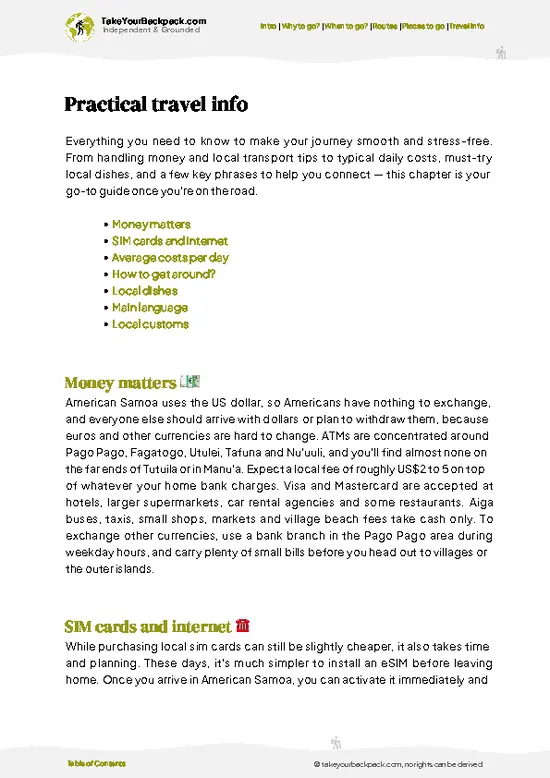
example page 0 from our offline Travel Guide for American Samoa
example page 1 from our offline Travel Guide for American Samoa
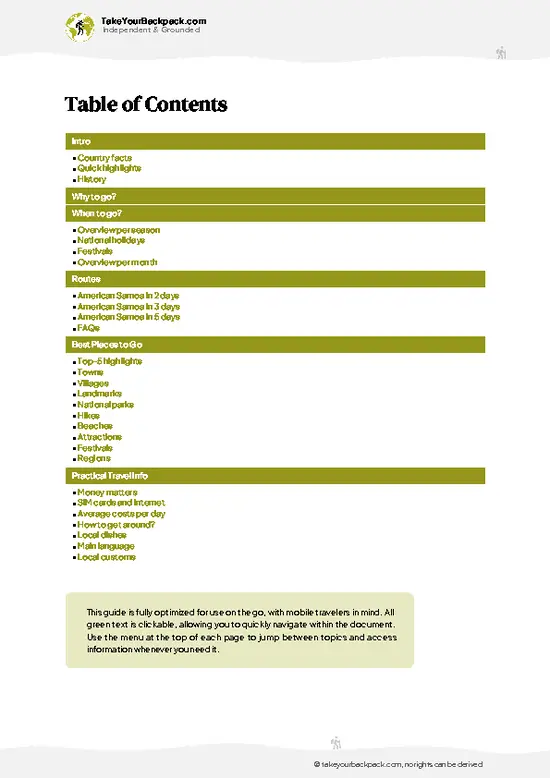
example page 2 from our offline Travel Guide for American Samoa
example page 3 from our offline Travel Guide for American Samoa
example page 4 from our offline Travel Guide for American Samoa
example page 5 from our offline Travel Guide for American Samoa
example page 6 from our offline Travel Guide for American Samoa
example page 7 from our offline Travel Guide for American Samoa
Loading the map 🌍
CLICK TO FILTER
towns
villages
landmarks
national parks
hikes
beaches
attractions
festivals
regions
SHOW COUNTRY’S BESTSHOW ALL

✨ Why go?
Ranked #4 unique site in American Samoa
Why Nu’uuli Falls should be on your travel list

Nu’uuli Falls earns its place because it gives you a village-side waterfall without the logistics of a big hike. You park near homes, walk a short trail through taro plots and banana groves, and reach the pool in under half an hour. For a traveler on an island where most scenery sits behind long drives or steep ridgelines, that is a rare ratio of effort to result.
The other draw is the setting itself. The falls belong to Nu’uuli village, so the walk passes real family land, and a polite greeting and a small contribution open doors that a self-guided tourist stop never would. Locals still swim and wash here, which makes it feel lived in rather than staged.
On a route, it pairs easily with the beaches and the harbor around Pago Pago, since it lies close to the island’s main road. Spend a morning … read more 👉
Nu’uuli Falls earns its place because it gives you a village-side waterfall without the logistics of a big hike. You park near homes, walk a short trail through taro plots and banana groves, and reach the pool in under half an hour. For a traveler on an island where most scenery sits behind long drives or steep ridgelines, that is a rare ratio of effort to result.
The other draw is the setting itself. The falls belong to Nu’uuli village, so the walk passes real family land, and a polite greeting and a small contribution open doors that a self-guided tourist stop never would. Locals still swim and wash here, which makes it feel lived in rather than staged.
On a route, it pairs easily with the beaches and the harbor around Pago Pago, since it lies close to the island’s main road. Spend a morning here, then spend the afternoon on the coast. A swim in fresh water after a hot, salty day is a good reset.

💡 HighlightsPlaces and moments you shouldn't skip

  1. Nu’uuli Falls cascade: The main drop is a modest ribbon of water over dark volcanic rock, best after rain when the flow thickens and the roar carries down the valley.
  2. The plunge pool: A shallow, cool basin at the base where you can wade or sit under the spray. Water clarity changes with the weather, so expect brown tones after storms.
  3. The approach trail: A short, muddy path winding through taro patches, banana palms and breadfruit trees. It is the best look at everyday village agriculture on the island.
  4. Village homes along the way: Open-sided Samoan fales sit beside the track. A friendly wave and a quiet pace go a long way, and the people here are generally glad to point you in the right direction.
  5. Stream crossings: The water crosses the path in spots, and hopping over the stones is half the fun.
… read more 👉
  1. Nu’uuli Falls cascade: The main drop is a modest ribbon of water over dark volcanic rock, best after rain when the flow thickens and the roar carries down the valley.
  2. The plunge pool: A shallow, cool basin at the base where you can wade or sit under the spray. Water clarity changes with the weather, so expect brown tones after storms.
  3. The approach trail: A short, muddy path winding through taro patches, banana palms and breadfruit trees. It is the best look at everyday village agriculture on the island.
  4. Village homes along the way: Open-sided Samoan fales sit beside the track. A friendly wave and a quiet pace go a long way, and the people here are generally glad to point you in the right direction.
  5. Stream crossings: The water crosses the path in spots, and hopping over the stones is half the fun. Sandals with a good grip beat flip-flops here.
  6. Rainforest sounds: Birdsong, running water and the occasional fruit bat overhead make the walk noisy in the best way, especially in the early morning.
  7. Photography spots at the pool: The green canopy framing the dark rock gives lovely light before the midday sun climbs, and a quick-shutter setting helps with the moving water.
Plan on one to two hours for the walk, a swim and a few photos together.
Spotted a mistake or missing something? Contact us.

🌤️ When to go?When to go for the best experience

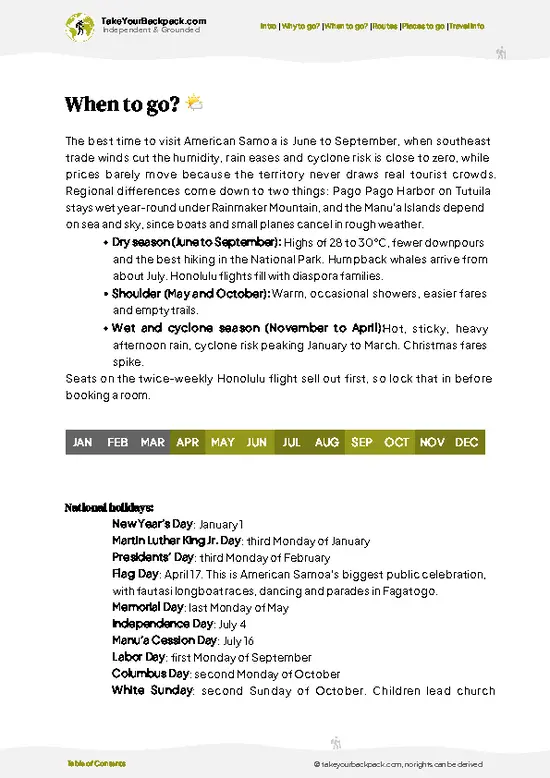
  • Dry Season (May to October): Falls run lower but the trail stays firmer, and the sky is clearer. Days reach 29 to 31°C (84 to 88°F), nights 23 to 25°C (73 to 77°F). Sunrise and sunset shift only about an hour across the year, so expect roughly 11 to 13 hours of light.
  • Wet Season (November to April): Heavy downpours fill the cascade and turn the steep, muddy path slippery. Humidity is thick and temperatures sit near 30 to 32°C (86 to 90°F). Cyclones are possible, mostly January to March.
  • Weekdays vs. Weekends: The pools are quiet on weekdays. Local families and church groups arrive on Saturdays, while Sundays are traditionally quiet and observed as a rest day.
  • Time of Day: Go before 10 a.m. for cooler air and softer light under the canopy. Afternoon showers are common year-round.
  • Prices: Lodging
… read more 👉
  • Dry Season (May to October): Falls run lower but the trail stays firmer, and the sky is clearer. Days reach 29 to 31°C (84 to 88°F), nights 23 to 25°C (73 to 77°F). Sunrise and sunset shift only about an hour across the year, so expect roughly 11 to 13 hours of light.
  • Wet Season (November to April): Heavy downpours fill the cascade and turn the steep, muddy path slippery. Humidity is thick and temperatures sit near 30 to 32°C (86 to 90°F). Cyclones are possible, mostly January to March.
  • Weekdays vs. Weekends: The pools are quiet on weekdays. Local families and church groups arrive on Saturdays, while Sundays are traditionally quiet and observed as a rest day.
  • Time of Day: Go before 10 a.m. for cooler air and softer light under the canopy. Afternoon showers are common year-round.
  • Prices: Lodging and car rental rates barely shift by season, though flights rise around Christmas and Flag Day in April.
Visit after two dry days so the trail is walkable and the water still flows.


source: climatestotravel.comJANJanuary: fair for travelingFEBFebruary: fair for travelingMARMarch: fair for travelingAPRApril: fair for travelingMAYMay: excellent for travelingJUNJune: excellent for travelingJULJuly: excellent for travelingAUGAugust: excellent for travelingSEPSeptember: excellent for travelingOCTOctober: fair for travelingNOVNovember: fair for travelingDECDecember: fair for traveling
american-samoa-unique-site-nuuuli-falls
© Google |

✈️ The backpacker research shortcutAmerican Samoa Travel Guide

An offline-friendly backpacking guide with optimized travel routes, ranked highlights, transport advice, and the best areas to stay.
example page 0 from our offline Travel Guide for American Samoa
example page 1 from our offline Travel Guide for American Samoa
example page 2 from our offline Travel Guide for American Samoa
example page 3 from our offline Travel Guide for American Samoa
example page 4 from our offline Travel Guide for American Samoa
example page 5 from our offline Travel Guide for American Samoa
example page 6 from our offline Travel Guide for American Samoa
example page 7 from our offline Travel Guide for American Samoa
The digital guide (141 pages) contains:
✅ 36 highlights, ranked by travel appeal
✅ Optimized 2, 3 & 5-day travel routes
✅ Cities, national parks, landmarks, beaches
✅ How to get around
✅ Offline-friendly for travel without Wi-Fi
👉 Click to see all 30+ guide features

📅 Plan smarter in minutes, not weeks
✅ Month by month travel advice
✅ Festivals & national holidays
✅ Budget expectations

🗺️ Go to the right places, skip the overrated ones
✅ Honest pros & cons of destinations
✅ Top hikes, parks & viewpoints
✅ Lesser-known places most travelers miss
✅ Clear “worth it vs skip it” guidance

🛏️ Travel smoothly without rookie mistakes
✅ Best areas to stay
✅ Transport systems explained simply
✅ Common scams & safety advice
✅ SIM cards, money & practical tips

🌍 Understand the country, not just visit it
✅ Culture & traditions
✅ 52 Essential phrases & customs
✅ Festivals worth planning around
✅ Traveler-friendly historical context
✅ Insights that make places more meaningful

📱 Built for real travel conditions
✅ Fully downloadable PDF
✅ Works completely offline
✅ Optimized for phone use
✅ Useful in remote areas & buses
✅ Everything in one place
Stop searching, start planning
Get instant access to your full guide. 30‑day money-back guarantee.
+ Add another guide for just

By proceeding you agree to our terms.
Sent to your inbox immediately after payment • 100% Secure Checkout
Best Backpacking Travel Advisor 2025 tourism awardBest Backpacking
Travel Advisor
2025
What others say about Take Your Backpack Guides:
⭐⭐⭐⭐⭐
Fantastic, amazing amount of information!
⭐⭐⭐⭐⭐
My goodness this is amazing, it's what I've been looking for hats off too you!
⭐⭐⭐⭐⭐
I think this is absolutely BRILLIANT
⭐⭐⭐⭐
Very complete and informative. It's still missing places, but I gotta to commend you
⭐⭐⭐⭐⭐
This is truly amazing, thank you, can't wait to explore it with my kids!
⭐⭐⭐⭐⭐
Awesome resource, thank you!
⭐⭐⭐⭐⭐
This is amazing! Can't wait to explore the ones I haven't seen
⭐⭐⭐⭐
I love this! Well done, great idea.
⭐⭐⭐⭐⭐
Thanks for taking the time to make this gem!
⭐⭐⭐⭐⭐
This might be the best website I've ever seen.
⭐⭐⭐⭐⭐
Congratulations, and thank you so much for your work; it's incredibly valuable.
⭐⭐⭐⭐
In all seriousness I think you did a great job pointing out the important spots
⭐⭐⭐⭐⭐
10/10 very good
⭐⭐⭐⭐⭐
As someone who's only just starting to visit regularly this is awesome, thank you.
⭐⭐⭐⭐
Thank you very much! I'm going to visit my dad, it's going to be very useful!
⭐⭐⭐⭐⭐
This is really cool! We'll be travelling for the first time and this definitely come in handy.
⭐⭐⭐⭐⭐
You are now our minister of culture, congratulations 👨‍💼
⭐⭐⭐⭐⭐
Just wanted to tell you that this is a pearl! Going to follow your recommendations.
⭐⭐⭐⭐⭐
This is so cool. I'll definitely be using the resource for my travels soon.
⭐⭐⭐⭐⭐
This is very impressive! Good work.
⭐⭐⭐⭐⭐
This is an amazing and informative site. Very well done!

🛏️ Where to stay?How to pick the right area

The best base is the Tafuna and Nu’uuli area on the main island of Tutuila, a few minutes by car from the falls trailhead and close to the airport. It has the island’s largest cluster of grocery stores, bakeries, and cheap takeout counters, so you can self-cater and keep costs down. Lodging here is mostly small guesthouses, family-run inns, and a few mid-range hotels, with limited dorm-style options. Social scenes are modest, but you will meet other travelers in shared kitchens and at the airport-side restaurants.

Pago Pago and the harbor villages to the east are the other sensible choice. Buses … read more 👉
The best base is the Tafuna and Nu’uuli area on the main island of Tutuila, a few minutes by car from the falls trailhead and close to the airport. It has the island’s largest cluster of grocery stores, bakeries, and cheap takeout counters, so you can self-cater and keep costs down. Lodging here is mostly small guesthouses, family-run inns, and a few mid-range hotels, with limited dorm-style options. Social scenes are modest, but you will meet other travelers in shared kitchens and at the airport-side restaurants.

Pago Pago and the harbor villages to the east are the other sensible choice. Buses run along the harbor and the market sees plenty of locals, which makes getting around without a car easier. Expect a quieter, more local atmosphere, and the ride back toward Nu’uuli takes around 30 to 45 minutes. Evenings are calm everywhere on the island, and many places close early.

Choose Tafuna and Nu’uuli if you rent a car or want fast airport access. Choose the Pago Pago area if you rely on the colorful aiga buses. Both feel safe, with the usual precautions: stray dogs after dark are the main nuisance, and you should lock valuables away.

👛 Costs (as of 15 October 2026)Money, prices, and spending tips

A backpacker visiting Nu’uuli Falls should plan on roughly USD 95 to 160 a day, mostly driven by lodging and transport, since American Samoa uses the US dollar and has few budget beds.
CategoryBudget RangeLocal Reality
Falls AccessUSD 0 to 5The trail crosses village land, and families sometimes ask for a small contribution or parking tip.
Accommodation (high season)USD 60 to 100Guesthouses and basic motels. Dorm beds are rare, so a private room is the norm.
FoodUSD 18 to 35Plate lunches and bakery items cost USD 6 to 12. Restaurant dinners start around USD 15.
Local TransportUSD 2 to 20Aiga bus rides cost about USD 1 to 2 per trip. A taxi from the airport area to the trailhead runs about USD 10 to 20.
Car Rental (optional)USD 0 to 25Rentals run about USD 60 to 90 a day, so most budget visitors split
… read more 👉
A backpacker visiting Nu’uuli Falls should plan on roughly USD 95 to 160 a day, mostly driven by lodging and transport, since American Samoa uses the US dollar and has few budget beds.
CategoryBudget RangeLocal Reality
Falls AccessUSD 0 to 5The trail crosses village land, and families sometimes ask for a small contribution or parking tip.
Accommodation (high season)USD 60 to 100Guesthouses and basic motels. Dorm beds are rare, so a private room is the norm.
FoodUSD 18 to 35Plate lunches and bakery items cost USD 6 to 12. Restaurant dinners start around USD 15.
Local TransportUSD 2 to 20Aiga bus rides cost about USD 1 to 2 per trip. A taxi from the airport area to the trailhead runs about USD 10 to 20.
Car Rental (optional)USD 0 to 25Rentals run about USD 60 to 90 a day, so most budget visitors split the cost or skip it.
ExtrasUSD 5 to 10Bottled water, snacks, and reef-safe sunscreen cost more than on the mainland US.
Total Daily BudgetUSD 95 to 160Per person, per day, in high season.
⚠️ Prices can change and everyone travels differently, so take this as a rough guide. Hope it helps you plan your adventure!

FAQCommon questions from travelers

Nu’uuli Falls is a small, multi-tiered waterfall on Tutuila, American Samoa’s main island, set in forest above the village of Nu’uuli. The cascade drops into a rocky pool, and the water flow depends heavily on recent rain. It lies a short drive from the airport and Tafuna, and the walk in takes about 15 to 25 minutes.
Plan on 1 to 2 hours, including the walk in, a swim or photo stop, and the climb back out. The trail is short but steep and slippery after rain. Combine it with other Tutuila stops such as Pago Pago harbor or Tafuna beaches for a full half day.
Drive or take a taxi from the airport area, about 10 to 15 minutes to the Nu’uuli trailhead, then walk the forest path. A taxi costs roughly USD 10 to 20, and the aiga bus along the main road runs about USD 1 to 2. From Pago Pago, allow 30 to 45 minutes by road.
⚠️ Things can change over time, so always validate details locally before you go.

Other American Samoan landmarks near Nu’uuli Falls

Explore more nearby:

  • Pala Lagoon—Mangrove edge, tidal flats, shorebirds, runway views| 1 km away
  • Matafao Peak—Tutuila high point, Fagasa Pass start, harbor view, slick ridge| 3 km away
  • Aitulagi—ridge summit, panoramic ocean views, cloud forest edge| 6 km away

💡 Not sure where to go next?
Create a personalized itinerary for American Samoa including Nu’uuli Falls and the places that fit your trip.

Generate my itinerary

👉 Discover all landmarks

Or checkout all American Samoa has to offer (think cities, towns, villages, national parks, hikes, beaches, festivals)
Country photo of American Samoa

We 💚 feedbackParting advice and final tips

Pair the falls with a slow morning, then drive on to the beaches near Pago Pago for the afternoon, so you get fresh water and salt water in one day. I would bring small bills for the village and a dry shirt for the ride back.

✍️ Help improve this page!
The information on this page is based on in-depth research, insights shared by experienced travelers, and feedback from the local travel community in American Samoa. While every effort is made to keep the information accurate and current, conditions can change — so if you spot anything incorrect or outdated, please get in touch.


🙋‍♂️ Give feedback

👋 Meet the founderWho’s Behind Take Your Backpack?

Johan, backpacker and founder of TakeYourBackpackHi, I’m Johan (Netherlands 🇳🇱), the creator of TakeYourBackpack. Over the past 3 decades, I’ve backpacked through 90+ countries across six continents, gaining extensive experience with independent travel, long-term trips, and overland routes.

This site is built on a combination of firsthand travel experience and carefully curated insights from other backpackers. Many guides are based on places I’ve personally visited, while others bring together tips, observations, and practical advice shared by trusted travelers I’ve met along the way.

The goal is to provide realistic, experience-driven guidance — not generic itineraries — so you can explore destinations with better context, clearer expectations, and more confidence.