v2.webp)
- Fortaleza de São Miguel: Built in 1576, this hilltop fort houses the military history museum and has azulejo tile panels telling Angola’s colonial story, old cannons and wide views over the bay. Go in the morning for softer light. Entry is roughly US$2 to 5, and you need 1.5 to 2 hours.
- Marginal de Luanda: The palm-lined seafront boulevard curves around the bay with joggers, kite sellers and street food. Late afternoon is best, when the heat drops. It is free and takes 1 to 2 hours on foot.
- Ilha do Cabo: A long sand spit with beach bars, fish grills and live music, plus the small 17th-century Igreja de Nossa Senhora do Cabo. Visit at sunset or on a weekend afternoon. Budget US$10 to 25 for a seafood meal and 2 to 3 hours.
- Museu Nacional de Antropologia: Masks, tools and ritual objects from Angola’s
- Fortaleza de São Miguel: Built in 1576, this hilltop fort houses the military history museum and has azulejo tile panels telling Angola’s colonial story, old cannons and wide views over the bay. Go in the morning for softer light. Entry is roughly US$2 to 5, and you need 1.5 to 2 hours.
- Marginal de Luanda: The palm-lined seafront boulevard curves around the bay with joggers, kite sellers and street food. Late afternoon is best, when the heat drops. It is free and takes 1 to 2 hours on foot.
- Ilha do Cabo: A long sand spit with beach bars, fish grills and live music, plus the small 17th-century Igreja de Nossa Senhora do Cabo. Visit at sunset or on a weekend afternoon. Budget US$10 to 25 for a seafood meal and 2 to 3 hours.
- Museu Nacional de Antropologia: Masks, tools and ritual objects from Angola’s many ethnic groups, including Chokwe art. Mornings are quiet. Entry is usually under US$5 and you need about 1 to 1.5 hours.
- Baixa and Cidade Alta walk: Colonial buildings, the Igreja de Nossa Senhora dos Remédios and faded pastel facades on the upper town streets. Go before noon to avoid the worst heat and traffic. It is free and takes 2 hours.
- Benfica handicraft market: South of the center, stalls sell carved masks, wooden figures, baskets and malachite. Bargain firmly, expect to pay US$5 to 40 depending on the piece, and plan on 1 to 2 hours. Mornings are calmer.
Spotted a mistake or missing something? Contact us.

Luanda City tour

Kissama National Park Safari

Two hours around the Angolan Capital

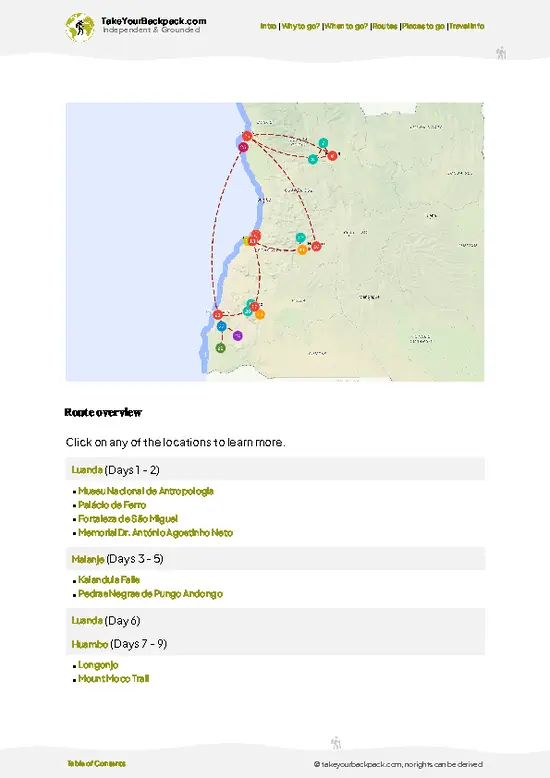
Calandula Falls - Overnight Tour in Malange

Luanda Private Airport Transfer with Door to Door Service

Adventure at Quiçama National Park Safari and Nature

Overnight Adventure at Calandula Falls and Black Rocks

Transfers from February 4 airport-Luanda

The Shores of Kwanza : Boat Tour


 Best Backpacking
.jpg) Hi, I’m Johan (Netherlands 🇳🇱), the creator of TakeYourBackpack. Over the past 3 decades, I’ve backpacked through 90+ countries across six continents, gaining extensive experience with independent travel, long-term trips, and overland routes.
Hi, I’m Johan (Netherlands 🇳🇱), the creator of TakeYourBackpack. Over the past 3 decades, I’ve backpacked through 90+ countries across six continents, gaining extensive experience with independent travel, long-term trips, and overland routes.