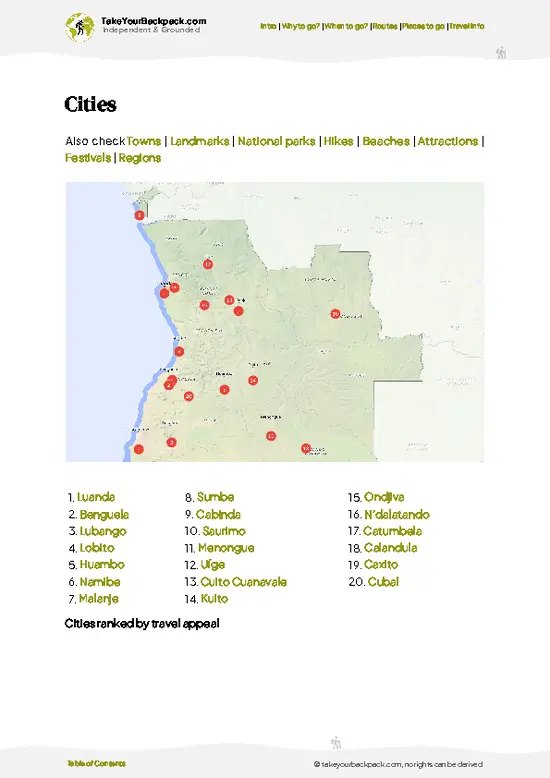
How Many Cities to Visit: I would advise
three cities on a trip of two weeks, four at the outside. Angola’s distances are enormous, intercity travel eats a full day, and costs stack up fast. Three lets you stay long enough to learn a neighborhood, find the market where grilled fish is sold off charcoal at lunchtime, and hear the semba and kizomba spilling from open doors at night.
Choosing Between Types: For a
big-city energy fix, choose a coastal metropolis: traffic, nightlife, galleries, seafood and the widest range of food. For
history, pick an older port with forts and colonial streets. For
cooler air and a slower pace, pick a highland town with red-dirt lanes and markets heaped with cassava and maize. Budget travelers should lean toward the interior and smaller towns, where prices fall. …
read more 👉 How Many Cities to Visit: I would advise
three cities on a trip of two weeks, four at the outside. Angola’s distances are enormous, intercity travel eats a full day, and costs stack up fast. Three lets you stay long enough to learn a neighborhood, find the market where grilled fish is sold off charcoal at lunchtime, and hear the semba and kizomba spilling from open doors at night.
Choosing Between Types: For a
big-city energy fix, choose a coastal metropolis: traffic, nightlife, galleries, seafood and the widest range of food. For
history, pick an older port with forts and colonial streets. For
cooler air and a slower pace, pick a highland town with red-dirt lanes and markets heaped with cassava and maize. Budget travelers should lean toward the interior and smaller towns, where prices fall. Comfort-seekers can accept the capital’s costs for reliable hotels and restaurants. Travelers who dislike chaos will do better in provincial centers than in the biggest urban area.
What It Costs: Angola is among the
priciest places in Africa for backpackers. Plan on
US$70 to 130 a day on a tight budget, and US$150 to 250 or more if you use mid-range hotels in the capital. Basic rooms run roughly US$40 to 90 a night, a street-side meal of grilled fish or chicken with funge or rice US$5 to 12, and a restaurant dinner US$15 to 35. Local minibus rides within a city cost under US$1 to 2, taxis US$5 to 20 depending on distance and negotiation, and intercity buses roughly US$10 to 35 per leg. Museum and fort entries are usually modest, around US$2 to 10, while a private guide or driver for a day runs US$50 to 120. Carry kwanza in small notes; card acceptance is patchy outside upscale venues, and ATMs can run dry. Per city visit, budget about US$200 to 400 for three days including lodging, food, local transport and entries.
Safety on the Ground: Petty theft and opportunistic street crime are the main risks, especially after dark in the larger cities. Keep phones out of sight near open car windows, use registered taxis or ride-hailing where available, and carry only what you need for the day. Landmines remain a danger in parts of the countryside, so stick to well-used roads and paths and never walk off-track outside towns. Police checkpoints are common; stay calm, carry a copy of your passport and visa, and be polite. Photography near government buildings, military sites and the presidential palace can cause trouble, so ask first. Tap water is not safe, so buy bottled water, and take malaria precautions.
Cultural Notes: Greeting people matters. A handshake and a “bom dia” or “boa tarde” before any request changes the entire exchange, and you get warmer service and better prices. Dress is casual but neat; Angolans take care with their clothes. Learn a few Portuguese phrases, because English is rare outside business hotels. Ask before photographing people, especially at markets, and expect some to refuse. Bargaining is normal at markets but not in shops. Sunday family gatherings and the late-evening music scene are part of daily life, so a seat at a roadside bar with a cold Cuca beer gives you a view into it.


 Best Backpacking
 Hi, I’m Johan (Netherlands 🇳🇱), the creator of TakeYourBackpack. Over the past 3 decades, I’ve backpacked through 90+ countries across six continents, gaining extensive experience with independent travel, long-term trips, and overland routes.