×

Angola🇦🇴 | attractionsMuseu Nacional da EscravaturaSlave-trade history, chapel, iron shackles, ocean overlook | things to do and best time to go

Explore Fortaleza de São Pedro da BarraExplore Centro Cultural Brasil-Angola

Backpacking in Museu Nacional da Escravatura
🏆 Top pickattraction ranked #4
By Johan Kruseman 🇳🇱 | Updated October 13, 2026

The museum is not in central Luanda. It stands on a coastal bluff at Morro da Cruz, about 25 km south of the city center, with the Atlantic wind pushing through the doorways and the surf audible below. Inside, the rooms are small and the light is dim. Rusted iron shackles, neck collars and branding tools sit under glass, and the air smells of old stone and sea salt. Crowds are rare, so you often have the whole place to yourself, which makes the material feel heavier. Getting here takes a taxi or driver and some patience with Luanda traffic. Labels are mostly in Portuguese, and the displays are modest next to Luanda’s bigger sights. The wow-factor is not spectacle. It comes from standing at the spot where enslaved people were held and baptized before the sea crossing, and it is a short, sobering, worthwhile detour.

Discover everything you want to know in the 📖 Angola Travel Guide.


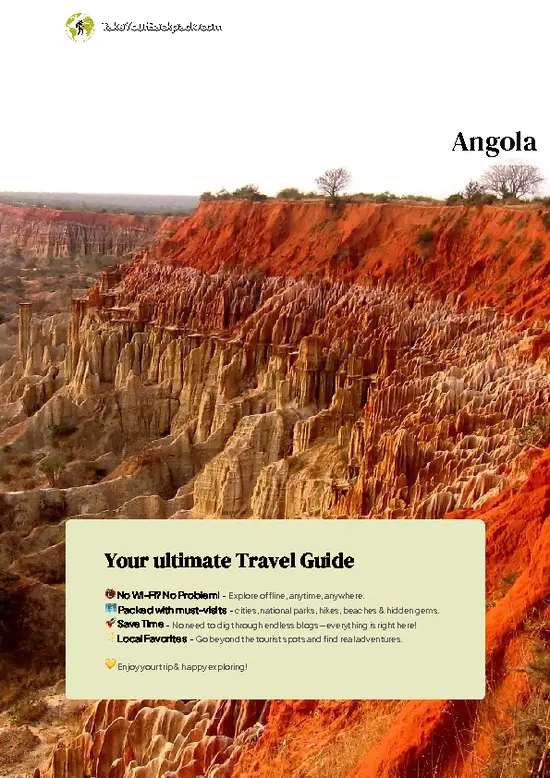
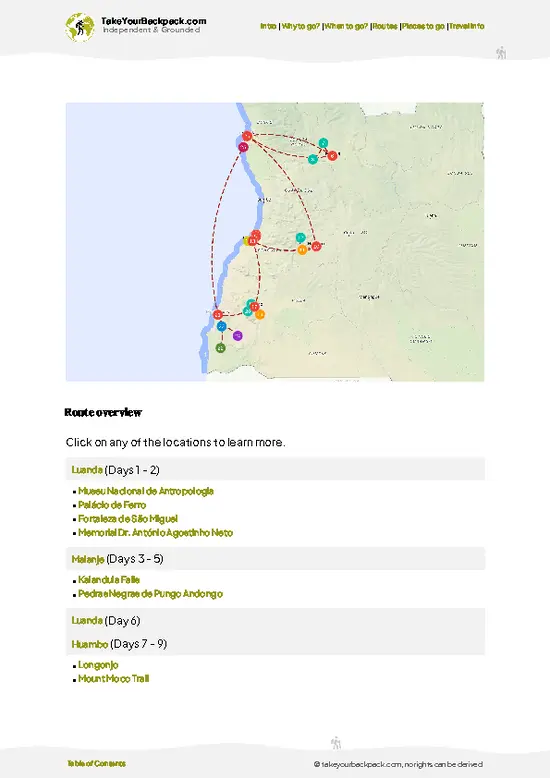
example page 0 from our offline Travel Guide for Angola
example page 1 from our offline Travel Guide for Angola
example page 2 from our offline Travel Guide for Angola
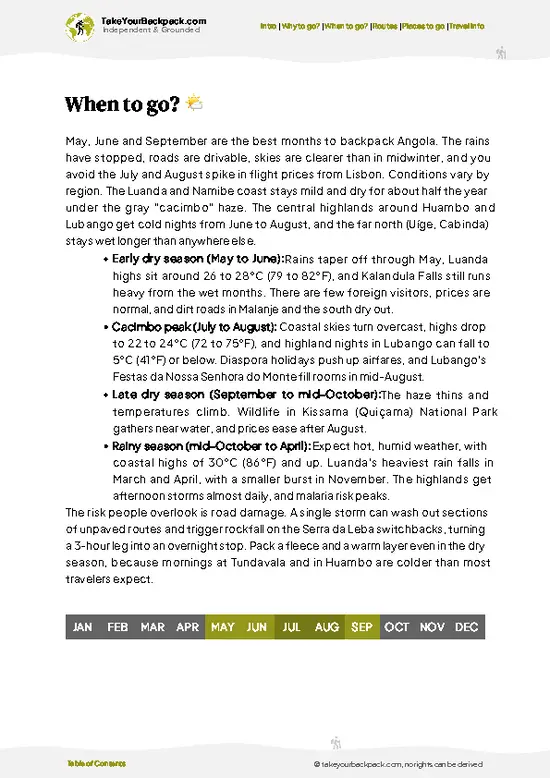
example page 3 from our offline Travel Guide for Angola
example page 4 from our offline Travel Guide for Angola
example page 5 from our offline Travel Guide for Angola
example page 6 from our offline Travel Guide for Angola
example page 7 from our offline Travel Guide for Angola
Loading the map 🌍
CLICK TO FILTER
cities
towns
landmarks
national parks
hikes
beaches
attractions
festivals
regions
SHOW COUNTRY’S BESTSHOW ALL

✨ Why go?
Ranked #4 attraction in Angola
The unique appeal for travelers

Luanda was one of the main embarkation ports of the Atlantic slave trade, with millions of Africans shipped from Angola to Brazil and the Caribbean. This museum is the country’s main place to face that history on the ground. Most of what you see on a typical Angola route is oil-boom skyline and colonial forts. Here you get the human cost behind that history, told in iron shackles and branding tools and in a small colonial-era chapel where captives were baptized before boarding ships. The setting matters as much as the objects. You look out over the same Atlantic horizon they were sent toward. Backpackers who want to understand why Angola, Brazil and Portugal are so tied together find it quickly clarifies the language, the food and the music. It takes one morning, costs little, and gives context to every other stop on your route.

💡 HighlightsEssential experiences to have while visiting Museu Nacional da Escravatura

  1. The chapel: The small whitewashed colonial chapel is the heart of the site. Captives were baptized here before being shipped across the Atlantic, so the quiet room carries real weight.
  2. Iron restraints: Shackles, neck rings and chains are displayed up close. Their rough, pitted surfaces and heavy weight make the history concrete in a way text cannot.
  3. Branding tools: Implements used to mark people as property are among the most confronting objects. Allow yourself a few minutes in front of them.
  4. Slave-ship models and maps: Panels and models trace routes from Angolan ports to Brazil and the Caribbean. They show how tightly packed the voyages were and how far the trade reached.
  5. Cultural exhibits: Displays of Angolan art, masks and everyday objects show the societies people were taken from. They balance
… read more 👉
  1. The chapel: The small whitewashed colonial chapel is the heart of the site. Captives were baptized here before being shipped across the Atlantic, so the quiet room carries real weight.
  2. Iron restraints: Shackles, neck rings and chains are displayed up close. Their rough, pitted surfaces and heavy weight make the history concrete in a way text cannot.
  3. Branding tools: Implements used to mark people as property are among the most confronting objects. Allow yourself a few minutes in front of them.
  4. Slave-ship models and maps: Panels and models trace routes from Angolan ports to Brazil and the Caribbean. They show how tightly packed the voyages were and how far the trade reached.
  5. Cultural exhibits: Displays of Angolan art, masks and everyday objects show the societies people were taken from. They balance the story and remind you what was lost.
  6. The Atlantic overlook: The bluff gives a wide view over the ocean. Wind, gulls and surf below make a quiet, reflective ending to the visit.
If time is short, skip the cultural exhibits and spend your minutes in the chapel and in front of the restraints.
Spotted a mistake or missing something? Contact us.

Things to do near Museu Nacional da Escravatura

Ratings based on Tripadvisor reviews. When you book through this link, you support our work at no extra cost to you.

🌤️ When to go?Seasonal considerations and timing

The best window for the Museu Nacional da Escravatura is the dry season, roughly May to September, when Luanda stays rainless and comfortable.
  • Dry Season (Cacimbo, May to September): Highs of 24 to 28°C (75 to 82°F), lows of 18 to 21°C (64 to 70°F), often overcast and cool by the coast. Roughly 11 hours of daylight. The road along the Atlantic to the museum at Morro da Cruz is easy to travel and the shoreline walk is pleasant.
  • Hot Rainy Season (October to April): Highs of 29 to 32°C (84 to 90°F), high humidity, and short downpours that flood roads and slow traffic. Daylight runs about 12.5 hours. Hotel prices stay high year-round in Luanda, so there is little seasonal discount.
  • Crowds and Events: The site is quiet on most days. Local school groups and commemorations tied to National Heroes Day
… read more 👉
The best window for the Museu Nacional da Escravatura is the dry season, roughly May to September, when Luanda stays rainless and comfortable.
  • Dry Season (Cacimbo, May to September): Highs of 24 to 28°C (75 to 82°F), lows of 18 to 21°C (64 to 70°F), often overcast and cool by the coast. Roughly 11 hours of daylight. The road along the Atlantic to the museum at Morro da Cruz is easy to travel and the shoreline walk is pleasant.
  • Hot Rainy Season (October to April): Highs of 29 to 32°C (84 to 90°F), high humidity, and short downpours that flood roads and slow traffic. Daylight runs about 12.5 hours. Hotel prices stay high year-round in Luanda, so there is little seasonal discount.
  • Crowds and Events: The site is quiet on most days. Local school groups and commemorations tied to National Heroes Day on September 17 can bring more visitors.
  • Time of Day: Morning visits beat the midday heat and the heaviest traffic.
Go on a weekday morning in the dry season and confirm opening hours before heading out, since the chapel and museum can close on short notice.


source: climatestotravel.comJANJanuary: below average for travelingFEBFebruary: below average for travelingMARMarch: below average for travelingAPRApril: fair for travelingMAYMay: good for travelingJUNJune: excellent for travelingJULJuly: excellent for travelingAUGAugust: highly recommended for travelingSEPSeptember: highly recommended for travelingOCTOctober: good for travelingNOVNovember: below average for travelingDECDecember: below average for traveling
angola-attraction-museu-nacional-da-escravatura
© Google |

✈️ The backpacker research shortcutAngola Travel Guide

An offline-friendly backpacking guide with optimized travel routes, ranked highlights, transport advice, and the best areas to stay.
example page 0 from our offline Travel Guide for Angola
example page 1 from our offline Travel Guide for Angola
example page 2 from our offline Travel Guide for Angola
example page 3 from our offline Travel Guide for Angola
example page 4 from our offline Travel Guide for Angola
example page 5 from our offline Travel Guide for Angola
example page 6 from our offline Travel Guide for Angola
example page 7 from our offline Travel Guide for Angola
The digital guide (246 pages) contains:
✅ 71 highlights, ranked by travel appeal
✅ Optimized 7, 14 & 21-day travel routes
✅ Cities, national parks, landmarks, beaches
✅ How to get around
✅ Offline-friendly for travel without Wi-Fi
👉 Click to see all 30+ guide features

📅 Plan smarter in minutes, not weeks
✅ Month by month travel advice
✅ Festivals & national holidays
✅ Budget expectations

🗺️ Go to the right places, skip the overrated ones
✅ Honest pros & cons of destinations
✅ Top hikes, parks & viewpoints
✅ Lesser-known places most travelers miss
✅ Clear “worth it vs skip it” guidance

🛏️ Travel smoothly without rookie mistakes
✅ Best areas to stay
✅ Transport systems explained simply
✅ Common scams & safety advice
✅ SIM cards, money & practical tips

🌍 Understand the country, not just visit it
✅ Culture & traditions
✅ 52 Essential phrases & customs
✅ Festivals worth planning around
✅ Traveler-friendly historical context
✅ Insights that make places more meaningful

📱 Built for real travel conditions
✅ Fully downloadable PDF
✅ Works completely offline
✅ Optimized for phone use
✅ Useful in remote areas & buses
✅ Everything in one place
Stop searching, start planning
Get instant access to your full guide. 30‑day money-back guarantee.
+ Add another guide for just

By proceeding you agree to our terms.
Sent to your inbox immediately after payment • 100% Secure Checkout
Best Backpacking Travel Advisor 2025 tourism awardBest Backpacking
Travel Advisor
2025
What others say about Take Your Backpack Guides:
⭐⭐⭐⭐⭐
Fantastic, amazing amount of information!
⭐⭐⭐⭐⭐
My goodness this is amazing, it's what I've been looking for hats off too you!
⭐⭐⭐⭐⭐
I think this is absolutely BRILLIANT
⭐⭐⭐⭐
Very complete and informative. It's still missing places, but I gotta to commend you
⭐⭐⭐⭐⭐
This is truly amazing, thank you, can't wait to explore it with my kids!
⭐⭐⭐⭐⭐
Awesome resource, thank you!
⭐⭐⭐⭐⭐
This is amazing! Can't wait to explore the ones I haven't seen
⭐⭐⭐⭐
I love this! Well done, great idea.
⭐⭐⭐⭐⭐
Thanks for taking the time to make this gem!
⭐⭐⭐⭐⭐
This might be the best website I've ever seen.
⭐⭐⭐⭐⭐
Congratulations, and thank you so much for your work; it's incredibly valuable.
⭐⭐⭐⭐
In all seriousness I think you did a great job pointing out the important spots
⭐⭐⭐⭐⭐
10/10 very good
⭐⭐⭐⭐⭐
As someone who's only just starting to visit regularly this is awesome, thank you.
⭐⭐⭐⭐
Thank you very much! I'm going to visit my dad, it's going to be very useful!
⭐⭐⭐⭐⭐
This is really cool! We'll be travelling for the first time and this definitely come in handy.
⭐⭐⭐⭐⭐
You are now our minister of culture, congratulations 👨‍💼
⭐⭐⭐⭐⭐
Just wanted to tell you that this is a pearl! Going to follow your recommendations.
⭐⭐⭐⭐⭐
This is so cool. I'll definitely be using the resource for my travels soon.
⭐⭐⭐⭐⭐
This is very impressive! Good work.
⭐⭐⭐⭐⭐
This is an amazing and informative site. Very well done!

🛏️ Where to stay?Best areas and accommodation options

Ilha de Luanda and the Miramar and Maianga districts are the most practical areas to base yourself, with Talatona as the closer alternative. Angola has a small backpacker scene, so expect guesthouses and budget hotels rather than big social hostels.
Miramar is a 40 to 60 minute drive from the museum, and has the best concentration of mid-priced guesthouses, restaurants and embassies. It feels safer than most of the city after dark, and taxis are easy to arrange through your accommodation.
Maianga and the downtown Baixa area put you near the Fortress of São Miguel, the Marginal waterfront and the … read more 👉
Ilha de Luanda and the Miramar and Maianga districts are the most practical areas to base yourself, with Talatona as the closer alternative. Angola has a small backpacker scene, so expect guesthouses and budget hotels rather than big social hostels.
Miramar is a 40 to 60 minute drive from the museum, and has the best concentration of mid-priced guesthouses, restaurants and embassies. It feels safer than most of the city after dark, and taxis are easy to arrange through your accommodation.
Maianga and the downtown Baixa area put you near the Fortress of São Miguel, the Marginal waterfront and the National Museum of Anthropology. Rooms cost less here, but streets get chaotic and you should take a registered taxi or app ride in the evening rather than walking.
Ilha de Luanda, the sandbar strip, has beach clubs and seafood shacks, and is where travelers and expats mingle. Rooms are limited and pricier, though, and traffic on the access road is slow on weekends.
Book ahead in every area, since Luanda has few budget beds and rates are high by regional standards. Ask your host to arrange airport pickup and a trusted driver for the museum.

👛 Costs (as of 13 October 2026)Money, prices, and spending tips

A visit to the Museu Nacional da Escravatura is inexpensive, but Luanda itself is one of the costlier cities in Africa, so transport and lodging drive your budget. Prices are in Angolan kwanza (AOA) with US dollar equivalents, and cards are not widely accepted at small sites, so carry cash.
CategoryBudget RangeLocal Reality
Museum entryUS$2 to 6Small fee for foreigners, often cash only. Guides are usually available on site.
Guide tipUS$3 to 10A guide adds real context on the chapel and the history of the port. Tipping is appreciated.
Transport to siteUS$5 to 20Taxi or ride-hailing from central Luanda. Minibus taxis (candongueiros) are cheaper but confusing for newcomers.
AccommodationUS$50 to 120Basic guesthouses and budget hotels. Dorm beds are rare.
FoodUS$10 to 25Street grills and local restaurants
… read more 👉
A visit to the Museu Nacional da Escravatura is inexpensive, but Luanda itself is one of the costlier cities in Africa, so transport and lodging drive your budget. Prices are in Angolan kwanza (AOA) with US dollar equivalents, and cards are not widely accepted at small sites, so carry cash.
CategoryBudget RangeLocal Reality
Museum entryUS$2 to 6Small fee for foreigners, often cash only. Guides are usually available on site.
Guide tipUS$3 to 10A guide adds real context on the chapel and the history of the port. Tipping is appreciated.
Transport to siteUS$5 to 20Taxi or ride-hailing from central Luanda. Minibus taxis (candongueiros) are cheaper but confusing for newcomers.
AccommodationUS$50 to 120Basic guesthouses and budget hotels. Dorm beds are rare.
FoodUS$10 to 25Street grills and local restaurants cost far less than expat-oriented places.
Water and snacksUS$1 to 4Bottled water is essential, as the site has limited facilities.
Photography permitUS$0 to 5Rules vary, so ask at the entrance before using a camera.
⚠️ Prices can change and everyone travels differently, so take this as a rough guide. Hope it helps you plan your adventure!

FAQTraveler FAQ

Plan on 60 to 90 minutes for the museum itself. Add 1 to 2 hours of round-trip travel from central Luanda, depending on traffic, so a half day is realistic. Go in the morning to avoid the worst traffic and the afternoon heat.
For most visitors it is worth it, since the fee is low (usually well under US$5) and the collection is small but powerful. The chapel and the shackles, chains and branding tools are the main draw, and the Atlantic overlook adds context. Labels are mostly in Portuguese, so a guide or translation app helps.
The museum is on the coast at Morro da Cruz, roughly 25 km south of central Luanda, and a taxi or ride-hailing car takes about 40 to 70 minutes depending on traffic. Most backpackers hire a driver for the round trip, often US$30 to 60, and ask them to wait. Public minibuses (candongueiros) run along the road but do not stop at the museum, so confirm the drop-off before you go.
⚠️ Things can change over time, so always validate details locally before you go.

Other Angolan attractions near Museu Nacional da Escravatura

Explore more nearby:


💡 Not sure where to go next?
Create a personalized itinerary for Angola including Museu Nacional da Escravatura and the places that fit your trip.

Generate my itinerary

👉 Discover all attractions

Or checkout all Angola has to offer (think cities, towns, villages, national parks, hikes, beaches, festivals)
Country photo of Angola

We 💚 feedbackWhat to keep in mind

Give it a solid 60 to 90 minutes. Less and you will rush the chapel, which is the part that lands hardest. Much more and the small collection runs out. Go in the morning, ask your driver to wait, and spend the last ten minutes at the bluff, where the wind and surf sink in. Bring small cash for entry and a Portuguese phrasebook.

✍️ Help improve this page!
The information on this page is based on in-depth research, insights shared by experienced travelers, and feedback from the local travel community in Angola. While every effort is made to keep the information accurate and current, conditions can change — so if you spot anything incorrect or outdated, please get in touch.


🙋‍♂️ Give feedback

👋 Meet the founderWho’s Behind Take Your Backpack?

Johan, backpacker and founder of TakeYourBackpackHi, I’m Johan (Netherlands 🇳🇱), the creator of TakeYourBackpack. Over the past 3 decades, I’ve backpacked through 90+ countries across six continents, gaining extensive experience with independent travel, long-term trips, and overland routes.

This site is built on a combination of firsthand travel experience and carefully curated insights from other backpackers. Many guides are based on places I’ve personally visited, while others bring together tips, observations, and practical advice shared by trusted travelers I’ve met along the way.

The goal is to provide realistic, experience-driven guidance — not generic itineraries — so you can explore destinations with better context, clearer expectations, and more confidence.