×

Azerbaijan🇦🇿 | best hikesThe Must-See 4 hikes in Azerbaijan

Hikes in Azerbaijan are mostly day walks in the Greater Caucasus, with a smaller set of volcanic, semi-desert and forest routes elsewhere. The northern mountains around Quba, Xinaliq, Qusar and Shahdag hold the highest villages and the longest trails, with the most dramatic relief and the least infrastructure. The northwest, around Sheki, Ilisu and Qakh, offers forested valleys, easier access and guesthouse stays. The south, near Lerik and the Talysh range, is quieter and wetter. Trails are rarely marked, so independent travel and backpacking here depend on local drivers, homestays and offline maps. Costs stay low, and crowds appear only on a few weekends.

By Johan Kruseman 🇳🇱 | Updated October 18, 2026
Explore the best beaches in Azerbaijan

Why go?Key Factors That Shape the Experience

Azerbaijan sits where the Greater Caucasus meets the Caspian lowlands, so a single country holds alpine ridges above 4,000 meters, mud volcanoes, dry steppe and humid broadleaf forest. That range of terrain is the main reason to hike here. Many routes also pass old mountain settlements where Lezgin, Tat, Khinalug and Udi communities keep distinct languages, and a walk often ends at a village rather than a summit.

The country is less suited to travelers who expect a developed trail culture. There is no national network of waymarked paths, few printed maps, and very little English signage outside Shahdag and Sheki. Huts and organized campsites are scarce, so overnight trips usually mean a homestay or carrying a tent. Roads into the high villages are paved but steep, and winter can close them. … read more 👉
Azerbaijan sits where the Greater Caucasus meets the Caspian lowlands, so a single country holds alpine ridges above 4,000 meters, mud volcanoes, dry steppe and humid broadleaf forest. That range of terrain is the main reason to hike here. Many routes also pass old mountain settlements where Lezgin, Tat, Khinalug and Udi communities keep distinct languages, and a walk often ends at a village rather than a summit.

The country is less suited to travelers who expect a developed trail culture. There is no national network of waymarked paths, few printed maps, and very little English signage outside Shahdag and Sheki. Huts and organized campsites are scarce, so overnight trips usually mean a homestay or carrying a tent. Roads into the high villages are paved but steep, and winter can close them.

Before choosing Azerbaijan for hiking, know that logistics decide the experience. Hiring a local driver or guide is normal and affordable, and it solves most navigation issues. Some border zones, notably near Armenia and in the formerly occupied territories, are restricted or mined, and permits or checks apply near the Russian and Georgian frontiers. Mobile coverage is good in villages and patchy on ridges. Visas are usually handled through the e-visa system.
Evaluating the Top Choices
The list of best hikes in Azerbaijan is created based on scenery, challenge, trail quality, landmarks, and overall enjoyment. If you feel a hike is missing in this list, please let us know.

When to go?When to Plan Your Trip

Best months: The best months for hiking in Azerbaijan are May to June and September to early October, when mountain trails are snow-free and valley temperatures sit around 15 to 25°C. In the Greater Caucasus, high routes above 2,500 meters usually clear of snow by June and can see new snow by October.

Summer: July and August bring 25 to 35°C in the foothills and over 38°C in lowland areas such as Baku and the Kura plain. Highland villages like Xinaliq stay cooler, around 12 to 20°C by day and cold at night. Afternoon thunderstorms can hit the ridges, so early starts matter. Summer is the busiest period for domestic tourism, particularly at weekends around Quba, Qusar and Shahdag, and guesthouse rates in those areas can rise by roughly 20 to 50 percent.

Shoulder and winter seasons: April … read more 👉
Best months: The best months for hiking in Azerbaijan are May to June and September to early October, when mountain trails are snow-free and valley temperatures sit around 15 to 25°C. In the Greater Caucasus, high routes above 2,500 meters usually clear of snow by June and can see new snow by October.

Summer: July and August bring 25 to 35°C in the foothills and over 38°C in lowland areas such as Baku and the Kura plain. Highland villages like Xinaliq stay cooler, around 12 to 20°C by day and cold at night. Afternoon thunderstorms can hit the ridges, so early starts matter. Summer is the busiest period for domestic tourism, particularly at weekends around Quba, Qusar and Shahdag, and guesthouse rates in those areas can rise by roughly 20 to 50 percent.

Shoulder and winter seasons: April has plenty of rain and mud in the northwest, around Sheki and Qakh, where spring rainfall is the heaviest of the year. Late October and November are clear and quiet, with lower prices, but days are short. From December to March the high north is under snow, roads to Xinaliq can close, and hiking is limited to low valleys and the semi-desert near Gobustan, which is pleasant in winter at 5 to 12°C. The Talysh south around Lerik is damp from autumn through spring.

hike hoppingHow to Combine hikes Into One Trip

Trip length: A trip combining several hikes in Azerbaijan needs 7 to 12 days, depending on how many regions you add and how much time you allow for road transfers.

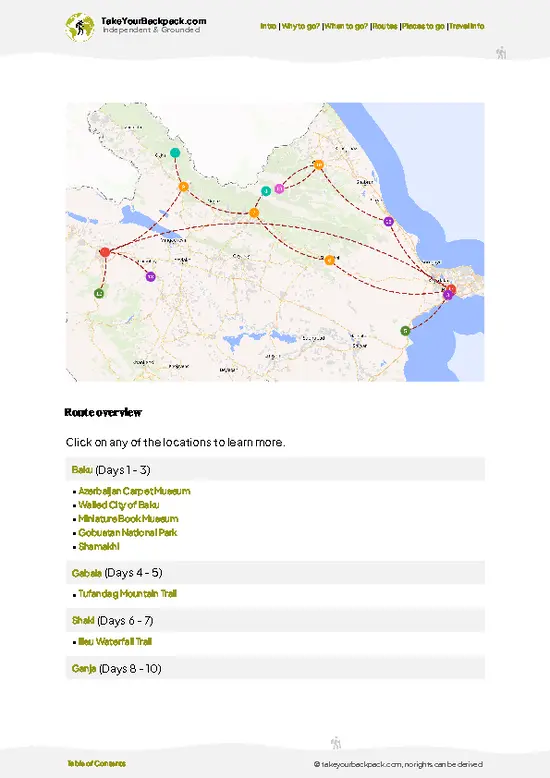
Grouping and direction: The country divides into clusters. Baku works as the arrival hub, with Gobustan and the Absheron peninsula close by. The northern cluster of Quba, Qusar and Xinaliq connects by road, and the northwest cluster of Sheki, Ilisu and Qakh forms another. A sensible direction runs from Baku north to Quba, then west along the foothills to Sheki, and back by a different road or a train from Gabala or Yevlakh. The south around Lerik and Lankaran is a separate leg, best treated as its own trip.

Time per stop and transfers: Allow 2 to 3 nights per mountain base so one day can be a hike and another can absorb weather … read more 👉
Trip length: A trip combining several hikes in Azerbaijan needs 7 to 12 days, depending on how many regions you add and how much time you allow for road transfers.

Grouping and direction: The country divides into clusters. Baku works as the arrival hub, with Gobustan and the Absheron peninsula close by. The northern cluster of Quba, Qusar and Xinaliq connects by road, and the northwest cluster of Sheki, Ilisu and Qakh forms another. A sensible direction runs from Baku north to Quba, then west along the foothills to Sheki, and back by a different road or a train from Gabala or Yevlakh. The south around Lerik and Lankaran is a separate leg, best treated as its own trip.

Time per stop and transfers: Allow 2 to 3 nights per mountain base so one day can be a hike and another can absorb weather or rest. Baku to Quba takes about 2.5 to 3 hours by road, Quba to Xinaliq around 2 hours, Quba to Sheki roughly 4 to 5 hours, and Sheki back to Baku 5 to 6 hours. Baku to Lerik takes around 5 to 6 hours.

Planning mistakes: The usual error is packing too many regions into too few days, which turns the trip into long drives. Pick two clusters and add the third only with extra days. Another is relying on shared minibuses to reach trailheads, since they run on fixed morning schedules and rarely go to the final village. Arrange a driver for the last leg instead. Checking mountain road status after rain or snow also prevents lost days.

The ListMust-Visit hikes in Azerbaijan

1 Shahdag Mountain Trail

high-altitude ridges, panoramic views, rocky outcrops, alpine flora

Ascend exposed ridgelines for wide-open vistas, traversing rocky ground where wildflowers and hardy shrubs cling to the windblown slopes.

azerbaijan-hike-shahdag-mountain-trail
© Google |

2 Garanohur Lake Trail

hidden lake, dense woodland, mossy boulders, tranquil setting

Walk beneath thick tree cover and over soft ground to a quiet mountain lake, where still water reflects the surrounding forest.

3 Ilisu Waterfall Trail

forest paths, river crossings, steep gorges, mountain springs

Follow winding forest tracks and cross clear streams to reach a secluded waterfall, surrounded by steep slopes and cool mountain air.

4 Tufandag Mountain Trail

cable car access, subalpine forests, broad plateaus, distant peaks

Ride up from town and hike through changing terrain, from dense woods to open plateaus, with distant summits always on the horizon.

azerbaijan-hike-tufandag-mountain-trail
© Google |
Loading the map 🌍

Expert viewInsights from Locals and Experts

How many hikes: Plan 4 to 6 hikes. That is enough to cover the main landscapes (high alpine, forested valley, dry hills) without making every day a transfer. Fewer than four leaves the country unsampled, and more than six usually means rushing between regions with weak public transport.

Choosing between kinds: First-timers and those with limited fitness should favor forest and village walks in the northwest, which are shorter, lower and well served by guesthouses. Experienced hikers should put the high Caucasus routes first, since they offer the real altitude and the least company. Anyone short on time can take the low-effort volcanic and semi-desert walks near Baku, which need no overnight stay. Photographers and culture-minded travelers tend to get more from routes that end in a village … read more 👉
How many hikes: Plan 4 to 6 hikes. That is enough to cover the main landscapes (high alpine, forested valley, dry hills) without making every day a transfer. Fewer than four leaves the country unsampled, and more than six usually means rushing between regions with weak public transport.

Choosing between kinds: First-timers and those with limited fitness should favor forest and village walks in the northwest, which are shorter, lower and well served by guesthouses. Experienced hikers should put the high Caucasus routes first, since they offer the real altitude and the least company. Anyone short on time can take the low-effort volcanic and semi-desert walks near Baku, which need no overnight stay. Photographers and culture-minded travelers tend to get more from routes that end in a village with a homestay.

Budget: Expect US$30 to 55 a day on an independent budget (roughly 50 to 95 AZN). Homestays or guesthouses cost about 25 to 60 AZN a night per person, often with breakfast, and dinner adds 12 to 25 AZN. A local guide for a day hike usually costs 60 to 150 AZN. A driver for a day to a trailhead runs about 60 to 120 AZN, or 25 to 50 AZN per seat on shared marshrutka routes. Entry fees are minor, and where a national park or reserve charges, it is typically a few AZN. For a trip of 7 to 10 days, a total of US$300 to 550 excluding flights is realistic.

Safety: Mountain weather changes quickly, with fog and afternoon storms above 2,000 meters even in summer. Download offline maps and tell your guesthouse your route and return time. Shepherd dogs guard flocks in the highlands and can be aggressive, so keep distance, avoid sudden movements and carry a stick. Water from streams below grazing land should be treated. Mine contamination remains in areas near the former front lines, so stay out of restricted zones and avoid unmarked ground in those regions. Emergency services are slow to reach remote villages, so carry a basic first-aid kit and travel insurance covering hiking. The emergency number is 112.

Cultural considerations: Azerbaijan is a predominantly Muslim but secular country, and villages are conservative. Dress modestly in settlements, with covered shoulders and knees, and ask before photographing people. Accept tea when offered, since refusing repeatedly can seem curt, and remove shoes indoors. Alcohol is available in towns but is better left alone in small villages. Tipping guides and drivers 10 to 15 percent is appreciated. Carry your passport, since police checkpoints on mountain roads are routine, and expect to register nothing extra if you stay in licensed guesthouses.

✈️ The backpacker research shortcutAzerbaijan Travel Guide

An offline-friendly backpacking guide with optimized travel routes, ranked highlights, transport advice, and the best areas to stay.
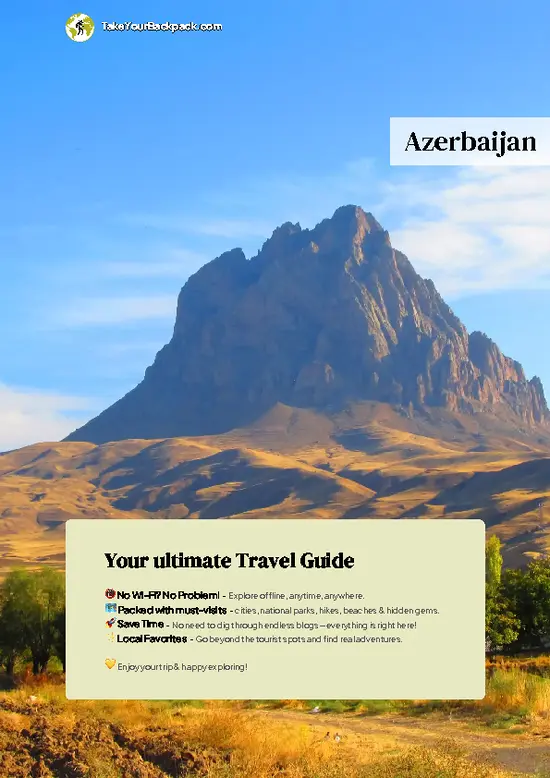
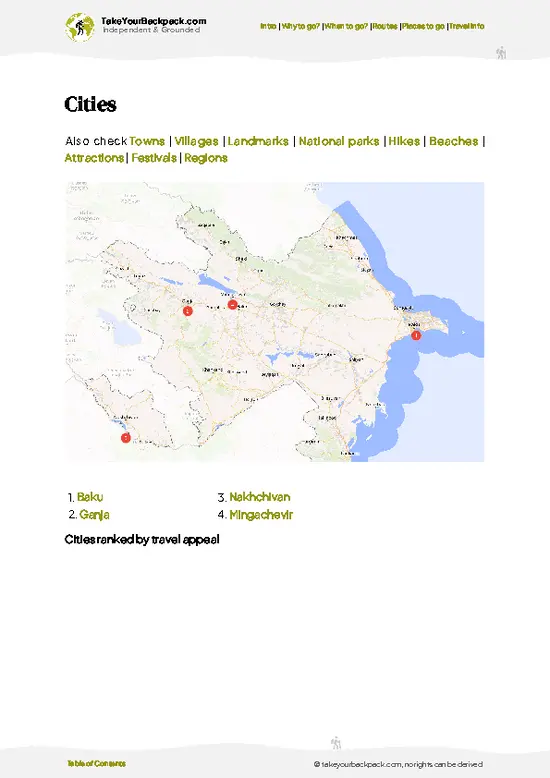
example page 0 from our offline Travel Guide for Azerbaijan
example page 1 from our offline Travel Guide for Azerbaijan
example page 2 from our offline Travel Guide for Azerbaijan
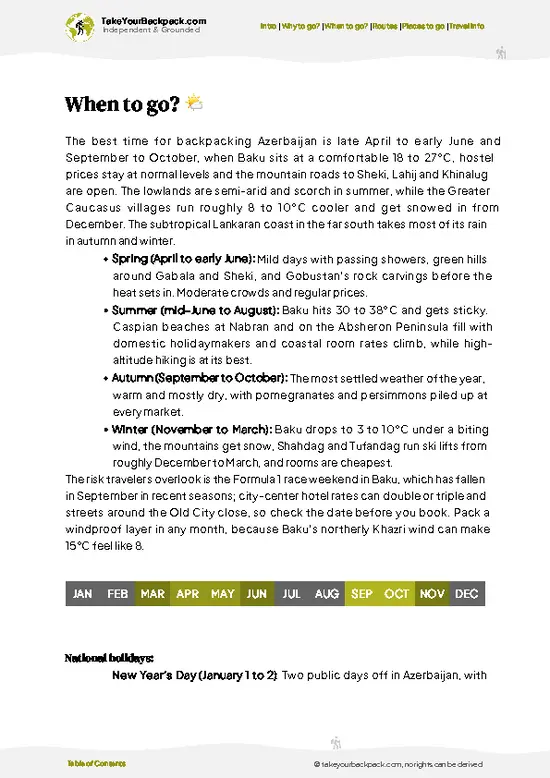
example page 3 from our offline Travel Guide for Azerbaijan
example page 4 from our offline Travel Guide for Azerbaijan
example page 5 from our offline Travel Guide for Azerbaijan
example page 6 from our offline Travel Guide for Azerbaijan
example page 7 from our offline Travel Guide for Azerbaijan
The digital guide (284 pages) contains:
✅ 71 highlights, ranked by travel appeal
✅ Optimized 5, 10 & 15-day travel routes
✅ Cities, national parks, landmarks, beaches
✅ How to get around
✅ Offline-friendly for travel without Wi-Fi
👉 Click to see all 30+ guide features

📅 Plan smarter in minutes, not weeks
✅ Month by month travel advice
✅ Festivals & national holidays
✅ Budget expectations

🗺️ Go to the right places, skip the overrated ones
✅ Honest pros & cons of destinations
✅ Top hikes, parks & viewpoints
✅ Lesser-known places most travelers miss
✅ Clear “worth it vs skip it” guidance

🛏️ Travel smoothly without rookie mistakes
✅ Best areas to stay
✅ Transport systems explained simply
✅ Common scams & safety advice
✅ SIM cards, money & practical tips

🌍 Understand the country, not just visit it
✅ Culture & traditions
✅ 52 Essential phrases & customs
✅ Festivals worth planning around
✅ Traveler-friendly historical context
✅ Insights that make places more meaningful

📱 Built for real travel conditions
✅ Fully downloadable PDF
✅ Works completely offline
✅ Optimized for phone use
✅ Useful in remote areas & buses
✅ Everything in one place
Stop searching, start planning
Get instant access to your full guide. 30‑day money-back guarantee.
+ Add another guide for just

By proceeding you agree to our terms.
Sent to your inbox immediately after payment • 100% Secure Checkout
Best Backpacking Travel Advisor 2025 tourism awardBest Backpacking
Travel Advisor
2025
What others say about Take Your Backpack Guides:
⭐⭐⭐⭐⭐
Fantastic, amazing amount of information!
⭐⭐⭐⭐⭐
My goodness this is amazing, it's what I've been looking for hats off too you!
⭐⭐⭐⭐⭐
I think this is absolutely BRILLIANT
⭐⭐⭐⭐
Very complete and informative. It's still missing places, but I gotta to commend you
⭐⭐⭐⭐⭐
This is truly amazing, thank you, can't wait to explore it with my kids!
⭐⭐⭐⭐⭐
Awesome resource, thank you!
⭐⭐⭐⭐⭐
This is amazing! Can't wait to explore the ones I haven't seen
⭐⭐⭐⭐
I love this! Well done, great idea.
⭐⭐⭐⭐⭐
Thanks for taking the time to make this gem!
⭐⭐⭐⭐⭐
This might be the best website I've ever seen.
⭐⭐⭐⭐⭐
Congratulations, and thank you so much for your work; it's incredibly valuable.
⭐⭐⭐⭐
In all seriousness I think you did a great job pointing out the important spots
⭐⭐⭐⭐⭐
10/10 very good
⭐⭐⭐⭐⭐
As someone who's only just starting to visit regularly this is awesome, thank you.
⭐⭐⭐⭐
Thank you very much! I'm going to visit my dad, it's going to be very useful!
⭐⭐⭐⭐⭐
This is really cool! We'll be travelling for the first time and this definitely come in handy.
⭐⭐⭐⭐⭐
You are now our minister of culture, congratulations 👨‍💼
⭐⭐⭐⭐⭐
Just wanted to tell you that this is a pearl! Going to follow your recommendations.
⭐⭐⭐⭐⭐
This is so cool. I'll definitely be using the resource for my travels soon.
⭐⭐⭐⭐⭐
This is very impressive! Good work.
⭐⭐⭐⭐⭐
This is an amazing and informative site. Very well done!

🛏️ Where to stay?Top Areas to Stay

Azerbaijan has plenty of hostels and guesthouses, mostly in Baku, where dorm beds typically run 15 to 30 AZN (about US$9 to 18) and private guesthouse rooms in Sheki or Gabala cost a little more. In Baku, the walled Old City (Icherisheher) puts you a short walk from the main sights and stays fairly quiet after dark, while the streets around Fountain Square and Nizami Street are livelier, with bars and late-night food steps away, though rooms there can be noisier. The area near 28 May metro and the railway station is cheaper and handy for the airport bus and the overnight train, but it has less character. All three areas are generally safe to walk at night.

If you enjoy meeting fellow travelers, … read more 👉
Azerbaijan has plenty of hostels and guesthouses, mostly in Baku, where dorm beds typically run 15 to 30 AZN (about US$9 to 18) and private guesthouse rooms in Sheki or Gabala cost a little more. In Baku, the walled Old City (Icherisheher) puts you a short walk from the main sights and stays fairly quiet after dark, while the streets around Fountain Square and Nizami Street are livelier, with bars and late-night food steps away, though rooms there can be noisier. The area near 28 May metro and the railway station is cheaper and handy for the airport bus and the overnight train, but it has less character. All three areas are generally safe to walk at night.

If you enjoy meeting fellow travelers, consider choosing hostels with high ratings for atmosphere. On the other hand, if you prefer having your own space, a hotel might be a better option.

AzerbaijanDiscover the Country

👋 Meet the founderWho’s Behind Take Your Backpack?

Johan, backpacker and founder of TakeYourBackpackHi, I’m Johan (Netherlands 🇳🇱), the creator of TakeYourBackpack. Over the past 3 decades, I’ve backpacked through 90+ countries across six continents, gaining extensive experience with independent travel, long-term trips, and overland routes.

This site is built on a combination of firsthand travel experience and carefully curated insights from other backpackers. Many guides are based on places I’ve personally visited, while others bring together tips, observations, and practical advice shared by trusted travelers I’ve met along the way.

The goal is to provide realistic, experience-driven guidance — not generic itineraries — so you can explore destinations with better context, clearer expectations, and more confidence.