×

Azerbaijan🇦🇿 | best national parksThe Must-See 9 national parks in Azerbaijan

National parks in Azerbaijan are mostly post-Soviet creations, carved out of older hunting reserves and nature sanctuaries, and they are run as protected landscapes rather than polished visitor attractions. Expect modest entry fees, light signage and few crowds outside summer weekends. The kind of park changes with the region. Semi-desert and coastal parks near Baku are easy to reach in a day. Forested and alpine parks in the Greater and Lesser Caucasus and the south need longer transfers and often a hired driver. For backpacking or independent travel, the closer parks suit short outings, and the mountain and forest ones suit those with several days to spare.

By Johan Kruseman 🇳🇱 | Updated October 18, 2026
Explore the best hikes in Azerbaijan

Why go?Key Factors That Shape the Experience

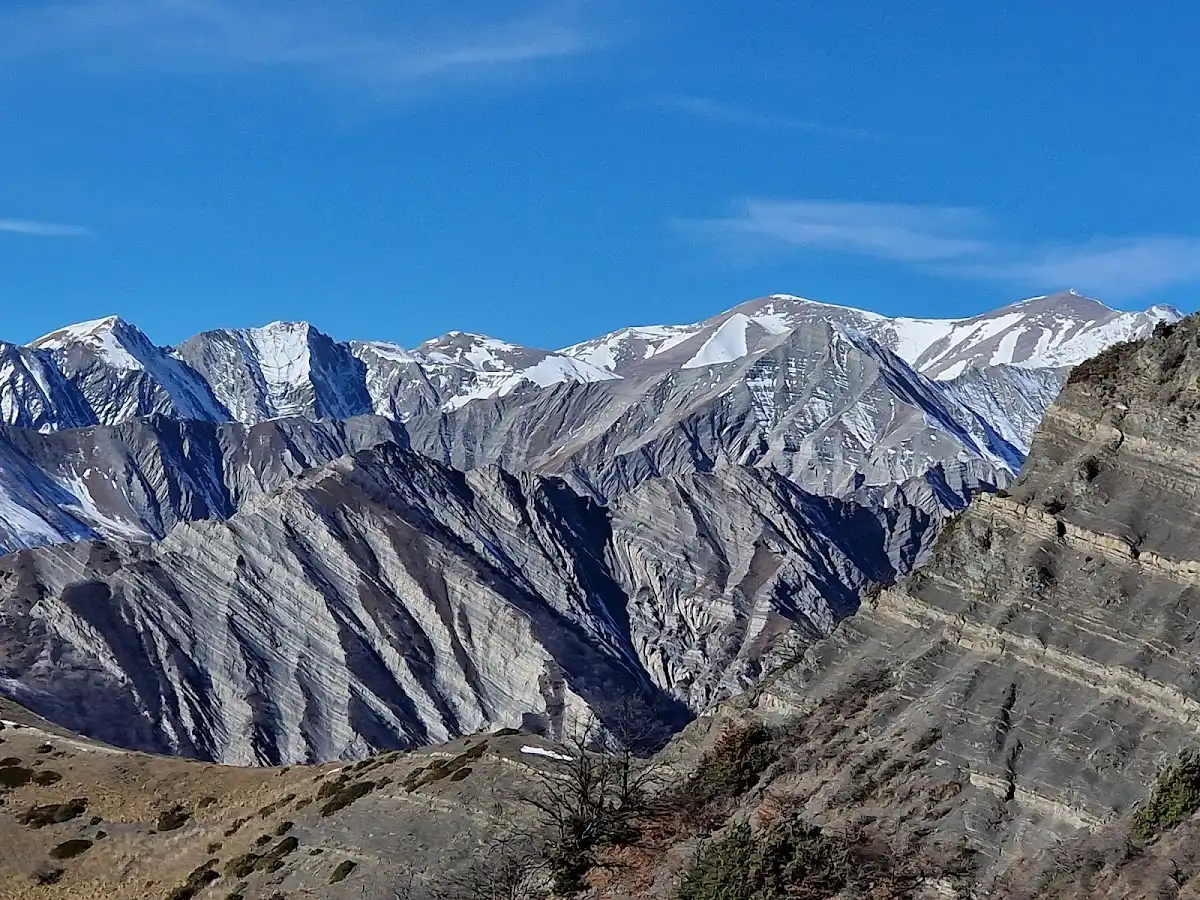
Azerbaijan packs unusual ecological range into a small country: dry steppe, Caspian shoreline, alpine ridges above 4,000 meters and the humid Hyrcanian forest in the southeast, a relict woodland that survived the last ice age. That variety, together with a Soviet tradition of strict nature reserves, gave the country a base of protected land that was later partly reorganized into national parks.

The system is still young, and the infrastructure is uneven. Trail marking, English-language information and public transport to park entrances are limited, and the national park label does not guarantee a visitor center or a staffed gate. Compared with Georgia next door, long-distance hiking culture is thin, so travelers should plan around ranger offices, local guides and taxis instead of assuming … read more 👉
Azerbaijan packs unusual ecological range into a small country: dry steppe, Caspian shoreline, alpine ridges above 4,000 meters and the humid Hyrcanian forest in the southeast, a relict woodland that survived the last ice age. That variety, together with a Soviet tradition of strict nature reserves, gave the country a base of protected land that was later partly reorganized into national parks.

The system is still young, and the infrastructure is uneven. Trail marking, English-language information and public transport to park entrances are limited, and the national park label does not guarantee a visitor center or a staffed gate. Compared with Georgia next door, long-distance hiking culture is thin, so travelers should plan around ranger offices, local guides and taxis instead of assuming a trail network.

Some territory is off limits or sensitive. Border zones with Armenia, Russia, Iran and Georgia can require permits, and areas recovered in the Karabakh region still contain landmines. Anyone choosing Azerbaijan for its parks should expect low prices, quiet landscapes and a country where hospitality is strong, but where self-sufficiency and some Russian or Azerbaijani phrases help considerably.
Our Approach to Ranking
The list of best national parks in Azerbaijan is created based on landscapes, wildlife, adventure opportunities, facilities, and overall experience. If you feel a national park is missing in this list, please let us know.

When to go?When to Plan Your Trip

Best months for national parks in Azerbaijan: May to June and September to October are the best months, because daytime temperatures in most regions sit between 15 and 28°C and mountain access is open. Lowland and coastal areas are comfortable then, while the high passes have usually lost their snow by late May.
Summer, winter and the shoulder seasons: July and August push the semi-desert and Caspian lowlands to 32 to 38°C with little shade, so steppe and coastal visits belong in early morning or in spring and autumn. The Greater Caucasus is the exception: at 1,500 to 2,500 meters, summer highs stay around 18 to 25°C, though afternoon storms are common. This is also when domestic visitors fill guesthouses on weekends, and prices in northern mountain towns rise by roughly 20 to 50 percent.

… read more 👉
Best months for national parks in Azerbaijan: May to June and September to October are the best months, because daytime temperatures in most regions sit between 15 and 28°C and mountain access is open. Lowland and coastal areas are comfortable then, while the high passes have usually lost their snow by late May.
Summer, winter and the shoulder seasons: July and August push the semi-desert and Caspian lowlands to 32 to 38°C with little shade, so steppe and coastal visits belong in early morning or in spring and autumn. The Greater Caucasus is the exception: at 1,500 to 2,500 meters, summer highs stay around 18 to 25°C, though afternoon storms are common. This is also when domestic visitors fill guesthouses on weekends, and prices in northern mountain towns rise by roughly 20 to 50 percent.

In the Talysh region of the southeast, rainfall is far higher than elsewhere, about 1,200 to 1,700 mm a year, with the wettest weather from September through November. Trails there turn muddy, and leeches and slick roots are normal. Around Baku and the central lowlands, annual rainfall is only about 200 to 300 mm.

From November to March, snow closes upper mountain roads and many trails in the north and west, and winter hotel prices climb only near ski areas. Lowland parks stay open and quiet, at 3 to 10°C, though fog and wind are frequent. Novruz in late March brings a national holiday week with crowded buses and booked rooms.

national park hoppingHow to Combine national parks Into One Trip

How many days to combine several parks: A trip linking several national parks in Azerbaijan needs 7 to 10 days, since road distances are long and mountain driving is slow. Baku is the natural hub, with the main airport, intercity buses and trains radiating from it.
Which regions group well: The Absheron peninsula and the steppe and coast south of Baku can be done in a day each, within 1 to 2.5 hours of the capital. The northern Greater Caucasus around Quba is 2.5 to 3.5 hours from Baku and links by road to the northwest foothills, another 3 to 4 hours onward. The Talysh forests in the south are 4 to 5 hours from Baku and sit apart from everything else, so they work as a separate leg or a standalone trip.

A clockwise or counterclockwise loop works better than returning to Baku between stops: … read more 👉
How many days to combine several parks: A trip linking several national parks in Azerbaijan needs 7 to 10 days, since road distances are long and mountain driving is slow. Baku is the natural hub, with the main airport, intercity buses and trains radiating from it.
Which regions group well: The Absheron peninsula and the steppe and coast south of Baku can be done in a day each, within 1 to 2.5 hours of the capital. The northern Greater Caucasus around Quba is 2.5 to 3.5 hours from Baku and links by road to the northwest foothills, another 3 to 4 hours onward. The Talysh forests in the south are 4 to 5 hours from Baku and sit apart from everything else, so they work as a separate leg or a standalone trip.

A clockwise or counterclockwise loop works better than returning to Baku between stops: out through the north, across the northwest and west, then back via Ganja by train or bus. Give mountain and forest stops 2 to 3 nights, and lowland stops a half day to one day.
Planning mistakes: The most common error is stacking the south and the northern mountains into the same three days, which means 8 to 10 hours of driving for little hiking time. Another is relying on marshrutkas to reach park gates. They usually stop in the nearest town, so budget for a shared taxi or a driver for the last 10 to 30 kilometers. Leave a spare day for weather, since rain closes mountain tracks.

The ListMust-Visit national parks in Azerbaijan

1 Gobustan National Park

rock carvings, mud volcanoes, semi-desert terrain

Trace ancient petroglyphs and wander among bubbling mud volcanoes in a stark landscape where human history and geology intersect.

2 Shahdag National Park

canyons, alpine meadows, glacial rivers

Trek along deep valleys and wildflower meadows, following cold streams that cut through the dramatic northern mountains.

azerbaijan-national-park-shahdag-national-park
© Google |

3 Goygol National Park

alpine lake, forested slopes, mountain vistas

Hike through dense forests to reach a clear mountain lake, surrounded by steep ridges and changing light throughout the day.

azerbaijan-national-park-goygol-national-park
© Google |

4 Hirkan National Park

Caspian forests, endemic flora, humid lowlands

Walk beneath broad-leaved trees in a humid subtropical forest, home to rare plant species and a dense, green canopy.

azerbaijan-national-park-hirkan-national-park
© Google |

5 Absheron National Park

coastal steppe, Caspian shoreline, migratory birds

Watch birdlife gather along the Caspian coast, where open steppe meets shallow lagoons and salt-tolerant plants thrive.

azerbaijan-national-park-absheron-national-park
© Google |

6 Shirvan National Park

semi-arid plains, gazelle habitat, saline lakes

Observe herds of gazelles moving across open plains, with distant salt lakes reflecting the sky in a dry, open landscape.

7 Altyaghach National Park

broadleaf woods, rolling hills, forest wildlife

Venture into undulating woodlands with scattered clearings, ideal for spotting deer and enjoying quiet, shaded trails.

8 Ag-Gol National Park

wetlands, reed beds, waterfowl colonies

Listen to the calls of nesting birds in a vast wetland, where reeds and shallow pools create a haven for migratory species.

9 Zangezur National Park

high-altitude plateaus, rare fauna, rugged peaks

Cross remote uplands where elusive animals roam, with panoramic views and a sense of isolation shaped by the harsh terrain.

Loading the map 🌍

Expert viewInsights from Locals and Experts

How many parks to visit: Two or three national parks is the right number for most backpackers. Road transfers between regions take 3 to 5 hours, and access to the gates is slow, so a fourth park usually means a day lost in transit. Choose one lowland or coastal park, one mountain park and, if time allows, one forest park in the south.
Prioritizing by travel style: Hikers should put the Caucasus mountain parks first, since they have the most walking and the best views. Travelers short on time or without a vehicle are better served by parks within a day trip of Baku, where a taxi return costs little. Anyone drawn to ecology and quiet should add the humid forest in the southeast, especially outside the wet autumn months. Wildlife is secretive in all of them, so do not plan around sightings.
What … read more 👉
How many parks to visit: Two or three national parks is the right number for most backpackers. Road transfers between regions take 3 to 5 hours, and access to the gates is slow, so a fourth park usually means a day lost in transit. Choose one lowland or coastal park, one mountain park and, if time allows, one forest park in the south.
Prioritizing by travel style: Hikers should put the Caucasus mountain parks first, since they have the most walking and the best views. Travelers short on time or without a vehicle are better served by parks within a day trip of Baku, where a taxi return costs little. Anyone drawn to ecology and quiet should add the humid forest in the southeast, especially outside the wet autumn months. Wildlife is secretive in all of them, so do not plan around sightings.
What it costs: A backpacker can manage on US$30 to 50 a day (AZN 50 to 85): hostel dorms in Baku run AZN 20 to 35 (US$12 to 20), rural guesthouses AZN 40 to 80 (US$24 to 47) with dinner often extra, and a local meal AZN 8 to 15 (US$5 to 9). Park entry fees are typically small, around AZN 2 to 10 (US$1 to 6) per person, and vehicles may be charged separately. A ranger or local guide for a day costs roughly AZN 40 to 100 (US$24 to 60). A private driver for a full day runs AZN 100 to 180 (US$60 to 105), and sharing it cuts the cost sharply. A realistic budget per park visit, including transport and a guide, is US$40 to 120.
Safety and cultural considerations: Hiking itself is low-risk, but infrastructure is thin: mobile signal drops in the mountains, rescue services are slow, and few trails are marked. Download offline maps, tell your guesthouse where you are going, and carry water and rain layers. Shepherd dogs near highland pastures can be aggressive, so keep distance and walk around flocks.

Stay out of border zones without the right permit and never leave established roads in areas recovered in the Karabakh region, where landmines remain. Official guidance should be checked before going anywhere near them.

In villages around the parks, modest clothing is appreciated, especially for women walking alone through settlements. Hosts will often offer tea or food, and refusing once politely is acceptable, though accepting is easier. Wild camping is not formally organized, so ask the ranger or landowner first and never light fires in dry months. Carry cash in manat, since cards are rarely accepted outside towns.

✈️ The backpacker research shortcutAzerbaijan Travel Guide

An offline-friendly backpacking guide with optimized travel routes, ranked highlights, transport advice, and the best areas to stay.
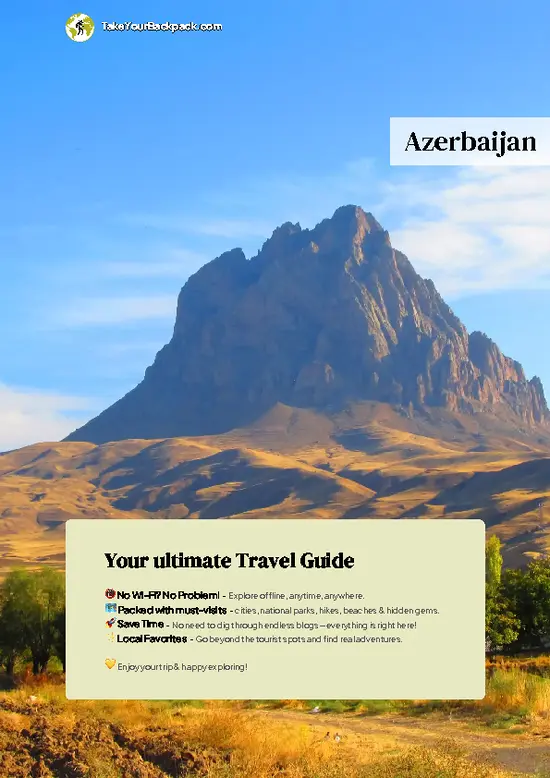
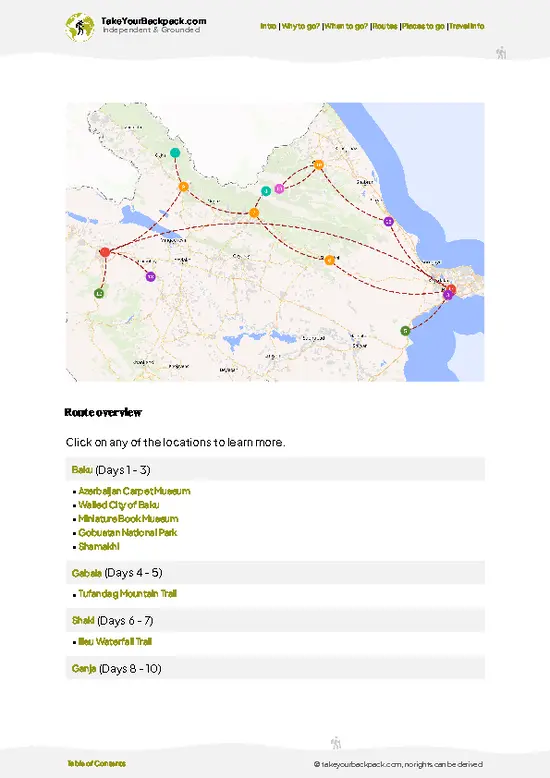
example page 0 from our offline Travel Guide for Azerbaijan
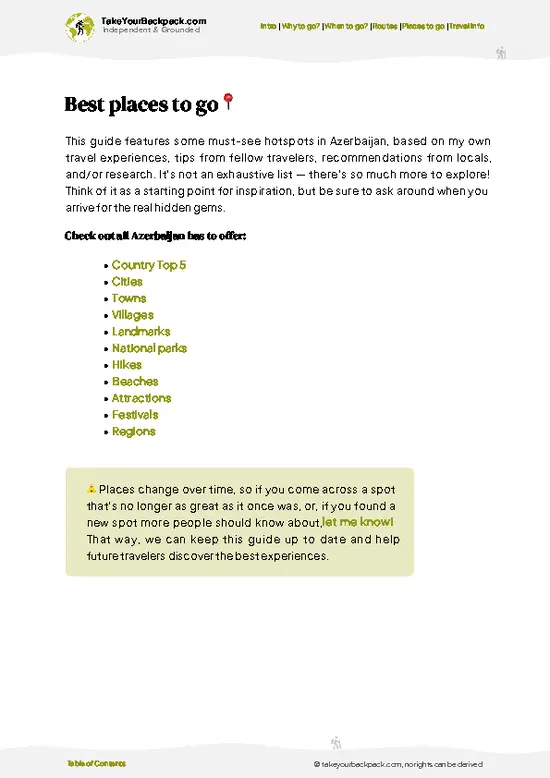
example page 1 from our offline Travel Guide for Azerbaijan
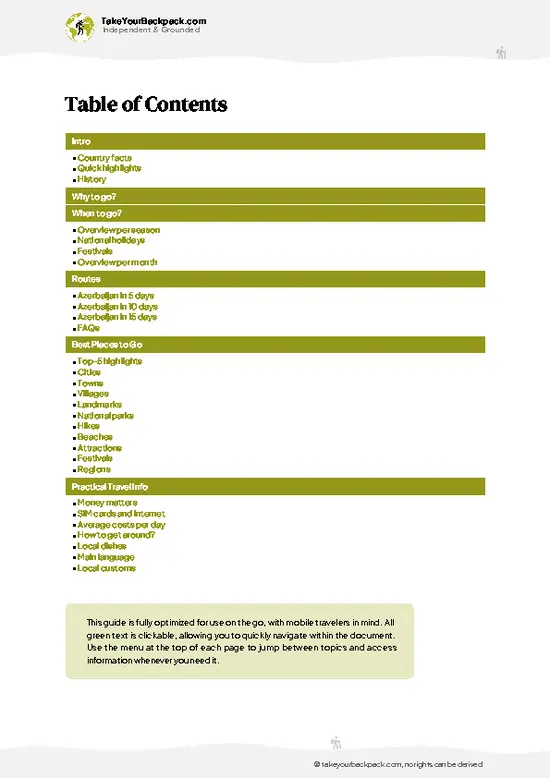
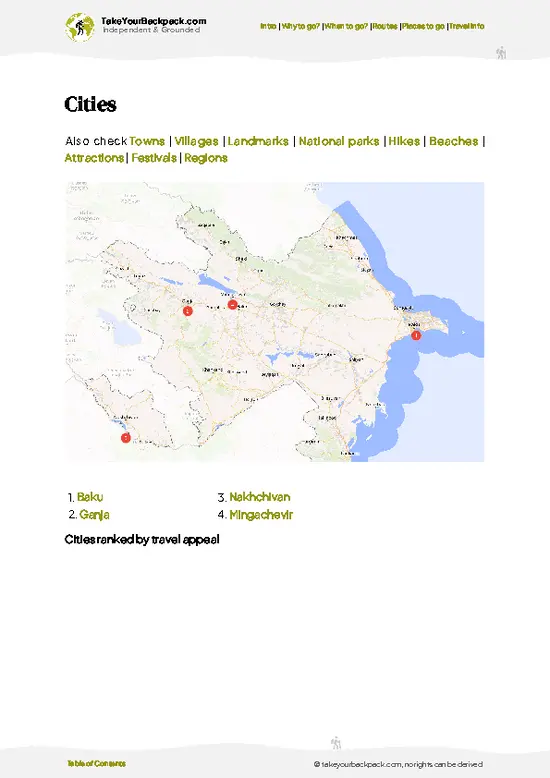
example page 2 from our offline Travel Guide for Azerbaijan
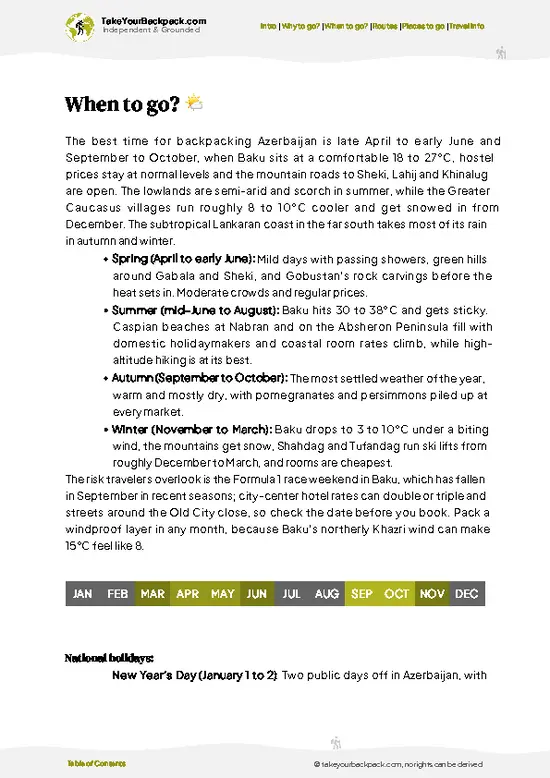
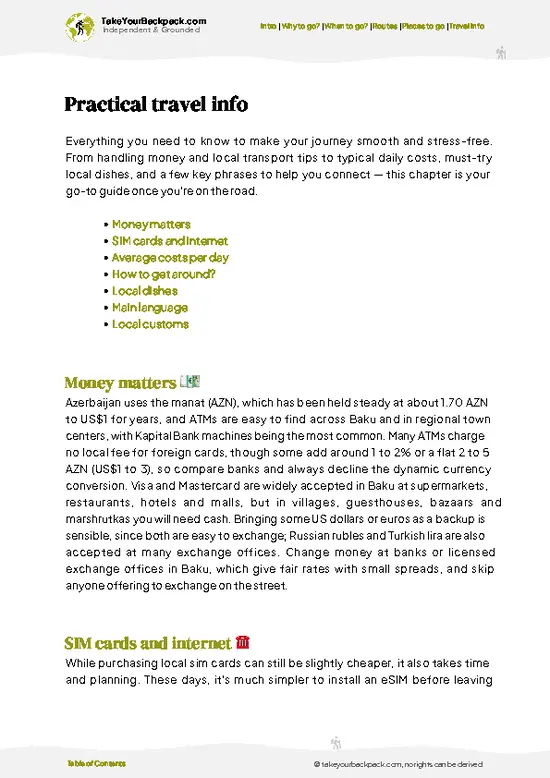
example page 3 from our offline Travel Guide for Azerbaijan
example page 4 from our offline Travel Guide for Azerbaijan
example page 5 from our offline Travel Guide for Azerbaijan
example page 6 from our offline Travel Guide for Azerbaijan
example page 7 from our offline Travel Guide for Azerbaijan
The digital guide (284 pages) contains:
✅ 71 highlights, ranked by travel appeal
✅ Optimized 5, 10 & 15-day travel routes
✅ Cities, national parks, landmarks, beaches
✅ How to get around
✅ Offline-friendly for travel without Wi-Fi
👉 Click to see all 30+ guide features

📅 Plan smarter in minutes, not weeks
✅ Month by month travel advice
✅ Festivals & national holidays
✅ Budget expectations

🗺️ Go to the right places, skip the overrated ones
✅ Honest pros & cons of destinations
✅ Top hikes, parks & viewpoints
✅ Lesser-known places most travelers miss
✅ Clear “worth it vs skip it” guidance

🛏️ Travel smoothly without rookie mistakes
✅ Best areas to stay
✅ Transport systems explained simply
✅ Common scams & safety advice
✅ SIM cards, money & practical tips

🌍 Understand the country, not just visit it
✅ Culture & traditions
✅ 52 Essential phrases & customs
✅ Festivals worth planning around
✅ Traveler-friendly historical context
✅ Insights that make places more meaningful

📱 Built for real travel conditions
✅ Fully downloadable PDF
✅ Works completely offline
✅ Optimized for phone use
✅ Useful in remote areas & buses
✅ Everything in one place
Stop searching, start planning
Get instant access to your full guide. 30‑day money-back guarantee.
+ Add another guide for just

By proceeding you agree to our terms.
Sent to your inbox immediately after payment • 100% Secure Checkout
Best Backpacking Travel Advisor 2025 tourism awardBest Backpacking
Travel Advisor
2025
What others say about Take Your Backpack Guides:
⭐⭐⭐⭐⭐
Fantastic, amazing amount of information!
⭐⭐⭐⭐⭐
My goodness this is amazing, it's what I've been looking for hats off too you!
⭐⭐⭐⭐⭐
I think this is absolutely BRILLIANT
⭐⭐⭐⭐
Very complete and informative. It's still missing places, but I gotta to commend you
⭐⭐⭐⭐⭐
This is truly amazing, thank you, can't wait to explore it with my kids!
⭐⭐⭐⭐⭐
Awesome resource, thank you!
⭐⭐⭐⭐⭐
This is amazing! Can't wait to explore the ones I haven't seen
⭐⭐⭐⭐
I love this! Well done, great idea.
⭐⭐⭐⭐⭐
Thanks for taking the time to make this gem!
⭐⭐⭐⭐⭐
This might be the best website I've ever seen.
⭐⭐⭐⭐⭐
Congratulations, and thank you so much for your work; it's incredibly valuable.
⭐⭐⭐⭐
In all seriousness I think you did a great job pointing out the important spots
⭐⭐⭐⭐⭐
10/10 very good
⭐⭐⭐⭐⭐
As someone who's only just starting to visit regularly this is awesome, thank you.
⭐⭐⭐⭐
Thank you very much! I'm going to visit my dad, it's going to be very useful!
⭐⭐⭐⭐⭐
This is really cool! We'll be travelling for the first time and this definitely come in handy.
⭐⭐⭐⭐⭐
You are now our minister of culture, congratulations 👨‍💼
⭐⭐⭐⭐⭐
Just wanted to tell you that this is a pearl! Going to follow your recommendations.
⭐⭐⭐⭐⭐
This is so cool. I'll definitely be using the resource for my travels soon.
⭐⭐⭐⭐⭐
This is very impressive! Good work.
⭐⭐⭐⭐⭐
This is an amazing and informative site. Very well done!

🛏️ Where to stay?Top Places to Consider Staying

Azerbaijan has plenty of hostels and guesthouses, mostly in Baku, where dorm beds typically run 15 to 30 AZN (about US$9 to 18) and private guesthouse rooms in Sheki or Gabala cost a little more. In Baku, the walled Old City (Icherisheher) puts you a short walk from the main sights and stays fairly quiet after dark, while the streets around Fountain Square and Nizami Street are livelier, with bars and late-night food steps away, though rooms there can be noisier. The area near 28 May metro and the railway station is cheaper and handy for the airport bus and the overnight train, but it has less character. All three areas are generally safe to walk at night.

If you enjoy meeting fellow travelers, … read more 👉
Azerbaijan has plenty of hostels and guesthouses, mostly in Baku, where dorm beds typically run 15 to 30 AZN (about US$9 to 18) and private guesthouse rooms in Sheki or Gabala cost a little more. In Baku, the walled Old City (Icherisheher) puts you a short walk from the main sights and stays fairly quiet after dark, while the streets around Fountain Square and Nizami Street are livelier, with bars and late-night food steps away, though rooms there can be noisier. The area near 28 May metro and the railway station is cheaper and handy for the airport bus and the overnight train, but it has less character. All three areas are generally safe to walk at night.

If you enjoy meeting fellow travelers, consider choosing hostels with high ratings for atmosphere. On the other hand, if you prefer having your own space, a hotel might be a better option.

AzerbaijanMore Places Across Azerbaijan

👋 Meet the founderWho’s Behind Take Your Backpack?

Johan, backpacker and founder of TakeYourBackpackHi, I’m Johan (Netherlands 🇳🇱), the creator of TakeYourBackpack. Over the past 3 decades, I’ve backpacked through 90+ countries across six continents, gaining extensive experience with independent travel, long-term trips, and overland routes.

This site is built on a combination of firsthand travel experience and carefully curated insights from other backpackers. Many guides are based on places I’ve personally visited, while others bring together tips, observations, and practical advice shared by trusted travelers I’ve met along the way.

The goal is to provide realistic, experience-driven guidance — not generic itineraries — so you can explore destinations with better context, clearer expectations, and more confidence.