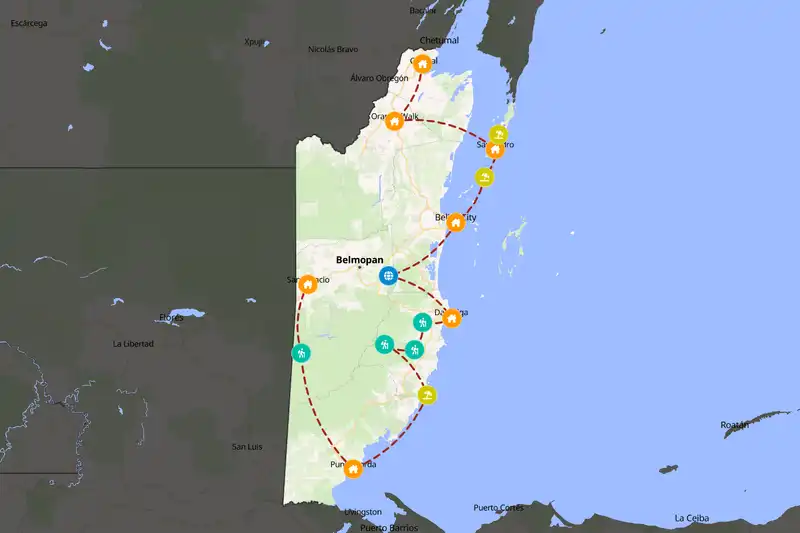
Yes, Belize is one of the easiest countries in Central America to backpack on your own: English is the official language, US dollars are accepted everywhere at a fixed rate of BZ$2 to US$1, and the main sights sit along a handful of bus and boat routes.
Most independent travelers link
Belize City,
San Ignacio,
Hopkins,
Placencia and
Caye Caulker without booking more than a few days ahead. Buses cost BZ$5 to 20 (US$2.50 to 10) per leg and water taxis to the cayes leave several times a day. The hurdle is cost: plan on US$45 to 70 a day, and sites like Actun Tunichil Muknal require a licensed guide (US$100 to 130).
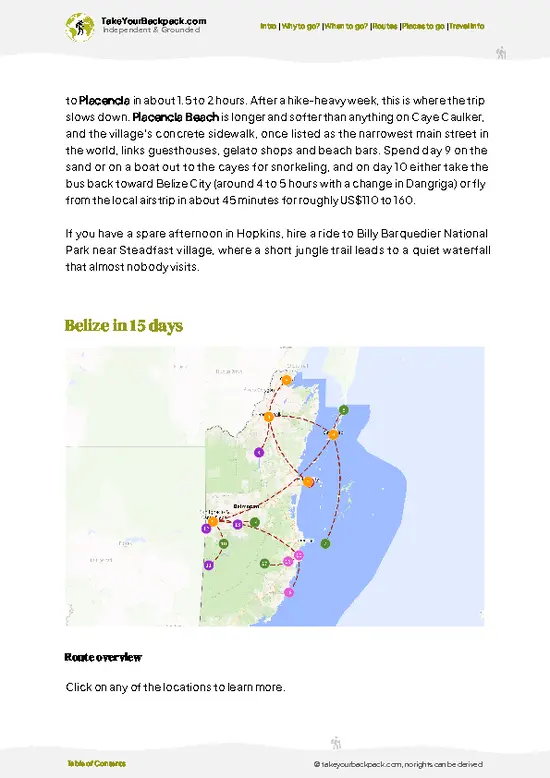
Ten days works well for a first trip to Belize, enough for the Cayo jungle, the southern coast and a few days on the reef without rushing.
With
5 days, stick to one region: either San Ignacio for caves and Maya ruins, or Caye Caulker and San Pedro for snorkeling. With
10 days, give three nights each to San Ignacio, Hopkins and Caye Caulker. With
14 to 15 days, add Lamanai in the north and Placencia in the south. Distances are short (Belize City to San Ignacio is 2 to 3 hours by bus), but tour days like ATM or Caracol take 8 to 10 hours.
Yes, you can travel Belize comfortably without a car, using local buses, water taxis and guided tours for the remote sites.
Buses run from
Belize City to
San Ignacio in 2 to 3 hours (about BZ$8 to 10, US$4 to 5) and to
Dangriga in about 3 hours, with taxis or shuttles covering the last 30 minutes to Hopkins. Water taxis reach
Caye Caulker in 45 minutes and
San Pedro in about 90 minutes, for roughly US$20 to 30 one way. Caracol and ATM need a tour, and domestic flights save time on the Placencia to Belize City leg (about 35 minutes).
The must-visits in Belize are Actun Tunichil Muknal cave, the barrier reef from Caye Caulker or San Pedro, and the Maya ruins of the Cayo District.
From
San Ignacio, give one day to
Actun Tunichil Muknal (US$100 to 130 with guide) and half a day to
Xunantunich, 20 minutes away by colectivo. On
Caye Caulker, a full-day snorkel trip to Hol Chan and Shark Ray Alley costs about US$80 to 110. If you have 10 days or more, add
Hopkins for Garifuna culture and
Cockscomb Basin Wildlife Sanctuary, and a boat up the New River to
Lamanai.
If you are short on time in Belize, skip overnights in Belize City and leave the far north and deep south for a future trip.
Go straight from the airport to San Ignacio (2 to 3 hours) or the water taxi to the cayes.
Corozal Town,
Sarteneja and
Punta Gorda each add a long travel day for fewer headline sights. Pick one island,
Caye Caulker for budget and atmosphere or
San Pedro for diving and restaurants, since both reach the same reef.
Victoria Peak is a guided expedition of three to four days, and Caracol takes a full 10-hour day, so it is the easiest ruin to drop if you have already seen Xunantunich.
Yes, our itinerary-planner does exactly that. Set your trip length in days, give your interests and travel style, optionally give start- and end location and/or some mandatory stops you would like to include and the itinerary planner creates your personalized routes for Belize in seconds. Try it out!
Try the itinerary plannerv2.webp)
 Best Backpacking