×

Belize🇧🇿 | best national parksTop-Rated 9 national parks in Belize

Belize protects its wild land in small, scattered patches, and the character shifts fast as you cross the country. In the Maya Mountains, national parks mean dripping broadleaf forest, the whine of cicadas, red mud on your boots and river crossings, with trails that need a guide or a long day on foot. Along the coast and the cayes, protected areas are marine reserves where you hear the boat engine before the water goes glassy turquoise. Facilities are basic, entry fees are modest, and crowds thin out once you leave the main highways. Independent travelers manage it well by bus, but the distances between parks are short and the roads slow.

By Johan Kruseman 🇳🇱 | Updated October 23, 2026
Explore the best hikes in Belize

Why go?Key Factors That Shape the Experience

Belize packs jungle, limestone caves, pine savanna, mangrove and the second-largest barrier reef in the world into a country about the size of Massachusetts. That compression is what makes it special for parks. Within a couple of hours you can swap humid canopy for salt air, and the Maya heritage sits inside the forest rather than apart from it, with temple stones and cave pottery found under the same trees that shelter howler monkeys. The country is also sparsely populated, with roughly 400,000 people, so large tracts remain intact. Protection is shared among the government, local NGOs and village co-management groups, which means facilities vary widely. Expect a simple visitor hut and a ranger in one place, and a gravel road with no signage in another. Before choosing Belize, know that public … read more 👉
Belize packs jungle, limestone caves, pine savanna, mangrove and the second-largest barrier reef in the world into a country about the size of Massachusetts. That compression is what makes it special for parks. Within a couple of hours you can swap humid canopy for salt air, and the Maya heritage sits inside the forest rather than apart from it, with temple stones and cave pottery found under the same trees that shelter howler monkeys. The country is also sparsely populated, with roughly 400,000 people, so large tracts remain intact. Protection is shared among the government, local NGOs and village co-management groups, which means facilities vary widely. Expect a simple visitor hut and a ranger in one place, and a gravel road with no signage in another. Before choosing Belize, know that public transport is limited to a few highways and that many parks are reached on rough dirt tracks, so a guide or shared shuttle is often needed. Mandatory guides apply in some areas, and costs add up faster than in Guatemala or Mexico. The climate adds its own texture: heat, bugs, sudden downpours and the smell of wet leaf litter are part of the deal. Bring sturdy footwear and patience, and the reward is wildlife that feels close at hand.
Why These Made the Cut
The list of best national parks in Belize is created based on landscapes, wildlife, adventure opportunities, facilities, and overall experience. If you feel a national park is missing in this list, please let us know.

When to go?Timing Your Visit for the Best Experience

Best months and the dry season: The best months for national parks in Belize are February to May, when the dry season keeps trails firm, rivers lower and skies clear for jungle and reef alike. Days run about 28 to 33°C (82 to 91°F), with mornings fresher and the forest crackling underfoot. Late dry season, especially April and May, is the hottest and driest, and the sun at midday is brutal.Wet season and shoulder months: The wet season runs roughly June to November. The south, around Toledo, gets the heaviest rain, often 3,000 to 4,000 mm a year, while the north is much drier at around 1,300 to 1,500 mm. Downpours arrive in short, loud bursts, trails turn to slick red clay, and rivers rise enough to close some crossings. Mosquitoes and sand flies thrive. Hurricane risk peaks from August to … read more 👉
Best months and the dry season: The best months for national parks in Belize are February to May, when the dry season keeps trails firm, rivers lower and skies clear for jungle and reef alike. Days run about 28 to 33°C (82 to 91°F), with mornings fresher and the forest crackling underfoot. Late dry season, especially April and May, is the hottest and driest, and the sun at midday is brutal.Wet season and shoulder months: The wet season runs roughly June to November. The south, around Toledo, gets the heaviest rain, often 3,000 to 4,000 mm a year, while the north is much drier at around 1,300 to 1,500 mm. Downpours arrive in short, loud bursts, trails turn to slick red clay, and rivers rise enough to close some crossings. Mosquitoes and sand flies thrive. Hurricane risk peaks from August to October, though direct hits are rare. June and July are a decent shoulder choice, with greener forest and fewer visitors, and November to January is cooler, 22 to 29°C (72 to 84°F), with occasional north-wind showers.Crowds and prices: Peak season runs December to April, and Christmas and Easter fill rooms and shuttles fastest. Lodging in the low season can drop by 20 to 40 percent, and guides are easier to book. Book ahead for the holidays, and carry a rain shell all year.

national park hoppingHow to Combine national parks Into One Trip

How many days to allow: A trip combining several national parks in Belize needs 7 to 12 days, which is enough to cover the interior and the coast without hurrying. Distances are short but roads are slow, so plan for time on the move.Which regions pair well: Group by region rather than hopping across the map. The western highlands around San Ignacio and the Cayo District work as one cluster, the central Maya Mountains and Hummingbird Highway as another, and the south around Placencia and Punta Gorda as a third. The cayes and offshore reserves are best done as a separate block by boat. A sensible direction is to enter by Belize City or the Guatemalan border, work through Cayo first, then move south and finish on the coast, where salt water rinses off the dust. Allow 2 to 3 days per area, since … read more 👉
How many days to allow: A trip combining several national parks in Belize needs 7 to 12 days, which is enough to cover the interior and the coast without hurrying. Distances are short but roads are slow, so plan for time on the move.Which regions pair well: Group by region rather than hopping across the map. The western highlands around San Ignacio and the Cayo District work as one cluster, the central Maya Mountains and Hummingbird Highway as another, and the south around Placencia and Punta Gorda as a third. The cayes and offshore reserves are best done as a separate block by boat. A sensible direction is to enter by Belize City or the Guatemalan border, work through Cayo first, then move south and finish on the coast, where salt water rinses off the dust. Allow 2 to 3 days per area, since early starts and slow rivers eat daylight. Typical travel times are 2 to 3 hours from Belize City to San Ignacio, 1 to 2 hours onward to the Hummingbird Highway, and 3 to 5 hours further south by bus.Common planning mistakes: The classic error is cramming a park into every day. Heat, humidity and muddy trails drain energy, so build in a rest day between big hikes. Another is assuming buses reach trailheads. Many stop on the highway, leaving a dusty walk or a pricey taxi, so arrange shuttles in advance. Also avoid tight ferry and flight connections, since weather can delay boats.

The ListThe Best national parks of Belize

1 Belize Barrier Reef Reserve System

Great Blue Hole, seven reef sites, cayes and atolls

Dive or snorkel a chain of protected reef sites, from the circular Great Blue Hole to calm shallows where nurse sharks and stingrays glide over sand.

belize-national-park-belize-barrier-reef-reserve-system
© Google | Ishmael Nicholson

2 Cockscomb Basin Wildlife Sanctuary

Jaguar reserve, Ben’s Bluff, creek tubing, night walks

Walk muddy forest trails past jaguar prints, climb to a lookout over the basin, then float South Stann Creek in an inner tube.

3 St. Herman’s Blue Hole National Park

Cold turquoise sinkhole, cave steps, Hummingbird Highway stop

Swim in a deep, cool sinkhole fed by an underground river, then climb stone steps to a limestone cave once used by the Maya.

belize-national-park-st-hermans-blue-hole-national-park
© Google |

4 Chiquibul National Park

Permit-only caves, scarlet macaws, Guatemala border forest

Join a licensed guide to reach vast cave passages and rainforest where macaws flock at dawn and jaguar and tapir leave tracks.

belize-national-park-chiquibul-national-park
© Google | Verde Speranza

5 Half Moon Caye

Booby colony, lighthouse atoll, wall dive, nesting turtles

Climb the treetop tower to watch red-footed boobies at eye level, then snorkel the reef wall just off the island’s white beach.

belize-national-park-half-moon-caye
© Google | Charlie C.

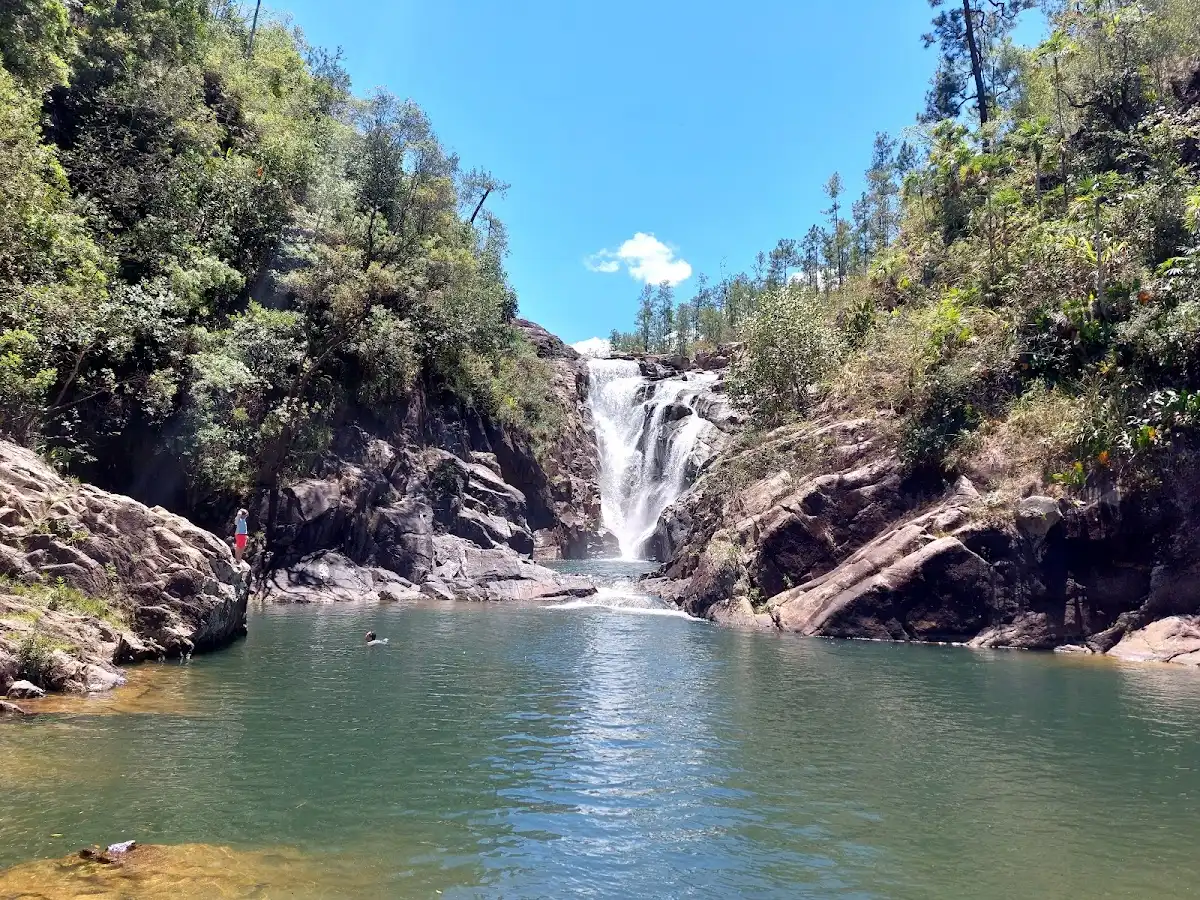
6 Mountain Pine Ridge Forest Reserve

Pine ridge, granite pools, Thousand Foot Falls, cave tunnel

Ride red gravel roads through pine forest to cold swimming pools, tall waterfalls and a river cave you can walk straight through.

belize-national-park-mountain-pine-ridge-forest-reserve
© Google |

7 Bacalar Chico National Park and Marine Reserve

Maya-cut canal, northern mangroves, Mexico border reef, empty beaches

Drift through a narrow mangrove canal, then snorkel the nearby barrier reef where stingrays, nurse sharks and turtles share shallow water far from the usual boat traffic.

belize-national-park-bacalar-chico-national-park-and-marine-reserve
© Google | Viince J

8 Guanacaste National Park

One giant tree, short loops, Belize River dip

Stand beneath a buttressed guanacaste tree draped in orchids, follow shaded loops with binoculars, then cool off in the Belize River.

belize-national-park-guanacaste-national-park
© Google | Fran's Kitchen

9 Shipstern Nature Reserve

Butterfly house, canopy tower, lagoon edge, spider monkeys

Scan the forest roof from a wooden tower, wander flat trails for spider monkeys and orchids, and visit the butterfly breeding center.

belize-national-park-shipstern-nature-reserve
© Google |
Loading the map 🌍

Expert viewWhat You Should Know

How many parks to visit: Visit three to five protected areas on a Belize trip. That is enough to taste forest, cave country and reef without spending every day in a van. Each one needs a half to full day once travel is counted, and the heat and humidity wear you down faster than the map suggests. Fewer, longer visits mean more time listening for toucans at dawn and less time on gravel roads.Choosing between kinds: If you like wildlife and quiet, pick rainforest reserves, where mornings are loud with howlers and birdsong and the air smells of wet bark. If you want something physical, choose cave and river parks, which involve wading, swimming and a headlamp. For a first trip with limited cash, pair one jungle park with one marine reserve and skip the rest. Reef days are the costliest, since … read more 👉
How many parks to visit: Visit three to five protected areas on a Belize trip. That is enough to taste forest, cave country and reef without spending every day in a van. Each one needs a half to full day once travel is counted, and the heat and humidity wear you down faster than the map suggests. Fewer, longer visits mean more time listening for toucans at dawn and less time on gravel roads.Choosing between kinds: If you like wildlife and quiet, pick rainforest reserves, where mornings are loud with howlers and birdsong and the air smells of wet bark. If you want something physical, choose cave and river parks, which involve wading, swimming and a headlamp. For a first trip with limited cash, pair one jungle park with one marine reserve and skip the rest. Reef days are the costliest, since a boat is mandatory. Culture-minded travelers should lean toward parks where Maya sites sit inside the forest, so the climb up a mossy stone stair and the view over the canopy come together.What it costs: Budget US$50 to 90 a day for a backpacker mixing hostels, street food and a park visit, which is higher than neighboring countries. Entry fees run about BZ$10 to 40 (US$5 to 20) for most land parks, and marine reserve fees are typically BZ$10 to 20 (US$5 to 10) on top of the boat. Guides cost roughly US$40 to 100 per person for a half or full day, often shared by a group, and cave tours with gear can reach US$60 to 120. Local transport adds US$2 to 6 per bus leg, and taxis or shuttles to trailheads US$10 to 40 split between riders. Belize dollars are fixed at 2 to 1 with the US dollar, so most places take either. Carry small cash, because card machines are rare at ranger huts, and a day with a guide you enjoy is the best money you will spend.Safety and cultural notes: Hiring a licensed guide is required in some areas and wise in all caves. Rivers rise quickly after rain, so check conditions before any crossing. Carry two liters of water per person, insect repellent and a rain layer, and watch your step for snakes, including the venomous fer-de-lance, which is well camouflaged on forest floors. Petty theft happens at trailhead parking areas, so leave nothing visible in a vehicle and travel in daylight. Stay on marked trails and do not touch cave formations or pottery, since many are sacred Maya sites. In village-run reserves, greet people, ask before photographing, and buy a snack or craft locally. Reef visitors should use mineral sunscreen and never stand on coral.

✈️ The backpacker research shortcutBelize Travel Guide

An offline-friendly backpacking guide with optimized travel routes, ranked highlights, transport advice, and the best areas to stay.
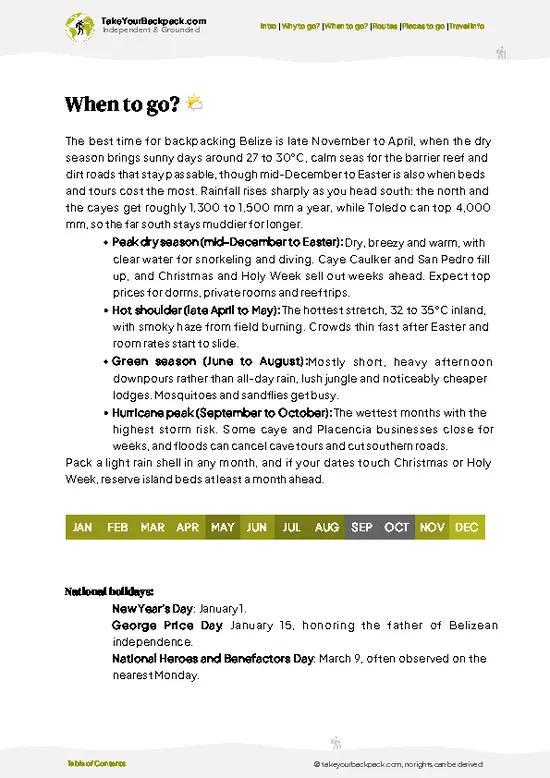
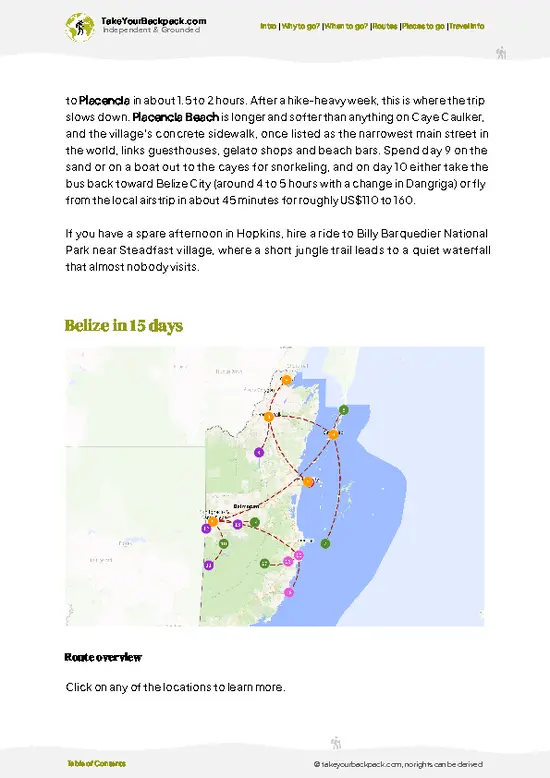
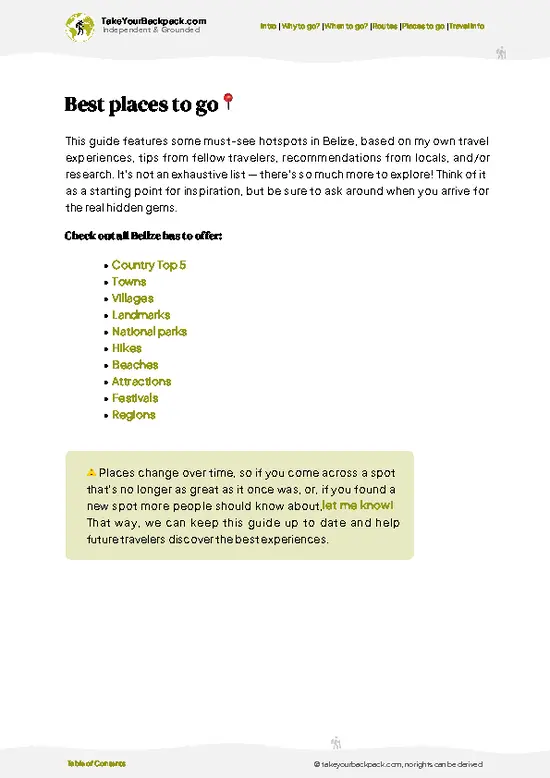
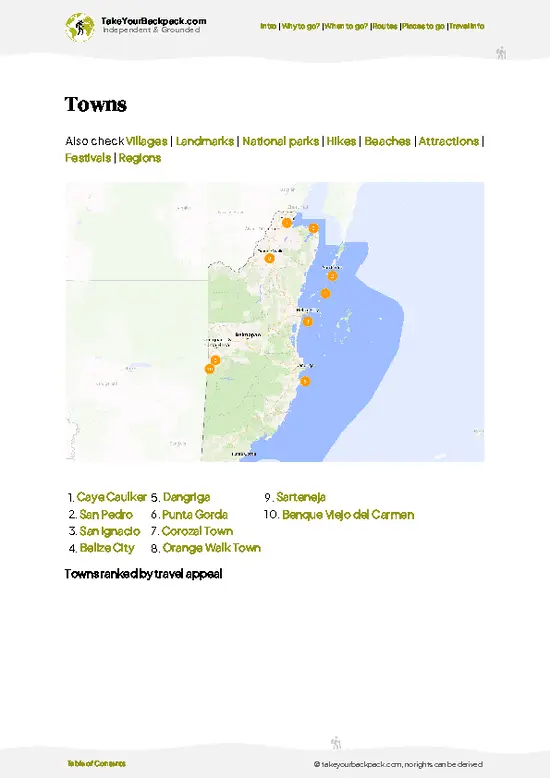
example page 0 from our offline Travel Guide for Belize
example page 1 from our offline Travel Guide for Belize
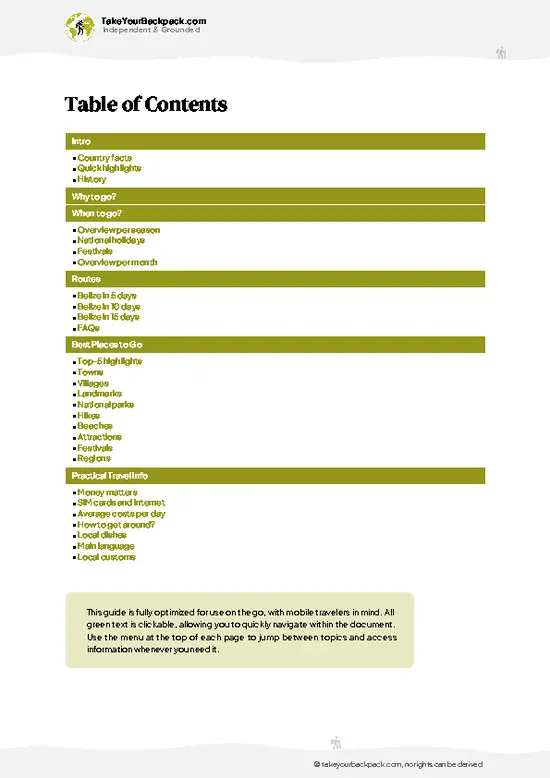
example page 2 from our offline Travel Guide for Belize
example page 3 from our offline Travel Guide for Belize
example page 4 from our offline Travel Guide for Belize
example page 5 from our offline Travel Guide for Belize
example page 6 from our offline Travel Guide for Belize
example page 7 from our offline Travel Guide for Belize
The digital guide (168 pages) contains:
✅ 44 highlights, ranked by travel appeal
✅ Optimized 5, 10 & 15-day travel routes
✅ Cities, national parks, landmarks, beaches
✅ How to get around
✅ Offline-friendly for travel without Wi-Fi
👉 Click to see all 30+ guide features

📅 Plan smarter in minutes, not weeks
✅ Month by month travel advice
✅ Festivals & national holidays
✅ Budget expectations

🗺️ Go to the right places, skip the overrated ones
✅ Honest pros & cons of destinations
✅ Top hikes, parks & viewpoints
✅ Lesser-known places most travelers miss
✅ Clear “worth it vs skip it” guidance

🛏️ Travel smoothly without rookie mistakes
✅ Best areas to stay
✅ Transport systems explained simply
✅ Common scams & safety advice
✅ SIM cards, money & practical tips

🌍 Understand the country, not just visit it
✅ Culture & traditions
✅ 52 Essential phrases & customs
✅ Festivals worth planning around
✅ Traveler-friendly historical context
✅ Insights that make places more meaningful

📱 Built for real travel conditions
✅ Fully downloadable PDF
✅ Works completely offline
✅ Optimized for phone use
✅ Useful in remote areas & buses
✅ Everything in one place
Stop searching, start planning
Get instant access to your full guide. 30‑day money-back guarantee.
+ Add another guide for just

By proceeding you agree to our terms.
Sent to your inbox immediately after payment • 100% Secure Checkout
Best Backpacking Travel Advisor 2025 tourism awardBest Backpacking
Travel Advisor
2025
What others say about Take Your Backpack Guides:
⭐⭐⭐⭐⭐
Fantastic, amazing amount of information!
⭐⭐⭐⭐⭐
My goodness this is amazing, it's what I've been looking for hats off too you!
⭐⭐⭐⭐⭐
I think this is absolutely BRILLIANT
⭐⭐⭐⭐
Very complete and informative. It's still missing places, but I gotta to commend you
⭐⭐⭐⭐⭐
This is truly amazing, thank you, can't wait to explore it with my kids!
⭐⭐⭐⭐⭐
Awesome resource, thank you!
⭐⭐⭐⭐⭐
This is amazing! Can't wait to explore the ones I haven't seen
⭐⭐⭐⭐
I love this! Well done, great idea.
⭐⭐⭐⭐⭐
Thanks for taking the time to make this gem!
⭐⭐⭐⭐⭐
This might be the best website I've ever seen.
⭐⭐⭐⭐⭐
Congratulations, and thank you so much for your work; it's incredibly valuable.
⭐⭐⭐⭐
In all seriousness I think you did a great job pointing out the important spots
⭐⭐⭐⭐⭐
10/10 very good
⭐⭐⭐⭐⭐
As someone who's only just starting to visit regularly this is awesome, thank you.
⭐⭐⭐⭐
Thank you very much! I'm going to visit my dad, it's going to be very useful!
⭐⭐⭐⭐⭐
This is really cool! We'll be travelling for the first time and this definitely come in handy.
⭐⭐⭐⭐⭐
You are now our minister of culture, congratulations 👨‍💼
⭐⭐⭐⭐⭐
Just wanted to tell you that this is a pearl! Going to follow your recommendations.
⭐⭐⭐⭐⭐
This is so cool. I'll definitely be using the resource for my travels soon.
⭐⭐⭐⭐⭐
This is very impressive! Good work.
⭐⭐⭐⭐⭐
This is an amazing and informative site. Very well done!

🛏️ Where to stay?Best Stay Options in Belize

Belize has hostels and budget guesthouses, with dorm beds usually around BZ$40 to 70 (US$20 to 35) and simple private rooms from roughly BZ$80 to 140 (US$40 to 70), though prices run higher than in neighboring Guatemala or Mexico. Caye Caulker has the densest cluster of backpacker beds, a walkable island with easy snorkel trips and a lively bar scene around the Split, while San Ignacio in the Cayo District is quieter, cheaper and close to Maya ruins and caves, and Placencia and Hopkins on the south coast offer calmer beach stays with fewer dorm options. Belize City has some budget rooms near the water taxi terminal, but most travelers treat it as a one-night transit stop because several neighborhoods … read more 👉
Belize has hostels and budget guesthouses, with dorm beds usually around BZ$40 to 70 (US$20 to 35) and simple private rooms from roughly BZ$80 to 140 (US$40 to 70), though prices run higher than in neighboring Guatemala or Mexico. Caye Caulker has the densest cluster of backpacker beds, a walkable island with easy snorkel trips and a lively bar scene around the Split, while San Ignacio in the Cayo District is quieter, cheaper and close to Maya ruins and caves, and Placencia and Hopkins on the south coast offer calmer beach stays with fewer dorm options. Belize City has some budget rooms near the water taxi terminal, but most travelers treat it as a one-night transit stop because several neighborhoods there are unsafe after dark.

If you enjoy meeting fellow travelers, consider choosing hostels with high ratings for atmosphere. On the other hand, if you prefer having your own space, a hotel might be a better option.

BelizeWhere to Go Next

👋 Meet the founderWho’s Behind Take Your Backpack?

Johan, backpacker and founder of TakeYourBackpackHi, I’m Johan (Netherlands 🇳🇱), the creator of TakeYourBackpack. Over the past 3 decades, I’ve backpacked through 90+ countries across six continents, gaining extensive experience with independent travel, long-term trips, and overland routes.

This site is built on a combination of firsthand travel experience and carefully curated insights from other backpackers. Many guides are based on places I’ve personally visited, while others bring together tips, observations, and practical advice shared by trusted travelers I’ve met along the way.

The goal is to provide realistic, experience-driven guidance — not generic itineraries — so you can explore destinations with better context, clearer expectations, and more confidence.