×

Belize🇧🇿 | best attractionsTop-Rated attractions in Belize

Belize packs jungle ruins, barrier reef water and limestone caves into a country roughly the size of Massachusetts, and the feel changes fast. Inland in Cayo, you walk into green, humid shade full of howler monkey roars, wet stone and the smell of damp leaf litter, with entry fees around US$10 to 20. Out on the cays, salt wind and glare replace the shade, and reef trips cost US$80 to 150 or more. Roads are short but rough, buses are old school buses, and the south is quiet. Independent travel works well here, though tours often save time.

By Johan Kruseman 🇳🇱 | Updated October 23, 2026
Explore the best festivals in Belize

Why go?Key Factors That Shape the Experience

Belize works for attractions because a lot of very different ecosystems sit close together. The Caribbean coast runs along the second-largest barrier reef system in the world, while behind it the land rises through pine ridge and broadleaf rainforest to the limestone Maya Mountains, where rivers have carved caves. That compactness means you can wake to the clatter of a jungle dawn and be wading warm turquoise shallows by evening. The Maya heritage is also real and layered. Ancient cities were built in the same forests that still surround them, so many sites feel like clearings in working jungle, with mud on the paths and cicadas drowning out conversation.

Before you commit, know that Belize is expensive for Central America. The Belize dollar is pegged at 2 to 1 against the US dollar, and … read more 👉
Belize works for attractions because a lot of very different ecosystems sit close together. The Caribbean coast runs along the second-largest barrier reef system in the world, while behind it the land rises through pine ridge and broadleaf rainforest to the limestone Maya Mountains, where rivers have carved caves. That compactness means you can wake to the clatter of a jungle dawn and be wading warm turquoise shallows by evening. The Maya heritage is also real and layered. Ancient cities were built in the same forests that still surround them, so many sites feel like clearings in working jungle, with mud on the paths and cicadas drowning out conversation.

Before you commit, know that Belize is expensive for Central America. The Belize dollar is pegged at 2 to 1 against the US dollar, and prices are generally quoted in either. Because many sites are protected, you often need a licensed guide or an operator for caves, reef and some reserves, which adds cost. Infrastructure is thin outside the main corridors, with few paved side roads, patchy signage and long waits for the occasional bus. In return you get small crowds, English as the working language, and a country where nature is the main event rather than a backdrop.
How the List Was Created
The list of best attractions in Belize is created based on cultural significance or entertainment value. If you feel a attraction is missing in this list, please let us know.

When to go?Timing Your Visit for the Best Experience

Best months and the dry season: The best months for attractions in Belize are February to May, when the dry season brings clear water, firm trails and the least rain. Days run about 28 to 32°C (82 to 90°F), with a steady sea breeze on the coast, and rivers drop to a level that makes cave and jungle trips easier. By April and May the inland heat gets heavy and the air smells of dust and smoke from burning fields, but the visibility on the reef is at its best.
Shoulder and wet season: November to January is a lovely shoulder period. Rain still comes in short bursts, the forest is lush, and from mid-December to early January prices rise and rooms fill up. Treat that stretch as peak, and book ahead, since beds on the cays can cost 20 to 40 percent more. June to October is the wet season, with heavy … read more 👉
Best months and the dry season: The best months for attractions in Belize are February to May, when the dry season brings clear water, firm trails and the least rain. Days run about 28 to 32°C (82 to 90°F), with a steady sea breeze on the coast, and rivers drop to a level that makes cave and jungle trips easier. By April and May the inland heat gets heavy and the air smells of dust and smoke from burning fields, but the visibility on the reef is at its best.
Shoulder and wet season: November to January is a lovely shoulder period. Rain still comes in short bursts, the forest is lush, and from mid-December to early January prices rise and rooms fill up. Treat that stretch as peak, and book ahead, since beds on the cays can cost 20 to 40 percent more. June to October is the wet season, with heavy afternoon downpours, mud on jungle tracks, and swollen rivers that can close some caves or roads for days. Rainfall is far higher in the south, in Toledo, where it can top 3,000 mm a year, than in the north, which gets roughly 1,300 to 1,500 mm. Hurricane risk peaks from August to October, mostly along the coast. In exchange, rooms are cheaper, crowds are thin and the forest is intensely green.

attraction hoppingHow to Combine attractions Into One Trip

How long you need: A trip combining several attractions in Belize needs 7 to 14 days, and 10 days is comfortable for most backpackers. The country is small, but the roads are slow, and a 100 km (60 mile) hop can take 2 to 3 hours.
Which regions cluster, and which way to go: The inland west around San Ignacio and the Cayo district pairs easily with Belize City, which is the transport hub. Go west first, then loop to the coast and the cays, since you end the trip with salt water and sandy feet rather than jungle mud. Belize City to San Ignacio takes about 2 hours by bus, and to the water taxi terminal about 15 minutes. Boats to Caye Caulker take 45 minutes to an hour. The south, around Dangriga, Hopkins and Punta Gorda, is a separate leg. Ride the Southern Highway for 3 to 5 hours, and set aside … read more 👉
How long you need: A trip combining several attractions in Belize needs 7 to 14 days, and 10 days is comfortable for most backpackers. The country is small, but the roads are slow, and a 100 km (60 mile) hop can take 2 to 3 hours.
Which regions cluster, and which way to go: The inland west around San Ignacio and the Cayo district pairs easily with Belize City, which is the transport hub. Go west first, then loop to the coast and the cays, since you end the trip with salt water and sandy feet rather than jungle mud. Belize City to San Ignacio takes about 2 hours by bus, and to the water taxi terminal about 15 minutes. Boats to Caye Caulker take 45 minutes to an hour. The south, around Dangriga, Hopkins and Punta Gorda, is a separate leg. Ride the Southern Highway for 3 to 5 hours, and set aside at least 3 to 4 days there.
Pacing and common mistakes: Allow 2 to 4 nights per base so you can do 2 or 3 outings from it, such as a day on the reef or a day inland. The usual mistakes are packing in too many stops, relying on late buses (the last ones often leave mid-afternoon), and booking a flight home the same day as a remote tour. Build one slack day before departure, and use water taxis or shuttles for the longer hauls.

The ListThe Best attractions of Belize

1 Museum of Belize

Former colonial prison, Maya jade and ceramics, slavery history, pinned insects and old stamps

Walk through barred doors and narrow cells to see Maya jade, painted pots, obsidian blades and carved stelae, then colonial-era objects, in about two hours.

belize-attraction-museum-of-belize
© Google |
Loading the map 🌍

Expert viewWhat You Should Know

How many to visit: I would advise 4 to 6 attractions in a typical 10 day trip, no more. Each outing takes most of a day once you count transport, a guide briefing and the slow ride back, and the wet heat saps energy faster than you expect. Fewer stops mean you actually see the howler monkeys at first light or the glassy water inside the reef, instead of watching them from a van window.
Choosing by travel style: If you love history and walking, put the Maya sites and jungle trails first, since they are cheaper and quieter at opening time. If water is your priority, spend more on the reef, because a good snorkel or dive trip is where the money goes furthest, with turquoise shallows and the warm hum of a boat engine. Cave lovers should budget for a licensed guide, because cave entry without one … read more 👉
How many to visit: I would advise 4 to 6 attractions in a typical 10 day trip, no more. Each outing takes most of a day once you count transport, a guide briefing and the slow ride back, and the wet heat saps energy faster than you expect. Fewer stops mean you actually see the howler monkeys at first light or the glassy water inside the reef, instead of watching them from a van window.
Choosing by travel style: If you love history and walking, put the Maya sites and jungle trails first, since they are cheaper and quieter at opening time. If water is your priority, spend more on the reef, because a good snorkel or dive trip is where the money goes furthest, with turquoise shallows and the warm hum of a boat engine. Cave lovers should budget for a licensed guide, because cave entry without one is not allowed at most sites and the dark, cold, wet passages are not forgiving. Anyone short on cash should lean inland.
What it costs: Plan on US$60 to 110 a day for a backpacker who mixes cheap eating with a paid outing or two. Dorms run US$15 to 30, local meals US$5 to 10, and buses US$3 to 10 per leg. Ruin entries are usually US$10 to 20 for foreigners, caves with a guide US$60 to 100, and reef snorkeling or diving US$80 to 150 or more per trip. Marine park fees are an extra US$10 to 20 or so, and paid in cash. Carry small bills, because many offices and boat captains cannot make change. Prices are quoted in both Belize dollars and US dollars, so check which one you are being told.
Safety and respect: Petty theft and occasional crime exist in Belize City, so keep valuables out of sight and use taxis after dark. At sites, stay on marked paths, and never climb on structures where it is banned, since the stone is fragile and slippery after rain. Sun is strong, so reef-safe sunscreen is the right choice, and never touch coral. Use insect repellent for mosquitoes, particularly at dusk. Many Maya villages and sacred places are still in use, so ask before photographing people, dress modestly away from the coast, and tip guides 10 to 20 percent, since it is a real part of their income.

✈️ The backpacker research shortcutBelize Travel Guide

An offline-friendly backpacking guide with optimized travel routes, ranked highlights, transport advice, and the best areas to stay.
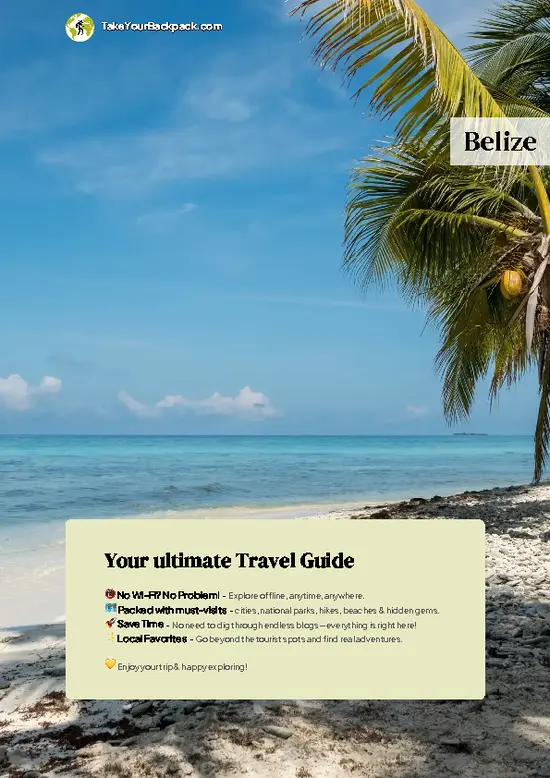
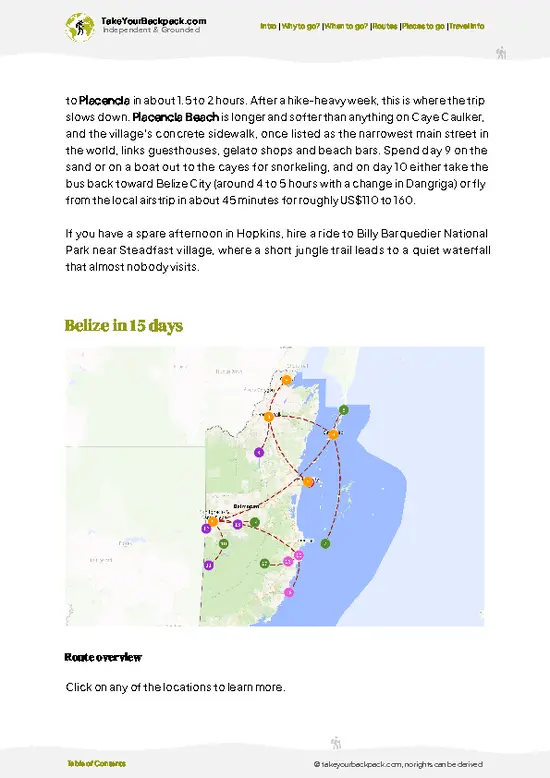
example page 0 from our offline Travel Guide for Belize
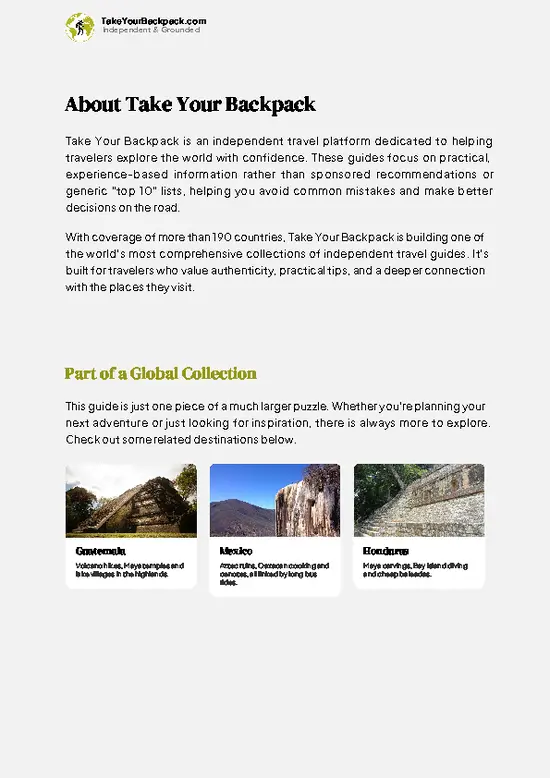
example page 1 from our offline Travel Guide for Belize
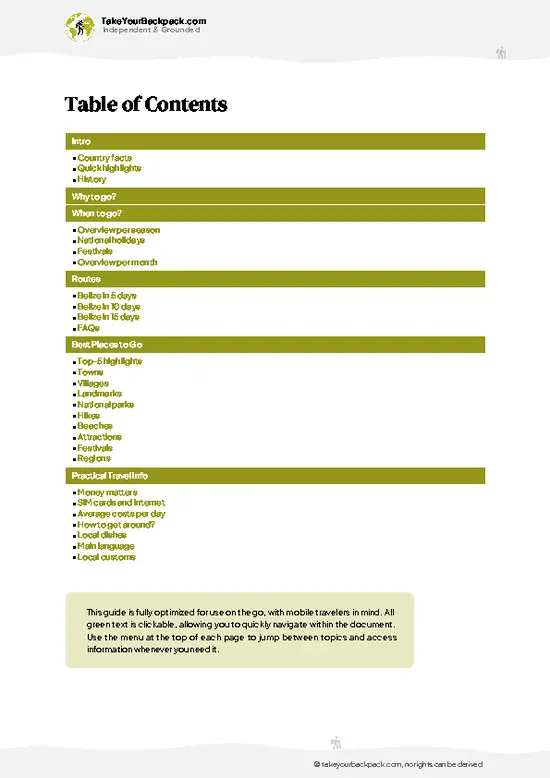
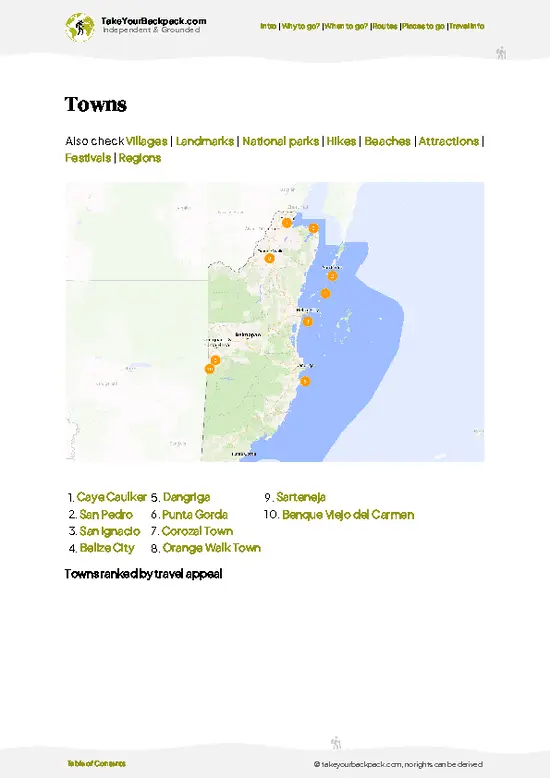
example page 2 from our offline Travel Guide for Belize
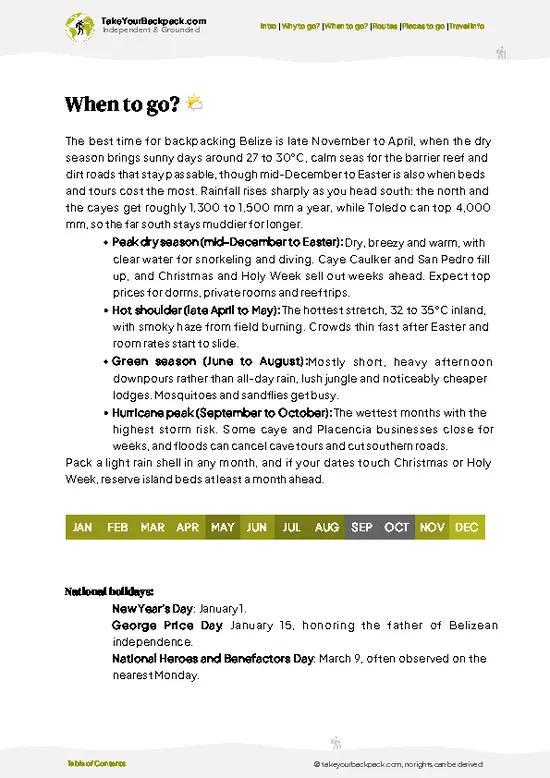
example page 3 from our offline Travel Guide for Belize
example page 4 from our offline Travel Guide for Belize
example page 5 from our offline Travel Guide for Belize
example page 6 from our offline Travel Guide for Belize
example page 7 from our offline Travel Guide for Belize
The digital guide (168 pages) contains:
✅ 44 highlights, ranked by travel appeal
✅ Optimized 5, 10 & 15-day travel routes
✅ Cities, national parks, landmarks, beaches
✅ How to get around
✅ Offline-friendly for travel without Wi-Fi
👉 Click to see all 30+ guide features

📅 Plan smarter in minutes, not weeks
✅ Month by month travel advice
✅ Festivals & national holidays
✅ Budget expectations

🗺️ Go to the right places, skip the overrated ones
✅ Honest pros & cons of destinations
✅ Top hikes, parks & viewpoints
✅ Lesser-known places most travelers miss
✅ Clear “worth it vs skip it” guidance

🛏️ Travel smoothly without rookie mistakes
✅ Best areas to stay
✅ Transport systems explained simply
✅ Common scams & safety advice
✅ SIM cards, money & practical tips

🌍 Understand the country, not just visit it
✅ Culture & traditions
✅ 52 Essential phrases & customs
✅ Festivals worth planning around
✅ Traveler-friendly historical context
✅ Insights that make places more meaningful

📱 Built for real travel conditions
✅ Fully downloadable PDF
✅ Works completely offline
✅ Optimized for phone use
✅ Useful in remote areas & buses
✅ Everything in one place
Stop searching, start planning
Get instant access to your full guide. 30‑day money-back guarantee.
+ Add another guide for just

By proceeding you agree to our terms.
Sent to your inbox immediately after payment • 100% Secure Checkout
Best Backpacking Travel Advisor 2025 tourism awardBest Backpacking
Travel Advisor
2025
What others say about Take Your Backpack Guides:
⭐⭐⭐⭐⭐
Fantastic, amazing amount of information!
⭐⭐⭐⭐⭐
My goodness this is amazing, it's what I've been looking for hats off too you!
⭐⭐⭐⭐⭐
I think this is absolutely BRILLIANT
⭐⭐⭐⭐
Very complete and informative. It's still missing places, but I gotta to commend you
⭐⭐⭐⭐⭐
This is truly amazing, thank you, can't wait to explore it with my kids!
⭐⭐⭐⭐⭐
Awesome resource, thank you!
⭐⭐⭐⭐⭐
This is amazing! Can't wait to explore the ones I haven't seen
⭐⭐⭐⭐
I love this! Well done, great idea.
⭐⭐⭐⭐⭐
Thanks for taking the time to make this gem!
⭐⭐⭐⭐⭐
This might be the best website I've ever seen.
⭐⭐⭐⭐⭐
Congratulations, and thank you so much for your work; it's incredibly valuable.
⭐⭐⭐⭐
In all seriousness I think you did a great job pointing out the important spots
⭐⭐⭐⭐⭐
10/10 very good
⭐⭐⭐⭐⭐
As someone who's only just starting to visit regularly this is awesome, thank you.
⭐⭐⭐⭐
Thank you very much! I'm going to visit my dad, it's going to be very useful!
⭐⭐⭐⭐⭐
This is really cool! We'll be travelling for the first time and this definitely come in handy.
⭐⭐⭐⭐⭐
You are now our minister of culture, congratulations 👨‍💼
⭐⭐⭐⭐⭐
Just wanted to tell you that this is a pearl! Going to follow your recommendations.
⭐⭐⭐⭐⭐
This is so cool. I'll definitely be using the resource for my travels soon.
⭐⭐⭐⭐⭐
This is very impressive! Good work.
⭐⭐⭐⭐⭐
This is an amazing and informative site. Very well done!

🛏️ Where to stay?Where to Stay: Belize Edition

Belize has hostels and budget guesthouses, with dorm beds usually around BZ$40 to 70 (US$20 to 35) and simple private rooms from roughly BZ$80 to 140 (US$40 to 70), though prices run higher than in neighboring Guatemala or Mexico. Caye Caulker has the densest cluster of backpacker beds, a walkable island with easy snorkel trips and a lively bar scene around the Split, while San Ignacio in the Cayo District is quieter, cheaper and close to Maya ruins and caves, and Placencia and Hopkins on the south coast offer calmer beach stays with fewer dorm options. Belize City has some budget rooms near the water taxi terminal, but most travelers treat it as a one-night transit stop because several neighborhoods … read more 👉
Belize has hostels and budget guesthouses, with dorm beds usually around BZ$40 to 70 (US$20 to 35) and simple private rooms from roughly BZ$80 to 140 (US$40 to 70), though prices run higher than in neighboring Guatemala or Mexico. Caye Caulker has the densest cluster of backpacker beds, a walkable island with easy snorkel trips and a lively bar scene around the Split, while San Ignacio in the Cayo District is quieter, cheaper and close to Maya ruins and caves, and Placencia and Hopkins on the south coast offer calmer beach stays with fewer dorm options. Belize City has some budget rooms near the water taxi terminal, but most travelers treat it as a one-night transit stop because several neighborhoods there are unsafe after dark.

If you enjoy meeting fellow travelers, consider choosing hostels with high ratings for atmosphere. On the other hand, if you prefer having your own space, a hotel might be a better option.

BelizeExplore Beyond This Category

👋 Meet the founderWho’s Behind Take Your Backpack?

Johan, backpacker and founder of TakeYourBackpackHi, I’m Johan (Netherlands 🇳🇱), the creator of TakeYourBackpack. Over the past 3 decades, I’ve backpacked through 90+ countries across six continents, gaining extensive experience with independent travel, long-term trips, and overland routes.

This site is built on a combination of firsthand travel experience and carefully curated insights from other backpackers. Many guides are based on places I’ve personally visited, while others bring together tips, observations, and practical advice shared by trusted travelers I’ve met along the way.

The goal is to provide realistic, experience-driven guidance — not generic itineraries — so you can explore destinations with better context, clearer expectations, and more confidence.