×

Belize🇧🇿 | national parksChiquibul National ParkPermit-only caves, scarlet macaws, Guatemala border forest | things to do and best time to go

Explore Blue Hole National ParkExplore Cockscomb Basin Wildlife Sanctuary

Backpacking in Chiquibul
🌟 Highlightnational park ranked #4
By Johan Kruseman 🇳🇱 | Updated October 22, 2026

The decision most travelers face is whether to chase Chiquibul’s big caves on a guided trip or skip the park because it feels out of reach. Access tips it: the interior is restricted and the caves need a licensed guide, so going independent usually means no entry at all. Chiquibul sits in the Cayo District in western Belize, on the Guatemalan border, in the Maya Mountains foothills. Expect wet limestone smell, dripping cave mouths, howler monkeys at dawn and thick heat that soaks your shirt in minutes. The reward is Belize’s largest protected forest, with jaguar, tapir, scarlet macaws and Central America’s biggest cave system, but there are no casual loop trails and no crowds because few get permits. The smarter move is to book a licensed Cayo operator that holds the access arrangements, since a guide handles permits and security. Before going, carry your passport.

Discover everything you want to know in the 📖 Belize Travel Guide.


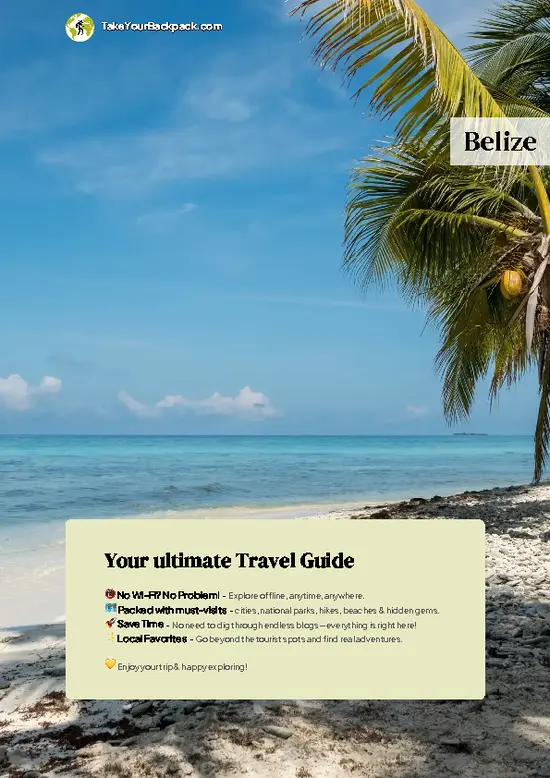
example page 0 from our offline Travel Guide for Belize
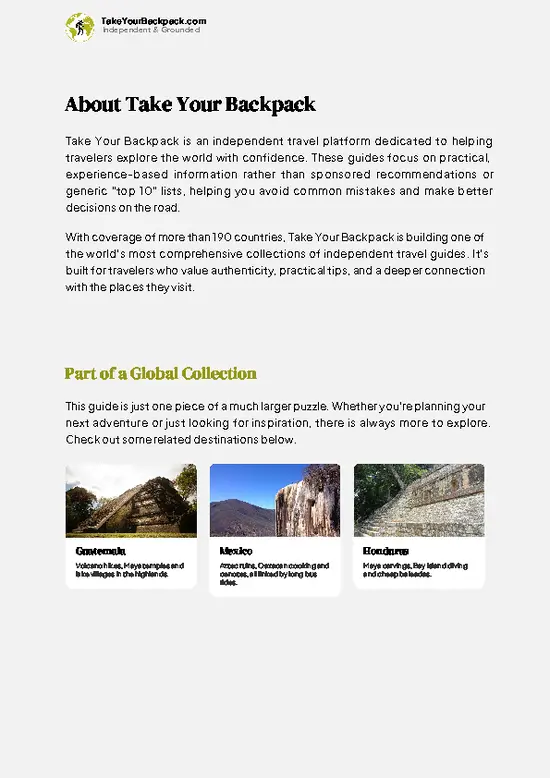
example page 1 from our offline Travel Guide for Belize
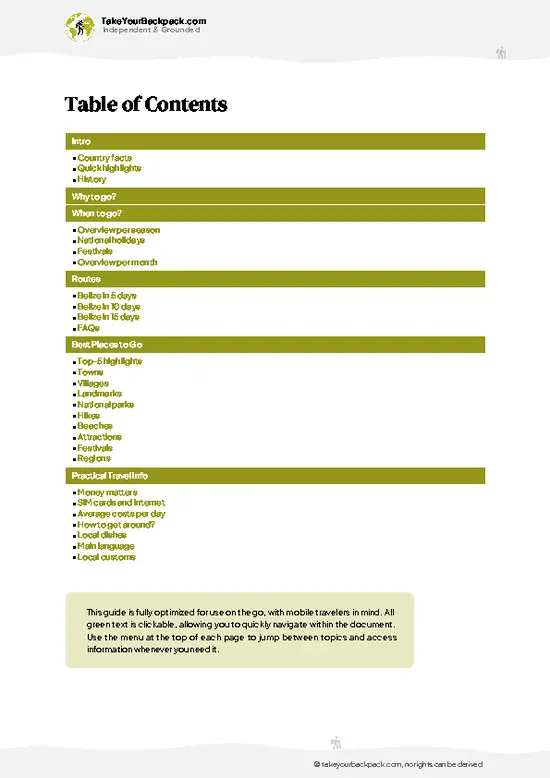
example page 2 from our offline Travel Guide for Belize
example page 3 from our offline Travel Guide for Belize
example page 4 from our offline Travel Guide for Belize
example page 5 from our offline Travel Guide for Belize
example page 6 from our offline Travel Guide for Belize
example page 7 from our offline Travel Guide for Belize
Loading the map 🌍
CLICK TO FILTER
towns
villages
landmarks
national parks
hikes
beaches
attractions
festivals
regions
SHOW COUNTRY’S BESTSHOW ALL

✨ Why go?
Ranked #4 national park in Belize
Why visitors keep coming back

Chiquibul National Park draws backpackers who want something the Belize cayes can’t give: raw, unmanicured forest with almost no one in it. The park holds the Chiquibul Cave System, among the longest in Central America, and the Maya Mountains rainforest that shelters one of the country’s healthiest scarlet macaw populations. That is the pull. You will not stroll in alone with a map, because access is controlled and the border area is monitored, so this is a guided destination rather than a self-guided one. Still, you can stay independent in the way that counts: base yourself cheaply in the Cayo area near San Ignacio, sort out your own transport, and book only the guided day or overnight you want. Small operators keep groups tiny, which means you hear the forest instead of other tourists. For … read more 👉
Chiquibul National Park draws backpackers who want something the Belize cayes can’t give: raw, unmanicured forest with almost no one in it. The park holds the Chiquibul Cave System, among the longest in Central America, and the Maya Mountains rainforest that shelters one of the country’s healthiest scarlet macaw populations. That is the pull. You will not stroll in alone with a map, because access is controlled and the border area is monitored, so this is a guided destination rather than a self-guided one. Still, you can stay independent in the way that counts: base yourself cheaply in the Cayo area near San Ignacio, sort out your own transport, and book only the guided day or overnight you want. Small operators keep groups tiny, which means you hear the forest instead of other tourists. For travelers tired of packed ruins and snorkel boats, a short, well-chosen trip here feels like real exploring.

💡 HighlightsTop highlights of Chiquibul

  1. Chiquibul Cave System: Passages stretching for tens of kilometers, with huge chambers and underground rivers. Access is by permit and guide only.
  2. Scarlet macaw habitat: The park’s forest shelters Belize’s wild scarlet macaws, with loud, red-and-yellow flocks seen at dawn near the Macal River side.
  3. Maya Mountains rainforest: Dense broadleaf canopy over karst hills, with giant ceiba trees, ferns and constant insect noise.
  4. Jaguar and tapir country: Cats and Baird’s tapir roam here. You are more likely to see tracks and camera-trap evidence than the animals themselves.
  5. Caracol Maya site: Just beside the park in the Chiquibul Forest Reserve, Caracol’s Caana pyramid rises about 43 meters, among the tallest man-made structures in Belize. Entry costs roughly US$15 for foreigners.
  6. Rio On Pools: A short
… read more 👉
  1. Chiquibul Cave System: Passages stretching for tens of kilometers, with huge chambers and underground rivers. Access is by permit and guide only.
  2. Scarlet macaw habitat: The park’s forest shelters Belize’s wild scarlet macaws, with loud, red-and-yellow flocks seen at dawn near the Macal River side.
  3. Maya Mountains rainforest: Dense broadleaf canopy over karst hills, with giant ceiba trees, ferns and constant insect noise.
  4. Jaguar and tapir country: Cats and Baird’s tapir roam here. You are more likely to see tracks and camera-trap evidence than the animals themselves.
  5. Caracol Maya site: Just beside the park in the Chiquibul Forest Reserve, Caracol’s Caana pyramid rises about 43 meters, among the tallest man-made structures in Belize. Entry costs roughly US$15 for foreigners.
  6. Rio On Pools: A short drive away in the Mountain Pine Ridge, granite slabs form natural pools and small cascades. Entry is free.
  7. Bird life: Toucans, trogons and Montezuma oropendolas call from the canopy, easiest to spot at first light.
Rio On Pools is the free item, while Caracol has a small entry fee and cave trips require a paid guide.
Spotted a mistake or missing something? Contact us.

Things to do near Chiquibul National Park

Ratings based on Tripadvisor reviews. When you book through this link, you support our work at no extra cost to you.

🌤️ When to go?When to go for the best experience

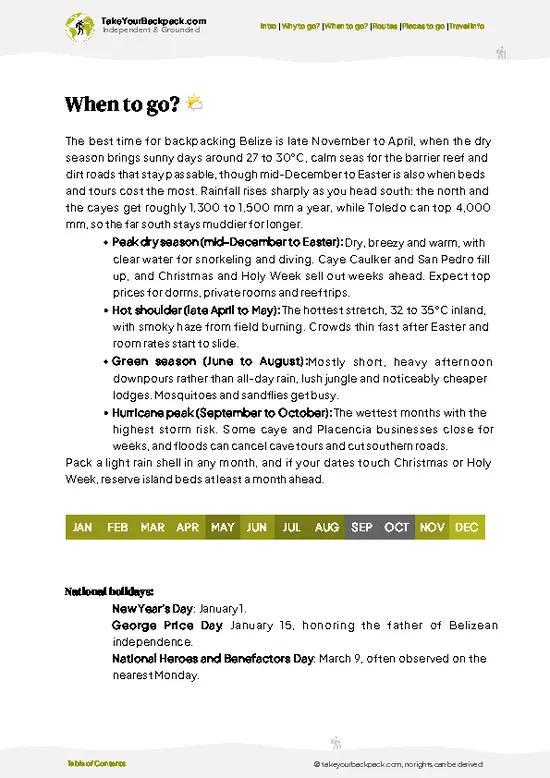
The drier months of February through May are the practical window for Chiquibul National Park, because the dirt road to the Mountain Pine Ridge and the river crossings stay passable.
  • Dry Season (Feb to May): Days run 28 to 34°C (82 to 93°F), nights 18 to 22°C (64 to 72°F). Rain is light, trails are firm, and cave trips through Actun Tunichil Muknal-style river caves are rarely cancelled. Guides and lodges charge their highest rates, yet crowds stay small because the park is remote.
  • Wet Season (Jun to Nov): Heavy afternoon downpours are common, rivers rise, and the gravel access road turns to mud. Permits for the Chiquibul Cave System are harder to arrange. Rates drop 15 to 30 percent, and the forest is intensely green with loud wildlife.
  • Cooler Months (Dec to Jan): Highs of 25 to 29°C (77 to
… read more 👉
The drier months of February through May are the practical window for Chiquibul National Park, because the dirt road to the Mountain Pine Ridge and the river crossings stay passable.
  • Dry Season (Feb to May): Days run 28 to 34°C (82 to 93°F), nights 18 to 22°C (64 to 72°F). Rain is light, trails are firm, and cave trips through Actun Tunichil Muknal-style river caves are rarely cancelled. Guides and lodges charge their highest rates, yet crowds stay small because the park is remote.
  • Wet Season (Jun to Nov): Heavy afternoon downpours are common, rivers rise, and the gravel access road turns to mud. Permits for the Chiquibul Cave System are harder to arrange. Rates drop 15 to 30 percent, and the forest is intensely green with loud wildlife.
  • Cooler Months (Dec to Jan): Highs of 25 to 29°C (77 to 84°F), occasional cold fronts with drizzle, and nights near 16°C (61°F) in the pine uplands. Holiday weeks fill lodges.
Daylight lasts about 11 to 13 hours, so start hikes early. Book guides at least a few weeks ahead for March and April.


source: climatestotravel.comJANJanuary: highly recommended for travelingFEBFebruary: excellent for travelingMARMarch: excellent for travelingAPRApril: excellent for travelingMAYMay: highly recommended for travelingJUNJune: fair for travelingJULJuly: fair for travelingAUGAugust: fair for travelingSEPSeptember: fair for travelingOCTOctober: fair for travelingNOVNovember: fair for travelingDECDecember: good for traveling
belize-national-park-chiquibul-national-park
© Google | Verde Speranza

✈️ The backpacker research shortcutBelize Travel Guide

An offline-friendly backpacking guide with optimized travel routes, ranked highlights, transport advice, and the best areas to stay.
example page 0 from our offline Travel Guide for Belize
example page 1 from our offline Travel Guide for Belize
example page 2 from our offline Travel Guide for Belize
example page 3 from our offline Travel Guide for Belize
example page 4 from our offline Travel Guide for Belize
example page 5 from our offline Travel Guide for Belize
example page 6 from our offline Travel Guide for Belize
example page 7 from our offline Travel Guide for Belize
The digital guide (168 pages) contains:
✅ 44 highlights, ranked by travel appeal
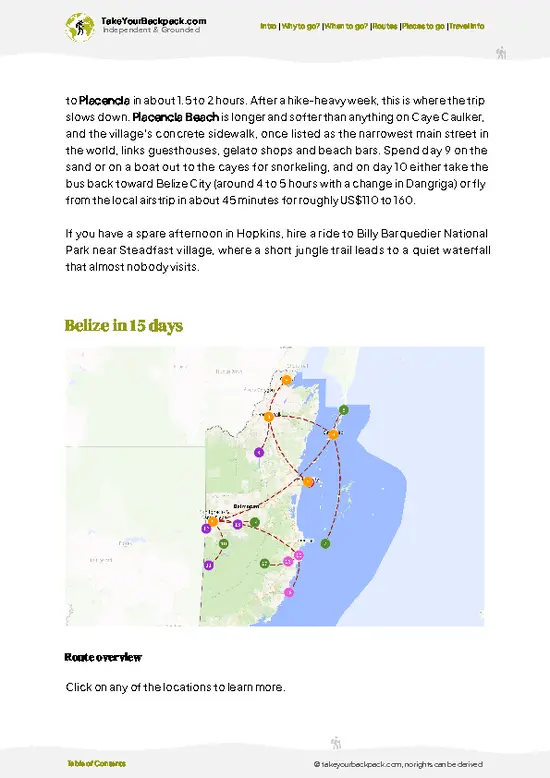
✅ Optimized 5, 10 & 15-day travel routes
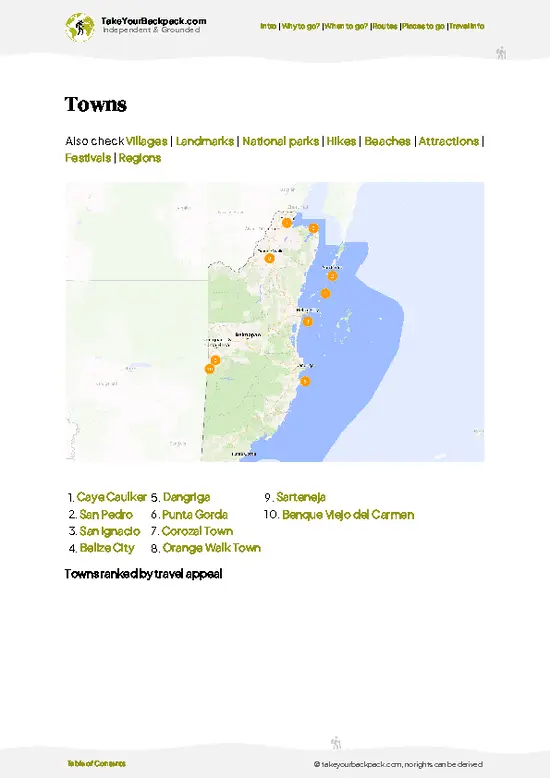
✅ Cities, national parks, landmarks, beaches
✅ How to get around
✅ Offline-friendly for travel without Wi-Fi
👉 Click to see all 30+ guide features

📅 Plan smarter in minutes, not weeks
✅ Month by month travel advice
✅ Festivals & national holidays
✅ Budget expectations

🗺️ Go to the right places, skip the overrated ones
✅ Honest pros & cons of destinations
✅ Top hikes, parks & viewpoints
✅ Lesser-known places most travelers miss
✅ Clear “worth it vs skip it” guidance

🛏️ Travel smoothly without rookie mistakes
✅ Best areas to stay
✅ Transport systems explained simply
✅ Common scams & safety advice
✅ SIM cards, money & practical tips

🌍 Understand the country, not just visit it
✅ Culture & traditions
✅ 52 Essential phrases & customs
✅ Festivals worth planning around
✅ Traveler-friendly historical context
✅ Insights that make places more meaningful

📱 Built for real travel conditions
✅ Fully downloadable PDF
✅ Works completely offline
✅ Optimized for phone use
✅ Useful in remote areas & buses
✅ Everything in one place
Stop searching, start planning
Get instant access to your full guide. 30‑day money-back guarantee.
+ Add another guide for just

By proceeding you agree to our terms.
Sent to your inbox immediately after payment • 100% Secure Checkout
Best Backpacking Travel Advisor 2025 tourism awardBest Backpacking
Travel Advisor
2025
What others say about Take Your Backpack Guides:
⭐⭐⭐⭐⭐
Fantastic, amazing amount of information!
⭐⭐⭐⭐⭐
My goodness this is amazing, it's what I've been looking for hats off too you!
⭐⭐⭐⭐⭐
I think this is absolutely BRILLIANT
⭐⭐⭐⭐
Very complete and informative. It's still missing places, but I gotta to commend you
⭐⭐⭐⭐⭐
This is truly amazing, thank you, can't wait to explore it with my kids!
⭐⭐⭐⭐⭐
Awesome resource, thank you!
⭐⭐⭐⭐⭐
This is amazing! Can't wait to explore the ones I haven't seen
⭐⭐⭐⭐
I love this! Well done, great idea.
⭐⭐⭐⭐⭐
Thanks for taking the time to make this gem!
⭐⭐⭐⭐⭐
This might be the best website I've ever seen.
⭐⭐⭐⭐⭐
Congratulations, and thank you so much for your work; it's incredibly valuable.
⭐⭐⭐⭐
In all seriousness I think you did a great job pointing out the important spots
⭐⭐⭐⭐⭐
10/10 very good
⭐⭐⭐⭐⭐
As someone who's only just starting to visit regularly this is awesome, thank you.
⭐⭐⭐⭐
Thank you very much! I'm going to visit my dad, it's going to be very useful!
⭐⭐⭐⭐⭐
This is really cool! We'll be travelling for the first time and this definitely come in handy.
⭐⭐⭐⭐⭐
You are now our minister of culture, congratulations 👨‍💼
⭐⭐⭐⭐⭐
Just wanted to tell you that this is a pearl! Going to follow your recommendations.
⭐⭐⭐⭐⭐
This is so cool. I'll definitely be using the resource for my travels soon.
⭐⭐⭐⭐⭐
This is very impressive! Good work.
⭐⭐⭐⭐⭐
This is an amazing and informative site. Very well done!

🛏️ Where to stay?Where staying makes the most sense

The best base for most backpackers is San Ignacio, about 1.5 to 2 hours by road from the park edge, since the park itself has no hotels or hostels.
Inside Chiquibul National Park, the only legal options are basic ranger and research stations such as Las Cuevas, which accommodate scientists and guided expeditions with the Belize Forest Department or Friends for Conservation and Development (FCD). Independent camping is not offered, and the park is largely closed to unguided visitors, so arrange everything through an operator.
In San Ignacio you will find dorm beds at US$10 to 20, private rooms at … read more 👉
The best base for most backpackers is San Ignacio, about 1.5 to 2 hours by road from the park edge, since the park itself has no hotels or hostels.
Inside Chiquibul National Park, the only legal options are basic ranger and research stations such as Las Cuevas, which accommodate scientists and guided expeditions with the Belize Forest Department or Friends for Conservation and Development (FCD). Independent camping is not offered, and the park is largely closed to unguided visitors, so arrange everything through an operator.
In San Ignacio you will find dorm beds at US$10 to 20, private rooms at US$30 to 60, and the town has the guides, supermarkets, and cafés you need for trip planning. Nearby Santa Elena sits across the river and has cheaper guesthouses.
For a quieter option, Mountain Pine Ridge lodges near Caracol Road, around Augustine (Douglas D’Silva) and the Río On Pools area, suit those with a vehicle. Expect rustic cabins at US$40 to 90. Benque Viejo del Carmen, near the Guatemala border, is the cheapest base, with rooms from US$20 to 35, but it has far fewer services. Most people stay in San Ignacio and join a guided day or multiday trip from there.

👛 Costs (as of 22 October 2026)Typical daily expenses

Expect to spend about US$110 per day for Chiquibul National Park when visiting with a guide and staying in San Ignacio, since guided access drives most of the cost.
CategoryBudget RangeLocal Reality
Entrance and permitsUS$10 to 25Park and cave permits are arranged through the Forest Department or your operator, and they are often bundled into tour prices.
Guide and tourUS$40 to 70Guides are required for most areas. Group day trips to Caracol and nearby sites cost less per person than private trips.
AccommodationUS$10 to 20 (dorm), US$30 to 60 (private room)Dorm beds in San Ignacio suit low budgets. High season runs February to May and prices rise then.
Local transportUS$3 to 20Buses to San Ignacio are cheap. Shared or private transfers toward the Pine Ridge cost more, and a rental car is a higher
… read more 👉
Expect to spend about US$110 per day for Chiquibul National Park when visiting with a guide and staying in San Ignacio, since guided access drives most of the cost.
CategoryBudget RangeLocal Reality
Entrance and permitsUS$10 to 25Park and cave permits are arranged through the Forest Department or your operator, and they are often bundled into tour prices.
Guide and tourUS$40 to 70Guides are required for most areas. Group day trips to Caracol and nearby sites cost less per person than private trips.
AccommodationUS$10 to 20 (dorm), US$30 to 60 (private room)Dorm beds in San Ignacio suit low budgets. High season runs February to May and prices rise then.
Local transportUS$3 to 20Buses to San Ignacio are cheap. Shared or private transfers toward the Pine Ridge cost more, and a rental car is a higher outlay.
Food and suppliesUS$12 to 25Street food and small restaurants in San Ignacio are affordable. Pack lunches for the trail, and buy water and snacks in town.
Total Daily BudgetUS$110Based on a dorm bed (US$15), a guided trip (US$55), a permit (US$10), transport (US$10), and food (US$20), with a small buffer.


source: travelbelize.org
⚠️ Prices can change and everyone travels differently, so take this as a rough guide. Hope it helps you plan your adventure!

🥾 TrailsDiscover Chiquibul's top trails and natural wonders

Chiquibul National Park has no marked public trail network, so hiking here means guided expeditions through trackless forest and to cave mouths. Terrain is steep limestone karst, red clay mud and fast, rain-swollen creeks. Humidity is heavy, and boots with grip matter more than speed.
  • Guided cave treks: Half to full days that pair a forest approach walk with scrambling inside large chambers. Moderate to hard, with wet, slippery rock and headlamps required.
  • Rainforest day hikes: Guided walks of roughly 3 to 6 hours along old logging and patrol tracks. Moderate difficulty, with birding and tracks
… read more 👉
Chiquibul National Park has no marked public trail network, so hiking here means guided expeditions through trackless forest and to cave mouths. Terrain is steep limestone karst, red clay mud and fast, rain-swollen creeks. Humidity is heavy, and boots with grip matter more than speed.
  • Guided cave treks: Half to full days that pair a forest approach walk with scrambling inside large chambers. Moderate to hard, with wet, slippery rock and headlamps required.
  • Rainforest day hikes: Guided walks of roughly 3 to 6 hours along old logging and patrol tracks. Moderate difficulty, with birding and tracks of tapir and peccary.
  • Caracol approach: Not a park trail, but the nearby ruins have flat, shaded paths between plazas and the Caana pyramid. Easy, around 2 to 3 hours on site.
  • Multi-day expeditions: Operators and conservation groups occasionally run overnight trips for experienced hikers. Hard, with camp conditions and river crossings.
Wildlife is the draw: howler and spider monkeys, scarlet macaws, ocelot, jaguar and tapir live here, though most are shy. Go early, move quietly and carry plenty of water.
Practical matters: the park lies in the Cayo District, and the nearest base is San Ignacio, reached by regular buses from Belize City. Beyond that, roads are rough and a guided 4x4 is the realistic way in. Visitors are few, so crowds are almost nonexistent. Entry is by permission and guide, and costs are folded into tour prices, with Caracol charging its own separate ticket.
⚠️ Hiking info can sometimes be outdated or inaccurate. Before you hit the trail, check the latest conditions with locals. If you do spot anything that's off, I'd love to hear from you, so I can update it for fellow travelers.

🛡️ SafetySafety Tips and Common Scams in Chiquibul

Chiquibul National Park is remote, wild, and not a place for independent wandering, so go with a licensed guide. Access to many areas requires permission from the Forest Department, and the Guatemalan border zone has seen illegal logging, poaching, and xate harvesting, so rangers restrict movement. Stay on routes your guide chooses and do not wander toward the border.
The forest is hot and humid, so carry 3 liters of water per person, wear quick-dry layers, and start early. Trails are muddy and slippery in the wet season, and river crossings can rise quickly after storms, so postpone if the water is brown and fast. Cave visits involve wet scrambling and uneven rock; sturdy shoes and a helmet are standard.
Jaguars, pumas, snakes including fer-de-lance, and scarlet macaws live here. Encounters … read more 👉
Chiquibul National Park is remote, wild, and not a place for independent wandering, so go with a licensed guide. Access to many areas requires permission from the Forest Department, and the Guatemalan border zone has seen illegal logging, poaching, and xate harvesting, so rangers restrict movement. Stay on routes your guide chooses and do not wander toward the border.
The forest is hot and humid, so carry 3 liters of water per person, wear quick-dry layers, and start early. Trails are muddy and slippery in the wet season, and river crossings can rise quickly after storms, so postpone if the water is brown and fast. Cave visits involve wet scrambling and uneven rock; sturdy shoes and a helmet are standard.
Jaguars, pumas, snakes including fer-de-lance, and scarlet macaws live here. Encounters are rare. Make noise, watch where you place hands and feet, and give animals space. Cell coverage is absent, so tell someone your plan, and carry a first-aid kit and insect repellent.

FAQTraveler FAQ

Plan on 2 to 4 days for Chiquibul National Park if you are going beyond a day trip. A day tour from San Ignacio can cover Caracol and the Mountain Pine Ridge, while a guided expedition into the Chiquibul cave system or research stations typically takes 3 to 5 days with a permit.
Visiting Chiquibul National Park without a car is possible but only with a guided tour from San Ignacio. Buses reach San Ignacio from Belize City in about 2.5 to 3 hours, and operators provide 4x4 transport along the rough Caracol Road, which takes roughly 2 to 3 hours each way. Independent travel on foot or by public bus is not practical.
Yes, Chiquibul National Park requires permission for most visits, and entry is arranged through the Belize Forest Department or a licensed guide. Expect about US$10 to 25 for permits, often included in tour prices of roughly US$80 to 120 per person for a day trip. Caves and research areas need special authorization booked in advance.
⚠️ Things can change over time, so always validate details locally before you go.

Other Belizean national parks near Chiquibul

Explore more nearby:


💡 Not sure where to go next?
Create a personalized itinerary for Belize including Chiquibul and the places that fit your trip.

Generate my itinerary

👉 Discover all national parks

Or checkout all Belize has to offer (think cities, towns, villages, national parks, hikes, beaches, festivals)
Country photo of Belize

We 💚 feedbackParting advice and final tips

Chiquibul National Park pairs best with a few days in the Cayo District: cave tubing and the Mountain Pine Ridge pools first, then Caracol on the same guided trip. Finish in San Ignacio for cheap food and a market morning. I would book a small local operator and bring boots that can handle red mud.

✍️ Help improve this page!
The information on this page is based on in-depth research, insights shared by experienced travelers, and feedback from the local travel community in Belize. While every effort is made to keep the information accurate and current, conditions can change — so if you spot anything incorrect or outdated, please get in touch.


🙋‍♂️ Give feedback

👋 Meet the founderWho’s Behind Take Your Backpack?

Johan, backpacker and founder of TakeYourBackpackHi, I’m Johan (Netherlands 🇳🇱), the creator of TakeYourBackpack. Over the past 3 decades, I’ve backpacked through 90+ countries across six continents, gaining extensive experience with independent travel, long-term trips, and overland routes.

This site is built on a combination of firsthand travel experience and carefully curated insights from other backpackers. Many guides are based on places I’ve personally visited, while others bring together tips, observations, and practical advice shared by trusted travelers I’ve met along the way.

The goal is to provide realistic, experience-driven guidance — not generic itineraries — so you can explore destinations with better context, clearer expectations, and more confidence.