v2.webp)
- Jaguar habitat and tracks: The sanctuary was created to protect jaguars, and the muddy trail edges often hold prints. Seeing the cat itself is unlikely, but the tracks and the knowledge you are in their range add tension to every walk.
- Tiger Fern Trail and waterfall: A short forest walk ends at a small waterfall with a pool you can cool off in. Ferns, buttress roots and leaf litter line the way.
- Ben’s Bluff Trail: A steep climb to a lookout over the basin and the Maya Mountains. The view is the best one in the park, and the humidity makes it feel harder than it looks.
- Antelope Trail: A longer walk deeper into the basin, with a fair chance of birds and small mammals near the creek.
- South Stann Creek tubing: Floating the creek in an inner tube through shaded forest is a cool, slow way to look for
- Jaguar habitat and tracks: The sanctuary was created to protect jaguars, and the muddy trail edges often hold prints. Seeing the cat itself is unlikely, but the tracks and the knowledge you are in their range add tension to every walk.
- Tiger Fern Trail and waterfall: A short forest walk ends at a small waterfall with a pool you can cool off in. Ferns, buttress roots and leaf litter line the way.
- Ben’s Bluff Trail: A steep climb to a lookout over the basin and the Maya Mountains. The view is the best one in the park, and the humidity makes it feel harder than it looks.
- Antelope Trail: A longer walk deeper into the basin, with a fair chance of birds and small mammals near the creek.
- South Stann Creek tubing: Floating the creek in an inner tube through shaded forest is a cool, slow way to look for birds and iguanas.
- Night walks: With a guide, the forest changes. Frogs, insects and eyeshine appear, and the sounds get louder.
- Bird watching: Keel-billed toucans, scarlet macaws and many forest species call from the canopy, especially early.
- Visitor center and creek crossings: The grounds are good for orientation, with maps and displays, plus a swimming spot nearby.
Spotted a mistake or missing something? Contact us.

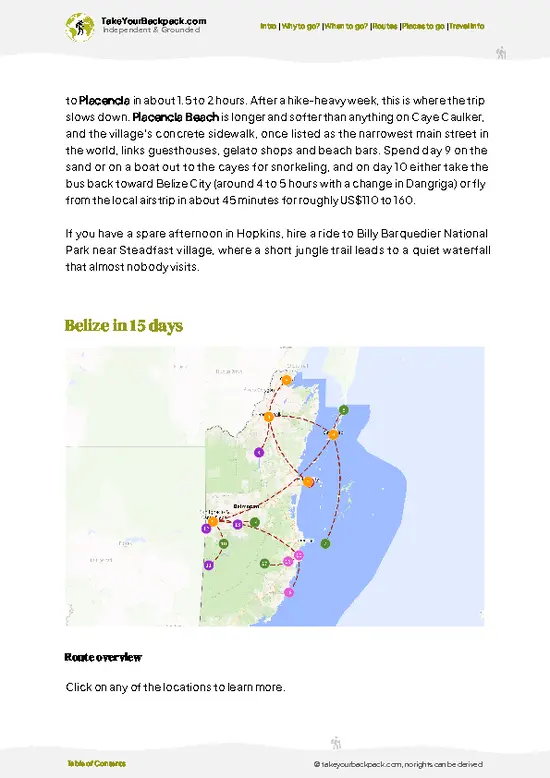
Barrier Reef Snorkel
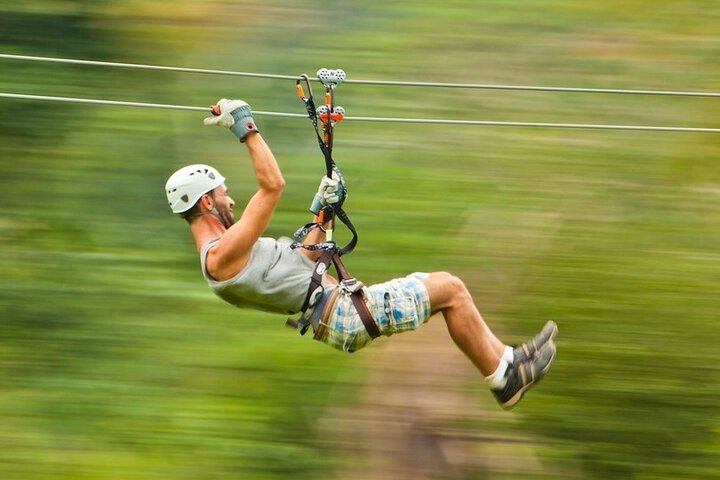
Thrilling Zipline Adventure at Bocawina Rainforest

Cockscomb Wildlife Sanctuary

Hopkins to Belize City Airport ( Private Shuttle )

Barrier Reef Snorkel & Fishing Combo

Cook Your Catch-Private Island Picnic

Explore Xunantunich Ruins and Jaguar Paw Cave Tubing from Hopkins

Xunantunich Maya Ruins & Cave Tubing - St. Herman's Cave

Cave Tubing & Zipline at Jaguar Paw


 Best Backpacking
.jpg) Hi, I’m Johan (Netherlands 🇳🇱), the creator of TakeYourBackpack. Over the past 3 decades, I’ve backpacked through 90+ countries across six continents, gaining extensive experience with independent travel, long-term trips, and overland routes.
Hi, I’m Johan (Netherlands 🇳🇱), the creator of TakeYourBackpack. Over the past 3 decades, I’ve backpacked through 90+ countries across six continents, gaining extensive experience with independent travel, long-term trips, and overland routes.