×

Benin🇧🇯 | beachesGrand-Popo BeachBouche du Roy sandbar, Mono River, mangroves, starry nights | things to do and best time to go

Explore Fidjrossè BeachExplore Ouidah Beach

Backpacking in Grand-Popo Beach
🏆 Top pickbeach ranked #1
By Johan Kruseman 🇳🇱 | Updated October 22, 2026

The Atlantic and the Mono River run side by side here, split by a sand strip so thin that you can look at rough surf on one side and flat, brown river water on the other. Grand-Popo Beach sits in southwest Benin, west of Cotonou, close to the Togo border. The beach itself is long, wide and lined with leaning coconut palms, and the sand is pale and coarse. It is mostly empty, with fishing pirogues pulled up and nets drying in the wind. Rubbish washes up in patches, and the smell of fish smoke drifts over from the villages. Swimming is the weak point, because the surf is heavy and the currents are strong, so wade and watch the waves rather than swim. The river side and the mangroves are the part to prioritize. Skip any idea of nightlife, since evenings are quiet, dark and good for stars. Simple guesthouses and roadside grills serve grilled fish and cold beer, and everything stays cheap. Bring enough cash in CFA francs before you arrive, because cash machines are scarce.

Discover everything you want to know in the 📖 Benin Travel Guide.


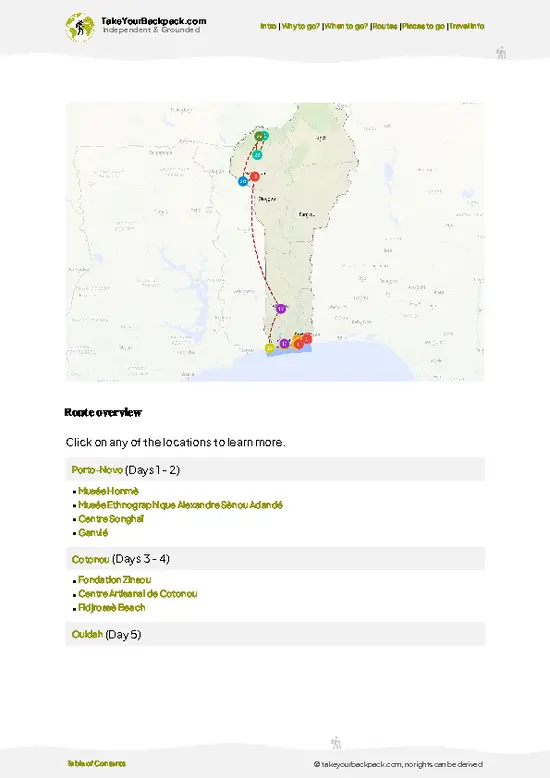
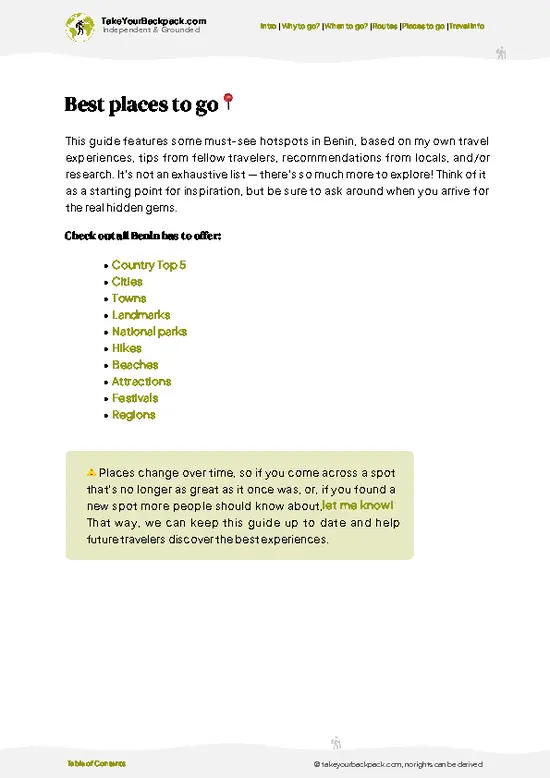
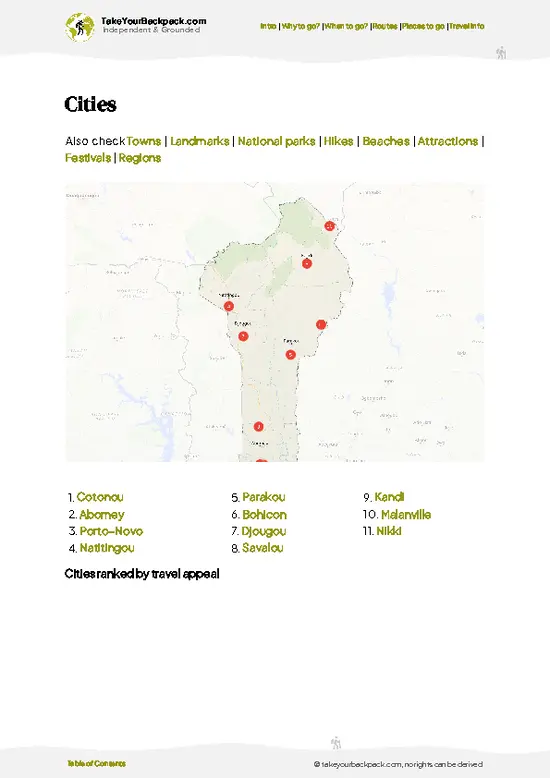
example page 0 from our offline Travel Guide for Benin
example page 1 from our offline Travel Guide for Benin
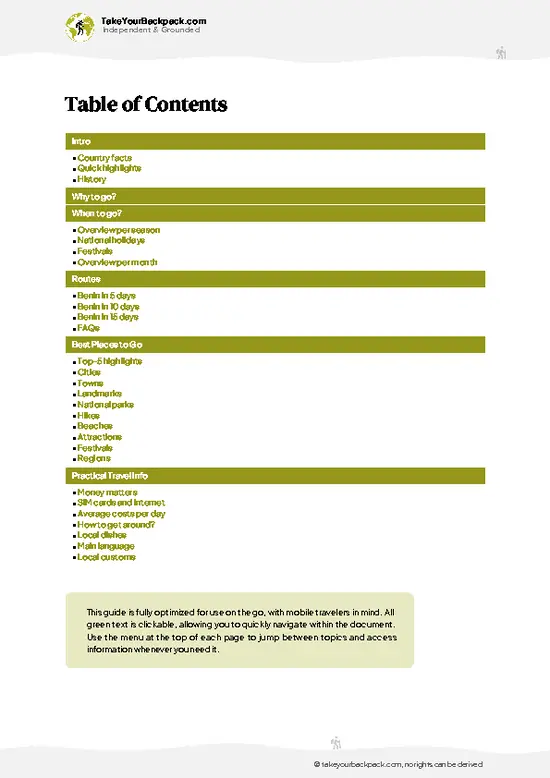
example page 2 from our offline Travel Guide for Benin
example page 3 from our offline Travel Guide for Benin
example page 4 from our offline Travel Guide for Benin
example page 5 from our offline Travel Guide for Benin
example page 6 from our offline Travel Guide for Benin
example page 7 from our offline Travel Guide for Benin
Loading the map 🌍
CLICK TO FILTER
cities
towns
landmarks
national parks
hikes
beaches
attractions
festivals
regions
SHOW COUNTRY’S BESTSHOW ALL

✨ Why go?
Ranked #1 beach in Benin
What sets this place apart

Grand-Popo Beach appeals to backpackers who want a slow stop on the coast road between Cotonou and the Togo border, with no tour buses and almost no hawkers. The main draw is the Mono River mouth, where a short pirogue ride takes you from village landing stages through mangroves to the point where river meets ocean. Few other beaches on this coast offer that combination of sea and delta within walking distance of your bed. The second reason is the people. Fishing families, small guesthouse owners and a few resident artists keep the place sociable in a low-key way, so you end up talking with the same faces over dinner. It is easy to stay longer than planned. Third, the town sits in Xwla and Vodun country, so a day of walking or riding a zemidjan (motorbike taxi) reveals shrines, fishing hamlets … read more 👉
Grand-Popo Beach appeals to backpackers who want a slow stop on the coast road between Cotonou and the Togo border, with no tour buses and almost no hawkers. The main draw is the Mono River mouth, where a short pirogue ride takes you from village landing stages through mangroves to the point where river meets ocean. Few other beaches on this coast offer that combination of sea and delta within walking distance of your bed. The second reason is the people. Fishing families, small guesthouse owners and a few resident artists keep the place sociable in a low-key way, so you end up talking with the same faces over dinner. It is easy to stay longer than planned. Third, the town sits in Xwla and Vodun country, so a day of walking or riding a zemidjan (motorbike taxi) reveals shrines, fishing hamlets and market days that feel far from the usual circuit. Use it as a pause before or after the border crossing.

💡 HighlightsThe experiences that define the visit

  1. Bouche du Roy sandbar: this is the spot most people come for, where the Mono River meets the Atlantic across a narrow spit of sand. You can stand with surf crashing on one side and calm river water on the other. Go by pirogue or on foot along the spit, and take shoes for hot sand.
  2. Mono River pirogue trip: local boatmen paddle or motor you through channels, past fishing nets, palm groves and small stilted villages. Mangrove roots, egrets and kingfishers line the banks. A morning trip is cooler and the water is calmer.
  3. Morning net hauling: fishermen pull long seine nets onto the beach by hand, in teams, chanting as they work. Watching takes little more than an hour, and you will see the catch sorted on the sand while women arrive to buy and smoke fish.
  4. Palm-lined beach walk: the shore stretches
… read more 👉
  1. Bouche du Roy sandbar: this is the spot most people come for, where the Mono River meets the Atlantic across a narrow spit of sand. You can stand with surf crashing on one side and calm river water on the other. Go by pirogue or on foot along the spit, and take shoes for hot sand.
  2. Mono River pirogue trip: local boatmen paddle or motor you through channels, past fishing nets, palm groves and small stilted villages. Mangrove roots, egrets and kingfishers line the banks. A morning trip is cooler and the water is calmer.
  3. Morning net hauling: fishermen pull long seine nets onto the beach by hand, in teams, chanting as they work. Watching takes little more than an hour, and you will see the catch sorted on the sand while women arrive to buy and smoke fish.
  4. Palm-lined beach walk: the shore stretches for kilometers with almost no buildings, so you can walk for hours past drying nets and painted wooden boats. Late afternoon is the best time, when the heat eases and the sea is loud but the beach is quiet. Wade only to knee depth because of the undertow.
  5. Evening under the stars: there is no club scene here, and that is the point. After dark the coast has little light pollution, so the sky fills with stars, and the sound of waves is constant. Order grilled fish and a cold drink at a beachside guesthouse and stay on the terrace.
Grand-Popo Beach rewards an early start, so do the Mono River pirogue trip first, because the water is calm, the light is soft and the birds are active before the heat builds.
Spotted a mistake or missing something? Contact us.

Things to do near Grand-Popo Beach

Ratings based on Tripadvisor reviews. When you book through this link, you support our work at no extra cost to you.

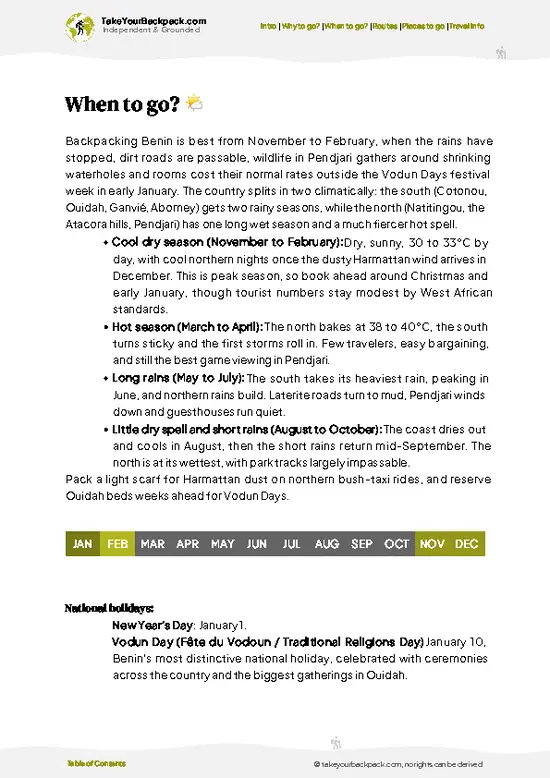
🌤️ When to go?Choosing the right time of year

  • Main Dry Season (November to March): Skies are mostly clear and rain is rare. Highs run 30 to 33°C (86 to 91°F), nights 23 to 25°C (73 to 77°F). Harmattan haze can dull the light from December to February, and the sea breeze keeps afternoons bearable. Daylight lasts about 11.5 to 12 hours. Beds fill and prices rise a little around Christmas and New Year.
  • Long Rains (April to July): Heavy downpours arrive, often in the afternoon or overnight, with highs of 28 to 31°C (82 to 88°F) and thick humidity. Sandy tracks turn to mud, but the beach is nearly empty and rooms are easier to bargain down.
  • Short Dry Spell (August to September): Rain eases and the sea is calm. Temperatures sit at 26 to 29°C (79 to 84°F), skies stay gray, and it is quiet and cheap.
  • Short Rains (October to November): Showers return
… read more 👉
  • Main Dry Season (November to March): Skies are mostly clear and rain is rare. Highs run 30 to 33°C (86 to 91°F), nights 23 to 25°C (73 to 77°F). Harmattan haze can dull the light from December to February, and the sea breeze keeps afternoons bearable. Daylight lasts about 11.5 to 12 hours. Beds fill and prices rise a little around Christmas and New Year.
  • Long Rains (April to July): Heavy downpours arrive, often in the afternoon or overnight, with highs of 28 to 31°C (82 to 88°F) and thick humidity. Sandy tracks turn to mud, but the beach is nearly empty and rooms are easier to bargain down.
  • Short Dry Spell (August to September): Rain eases and the sea is calm. Temperatures sit at 26 to 29°C (79 to 84°F), skies stay gray, and it is quiet and cheap.
  • Short Rains (October to November): Showers return briefly before the dry season settles in.
  • Vodun Festival (January): Ouidah’s national Vodun Day on January 10 brings extra traffic and higher prices along the coast.
Arrive in late November or early February for dry weather with quiet sand.


source: climatestotravel.comJANJanuary: highly recommended for travelingFEBFebruary: excellent for travelingMARMarch: highly recommended for travelingAPRApril: fair for travelingMAYMay: fair for travelingJUNJune: fair for travelingJULJuly: fair for travelingAUGAugust: fair for travelingSEPSeptember: fair for travelingOCTOctober: fair for travelingNOVNovember: highly recommended for travelingDECDecember: good for traveling
when-to-go

✈️ The backpacker research shortcutBenin Travel Guide

An offline-friendly backpacking guide with optimized travel routes, ranked highlights, transport advice, and the best areas to stay.
example page 0 from our offline Travel Guide for Benin
example page 1 from our offline Travel Guide for Benin
example page 2 from our offline Travel Guide for Benin
example page 3 from our offline Travel Guide for Benin
example page 4 from our offline Travel Guide for Benin
example page 5 from our offline Travel Guide for Benin
example page 6 from our offline Travel Guide for Benin
example page 7 from our offline Travel Guide for Benin
The digital guide (213 pages) contains:
✅ 48 highlights, ranked by travel appeal
✅ Optimized 5, 10 & 15-day travel routes
✅ Cities, national parks, landmarks, beaches
✅ How to get around
✅ Offline-friendly for travel without Wi-Fi
👉 Click to see all 30+ guide features

📅 Plan smarter in minutes, not weeks
✅ Month by month travel advice
✅ Festivals & national holidays
✅ Budget expectations

🗺️ Go to the right places, skip the overrated ones
✅ Honest pros & cons of destinations
✅ Top hikes, parks & viewpoints
✅ Lesser-known places most travelers miss
✅ Clear “worth it vs skip it” guidance

🛏️ Travel smoothly without rookie mistakes
✅ Best areas to stay
✅ Transport systems explained simply
✅ Common scams & safety advice
✅ SIM cards, money & practical tips

🌍 Understand the country, not just visit it
✅ Culture & traditions
✅ 52 Essential phrases & customs
✅ Festivals worth planning around
✅ Traveler-friendly historical context
✅ Insights that make places more meaningful

📱 Built for real travel conditions
✅ Fully downloadable PDF
✅ Works completely offline
✅ Optimized for phone use
✅ Useful in remote areas & buses
✅ Everything in one place
Stop searching, start planning
Get instant access to your full guide. 30‑day money-back guarantee.
+ Add another guide for just

By proceeding you agree to our terms.
Sent to your inbox immediately after payment • 100% Secure Checkout
Best Backpacking Travel Advisor 2025 tourism awardBest Backpacking
Travel Advisor
2025
What others say about Take Your Backpack Guides:
⭐⭐⭐⭐⭐
Fantastic, amazing amount of information!
⭐⭐⭐⭐⭐
My goodness this is amazing, it's what I've been looking for hats off too you!
⭐⭐⭐⭐⭐
I think this is absolutely BRILLIANT
⭐⭐⭐⭐
Very complete and informative. It's still missing places, but I gotta to commend you
⭐⭐⭐⭐⭐
This is truly amazing, thank you, can't wait to explore it with my kids!
⭐⭐⭐⭐⭐
Awesome resource, thank you!
⭐⭐⭐⭐⭐
This is amazing! Can't wait to explore the ones I haven't seen
⭐⭐⭐⭐
I love this! Well done, great idea.
⭐⭐⭐⭐⭐
Thanks for taking the time to make this gem!
⭐⭐⭐⭐⭐
This might be the best website I've ever seen.
⭐⭐⭐⭐⭐
Congratulations, and thank you so much for your work; it's incredibly valuable.
⭐⭐⭐⭐
In all seriousness I think you did a great job pointing out the important spots
⭐⭐⭐⭐⭐
10/10 very good
⭐⭐⭐⭐⭐
As someone who's only just starting to visit regularly this is awesome, thank you.
⭐⭐⭐⭐
Thank you very much! I'm going to visit my dad, it's going to be very useful!
⭐⭐⭐⭐⭐
This is really cool! We'll be travelling for the first time and this definitely come in handy.
⭐⭐⭐⭐⭐
You are now our minister of culture, congratulations 👨‍💼
⭐⭐⭐⭐⭐
Just wanted to tell you that this is a pearl! Going to follow your recommendations.
⭐⭐⭐⭐⭐
This is so cool. I'll definitely be using the resource for my travels soon.
⭐⭐⭐⭐⭐
This is very impressive! Good work.
⭐⭐⭐⭐⭐
This is an amazing and informative site. Very well done!

🛏️ Where to stay?Choosing the right base

The best base is the beachfront strip just west of Grand-Popo town, along the sandy road toward the Togo border, where small guesthouses and eco-lodges sit between the ocean and the Mono River lagoon. Rooms and dorm beds run roughly €8 to 25 a night, and a few places charge a little more for air-conditioning. Backpackers gather here because the sand is a few steps from your door, the sea breeze makes fans enough in most rooms, and the shared terraces and restaurants make it easy to meet other travelers over dinner. Staying on this strip also means you can walk to the beach at any hour, which is … read more 👉
The best base is the beachfront strip just west of Grand-Popo town, along the sandy road toward the Togo border, where small guesthouses and eco-lodges sit between the ocean and the Mono River lagoon. Rooms and dorm beds run roughly €8 to 25 a night, and a few places charge a little more for air-conditioning. Backpackers gather here because the sand is a few steps from your door, the sea breeze makes fans enough in most rooms, and the shared terraces and restaurants make it easy to meet other travelers over dinner. Staying on this strip also means you can walk to the beach at any hour, which is a real plus after dark, when you would rather not wander far.
The second option is Grand-Popo town itself, a few kilometers inland. It is cheaper, with simple guesthouses from about €6 to 15, and you are close to the market, motorbike taxis, and local eateries. It is quieter socially, and you will need a zem (motorbike taxi) ride of about €1 to 2 to reach the sea.
Book ahead only for December and January weekends. Outside those, arriving and choosing in person works fine.

🛡️ SafetySafety Tips and Common Scams in Grand-Popo Beach

Grand-Popo Beach is calm on land but demanding in the water. The Atlantic here is open and powerful, with strong rip currents, a steep shelving shore, and heavy shore-break that can knock you off your feet. There are no lifeguards or flags, so most travelers wade or paddle at the edge rather than swim out. Locals rarely swim far either, which is a good guide. If you do go in, pick a calm day, stay in knee to waist depth, and never swim alone.
The sun is strong all year, even under haze, so bring high-SPF sunscreen, a hat, and plenty of water. Midday heat is fierce, and mornings and late afternoons are far more pleasant for walking the sand. Mosquitoes come out at dusk, especially near the lagoon.
Petty theft is uncommon, but keep phones and cash out of sight and do not leave bags unattended … read more 👉
Grand-Popo Beach is calm on land but demanding in the water. The Atlantic here is open and powerful, with strong rip currents, a steep shelving shore, and heavy shore-break that can knock you off your feet. There are no lifeguards or flags, so most travelers wade or paddle at the edge rather than swim out. Locals rarely swim far either, which is a good guide. If you do go in, pick a calm day, stay in knee to waist depth, and never swim alone.
The sun is strong all year, even under haze, so bring high-SPF sunscreen, a hat, and plenty of water. Midday heat is fierce, and mornings and late afternoons are far more pleasant for walking the sand. Mosquitoes come out at dusk, especially near the lagoon.
Petty theft is uncommon, but keep phones and cash out of sight and do not leave bags unattended on the sand. After dark, stick to the lodges and the main beach road rather than walking the dark shore.

FAQCommon questions from travelers

Grand-Popo Beach lies about 80 to 90 km west of Cotonou, close to the Togo border, and the trip takes roughly 1.5 to 2 hours by road. Shared minibuses and taxis-brousse leave Cotonou’s Dantokpa area for Grand-Popo town for around €3 to 5, then a zem (motorbike taxi) covers the last few kilometers to the sand for about €1 to 2. A private taxi from Cotonou costs about €30 to 50, and from Lomé in Togo you can cross at Hillacondji and continue in about 2.5 to 3 hours.
Grand-Popo Beach is better for walking, sunbathing, and birdwatching than for swimming. The Atlantic has strong rip currents and heavy shore-break, with no lifeguards, so most visitors only paddle at the edge. Surfing is not established here, with no board rental or school, and snorkeling is not possible because the water is murky and rough. For calmer water, take a pirogue trip on the Mono River or the lagoon, which costs roughly €5 to 15 a person.
Grand-Popo Beach is free to visit, and there is no gate or entrance charge along the open sand. Some lodges with beachfront terraces and loungers may ask you to buy a drink or meal, usually €2 to 5, if you use their seating. Costs come from the extras, such as a zem ride from town for €1 to 2 or a river and mangrove boat tour for about €5 to 15.
⚠️ Things can change over time, so always validate details locally before you go.

Other Beninese beaches near Grand-Popo Beach

Explore more nearby:

  • Ouidah Beach—slave route memorials, quiet shoreline, historical markers, scattered shrines| 39 km away
  • Avlékété Beach—fishing canoes, mangrove edge, early morning markets, tidal pools| 52 km away
  • Togbin Beach—surf breaks, informal bars, relaxed atmosphere, local music| 65 km away

💡 Not sure where to go next?
Create a personalized itinerary for Benin including Grand-Popo Beach and the places that fit your trip.

Generate my itinerary

👉 Discover all beaches

Or checkout all Benin has to offer (think cities, towns, villages, national parks, hikes, beaches, festivals)
Country photo of Benin

We 💚 feedbackIs it worth it?

Grand-Popo Beach pairs best with a coastal run from Ouidah, for its history, to the Togo border and on to Lomé. I would give it two nights, one for the river mouth and one for doing nothing. Skip swimming in the surf, bring cash and a torch for the dark walk back, and take the early boat before the wind picks up.

✍️ Help improve this page!
The information on this page is based on in-depth research, insights shared by experienced travelers, and feedback from the local travel community in Benin. While every effort is made to keep the information accurate and current, conditions can change — so if you spot anything incorrect or outdated, please get in touch.


🙋‍♂️ Give feedback

👋 Meet the founderWho’s Behind Take Your Backpack?

Johan, backpacker and founder of TakeYourBackpackHi, I’m Johan (Netherlands 🇳🇱), the creator of TakeYourBackpack. Over the past 3 decades, I’ve backpacked through 90+ countries across six continents, gaining extensive experience with independent travel, long-term trips, and overland routes.

This site is built on a combination of firsthand travel experience and carefully curated insights from other backpackers. Many guides are based on places I’ve personally visited, while others bring together tips, observations, and practical advice shared by trusted travelers I’ve met along the way.

The goal is to provide realistic, experience-driven guidance — not generic itineraries — so you can explore destinations with better context, clearer expectations, and more confidence.