

×

Benin🇧🇯 | beachesOuidah BeachDoor of No Return, Route des Esclaves, Vodun festival, painted pirogues | things to do and best time to go

Explore Grand-Popo BeachExplore Togbin Beach

Backpacking in Ouidah Beach
👍 Recommendedbeach ranked #3
By Johan Kruseman 🇳🇱 | Updated October 22, 2026

Ouidah Beach is a memorial shoreline rather than a resort strip, and the Atlantic here is no place to swim: heavy surf and a strong undertow pull hard along this coast. It lies on the coast of Benin, south of Ouidah town and west of Cotonou, at the far end of the old Route des Esclaves. What you get is a wide band of pale sand, leaning coconut palms, the thud of breakers, and the smell of salt, smoked fish and wood smoke drifting from fishing hamlets. Painted pirogues sit hauled up on the sand. Crowds are thin outside festival days, costs stay low, and shade is scarce, so the white midday glare can wear you down. The concrete Door of No Return arch, with its carved reliefs, is what makes the trip worth it. Snorkeling and diving are not on offer. Cheap guesthouses and grilled fish are in town. Go in the morning and carry cash, since cards rarely work out here.

Discover everything you want to know in the 📖 Benin Travel Guide.


example page 0 from our offline Travel Guide for Benin
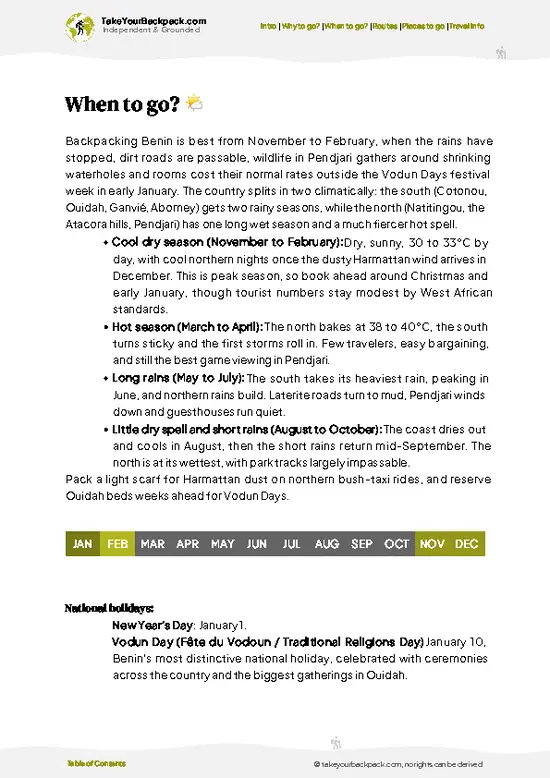
example page 1 from our offline Travel Guide for Benin
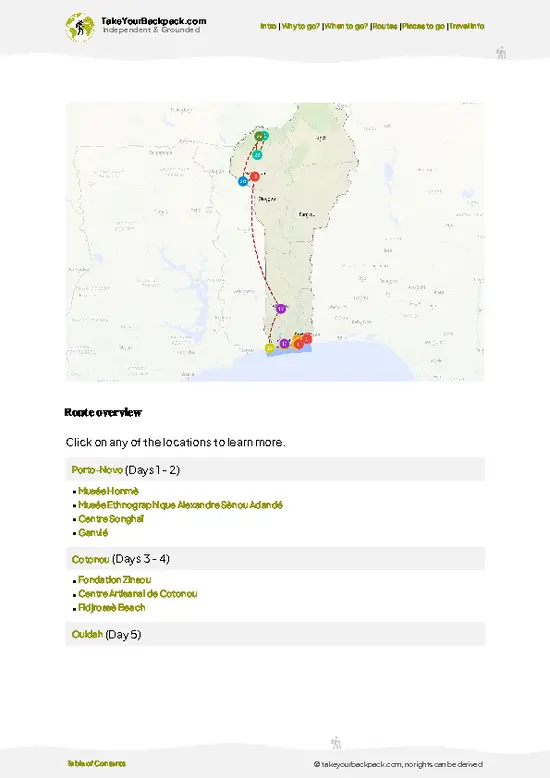
example page 2 from our offline Travel Guide for Benin
example page 3 from our offline Travel Guide for Benin
example page 4 from our offline Travel Guide for Benin
example page 5 from our offline Travel Guide for Benin
example page 6 from our offline Travel Guide for Benin
example page 7 from our offline Travel Guide for Benin
Loading the map 🌍
CLICK TO FILTER
cities
towns
landmarks
national parks
hikes
beaches
attractions
festivals
regions
SHOW COUNTRY’S BESTSHOW ALL

✨ Why go?
Ranked #3 beach in Benin
What sets this place apart

Ouidah Beach earns its stop because of what stands on it. The Door of No Return marks the point where captives were marched to waiting ships, and standing there with the surf roaring behind the arch gives the history a weight no museum label can match. Most people arrive after walking or riding the Route des Esclaves, the sandy track that starts in town and runs down to the water, so the beach is the end of a story rather than a place to lie around.

It also works as a pause on the coastal road between Cotonou and the quieter shores toward Grand-Popo. You can spend a morning here, eat fresh fish from the fishermen’s stalls, and still reach other towns by evening. Backpackers who like places with a sense of purpose, little hassle and almost no tourist infrastructure tend to rate it highly. … read more 👉
Ouidah Beach earns its stop because of what stands on it. The Door of No Return marks the point where captives were marched to waiting ships, and standing there with the surf roaring behind the arch gives the history a weight no museum label can match. Most people arrive after walking or riding the Route des Esclaves, the sandy track that starts in town and runs down to the water, so the beach is the end of a story rather than a place to lie around.

It also works as a pause on the coastal road between Cotonou and the quieter shores toward Grand-Popo. You can spend a morning here, eat fresh fish from the fishermen’s stalls, and still reach other towns by evening. Backpackers who like places with a sense of purpose, little hassle and almost no tourist infrastructure tend to rate it highly. Come in early January and the whole shoreline fills with drummers, dancers and masked figures for the national Vodun celebrations, which is when the beach is at its loudest.

💡 HighlightsDon't-miss highlights and experiences

  1. The Door of No Return: A tall concrete arch built on the sand, with figures carved into its sides. It is the memorial most travelers come to see, and the sea beyond it makes the point without any words.
  2. The Route des Esclaves: The old trail from town to the shore, lined with monuments along the way, including the Tree of Forgetfulness and the Zomai memorial. Walk it if the heat allows, because the order of the stops tells the story from beginning to end.
  3. Fishing pirogues on the shore: Wooden boats painted in bright colors are launched and hauled in through the surf by local crews. Come in the morning when nets are being untangled and fish are laid out to sell. It is the most lively and honest scene on the beach.
  4. Vodun Day on January 10: Benin’s national Vodun festival brings drummers, dancers
… read more 👉
  1. The Door of No Return: A tall concrete arch built on the sand, with figures carved into its sides. It is the memorial most travelers come to see, and the sea beyond it makes the point without any words.
  2. The Route des Esclaves: The old trail from town to the shore, lined with monuments along the way, including the Tree of Forgetfulness and the Zomai memorial. Walk it if the heat allows, because the order of the stops tells the story from beginning to end.
  3. Fishing pirogues on the shore: Wooden boats painted in bright colors are launched and hauled in through the surf by local crews. Come in the morning when nets are being untangled and fish are laid out to sell. It is the most lively and honest scene on the beach.
  4. Vodun Day on January 10: Benin’s national Vodun festival brings drummers, dancers and masked figures to the Ouidah coast. Crowds swell, the sound carries along the sand, and the beach feels very different from a normal day. Arrive early if you want a good spot.
  5. The Temple of Pythons and the Portuguese Fort museum: These two sights sit back in town but go hand in hand with the beach. The temple houses sacred pythons, while the old fort holds the Ouidah History Museum with displays on the slave trade and local spirit worship. Both help the shoreline make sense.
On a first visit to Ouidah Beach, go straight to the Door of No Return, preferably after walking the Route des Esclaves so the arch lands with its full meaning.
Spotted a mistake or missing something? Contact us.

Things to do near Ouidah Beach

Ratings based on Tripadvisor reviews. When you book through this link, you support our work at no extra cost to you.

🌤️ When to go?Weather, crowds, and seasonal trade-offs

  • Main Dry Season (December to February): Days run 29 to 32°C (84 to 90°F) with lower humidity and a harmattan haze that can dull the sky. This is the busiest window, especially around the 10 January Vodun Festival, when Ouidah fills and beds cost roughly €5 to 15 more.
  • Hot Months (March to April): Expect 30 to 34°C (86 to 93°F), sticky air and sea breezes that make the shore the only comfortable place by noon.
  • Long Rains (May to July): Heavy downpours turn sand tracks to mud, the surf grows rougher, and 27 to 30°C (81 to 86°F) feels muggy. Crowds vanish and rooms are cheapest.
  • Short Dry Spell (August to September): Cloudier and cooler at 25 to 28°C (77 to 82°F), with fewer showers and quiet sand.
  • Short Rains (October to November): Brief afternoon storms, then clear evenings.
Daylight stays close … read more 👉
  • Main Dry Season (December to February): Days run 29 to 32°C (84 to 90°F) with lower humidity and a harmattan haze that can dull the sky. This is the busiest window, especially around the 10 January Vodun Festival, when Ouidah fills and beds cost roughly €5 to 15 more.
  • Hot Months (March to April): Expect 30 to 34°C (86 to 93°F), sticky air and sea breezes that make the shore the only comfortable place by noon.
  • Long Rains (May to July): Heavy downpours turn sand tracks to mud, the surf grows rougher, and 27 to 30°C (81 to 86°F) feels muggy. Crowds vanish and rooms are cheapest.
  • Short Dry Spell (August to September): Cloudier and cooler at 25 to 28°C (77 to 82°F), with fewer showers and quiet sand.
  • Short Rains (October to November): Brief afternoon storms, then clear evenings.
Daylight stays close to 12 hours all year, so plan beach time before 5 pm. Arrive a few days before 10 January to secure a bed.


source: climatestotravel.comJANJanuary: excellent for travelingFEBFebruary: excellent for travelingMARMarch: excellent for travelingAPRApril: fair for travelingMAYMay: fair for travelingJUNJune: fair for travelingJULJuly: fair for travelingAUGAugust: fair for travelingSEPSeptember: fair for travelingOCTOctober: fair for travelingNOVNovember: highly recommended for travelingDECDecember: excellent for traveling
when-to-go

✈️ The backpacker research shortcutBenin Travel Guide

An offline-friendly backpacking guide with optimized travel routes, ranked highlights, transport advice, and the best areas to stay.
example page 0 from our offline Travel Guide for Benin
example page 1 from our offline Travel Guide for Benin
example page 2 from our offline Travel Guide for Benin
example page 3 from our offline Travel Guide for Benin
example page 4 from our offline Travel Guide for Benin
example page 5 from our offline Travel Guide for Benin
example page 6 from our offline Travel Guide for Benin
example page 7 from our offline Travel Guide for Benin
The digital guide (213 pages) contains:
✅ 48 highlights, ranked by travel appeal
✅ Optimized 5, 10 & 15-day travel routes
✅ Cities, national parks, landmarks, beaches
✅ How to get around
✅ Offline-friendly for travel without Wi-Fi
👉 Click to see all 30+ guide features

📅 Plan smarter in minutes, not weeks
✅ Month by month travel advice
✅ Festivals & national holidays
✅ Budget expectations

🗺️ Go to the right places, skip the overrated ones
✅ Honest pros & cons of destinations
✅ Top hikes, parks & viewpoints
✅ Lesser-known places most travelers miss
✅ Clear “worth it vs skip it” guidance

🛏️ Travel smoothly without rookie mistakes
✅ Best areas to stay
✅ Transport systems explained simply
✅ Common scams & safety advice
✅ SIM cards, money & practical tips

🌍 Understand the country, not just visit it
✅ Culture & traditions
✅ 52 Essential phrases & customs
✅ Festivals worth planning around
✅ Traveler-friendly historical context
✅ Insights that make places more meaningful

📱 Built for real travel conditions
✅ Fully downloadable PDF
✅ Works completely offline
✅ Optimized for phone use
✅ Useful in remote areas & buses
✅ Everything in one place
Stop searching, start planning
Get instant access to your full guide. 30‑day money-back guarantee.
+ Add another guide for just

By proceeding you agree to our terms.
Sent to your inbox immediately after payment • 100% Secure Checkout
Best Backpacking Travel Advisor 2025 tourism awardBest Backpacking
Travel Advisor
2025
What others say about Take Your Backpack Guides:
⭐⭐⭐⭐⭐
Fantastic, amazing amount of information!
⭐⭐⭐⭐⭐
My goodness this is amazing, it's what I've been looking for hats off too you!
⭐⭐⭐⭐⭐
I think this is absolutely BRILLIANT
⭐⭐⭐⭐
Very complete and informative. It's still missing places, but I gotta to commend you
⭐⭐⭐⭐⭐
This is truly amazing, thank you, can't wait to explore it with my kids!
⭐⭐⭐⭐⭐
Awesome resource, thank you!
⭐⭐⭐⭐⭐
This is amazing! Can't wait to explore the ones I haven't seen
⭐⭐⭐⭐
I love this! Well done, great idea.
⭐⭐⭐⭐⭐
Thanks for taking the time to make this gem!
⭐⭐⭐⭐⭐
This might be the best website I've ever seen.
⭐⭐⭐⭐⭐
Congratulations, and thank you so much for your work; it's incredibly valuable.
⭐⭐⭐⭐
In all seriousness I think you did a great job pointing out the important spots
⭐⭐⭐⭐⭐
10/10 very good
⭐⭐⭐⭐⭐
As someone who's only just starting to visit regularly this is awesome, thank you.
⭐⭐⭐⭐
Thank you very much! I'm going to visit my dad, it's going to be very useful!
⭐⭐⭐⭐⭐
This is really cool! We'll be travelling for the first time and this definitely come in handy.
⭐⭐⭐⭐⭐
You are now our minister of culture, congratulations 👨‍💼
⭐⭐⭐⭐⭐
Just wanted to tell you that this is a pearl! Going to follow your recommendations.
⭐⭐⭐⭐⭐
This is so cool. I'll definitely be using the resource for my travels soon.
⭐⭐⭐⭐⭐
This is very impressive! Good work.
⭐⭐⭐⭐⭐
This is an amazing and informative site. Very well done!

🛏️ Where to stay?Best areas and accommodation options

Ouidah town is the best base for backpackers, with the beach about 5 to 6 km (3 to 4 miles) south along the road to the Door of No Return. Guesthouses in the center around Place Chacha and the Python Temple area put you within walking distance of the Route des Esclaves start, the market and the cheapest food stalls. Expect dorm-style or basic rooms at roughly €8 to 20 a night, and these are where you meet other travelers, mostly over shared moto-taxi rides to the coast.

For a sea breeze and waking up to surf, choose the coastal strip near the Door of No Return memorial and the beach road. A handful … read more 👉
Ouidah town is the best base for backpackers, with the beach about 5 to 6 km (3 to 4 miles) south along the road to the Door of No Return. Guesthouses in the center around Place Chacha and the Python Temple area put you within walking distance of the Route des Esclaves start, the market and the cheapest food stalls. Expect dorm-style or basic rooms at roughly €8 to 20 a night, and these are where you meet other travelers, mostly over shared moto-taxi rides to the coast.

For a sea breeze and waking up to surf, choose the coastal strip near the Door of No Return memorial and the beach road. A handful of small beachfront lodges and eco-style guesthouses sit here, typically €15 to 35 a night. It is quiet and social in a low-key way, with fewer people but easy sunrise and evening walks on the sand. Food options are limited, so you will eat at the lodge or ride into town.

Cotonou, about 40 km east, works if you arrive late or want nightlife, but most people prefer to stay in Ouidah itself.

🛡️ SafetySafety Tips and Common Scams in Ouidah Beach

Ouidah Beach is a wild Atlantic shore, and the surf is the main thing to respect. Strong rip currents, a steep drop-off and heavy shore-break are normal here, and there are no lifeguards or flags. Locals wade and cool off at the edge rather than swim out, and I would copy them. Paddle ankle to knee deep, never go in alone, and skip it entirely when the waves are big, particularly in the rainy months.

The sun is fierce with little shade along the sand, so bring a hat, sunscreen and water, and plan your visit for the morning or late afternoon. Midday brings heat and glare. Stinging jellyfish are not a regular issue.

The beach is usually calm and quiet, with fishermen and the occasional group at the memorial. Keep phones and cameras in your hand or bag and avoid walking deserted stretches after … read more 👉
Ouidah Beach is a wild Atlantic shore, and the surf is the main thing to respect. Strong rip currents, a steep drop-off and heavy shore-break are normal here, and there are no lifeguards or flags. Locals wade and cool off at the edge rather than swim out, and I would copy them. Paddle ankle to knee deep, never go in alone, and skip it entirely when the waves are big, particularly in the rainy months.

The sun is fierce with little shade along the sand, so bring a hat, sunscreen and water, and plan your visit for the morning or late afternoon. Midday brings heat and glare. Stinging jellyfish are not a regular issue.

The beach is usually calm and quiet, with fishermen and the occasional group at the memorial. Keep phones and cameras in your hand or bag and avoid walking deserted stretches after dark. Take a moto-taxi both ways, since few vehicles pass in the evening.

FAQTraveler FAQ

Ouidah Beach lies about 5 to 6 km south of Ouidah town, and the easiest way is a moto-taxi along the paved Route des Esclaves for roughly €1 to 3 each way. Ouidah is around 40 km west of Cotonou, reached by shared taxi or minibus in about 1 to 1.5 hours for roughly €2 to 4. A private taxi from Cotonou airport costs about €25 to 40 one way.
Ouidah Beach is better for walking and scenery than for swimming, since strong rips, a steep shelf and heavy surf make going out deep risky and there are no lifeguards. Surfing is not established here, with no schools or board rentals, and snorkeling is not possible because of poor visibility and rough water. Most people paddle at the edge in the dry months and spend the rest of the time at the Door of No Return memorial.
Ouidah Beach is free to enter, as it is an open public shore with no gate or ticket. The Door of No Return monument at the end of the Route des Esclaves can also be seen from the road at no cost. Museums in town such as the Ouidah Museum of History charge around €3 to 5, and a local guide for the full slave route runs about €10 to 20.
⚠️ Things can change over time, so always validate details locally before you go.

Other Beninese beaches near Ouidah Beach

Explore more nearby:

  • Avlékété Beach—fishing canoes, mangrove edge, early morning markets, tidal pools| 13 km away
  • Togbin Beach—surf breaks, informal bars, relaxed atmosphere, local music| 26 km away
  • Fidjrossè Beach—city edge, local food stalls, volleyball courts, weekend crowds| 30 km away

💡 Not sure where to go next?
Create a personalized itinerary for Benin including Ouidah Beach and the places that fit your trip.

Generate my itinerary

👉 Discover all beaches

Or checkout all Benin has to offer (think cities, towns, villages, national parks, hikes, beaches, festivals)
Country photo of Benin

We 💚 feedbackKey takeaways before you go

Ouidah Beach needs half a day, and a full day only if you want to sit with the history or catch the fishermen at work. I would walk the slave route in the cool of the morning, eat fish near the shore, and sleep in town instead of lingering for sunset. Bring water and a hat, and keep out of the surf.

✍️ Help improve this page!
The information on this page is based on in-depth research, insights shared by experienced travelers, and feedback from the local travel community in Benin. While every effort is made to keep the information accurate and current, conditions can change — so if you spot anything incorrect or outdated, please get in touch.


🙋‍♂️ Give feedback

👋 Meet the founderWho’s Behind Take Your Backpack?

Johan, backpacker and founder of TakeYourBackpackHi, I’m Johan (Netherlands 🇳🇱), the creator of TakeYourBackpack. Over the past 3 decades, I’ve backpacked through 90+ countries across six continents, gaining extensive experience with independent travel, long-term trips, and overland routes.

This site is built on a combination of firsthand travel experience and carefully curated insights from other backpackers. Many guides are based on places I’ve personally visited, while others bring together tips, observations, and practical advice shared by trusted travelers I’ve met along the way.

The goal is to provide realistic, experience-driven guidance — not generic itineraries — so you can explore destinations with better context, clearer expectations, and more confidence.