
×

Benin🇧🇯 | attractionsMusée Ethnographique Alexandre Sènou AdandéGelede masks, Ifa trays, Yoruba ritual, one-hour visit | things to do and best time to go

Explore Centre SonghaïExplore Centre Culturel Artisttik Africa

Backpacking in Musée Ethnographique Alexandre Sènou Adandé
🏆 Top pickattraction ranked #5
By Johan Kruseman 🇳🇱 | Updated October 22, 2026

Musée Ethnographique Alexandre Sènou Adandé is small enough to see in an easy hour, and it sits a short walk from Porto-Novo’s other museums, so it costs you almost no detour. It stands in Porto-Novo, Benin’s official capital, east of Cotonou near the Nigerian border. Inside, the rooms are dim and quiet, with a faint smell of old wood, raffia and dust, and the objects do the talking: carved masks with scarred, polished surfaces, heavy Egungun costumes, and ritual items from Yoruba and Goun traditions. The ethnographic displays are the strongest part. Come for the masks and ceremonial cloth, and don’t expect slick interpretation or much air conditioning. Labels can be thin, and the light is uneven. Crowds rarely appear. Pair it with a guide or your own reading to get the most out of it. Carry small cash in CFA francs, since card payment is unlikely.

Discover everything you want to know in the 📖 Benin Travel Guide.


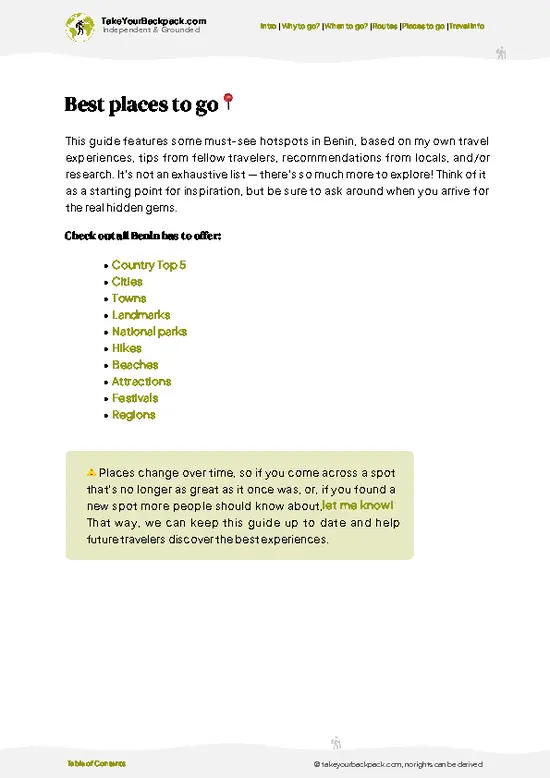
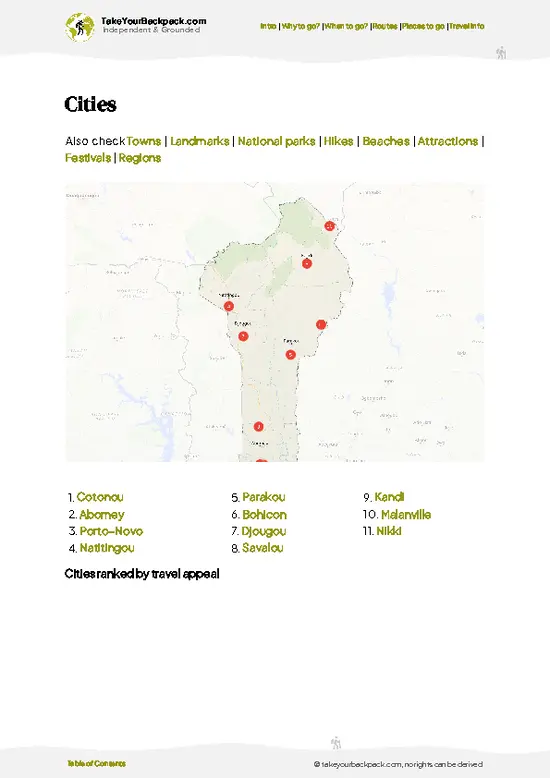
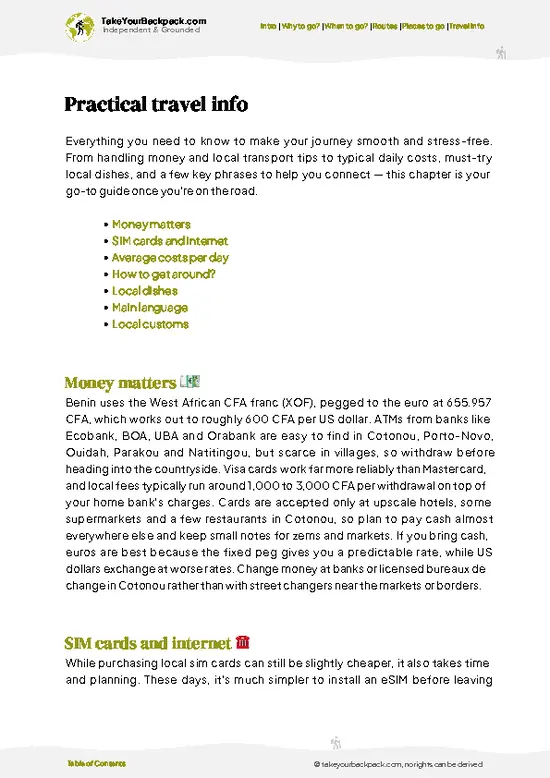
example page 0 from our offline Travel Guide for Benin
example page 1 from our offline Travel Guide for Benin
example page 2 from our offline Travel Guide for Benin
example page 3 from our offline Travel Guide for Benin
example page 4 from our offline Travel Guide for Benin
example page 5 from our offline Travel Guide for Benin
example page 6 from our offline Travel Guide for Benin
example page 7 from our offline Travel Guide for Benin
Loading the map 🌍
CLICK TO FILTER
cities
towns
landmarks
national parks
hikes
beaches
attractions
festivals
regions
SHOW COUNTRY’S BESTSHOW ALL

✨ Why go?
Ranked #5 attraction in Benin
What sets this place apart

Musée Ethnographique Alexandre Sènou Adandé gives you a grounded introduction to the cultures of southern Benin before you meet them in the street, at a market or at a ceremony. Porto-Novo was the seat of a Yoruba-influenced kingdom, and the collection reflects that: Egungun ancestor costumes and Gelede masks make more sense once you see them up close, still and silent, rather than whirling past in a festival crowd. That context changes how you read the rest of the country, from vodun shrines in Ouidah to the palaces in Abomey. It also works as a milestone in a Porto-Novo day, a calm stop between the royal palace museum and the colonial-era streets. Most people spend about an hour. If you only have a day in the capital, I would spend it here and at the neighboring museums rather than rushing … read more 👉
Musée Ethnographique Alexandre Sènou Adandé gives you a grounded introduction to the cultures of southern Benin before you meet them in the street, at a market or at a ceremony. Porto-Novo was the seat of a Yoruba-influenced kingdom, and the collection reflects that: Egungun ancestor costumes and Gelede masks make more sense once you see them up close, still and silent, rather than whirling past in a festival crowd. That context changes how you read the rest of the country, from vodun shrines in Ouidah to the palaces in Abomey. It also works as a milestone in a Porto-Novo day, a calm stop between the royal palace museum and the colonial-era streets. Most people spend about an hour. If you only have a day in the capital, I would spend it here and at the neighboring museums rather than rushing between markets. The Adandé name itself carries weight, honoring a Beninese scholar who worked to document his own country’s heritage.

💡 HighlightsDon't-miss highlights and experiences

  1. Egungun costumes: layered, tasseled ancestral costumes that show how the masquerade tradition hides the wearer completely and brings the dead into the community.
  2. Gelede masks: carved Yoruba masks, often with elaborate figures on top, made to honor women’s spiritual power. Look at the paint wear and the fine carving.
  3. Ifa divination objects: trays, tapping implements and casting chains used by diviners. They explain the system behind Yoruba consultation and decisions.
  4. Royal and ceremonial regalia: staffs, stools and display items tied to local chiefs and kingship, useful for understanding Porto-Novo’s royal history.
  5. Musical instruments: drums, rattles and gongs that connect to ceremonies and everyday gatherings, with differences in shape that hint at origin.
  6. Textiles and dress: woven and dyed cloths
… read more 👉
  1. Egungun costumes: layered, tasseled ancestral costumes that show how the masquerade tradition hides the wearer completely and brings the dead into the community.
  2. Gelede masks: carved Yoruba masks, often with elaborate figures on top, made to honor women’s spiritual power. Look at the paint wear and the fine carving.
  3. Ifa divination objects: trays, tapping implements and casting chains used by diviners. They explain the system behind Yoruba consultation and decisions.
  4. Royal and ceremonial regalia: staffs, stools and display items tied to local chiefs and kingship, useful for understanding Porto-Novo’s royal history.
  5. Musical instruments: drums, rattles and gongs that connect to ceremonies and everyday gatherings, with differences in shape that hint at origin.
  6. Textiles and dress: woven and dyed cloths showing regional patterns and the techniques behind them.
  7. Domestic and farming tools: pottery, baskets, iron implements and fishing gear, which show daily life in the lagoon and plateau areas.
  8. The surrounding museum quarter: step outside and walk the old streets of Porto-Novo, where colonial and Afro-Brazilian facades stand close together.
Musée Ethnographique Alexandre Sènou Adandé charges only a modest entry, and the walk through the surrounding streets is the one part that costs nothing.
Spotted a mistake or missing something? Contact us.

Things to do near Musée Ethnographique Alexandre Sènou Adandé

Ratings based on Tripadvisor reviews. When you book through this link, you support our work at no extra cost to you.

🌤️ When to go?Choosing the right time of year

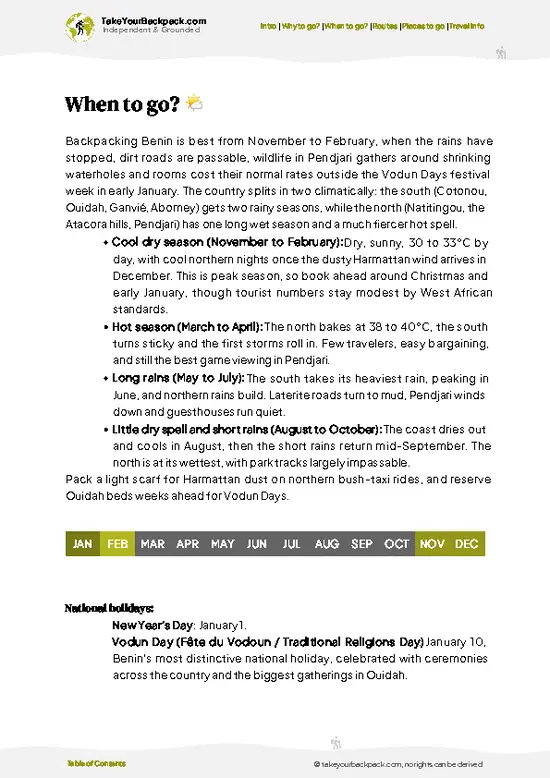
  • Long Dry Season (December to March): Porto-Novo is hottest and sunniest now, around 30 to 34°C (86 to 93°F), with Harmattan haze some mornings. Galleries stay comfortable and roads are easy. Hotel rates in the capital region stay steady.
  • Long Rainy Season (April to July): Expect 25 to 31°C (77 to 88°F), heavy downpours and sticky air. Rain can flood the streets around the museum, but visitor numbers are very low.
  • Short Dry Spell (August to September): Rain eases and it is 24 to 29°C (75 to 84°F). Cloudy skies make for pleasant walking between Porto-Novo's museums.
  • Short Rainy Season (October to November): Showers return, but they are shorter. Daylight stays around 11 to 12 hours all year, so plan your visit before the late afternoon closing.
  • Festival Period (January): Vodun Days on January 10
… read more 👉
  • Long Dry Season (December to March): Porto-Novo is hottest and sunniest now, around 30 to 34°C (86 to 93°F), with Harmattan haze some mornings. Galleries stay comfortable and roads are easy. Hotel rates in the capital region stay steady.
  • Long Rainy Season (April to July): Expect 25 to 31°C (77 to 88°F), heavy downpours and sticky air. Rain can flood the streets around the museum, but visitor numbers are very low.
  • Short Dry Spell (August to September): Rain eases and it is 24 to 29°C (75 to 84°F). Cloudy skies make for pleasant walking between Porto-Novo's museums.
  • Short Rainy Season (October to November): Showers return, but they are shorter. Daylight stays around 11 to 12 hours all year, so plan your visit before the late afternoon closing.
  • Festival Period (January): Vodun Days on January 10 draw crowds and push up prices for rooms in nearby Cotonou.
Arrive on a weekday morning when guides are free and the rooms are coolest.


source: climatestotravel.comJANJanuary: highly recommended for travelingFEBFebruary: highly recommended for travelingMARMarch: highly recommended for travelingAPRApril: fair for travelingMAYMay: fair for travelingJUNJune: fair for travelingJULJuly: fair for travelingAUGAugust: fair for travelingSEPSeptember: fair for travelingOCTOctober: fair for travelingNOVNovember: excellent for travelingDECDecember: highly recommended for traveling
when-to-go

✈️ The backpacker research shortcutBenin Travel Guide

An offline-friendly backpacking guide with optimized travel routes, ranked highlights, transport advice, and the best areas to stay.
example page 0 from our offline Travel Guide for Benin
example page 1 from our offline Travel Guide for Benin
example page 2 from our offline Travel Guide for Benin
example page 3 from our offline Travel Guide for Benin
example page 4 from our offline Travel Guide for Benin
example page 5 from our offline Travel Guide for Benin
example page 6 from our offline Travel Guide for Benin
example page 7 from our offline Travel Guide for Benin
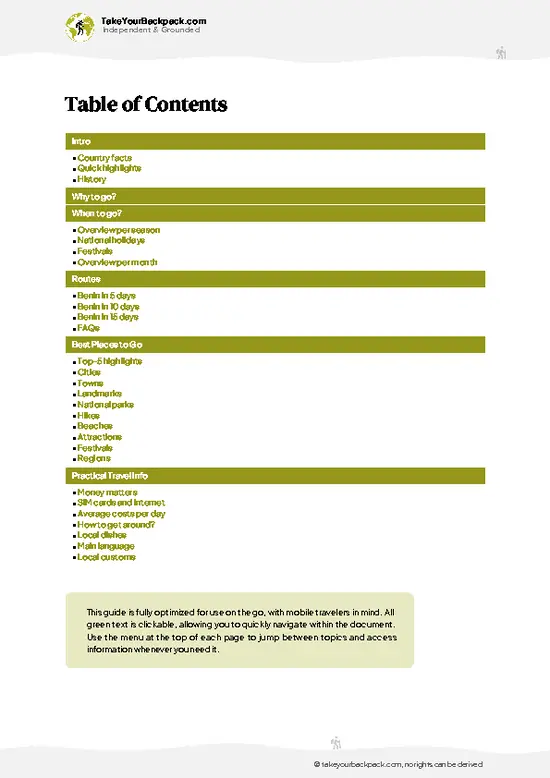
The digital guide (213 pages) contains:
✅ 48 highlights, ranked by travel appeal
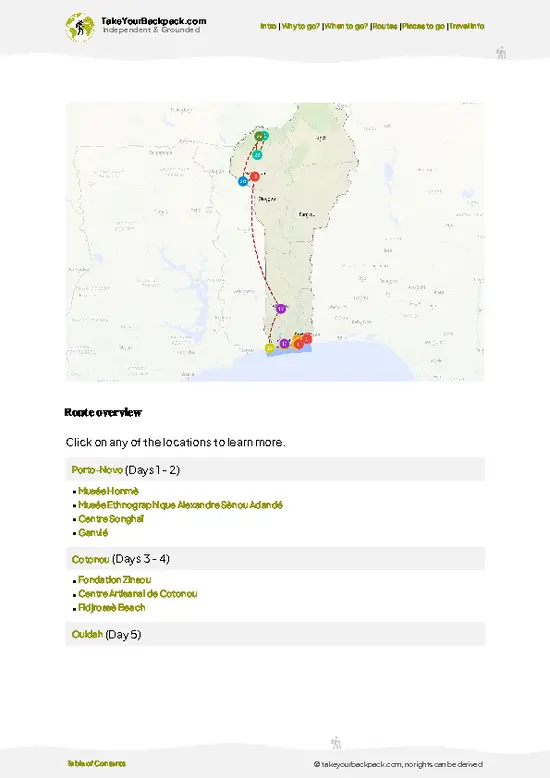
✅ Optimized 5, 10 & 15-day travel routes
✅ Cities, national parks, landmarks, beaches
✅ How to get around
✅ Offline-friendly for travel without Wi-Fi
👉 Click to see all 30+ guide features

📅 Plan smarter in minutes, not weeks
✅ Month by month travel advice
✅ Festivals & national holidays
✅ Budget expectations

🗺️ Go to the right places, skip the overrated ones
✅ Honest pros & cons of destinations
✅ Top hikes, parks & viewpoints
✅ Lesser-known places most travelers miss
✅ Clear “worth it vs skip it” guidance

🛏️ Travel smoothly without rookie mistakes
✅ Best areas to stay
✅ Transport systems explained simply
✅ Common scams & safety advice
✅ SIM cards, money & practical tips

🌍 Understand the country, not just visit it
✅ Culture & traditions
✅ 52 Essential phrases & customs
✅ Festivals worth planning around
✅ Traveler-friendly historical context
✅ Insights that make places more meaningful

📱 Built for real travel conditions
✅ Fully downloadable PDF
✅ Works completely offline
✅ Optimized for phone use
✅ Useful in remote areas & buses
✅ Everything in one place
Stop searching, start planning
Get instant access to your full guide. 30‑day money-back guarantee.
+ Add another guide for just

By proceeding you agree to our terms.
Sent to your inbox immediately after payment • 100% Secure Checkout
Best Backpacking Travel Advisor 2025 tourism awardBest Backpacking
Travel Advisor
2025
What others say about Take Your Backpack Guides:
⭐⭐⭐⭐⭐
Fantastic, amazing amount of information!
⭐⭐⭐⭐⭐
My goodness this is amazing, it's what I've been looking for hats off too you!
⭐⭐⭐⭐⭐
I think this is absolutely BRILLIANT
⭐⭐⭐⭐
Very complete and informative. It's still missing places, but I gotta to commend you
⭐⭐⭐⭐⭐
This is truly amazing, thank you, can't wait to explore it with my kids!
⭐⭐⭐⭐⭐
Awesome resource, thank you!
⭐⭐⭐⭐⭐
This is amazing! Can't wait to explore the ones I haven't seen
⭐⭐⭐⭐
I love this! Well done, great idea.
⭐⭐⭐⭐⭐
Thanks for taking the time to make this gem!
⭐⭐⭐⭐⭐
This might be the best website I've ever seen.
⭐⭐⭐⭐⭐
Congratulations, and thank you so much for your work; it's incredibly valuable.
⭐⭐⭐⭐
In all seriousness I think you did a great job pointing out the important spots
⭐⭐⭐⭐⭐
10/10 very good
⭐⭐⭐⭐⭐
As someone who's only just starting to visit regularly this is awesome, thank you.
⭐⭐⭐⭐
Thank you very much! I'm going to visit my dad, it's going to be very useful!
⭐⭐⭐⭐⭐
This is really cool! We'll be travelling for the first time and this definitely come in handy.
⭐⭐⭐⭐⭐
You are now our minister of culture, congratulations 👨‍💼
⭐⭐⭐⭐⭐
Just wanted to tell you that this is a pearl! Going to follow your recommendations.
⭐⭐⭐⭐⭐
This is so cool. I'll definitely be using the resource for my travels soon.
⭐⭐⭐⭐⭐
This is very impressive! Good work.
⭐⭐⭐⭐⭐
This is an amazing and informative site. Very well done!

🛏️ Where to stay?Choosing the right base

Porto-Novo itself is the best base, since the museum sits in the city's old colonial quarter and everything else worth seeing is a short zemidjan (motorbike taxi) ride away. Stay near the Place Jean Bayol and the Grand Marché area if you want to walk to the museum, the Honmè Palace museum and the Da Silva Museum, with cheap eateries and street vendors all around. Guesthouses here are quiet, family-run and friendly, though the nightlife is limited and there are few dorm options. Solo travelers should stay central rather than on the outskirts, as streets get dim after dark and walking at night is … read more 👉
Porto-Novo itself is the best base, since the museum sits in the city's old colonial quarter and everything else worth seeing is a short zemidjan (motorbike taxi) ride away. Stay near the Place Jean Bayol and the Grand Marché area if you want to walk to the museum, the Honmè Palace museum and the Da Silva Museum, with cheap eateries and street vendors all around. Guesthouses here are quiet, family-run and friendly, though the nightlife is limited and there are few dorm options. Solo travelers should stay central rather than on the outskirts, as streets get dim after dark and walking at night is best avoided.

Cotonou is the social alternative, with the country's best choice of hostels and backpacker-friendly guesthouses, mostly around Haie Vive, Fidjrossè and the Akpakpa district. Expect to meet other travelers there, share taxis and swap onward plans. The trade-off is a shared-taxi or minibus ride of roughly 1 to 1.5 hours each way, which suits a day trip if you prefer a livelier evening scene. Most backpackers who want more than one night in Porto-Novo still choose the capital's quiet guesthouses for the calm and the walkable heritage sites.

👛 Costs (as of 22 October 2026)How expensive it really is

Budget about €22 to 40 a day around Musée Ethnographique Alexandre Sènou Adandé, with the museum entry itself costing very little. Travelers pay in West African CFA francs, and prices below are converted to euros.
CategoryBudget RangeLocal Reality
Museum entry€1.50 to 3Paid at the door, with a guide usually included or tipped separately
Guide tip€1 to 3Guides explain the masks, ritual objects and Yoruba collections in French
Photography permit€1 to 3Sometimes charged on top of entry
Accommodation (low season)€8 to 15Simple guesthouse room with fan in Porto-Novo
Accommodation (high season)€12 to 20Rates rise around January festivals
Food€4 to 8Street rice, grilled fish and pâte at local stalls
Local transport€2 to 5Zemidjan rides across town cost €0.50 to 1.50 each
Other museums€1.50 to 4Honmè Palace
… read more 👉
Budget about €22 to 40 a day around Musée Ethnographique Alexandre Sènou Adandé, with the museum entry itself costing very little. Travelers pay in West African CFA francs, and prices below are converted to euros.
CategoryBudget RangeLocal Reality
Museum entry€1.50 to 3Paid at the door, with a guide usually included or tipped separately
Guide tip€1 to 3Guides explain the masks, ritual objects and Yoruba collections in French
Photography permit€1 to 3Sometimes charged on top of entry
Accommodation (low season)€8 to 15Simple guesthouse room with fan in Porto-Novo
Accommodation (high season)€12 to 20Rates rise around January festivals
Food€4 to 8Street rice, grilled fish and pâte at local stalls
Local transport€2 to 5Zemidjan rides across town cost €0.50 to 1.50 each
Other museums€1.50 to 4Honmè Palace and Da Silva Museum charge separate fees
Total Daily Budget€22 to 40Based on high-season lodging and a few museum visits
⚠️ Prices can change and everyone travels differently, so take this as a rough guide. Hope it helps you plan your adventure!

FAQFrequently asked questions about Musée Ethnographique Alexandre Sènou Adandé

Allow 1 to 2 hours for Musée Ethnographique Alexandre Sènou Adandé, which is enough for the main galleries of masks, textiles and ritual objects. Add another 3 to 4 hours if you want to combine it with the Honmè Palace and the Da Silva Museum in Porto-Novo. A full day covers all the main sites in the city comfortably.
Yes, Musée Ethnographique Alexandre Sènou Adandé is good value at roughly €1.50 to 3 for entry. The collection gives context on Yoruba, Fon and other cultures that you will meet across southern Benin. A guide brings the Egungun costumes and Vodun objects to life, and a tip of €1 to 3 is customary.
To reach Musée Ethnographique Alexandre Sènou Adandé from Cotonou, take a shared taxi or minibus to Porto-Novo, which takes roughly 1 to 1.5 hours and costs about €1.50 to 3. Once in the city, a zemidjan motorbike taxi to the museum costs around €0.50 to 1.50. Many travelers also hire a private car for the day from Cotonou, at around €25 to 40.
⚠️ Things can change over time, so always validate details locally before you go.

Other Beninese attractions near Musée Ethnographique Alexandre Sènou Adandé

Explore more nearby:

  • Musée Honmè—Former royal palace, throne room, clay courtyards, guided tour| 1 km away
  • Centre Songhaï—Working farm, biogas digesters, fish ponds, trainee guides| 3 km away
  • Centre Culturel Ouadada—Porto-Novo museums, zem rides, red-earth lanes, quiet culture| 3 km away

💡 Not sure where to go next?
Create a personalized itinerary for Benin including Musée Ethnographique Alexandre Sènou Adandé and the places that fit your trip.

Generate my itinerary

👉 Discover all attractions

Or checkout all Benin has to offer (think cities, towns, villages, national parks, hikes, beaches, festivals)
Country photo of Benin

We 💚 feedbackFinal thoughts on visiting Musée Ethnographique Alexandre Sènou Adandé

Musée Ethnographique Alexandre Sènou Adandé fits neatly into a single visit of about 60 to 90 minutes, which is enough to see the main galleries without rushing. Go in the morning, before the Porto-Novo heat settles into the rooms. I would add a second hour only if you plan to read every label or talk with a guide. Skip a full day here, and pair the museum with other nearby sites on the same afternoon.

✍️ Help improve this page!
The information on this page is based on in-depth research, insights shared by experienced travelers, and feedback from the local travel community in Benin. While every effort is made to keep the information accurate and current, conditions can change — so if you spot anything incorrect or outdated, please get in touch.


🙋‍♂️ Give feedback

👋 Meet the founderWho’s Behind Take Your Backpack?

Johan, backpacker and founder of TakeYourBackpackHi, I’m Johan (Netherlands 🇳🇱), the creator of TakeYourBackpack. Over the past 3 decades, I’ve backpacked through 90+ countries across six continents, gaining extensive experience with independent travel, long-term trips, and overland routes.

This site is built on a combination of firsthand travel experience and carefully curated insights from other backpackers. Many guides are based on places I’ve personally visited, while others bring together tips, observations, and practical advice shared by trusted travelers I’ve met along the way.

The goal is to provide realistic, experience-driven guidance — not generic itineraries — so you can explore destinations with better context, clearer expectations, and more confidence.