×

Benin🇧🇯 | best attractionsEssential 12 attractions to Explore in Benin

Attractions in Benin are lived-in places more than ticketed sights. Expect red laterite roads, the smell of woodsmoke and palm oil, and drumming that carries across a village at dusk. The south packs royal palaces, lagoon stilt settlements and Atlantic beaches into short, dusty hops, with motorbike taxis (zemidjans) filling the gaps. The north is slower and hotter, with savanna, wildlife reserves and earthen fortress-homes, where distances stretch and few visitors appear. Entry fees are modest, crowds are thin almost everywhere, and independent backpacking works well if you accept patchy signage, heat and long rides on rough road.

By Johan Kruseman 🇳🇱 | Updated October 23, 2026
Explore the best festivals in Benin

Why go?Why These attraction Stand Out

Benin is the birthplace of Vodun, and that single fact shapes almost everything a visitor sees. Spirit shrines, sacred forests and ceremonies are part of daily life rather than staged shows, so the smell of fermented palm drink, the clang of iron bells and the sight of white-clay-smeared devotees appear without a ticket booth. The country also carries the weight of the Dahomey kingdom and the Atlantic slave trade, which gives its history a gravity you feel along the old coastal routes. Geography stretches the experience: a humid, flat south of lagoons and coconut groves gives way to dry savanna and rocky hills in the north, so the character changes sharply within a day of travel.
Before choosing Benin, know that infrastructure is basic. Few sites have English labeling, guides are often needed … read more 👉
Benin is the birthplace of Vodun, and that single fact shapes almost everything a visitor sees. Spirit shrines, sacred forests and ceremonies are part of daily life rather than staged shows, so the smell of fermented palm drink, the clang of iron bells and the sight of white-clay-smeared devotees appear without a ticket booth. The country also carries the weight of the Dahomey kingdom and the Atlantic slave trade, which gives its history a gravity you feel along the old coastal routes. Geography stretches the experience: a humid, flat south of lagoons and coconut groves gives way to dry savanna and rocky hills in the north, so the character changes sharply within a day of travel.
Before choosing Benin, know that infrastructure is basic. Few sites have English labeling, guides are often needed to explain what you are seeing, and the tarmac between regions can be pocked with potholes. Tourism is small, which means personal welcome and little queuing, but also fewer services, patchy card acceptance and heavy reliance on cash in CFA francs. Respect for sacred spaces matters, and photography is often restricted. Go with patience and curiosity and the country gives back more than busier neighbors.
Our Approach to Ranking
The list of best attractions in Benin is created based on cultural significance or entertainment value. If you feel a attraction is missing in this list, please let us know.

When to go?Best Time to Visit Benin for attractions

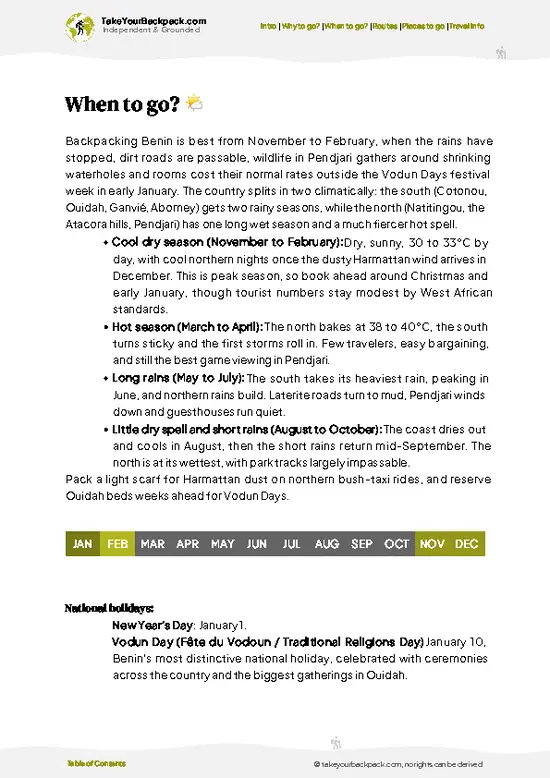
Best months and the dry season: The best months for attractions in Benin are November to February, when the dry season keeps roads passable and skies mostly clear, though the Harmattan can drape everything in pale dust. Daytime temperatures run about 28 to 34°C in the south, with nights around 22 to 25°C. In the north, mornings can drop to 15 to 20°C in December and January, while afternoons still climb past 33°C. Harmattan haze softens the light and dulls long views, and the dry air chaps lips and leaves a fine grit on everything.
Shoulder seasons and the rains: The south has two rainy seasons, roughly April to July and a lighter one in September to November, with annual rainfall around 1,100 to 1,400 mm near Cotonou. Downpours turn laterite tracks into slick orange mud and make motorbike … read more 👉
Best months and the dry season: The best months for attractions in Benin are November to February, when the dry season keeps roads passable and skies mostly clear, though the Harmattan can drape everything in pale dust. Daytime temperatures run about 28 to 34°C in the south, with nights around 22 to 25°C. In the north, mornings can drop to 15 to 20°C in December and January, while afternoons still climb past 33°C. Harmattan haze softens the light and dulls long views, and the dry air chaps lips and leaves a fine grit on everything.
Shoulder seasons and the rains: The south has two rainy seasons, roughly April to July and a lighter one in September to November, with annual rainfall around 1,100 to 1,400 mm near Cotonou. Downpours turn laterite tracks into slick orange mud and make motorbike rides slow, though the air smells green and the heat eases. In the north, a single rainy season runs roughly May to October, and dirt roads to remote areas can become impassable. March and April bring the hottest days, often above 35°C in the north, and wildlife viewing is best late in the dry season when animals gather at water.
Crowds and prices: Benin has no true peak crowds, and prices barely shift by season. Early January is the main exception, when the national Vodun festival period draws visitors and lifts lodging demand in the south, so book ahead.

attraction hoppingHow to Combine attractions Into One Trip

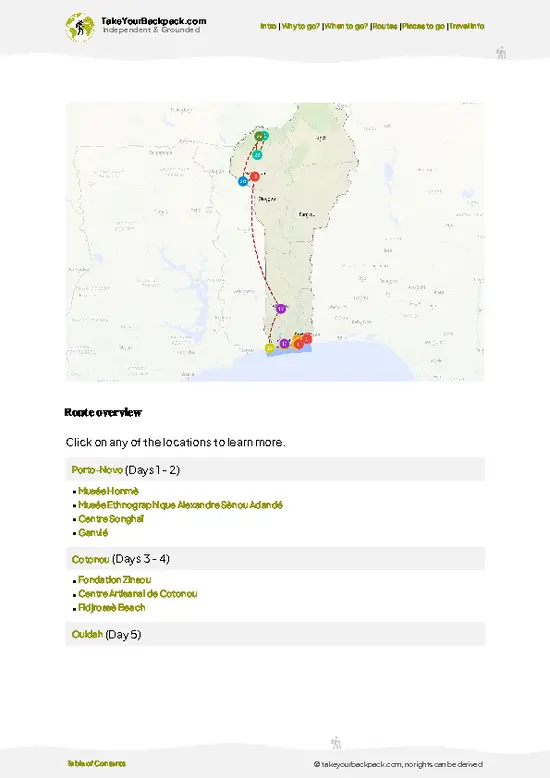
How many days to plan: A trip combining several attractions in Benin needs 8 to 12 days, and 10 gives room to breathe. The country is long and narrow, so the logic is a single north-south line rather than a loop. Start in Cotonou or Ouidah on the coast, work inland through Abomey and Dassa, then continue to the northwest around Natitingou, Tanguiéta and Pendjari, and finish in the north before heading back by bus or flying out of Cotonou.
Time per stop and between regions: Allow half a day to a full day for most single stops, and 2 to 3 days for the northern savanna and its remote villages, where distances are large. Typical road times are 1 to 1.5 hours from Cotonou to Ouidah, about 2 to 3 hours to Abomey, 3 to 4 hours from Abomey to Dassa, and a full day of 7 to 9 hours from the center to … read more 👉
How many days to plan: A trip combining several attractions in Benin needs 8 to 12 days, and 10 gives room to breathe. The country is long and narrow, so the logic is a single north-south line rather than a loop. Start in Cotonou or Ouidah on the coast, work inland through Abomey and Dassa, then continue to the northwest around Natitingou, Tanguiéta and Pendjari, and finish in the north before heading back by bus or flying out of Cotonou.
Time per stop and between regions: Allow half a day to a full day for most single stops, and 2 to 3 days for the northern savanna and its remote villages, where distances are large. Typical road times are 1 to 1.5 hours from Cotonou to Ouidah, about 2 to 3 hours to Abomey, 3 to 4 hours from Abomey to Dassa, and a full day of 7 to 9 hours from the center to Natitingou. Shared taxis and buses leave when full, so mornings are far better than afternoons.
Planning mistakes to avoid: The common error is cramming the south into two days and arriving in the north exhausted. Another is underestimating rough roads, which can double travel time in the rainy season. Build in a buffer day before any flight, avoid driving after dark because of unlit trucks and livestock, and hire a driver or use a reliable bus company for the long northern leg rather than chaining multiple connections.

The ListMust-Visit attractions in Benin

1 Musée d’Histoire de Ouidah

Portuguese fort, shackles, Dahomey kings, Egungun costumes

Pass through the whitewashed fort gate to see iron shackles, royal objects, vodun masks and the story of Brazilian returnees.

2 Fondation Zinsou

Red villa, contemporary African art, free entry, jerrycan masks

Step into a red villa of rotating African art shows, find faces built from jerrycans, and finish at the bookshop.

benin-attraction-fondation-zinsou
© Google |

3 Musée Ethnographique Alexandre Sènou Adandé

Gelede masks, Ifa trays, Yoruba ritual, one-hour visit

Examine scarred carved masks, tasseled ancestral costumes and divination tools before walking the old streets between Porto-Novo’s museums.

4 Musée Honmè

Former royal palace, throne room, clay courtyards, guided tour

Follow a local guide through thrones, ceremonial robes and earth-walled courtyards to learn how Porto-Novo’s kings staged power.

benin-attraction-musee-honme
© Google |

5 Centre Songhaï

Working farm, biogas digesters, fish ponds, trainee guides

Tour a training campus where manure becomes cooking gas, tilapia swim in ponds, and guides cut open fresh papaya in the orchards.

benin-attraction-centre-songhai
© Google |

6 Centre Artisanal de Cotonou

Bronze casting, wood carving, batik, appliqué hangings

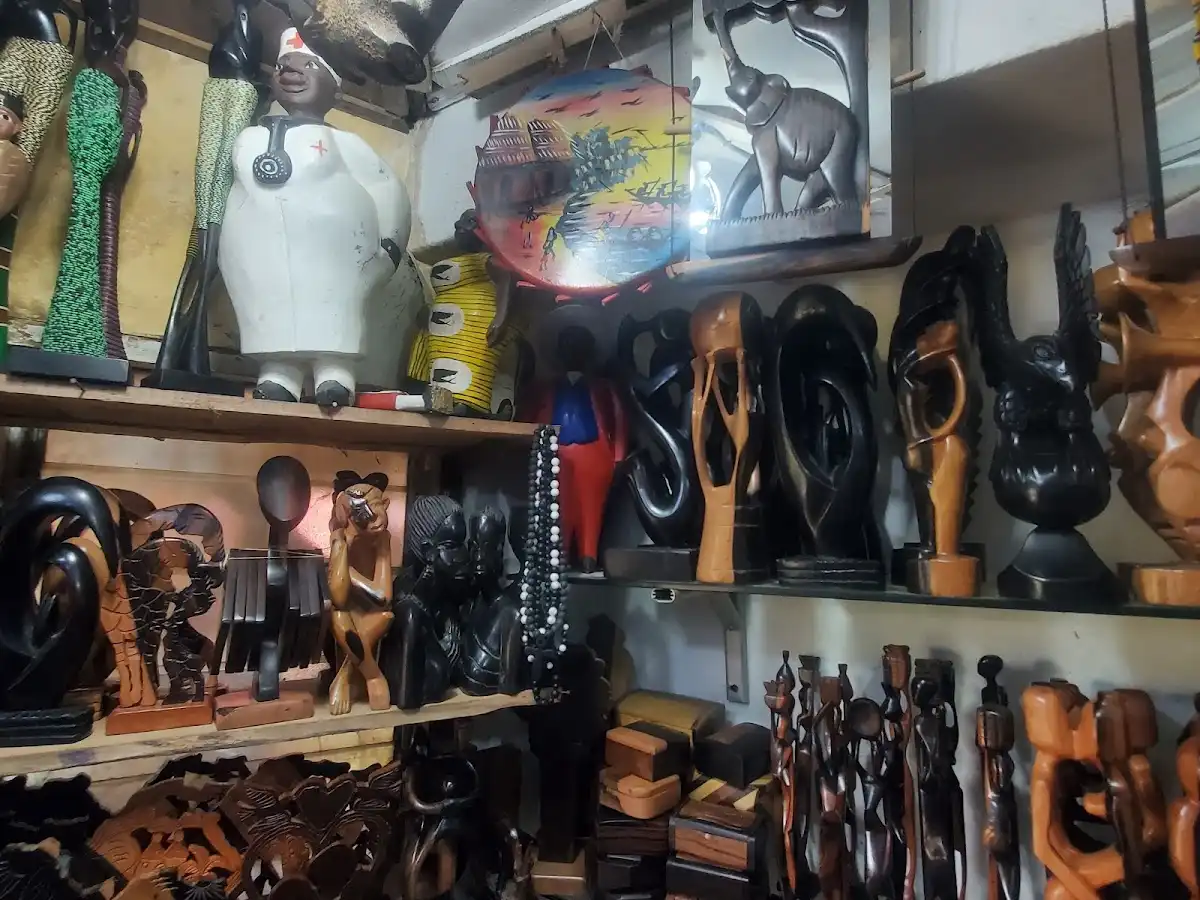
Watch makers pour molten bronze, carve hardwood and stitch cloth in one fenced compound, then haggle for pieces you saw being made.

benin-attraction-centre-artisanal-de-cotonou
© Google |

7 Institut Français de Cotonou

Open-air stage, film nights, courtyard gallery, French library

Catch a concert under the night sky, a film with the director present, or an exhibition by Beninese artists.

benin-attraction-institut-francais-de-cotonou
© Google |

8 Centre Culturel Ouadada

Porto-Novo museums, zem rides, red-earth lanes, quiet culture

Use this Porto-Novo cultural stop as a base for the royal palace, Afro-Brazilian heritage, the yellow-and-green mosque and a shaded botanical garden.

benin-attraction-centre-culturel-ouadada
© Google |

9 Place Chacha

Old auction square, Route des Esclaves start, red laterite, Afro-Brazilian houses

Begin the walk toward the Atlantic where captives were once sold, passing monuments, shrines and a Python Temple on the way to the Door of No Return.

10 Place Goho

Abomey square, palace gateway, bas-reliefs, appliqué tailors

Get your bearings in a free town square, then continue to earthen palace compounds, painted clay panels and tailors stitching royal emblems.

11 Place des Martyrs

1977 memorial, bronze monument, moto-taxi corner, low-sun photos

Pause at a small paved square around a monument to those killed in 1977, best visited early or late when the heat eases.

12 Centre Culturel Artisttik Africa

Artist-run yard, salvaged-metal sculpture, resident painters, hands-on workshops

Walk among welded sculptures, talk technique with painters at work, and try batik or sculpting yourself in a small studio space.

Loading the map 🌍

Expert viewExpert Commentary on attractions

How many attractions to choose: I advise 6 to 8 attractions over a 10 to 12 day trip. Benin rewards unhurried visits because most sites need a local guide to make sense, and a single stop with explanation takes 2 to 4 hours once you add dusty rides and waiting. Cram in more and you spend the trip in a shared taxi smelling gasoline and fried plantain instead of listening to a priest explain a shrine.
Prioritizing by travel style: If your interest is culture and history, put the south first: palaces, Vodun sites and coastal memorials need guides but are close together, so you see a lot cheaply. If you want wildlife and landscape, focus on the north, where savanna, red cliffs and earthen houses reward the extra effort of long, hot journeys. Beach and lagoon stops suit a rest day between heavier … read more 👉
How many attractions to choose: I advise 6 to 8 attractions over a 10 to 12 day trip. Benin rewards unhurried visits because most sites need a local guide to make sense, and a single stop with explanation takes 2 to 4 hours once you add dusty rides and waiting. Cram in more and you spend the trip in a shared taxi smelling gasoline and fried plantain instead of listening to a priest explain a shrine.
Prioritizing by travel style: If your interest is culture and history, put the south first: palaces, Vodun sites and coastal memorials need guides but are close together, so you see a lot cheaply. If you want wildlife and landscape, focus on the north, where savanna, red cliffs and earthen houses reward the extra effort of long, hot journeys. Beach and lagoon stops suit a rest day between heavier travel, with salty air and slow canoe rides as the payoff. Mixing one of each type keeps energy up.
What it costs: Budget US$25 to 45 a day for independent travel, covering a simple guesthouse, street food and local transport. Entry fees at most sites run about 2,000 to 10,000 CFA francs (roughly US$3 to 17), with museums at the lower end and park access higher. Local guides usually charge 5,000 to 15,000 CFA francs (US$8 to 25) per visit, and wildlife reserves can add several tens of dollars for vehicle and ranger. Zemidjan rides within towns cost 300 to 1,000 CFA francs (under US$2). Carry small notes, because change is scarce and ATMs outside cities fail often.
Safety and cultural considerations: The far northern border areas near parks carry government travel advisories, so check current guidance before heading there and use registered guides. In cities, keep phones tucked away on zemidjans and avoid night riding. Vodun sites are active places of worship: ask permission before photographing, pay any requested fee openly, and dress modestly with covered shoulders and knees. Never touch altars or offerings. Greet people first, since a handshake and a few words of French open doors that a camera never will, and you get the story behind the site instead of just the picture.

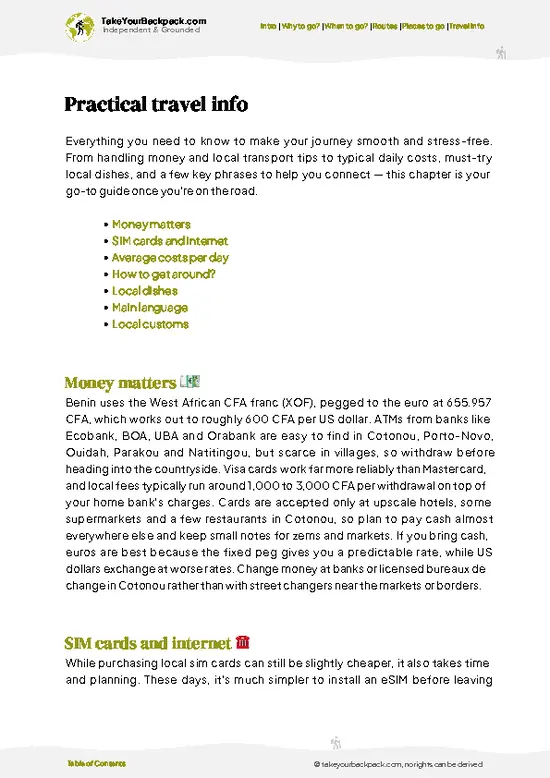
✈️ The backpacker research shortcutBenin Travel Guide

An offline-friendly backpacking guide with optimized travel routes, ranked highlights, transport advice, and the best areas to stay.
example page 0 from our offline Travel Guide for Benin
example page 1 from our offline Travel Guide for Benin
example page 2 from our offline Travel Guide for Benin
example page 3 from our offline Travel Guide for Benin
example page 4 from our offline Travel Guide for Benin
example page 5 from our offline Travel Guide for Benin
example page 6 from our offline Travel Guide for Benin
example page 7 from our offline Travel Guide for Benin
The digital guide (213 pages) contains:
✅ 48 highlights, ranked by travel appeal
✅ Optimized 5, 10 & 15-day travel routes
✅ Cities, national parks, landmarks, beaches
✅ How to get around
✅ Offline-friendly for travel without Wi-Fi
👉 Click to see all 30+ guide features

📅 Plan smarter in minutes, not weeks
✅ Month by month travel advice
✅ Festivals & national holidays
✅ Budget expectations

🗺️ Go to the right places, skip the overrated ones
✅ Honest pros & cons of destinations
✅ Top hikes, parks & viewpoints
✅ Lesser-known places most travelers miss
✅ Clear “worth it vs skip it” guidance

🛏️ Travel smoothly without rookie mistakes
✅ Best areas to stay
✅ Transport systems explained simply
✅ Common scams & safety advice
✅ SIM cards, money & practical tips

🌍 Understand the country, not just visit it
✅ Culture & traditions
✅ 52 Essential phrases & customs
✅ Festivals worth planning around
✅ Traveler-friendly historical context
✅ Insights that make places more meaningful

📱 Built for real travel conditions
✅ Fully downloadable PDF
✅ Works completely offline
✅ Optimized for phone use
✅ Useful in remote areas & buses
✅ Everything in one place
Stop searching, start planning
Get instant access to your full guide. 30‑day money-back guarantee.
+ Add another guide for just

By proceeding you agree to our terms.
Sent to your inbox immediately after payment • 100% Secure Checkout
Best Backpacking Travel Advisor 2025 tourism awardBest Backpacking
Travel Advisor
2025
What others say about Take Your Backpack Guides:
⭐⭐⭐⭐⭐
Fantastic, amazing amount of information!
⭐⭐⭐⭐⭐
My goodness this is amazing, it's what I've been looking for hats off too you!
⭐⭐⭐⭐⭐
I think this is absolutely BRILLIANT
⭐⭐⭐⭐
Very complete and informative. It's still missing places, but I gotta to commend you
⭐⭐⭐⭐⭐
This is truly amazing, thank you, can't wait to explore it with my kids!
⭐⭐⭐⭐⭐
Awesome resource, thank you!
⭐⭐⭐⭐⭐
This is amazing! Can't wait to explore the ones I haven't seen
⭐⭐⭐⭐
I love this! Well done, great idea.
⭐⭐⭐⭐⭐
Thanks for taking the time to make this gem!
⭐⭐⭐⭐⭐
This might be the best website I've ever seen.
⭐⭐⭐⭐⭐
Congratulations, and thank you so much for your work; it's incredibly valuable.
⭐⭐⭐⭐
In all seriousness I think you did a great job pointing out the important spots
⭐⭐⭐⭐⭐
10/10 very good
⭐⭐⭐⭐⭐
As someone who's only just starting to visit regularly this is awesome, thank you.
⭐⭐⭐⭐
Thank you very much! I'm going to visit my dad, it's going to be very useful!
⭐⭐⭐⭐⭐
This is really cool! We'll be travelling for the first time and this definitely come in handy.
⭐⭐⭐⭐⭐
You are now our minister of culture, congratulations 👨‍💼
⭐⭐⭐⭐⭐
Just wanted to tell you that this is a pearl! Going to follow your recommendations.
⭐⭐⭐⭐⭐
This is so cool. I'll definitely be using the resource for my travels soon.
⭐⭐⭐⭐⭐
This is very impressive! Good work.
⭐⭐⭐⭐⭐
This is an amazing and informative site. Very well done!

🛏️ Where to stay?Best Places to Stay in Benin

Benin has only a handful of true backpacker hostels, but simple guesthouses (auberges) and basic hotels are easy to find, with fan rooms at roughly 8,000 to 15,000 CFA (US$13 to 25) and air-conditioned doubles at 15,000 to 25,000 CFA (US$25 to 42). In Cotonou, Haie Vive has the most choice plus the best restaurants and bars, though prices run higher, while Ganhi puts you close to banks and the Dantokpa market but goes quiet after dark. Fidjrossè is a calmer beach-side option that gets lively on weekends. Beyond the capital, Ouidah and Grand-Popo offer relaxed, cheap beach lodges with little nightlife, and Abomey has basic rooms within walking distance of the royal palaces.

If you enjoy meeting … read more 👉
Benin has only a handful of true backpacker hostels, but simple guesthouses (auberges) and basic hotels are easy to find, with fan rooms at roughly 8,000 to 15,000 CFA (US$13 to 25) and air-conditioned doubles at 15,000 to 25,000 CFA (US$25 to 42). In Cotonou, Haie Vive has the most choice plus the best restaurants and bars, though prices run higher, while Ganhi puts you close to banks and the Dantokpa market but goes quiet after dark. Fidjrossè is a calmer beach-side option that gets lively on weekends. Beyond the capital, Ouidah and Grand-Popo offer relaxed, cheap beach lodges with little nightlife, and Abomey has basic rooms within walking distance of the royal palaces.

If you enjoy meeting fellow travelers, consider choosing hostels with high ratings for atmosphere. On the other hand, if you prefer having your own space, a hotel might be a better option.

BeninExplore Benin

👋 Meet the founderWho’s Behind Take Your Backpack?

Johan, backpacker and founder of TakeYourBackpackHi, I’m Johan (Netherlands 🇳🇱), the creator of TakeYourBackpack. Over the past 3 decades, I’ve backpacked through 90+ countries across six continents, gaining extensive experience with independent travel, long-term trips, and overland routes.

This site is built on a combination of firsthand travel experience and carefully curated insights from other backpackers. Many guides are based on places I’ve personally visited, while others bring together tips, observations, and practical advice shared by trusted travelers I’ve met along the way.

The goal is to provide realistic, experience-driven guidance — not generic itineraries — so you can explore destinations with better context, clearer expectations, and more confidence.