×

Botswana🇧🇼 | landmarksSavuti Channelseasonal waterway, shifting landscapes, elephant herds, predator activity | things to do and best time to go

Explore JwanengExplore Gweta

Backpacking in Savuti Channel
🏆 Top pickunique site ranked #1
By Johan Kruseman 🇳🇱 | Updated June 10, 2026

Here’s what nobody tells you: in Savuti, you can watch lions hunt by moonlight without a single fence between you and the food chain. That’s the practical edge—real wild, not the sanitized safari version. Savuti Channel slices through Chobe National Park in northern Botswana, a shifting river that sometimes disappears for decades, then roars back to life, dragging elephants and predators with it.

Savuti isn’t cheap, and it’s not easy—self-drivers need grit and a shovel, and even guided trips cost more than your average backpacker’s month in Southeast Asia. But the payoff? You’re not elbowing for space with a hundred jeeps; you’re tracking hyenas across ancient rock paintings, or waking to the sound of hippos arguing outside your tent. The landscape is raw, sun-bleached, and honest. Photos can’t touch the adrenaline of a night drive here. If you want a wildlife experience that feels earned, not packaged, Savuti delivers—just be ready to work for it.

Discover everything you want to know in the 📖 Botswana Travel Guide.


Get your Botswana guide
58 ranked highlights, routes & tips, works offline (257 pages)
Loading the map 🌍
CLICK TO FILTER
cities
towns
villages
landmarks
national parks
hikes
attractions
festivals
regions
SHOW COUNTRY’S BESTSHOW ALL

✨ Why go?
Ranked #1 unique site in Botswana
Why visitors keep coming back

Savuti Channel in Botswana isn’t just another pretty picture for your Instagram feed. Sure, it’s a world wonder, but let’s cut through the fluff. The crowds can be intense, especially during peak season. You’ll share the landscape with other travelers, but here’s the kicker: the wildlife is worth every moment of that hustle.

This place is a living ecosystem. You’ll witness elephants, lions, and a myriad of birds in their natural habitat, all while surrounded by stunning landscapes that shift from savanna to marsh. The effort-to-reward ratio is solid. Getting here might require a bit of planning, but once you’re in, the adventure unfolds.

Savuti fits perfectly into a broader route through Chobe National Park and the Okavango Delta, making it a natural stop rather than a standalone trek. … read more 👉
Savuti Channel in Botswana isn’t just another pretty picture for your Instagram feed. Sure, it’s a world wonder, but let’s cut through the fluff. The crowds can be intense, especially during peak season. You’ll share the landscape with other travelers, but here’s the kicker: the wildlife is worth every moment of that hustle.

This place is a living ecosystem. You’ll witness elephants, lions, and a myriad of birds in their natural habitat, all while surrounded by stunning landscapes that shift from savanna to marsh. The effort-to-reward ratio is solid. Getting here might require a bit of planning, but once you’re in, the adventure unfolds.

Savuti fits perfectly into a broader route through Chobe National Park and the Okavango Delta, making it a natural stop rather than a standalone trek. It’s not just about the destination; it’s about the journey.

And let’s talk cost. Compared to other iconic sites, Savuti offers a more affordable experience without sacrificing the thrill. You’ll leave with stories that outshine any filter. This is the real magic of Savuti Channel—raw, unfiltered, and absolutely unforgettable.
Want to include Savuti Channel in your Botswana route?
Create a personalized Botswana itinerary that includes Savuti Channel and the places that fit your trip — based on your travel style, budget, and available time. Get your route in seconds.

Generate my trip

💡 HighlightsPlaces and moments you shouldn't skip

  • The shifting Savuti Channel — this watercourse is famous because it doesn’t behave like a regular river: it has dried up for years, then suddenly flowed again (notably resumed in 2008), and those swings reshape the whole ecosystem. Watching the channel change between marsh, mud and ribbon of water is like watching nature rearrange itself in real time.
  • Predator theatre on open plains — Savuti is one of Africa’s best places to see dramatic predator action up close: lions, spotted hyenas and the occasional cheetah use the flat, open ground to hunt, stalk and clash in daylight when visibility is excellent. You’ll often witness tense chases, coalition tactics and the messy aftermath — raw wildlife, no filters.
  • Elephant “tree-pushers” and massive herds — huge elephant groups congregate here
read more 👉
  • The shifting Savuti Channel — this watercourse is famous because it doesn’t behave like a regular river: it has dried up for years, then suddenly flowed again (notably resumed in 2008), and those swings reshape the whole ecosystem. Watching the channel change between marsh, mud and ribbon of water is like watching nature rearrange itself in real time.
  • Predator theatre on open plains — Savuti is one of Africa’s best places to see dramatic predator action up close: lions, spotted hyenas and the occasional cheetah use the flat, open ground to hunt, stalk and clash in daylight when visibility is excellent. You’ll often witness tense chases, coalition tactics and the messy aftermath — raw wildlife, no filters.
  • Elephant “tree-pushers” and massive herds — huge elephant groups congregate here and have literally reshaped the landscape by toppling ancient trees while accessing bark and water. The scale of these herds and their impact makes Savuti feel like a place controlled as much by elephants as by humans.
  • Hippo pods and croc encounters — when there’s water the channel attracts dense pods of hippos and resident Nile crocodiles, giving close, noisy, sometimes tense sightings at water’s edge. The combination of booming hippos, floating crocs and shimmering water is uniquely Savuti.
  • Birdlife in the wetlands — the fluctuating channel creates a magnet for waterbirds and raptors: storks, herons, kingfishers, gulls and eagles are all common, with seasonal migrants turning the sky and shoreline into a living field guide. If you like birds, this changing wetland is a treat.
  • Wide-open scenery and light for photography — low vegetation, sandy plains and distant kopjes give unobstructed views and incredible light at dawn and dusk. Sunsets, silhouettes of lone trees and starlit nights make Savuti an especially photogenic, cinematic landscape.
  • Seasonal dynamics and ecosystem storytelling — the channel’s on/off flow creates clear cause-and-effect you can observe: when water returns, fish and birds explode; when it dries, grazers and predators rearrange. That seasonal pulse makes Savuti a living lesson in how water controls everything on the plains.
Spotted a mistake or missing something? Contact us.

🌤️ When to go?Choosing the right time of year


  • Weather: The dry season from May to October is prime time. Expect bone-dry conditions that concentrate wildlife around the channel, making sightings easier. The wet season (November to April) turns the area into a muddy mess, often inaccessible and buggy.

  • Temperature: Dry season days hover between 20-30°C (68-86°F), perfect for daytime game drives. Nights can plunge to 5°C (41°F), so pack layers. Wet season heats up to 35°C (95°F) with sticky humidity, not ideal for backpackers craving comfort.

  • Daylight Hours: Roughly 11-12 hours year-round, but the dry season’s clear skies mean longer, more productive daylight for exploring and photography.

  • Crowds: Peak dry months (July-August) attract safari lodges and tour groups, but Savuti’s remoteness keeps crowds manageable. Wet season sees
read more 👉

  • Weather: The dry season from May to October is prime time. Expect bone-dry conditions that concentrate wildlife around the channel, making sightings easier. The wet season (November to April) turns the area into a muddy mess, often inaccessible and buggy.

  • Temperature: Dry season days hover between 20-30°C (68-86°F), perfect for daytime game drives. Nights can plunge to 5°C (41°F), so pack layers. Wet season heats up to 35°C (95°F) with sticky humidity, not ideal for backpackers craving comfort.

  • Daylight Hours: Roughly 11-12 hours year-round, but the dry season’s clear skies mean longer, more productive daylight for exploring and photography.

  • Crowds: Peak dry months (July-August) attract safari lodges and tour groups, but Savuti’s remoteness keeps crowds manageable. Wet season sees fewer visitors, but many camps close, limiting options.

  • Seasonal Activities: Dry season is the jackpot for predator action—lions, hyenas, and wild dogs gather around shrinking water sources. Wet season offers lush landscapes and birdwatching but less reliable wildlife viewing.

  • Price Fluctuations: Expect premium rates in the dry season due to demand and accessibility. Wet season drops prices but at the cost of limited services and tougher travel conditions.


Pro-tip: Aim for late dry season (September-October) to dodge peak crowds, enjoy great wildlife action, and snag slightly better rates before the rains roll in.


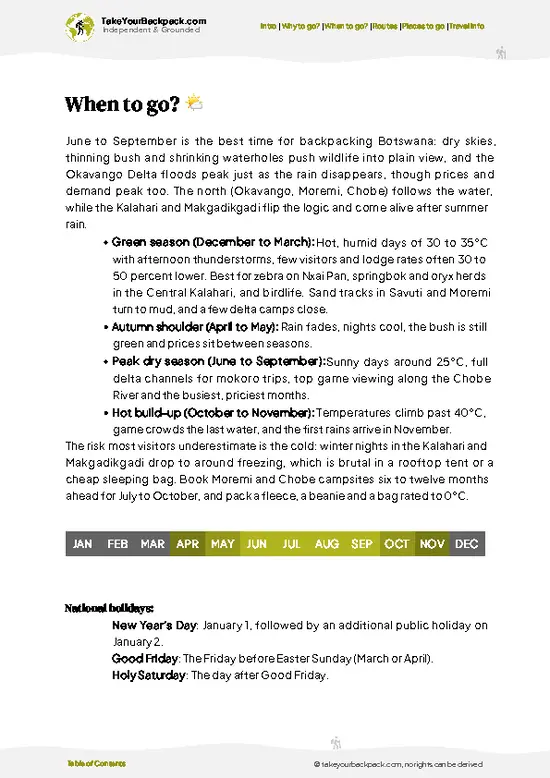
source: climatestotravel.comJANJanuary: fair for travelingFEBFebruary: fair for travelingMARMarch: fair for travelingAPRApril: fair for travelingMAYMay: highly recommended for travelingJUNJune: highly recommended for travelingJULJuly: excellent for travelingAUGAugust: excellent for travelingSEPSeptember: excellent for travelingOCTOctober: highly recommended for travelingNOVNovember: fair for travelingDECDecember: fair for traveling
when-to-go

✈️ The backpacker research shortcutBotswana Travel Guide

An offline-friendly backpacking guide with optimized travel routes, ranked highlights, transport advice, and the best areas to stay.
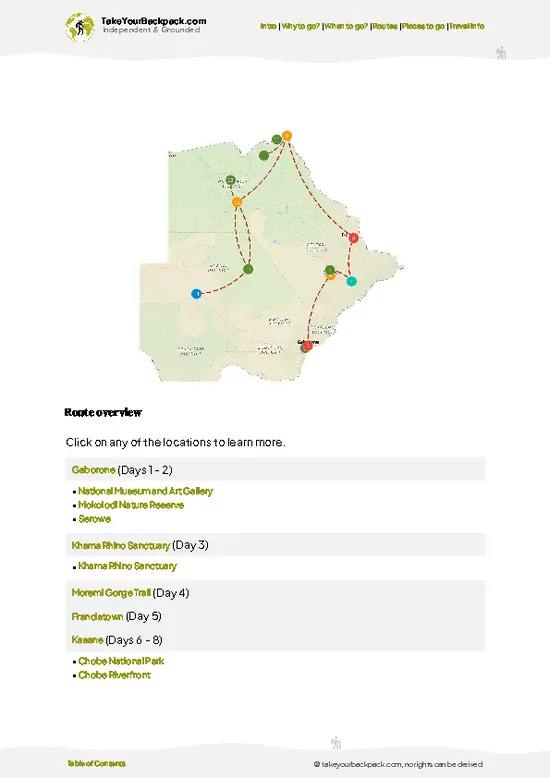
example page 0 from our offline Travel Guide for Botswana
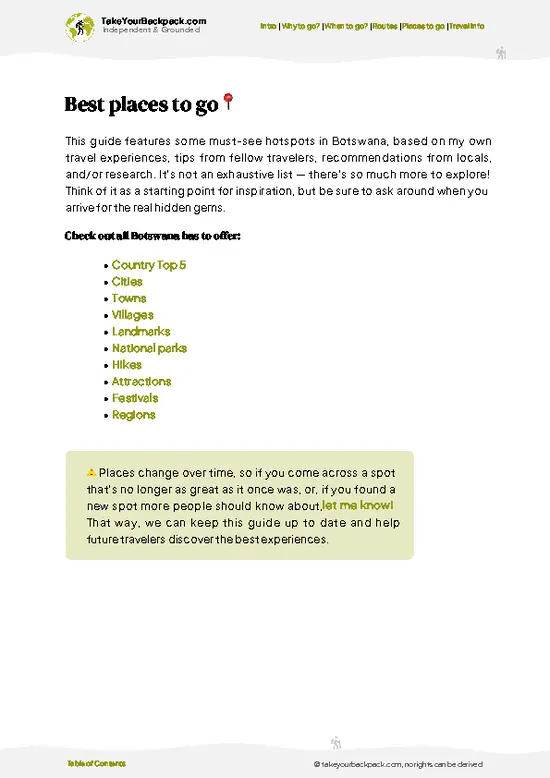
example page 1 from our offline Travel Guide for Botswana
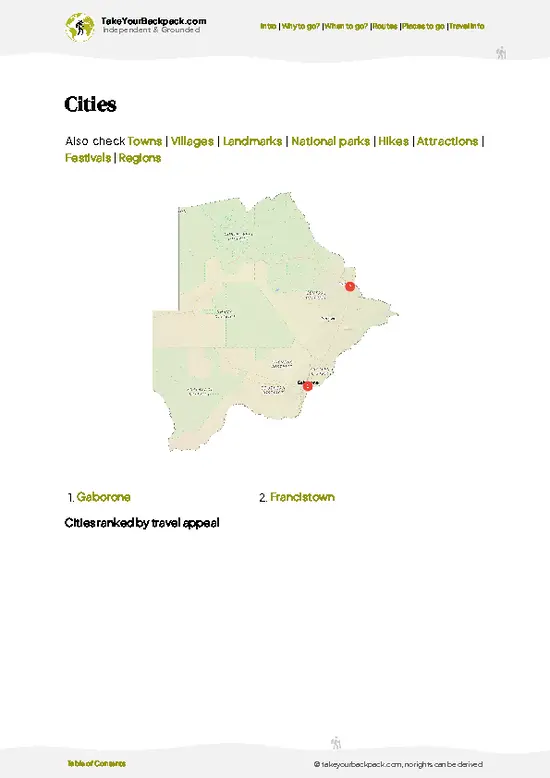
example page 2 from our offline Travel Guide for Botswana
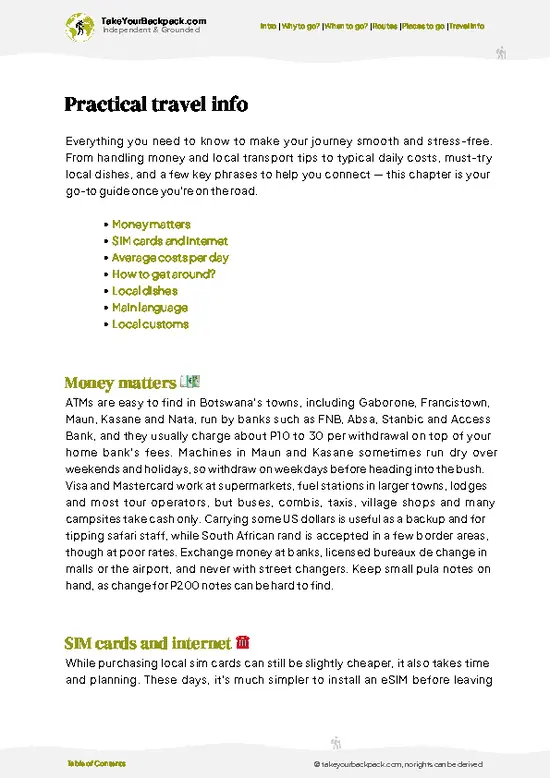
example page 3 from our offline Travel Guide for Botswana
example page 4 from our offline Travel Guide for Botswana
example page 5 from our offline Travel Guide for Botswana
example page 6 from our offline Travel Guide for Botswana
example page 7 from our offline Travel Guide for Botswana
The digital guide (257 pages) contains:
58 highlights, ranked by travel appeal
Optimized 5, 10 & 15-day travel routes
Cities, national parks, landmarks, beaches
How to get around
Offline-friendly for travel without Wi-Fi
👉 Click to see all 30+ guide features

📅 Plan smarter in minutes, not weeks
Month by month travel advice
Festivals & national holidays
Budget expectations

🗺️ Go to the right places, skip the overrated ones
Honest pros & cons of destinations
Top hikes, parks & viewpoints
Lesser-known places most travelers miss
Clear “worth it vs skip it” guidance

🛏️ Travel smoothly without rookie mistakes
Best areas to stay
Transport systems explained simply
Common scams & safety advice
SIM cards, money & practical tips

🌍 Understand the country, not just visit it
Culture & traditions
52 Essential phrases & customs
Festivals worth planning around
Traveler-friendly historical context
Insights that make places more meaningful

📱 Built for real travel conditions
Fully downloadable PDF
Works completely offline
Optimized for phone use
Useful in remote areas & buses
Everything in one place
Save weeks of stressful planning
Get instant access to your full guide. 30‑day money-back guarantee.


By proceeding you agree to our terms.
Sent to your inbox immediately after payment • 100% Secure Checkout
Best Backpacking Travel Advisor 2025 tourism awardBest Backpacking
Travel Advisor
2025
What others say about Take Your Backpack Guides:
⭐⭐⭐⭐⭐
Fantastic, amazing amount of information!
⭐⭐⭐⭐⭐
My goodness this is amazing, it's what I've been looking for hats off too you!
⭐⭐⭐⭐⭐
I think this is absolutely BRILLIANT
⭐⭐⭐⭐
Very complete and informative. It's still missing places, but I gotta to commend you
⭐⭐⭐⭐⭐
This is truly amazing, thank you, can't wait to explore it with my kids!
⭐⭐⭐⭐⭐
Awesome resource, thank you!
⭐⭐⭐⭐⭐
This is amazing! Can't wait to explore the ones I haven't seen
⭐⭐⭐⭐
I love this! Well done, great idea.
⭐⭐⭐⭐⭐
Thanks for taking the time to make this gem!
⭐⭐⭐⭐⭐
This might be the best website I've ever seen.
⭐⭐⭐⭐⭐
Congratulations, and thank you so much for your work; it's incredibly valuable.
⭐⭐⭐⭐
In all seriousness I think you did a great job pointing out the important spots
⭐⭐⭐⭐⭐
10/10 very good
⭐⭐⭐⭐⭐
As someone who's only just starting to visit regularly this is awesome, thank you.
⭐⭐⭐⭐
Thank you very much! I'm going to visit my dad, it's going to be very useful!
⭐⭐⭐⭐⭐
This is really cool! We'll be travelling for the first time and this definitely come in handy.
⭐⭐⭐⭐⭐
You are now our minister of culture, congratulations 👨‍💼
⭐⭐⭐⭐⭐
Just wanted to tell you that this is a pearl! Going to follow your recommendations.
⭐⭐⭐⭐⭐
This is so cool. I'll definitely be using the resource for my travels soon.
⭐⭐⭐⭐⭐
This is very impressive! Good work.
⭐⭐⭐⭐⭐
This is an amazing and informative site. Very well done!

🛏️ Where to stay?Choosing the right base

Savuti Channel is a wild, untamed slice of Botswana that draws in adventurers like moths to a flame. But let’s cut through the Instagram gloss: it can get crowded, and the costs can stack up if you’re not careful.

For budget travelers and solo backpackers, the best areas to stay are around the nearby campsites and community-run lodges. These spots often have a more authentic vibe, allowing you to connect with fellow travelers and locals. You’ll find a mix of shared accommodations and communal spaces that foster camaraderie.

Look for places near the Savuti Marsh. It’s a prime location for wildlife … read more 👉
Savuti Channel is a wild, untamed slice of Botswana that draws in adventurers like moths to a flame. But let’s cut through the Instagram gloss: it can get crowded, and the costs can stack up if you’re not careful.

For budget travelers and solo backpackers, the best areas to stay are around the nearby campsites and community-run lodges. These spots often have a more authentic vibe, allowing you to connect with fellow travelers and locals. You’ll find a mix of shared accommodations and communal spaces that foster camaraderie.

Look for places near the Savuti Marsh. It’s a prime location for wildlife viewing, and you can often hear the sounds of nature right outside your tent. The atmosphere is electric, especially at dusk when the sun dips below the horizon.

Another option is to camp at designated sites within Chobe National Park. It’s safe, and you’ll be surrounded by fellow backpackers who share your passion for adventure. Plus, you can save money by cooking your own meals.

Skip the overpriced lodges that promise luxury but deliver little. Instead, embrace the raw beauty of the Savuti Channel. It’s not just about the destination; it’s about the experience, the stories, and the connections you make along the way.

👛 Costs (as of 4 April 2026)Travel costs and budget guide for Savuti Channel

Visiting the Savuti Channel in Botswana isn’t just about the stunning landscapes; it’s also about navigating the costs that come with it. Here’s a breakdown of what you can expect to spend.
  • Accommodation: Expect to pay between $50 to $300 per night. Options range from basic campsites to luxury lodges. Campsites are more budget-friendly, while lodges offer a more comfortable experience with amenities.
  • Park Fees: Entrance fees for Chobe National Park, which includes Savuti, are around $10 to $15 per person per day. This is a must for accessing the wildlife and scenery that make this area special.
  • Guided Tours: If you want to enhance your experience, guided tours can cost anywhere from $100 to $300 per person. This often includes game drives and knowledgeable guides who can provide insights you
read more 👉
Visiting the Savuti Channel in Botswana isn’t just about the stunning landscapes; it’s also about navigating the costs that come with it. Here’s a breakdown of what you can expect to spend.
  • Accommodation: Expect to pay between $50 to $300 per night. Options range from basic campsites to luxury lodges. Campsites are more budget-friendly, while lodges offer a more comfortable experience with amenities.
  • Park Fees: Entrance fees for Chobe National Park, which includes Savuti, are around $10 to $15 per person per day. This is a must for accessing the wildlife and scenery that make this area special.
  • Guided Tours: If you want to enhance your experience, guided tours can cost anywhere from $100 to $300 per person. This often includes game drives and knowledgeable guides who can provide insights you might miss on your own.
  • Food and Drink: Budget about $20 to $60 per day for meals. If you’re camping, you can save by cooking your own food. Lodges typically offer meal plans that can be pricier but more convenient.
  • Transportation: Renting a 4x4 vehicle is essential for navigating the rugged terrain. Expect to pay around $70 to $150 per day, plus fuel costs. Alternatively, shuttle services can range from $50 to $100 per person, depending on your starting point.

Understanding these costs helps you plan better. Savuti Channel is worth the investment, but being aware of what you’re getting into makes the journey smoother.


source: botswanatourism.co.bw
⚠️ Prices can change and everyone travels differently, so take this as a rough guide. Hope it helps you plan your adventure!

Other destinations worth considering

Savuti Channel isn’t the only highlight in Botswana. Explore all what Botswana has to offer.
Country photo of Botswana

We 💚 feedbackFinal thoughts on visiting Savuti Channel

Savuti Channel isn’t just about the wildlife; it’s about the raw energy of the landscape. Expect crowds, especially during peak season, but don’t let that deter you. The real magic happens at dawn when the light spills over the water, and the hippos start their morning chorus. A surprise? The sheer variety of birdlife—bring binoculars. Just a heads-up: the roads can be rough, so a sturdy vehicle is a must. Embrace the chaos; it’s all part of the adventure.

✍️ Help improve this page!
The information on this page is based on in-depth research, insights shared by experienced travelers, and feedback from the local travel community in Botswana. While every effort is made to keep the information accurate and current, conditions can change — so if you spot anything incorrect or outdated, please get in touch.


🙋‍♂️ Give feedback

👋 Meet the founderWho’s Behind Take Your Backpack?

Johan, backpacker and founder of TakeYourBackpackHi, I’m Johan (Netherlands 🇳🇱), the creator of TakeYourBackpack. Over the past decade, I’ve backpacked through 80+ countries across six continents, gaining extensive experience with independent travel, long-term trips, and overland routes.

This site is built on a combination of firsthand travel experience and carefully curated insights from other backpackers. Many guides are based on places I’ve personally visited, while others bring together tips, observations, and practical advice shared by trusted travelers I’ve met along the way.

The goal is to provide realistic, experience-driven guidance — not generic itineraries — so you can explore destinations with better context, clearer expectations, and more confidence.

Get full Botswana guide •
Instant download • 58 highlights • Full Offline guide