×

Botswana🇧🇼 | best landmarksExplore the 2 Best landmarks in Botswana

Landmarks in Botswana are mostly natural and mostly remote: wetland channels, salt pans, rock hills with ancient paintings, and a few sites tied to Tswana and San heritage. Few are built monuments. The north carries the famous names, with high park fees, fly-in lodges and busy peak months. The south and east are quieter, cheaper and reachable on paved roads, often for a small entry fee. The Kalahari interior demands sand driving and self-sufficiency. For backpacking or independent travel, the real question is access: a few sites suit buses and day tours, many need a 4x4 or a guided transfer.

By Johan Kruseman 🇳🇱 | Updated October 23, 2026
Explore the best national parks in Botswana

Why go?Key Factors That Shape the Experience

Botswana has few of the temples, cathedrals or old city walls that define landmarks elsewhere. The country is about 70 percent Kalahari sand, and for most of history its people were herders, hunters and farmers who built lightly. What stands out instead is geology and water: the Okavango Delta, an inland delta that floods from rain falling in Angola, and the vast salt pans left by a dried lake system. Rock outcrops hold San rock art that is thousands of years old, and several of these places carry spiritual meaning for local communities.

Government policy shapes the experience. Botswana follows a low-volume, high-value approach to tourism, so park fees and lodge rates are set well above those of neighboring countries. Protected areas are large, unfenced and sparsely served by roads. Public … read more 👉
Botswana has few of the temples, cathedrals or old city walls that define landmarks elsewhere. The country is about 70 percent Kalahari sand, and for most of history its people were herders, hunters and farmers who built lightly. What stands out instead is geology and water: the Okavango Delta, an inland delta that floods from rain falling in Angola, and the vast salt pans left by a dried lake system. Rock outcrops hold San rock art that is thousands of years old, and several of these places carry spiritual meaning for local communities.

Government policy shapes the experience. Botswana follows a low-volume, high-value approach to tourism, so park fees and lodge rates are set well above those of neighboring countries. Protected areas are large, unfenced and sparsely served by roads. Public transport links the main towns along the eastern corridor, but not the remote sites, and distances between them are long, often 300 to 600 kilometers.

Before choosing Botswana for its landmarks, expect to spend more on access than on entry, to plan fuel and water carefully, and to accept that signage and interpretation are limited. In return, crowds are thin and the sense of space is unusual.
Evaluating the Top Choices
The list of best unique sites in Botswana is created based on history or culture, wow factor, atmosphere, quirks, and memorability. If you feel a unique site is missing in this list, please let us know.

When to go?Timing Your Visit for the Best Experience

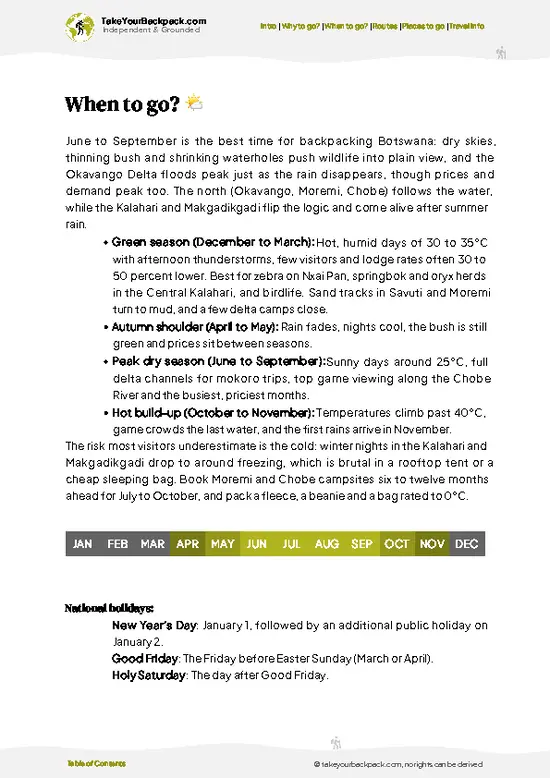
Best months: May to September is the best window for landmarks in Botswana because the days are dry and clear, with highs around 24 to 30°C and almost no rain. Roads and tracks are firm, and wildlife concentrates near water, which matters for the northern wetlands. In the Okavango, the flood arrives from about June and peaks around July and August, even though local rainfall is minimal.
Shoulder seasons: October and November are hot and dry, with highs of 35 to 40°C, particularly in the Kalahari and the Makgadikgadi region, but crowds and rates drop. April and early May offer green landscapes, lower prices and cooler mornings, as the rains have just ended.
Wet season: December to March brings most of the annual rainfall, roughly 400 to 650 mm in the north and less in the southwest. Storms cause … read more 👉
Best months: May to September is the best window for landmarks in Botswana because the days are dry and clear, with highs around 24 to 30°C and almost no rain. Roads and tracks are firm, and wildlife concentrates near water, which matters for the northern wetlands. In the Okavango, the flood arrives from about June and peaks around July and August, even though local rainfall is minimal.
Shoulder seasons: October and November are hot and dry, with highs of 35 to 40°C, particularly in the Kalahari and the Makgadikgadi region, but crowds and rates drop. April and early May offer green landscapes, lower prices and cooler mornings, as the rains have just ended.
Wet season: December to March brings most of the annual rainfall, roughly 400 to 650 mm in the north and less in the southwest. Storms cause heat haze, flooded sand tracks, and impassable black cotton soil around the salt pans. Some remote camps close, and pans can turn to mud, limiting access. Rates for lodges and camps can fall by 30 to 50 percent, but road travel is slower.
Peak periods: July to September sees the highest prices in the north, and campsites in the main parks often need booking months ahead. Nights in winter, particularly in the Kalahari, can fall to near freezing, so warm layers are necessary.

unique site hoppingOptimizing Your Multi-Stop Itinerary

Trip length: A trip combining several landmarks in Botswana needs 10 to 14 days, because distances are long and many roads are slow. The country divides into three clusters: the northeast and north around Kasane, Maun and the Okavango, the central pans between Nata and Maun, and the south and east along the Gaborone to Francistown corridor.
Direction and timing: A west to east or east to west line works best, starting in Maun or Kasane, which have the main airports and bus connections, and finishing in Gaborone or Francistown. Allow 2 to 3 days per stop in the north, since access often means boat, flight or guided transfer, and 1 to 2 days for the pans and for sites in the south and east. Typical drives are Kasane to Nata about 4 hours, Nata to Maun about 3 hours, Maun to Ghanzi about 3.5 hours, … read more 👉
Trip length: A trip combining several landmarks in Botswana needs 10 to 14 days, because distances are long and many roads are slow. The country divides into three clusters: the northeast and north around Kasane, Maun and the Okavango, the central pans between Nata and Maun, and the south and east along the Gaborone to Francistown corridor.
Direction and timing: A west to east or east to west line works best, starting in Maun or Kasane, which have the main airports and bus connections, and finishing in Gaborone or Francistown. Allow 2 to 3 days per stop in the north, since access often means boat, flight or guided transfer, and 1 to 2 days for the pans and for sites in the south and east. Typical drives are Kasane to Nata about 4 hours, Nata to Maun about 3 hours, Maun to Ghanzi about 3.5 hours, and Francistown to Gaborone about 5 hours. Buses and shared minibuses cover the paved routes, while fly-in and 4x4 access suits the remote areas.
Common planning mistakes: Travelers often underestimate distances and try to cover the north and the south in a week. Instead, choose one or two clusters. Another mistake is arriving in remote areas without fuel reserves, since stations can be 200 to 400 km apart. Fill up at every large town. Also avoid scheduling long drives after dark, as livestock and wildlife wander onto the road.

The ListHighly Recommended landmarks of Botswana

1 Savuti Channel

Dry-and-flowing channel, bleached dead trees, elephant-hunting lions, deep-sand tracks

Drive sandy tracks along a channel that has run dry and refilled, passing drowned tree trunks, open marsh, predators and San rock paintings.

2 Matsieng Footprints

Sandstone footprints, ancestor legend, Kgatleng bushveld, rough access road

Walk across a flat sandstone slab pressed with human and animal tracks, then see the emergence pit tied to Matsieng’s legend.

botswana-unique-site-matsieng-footprints
© Google |
Loading the map 🌍

Expert viewTips and Advice from Travelers

How many to visit: Three to five landmarks is the sensible range for a backpacker. Distances in Botswana are large, and each stop usually costs a full day or two in transit, so more than five turns the trip into a driving exercise. Fewer than three wastes the effort of getting here. Pick one major wetland or pan site, one cultural or rock art site, and one or two easy extras near the main road.
Prioritizing by travel style: On a tight budget, favor sites near paved routes in the south and east, where entry is cheap and public transport or hitching a short distance works. If you have flexibility, add one northern highlight and accept it will take a large part of the budget, because access, guides and park fees drive the cost. For travelers with a rented 4x4, the pans and Kalahari offer more … read more 👉
How many to visit: Three to five landmarks is the sensible range for a backpacker. Distances in Botswana are large, and each stop usually costs a full day or two in transit, so more than five turns the trip into a driving exercise. Fewer than three wastes the effort of getting here. Pick one major wetland or pan site, one cultural or rock art site, and one or two easy extras near the main road.
Prioritizing by travel style: On a tight budget, favor sites near paved routes in the south and east, where entry is cheap and public transport or hitching a short distance works. If you have flexibility, add one northern highlight and accept it will take a large part of the budget, because access, guides and park fees drive the cost. For travelers with a rented 4x4, the pans and Kalahari offer more solitude, but they require two vehicles or satellite communication in remote sections. Cultural sites tied to local communities are often best visited with a community guide, who can explain meaning that no sign will. This is also how the money reaches the people who look after the place.
What it costs: A budget-focused trip runs about US$60 to 100 a day, mostly camping, self-catering and shared transport. A mid-range trip with a rented vehicle and guided activities is US$150 to 250 a day. Park entry for foreigners in major national parks commonly runs about US$30 to 60 per person per day, plus vehicle and camping fees, while smaller sites and community-run places charge roughly US$3 to 15. Guides range from US$20 to 60 for a half day. A mokoro or boat trip often adds US$30 to 80. Fuel and car rental are usually the largest costs. Many fees are set in pula, so carry cash for rural gates and card machines can fail.
Safety and etiquette: Wildlife is the main risk. Elephants, hippos and lions move through unfenced areas, so keep to marked tracks, stay in the vehicle where advised and never walk at night outside camp. Self-driving requires a spare tire, extra water of at least 5 liters per person per day, and tire pressure adjusted for sand. Mobile coverage is absent in many places, so tell someone your route. Malaria is a risk in the north in the wet season, so ask a travel clinic about prophylaxis. At cultural and rock art sites, do not touch or chalk paintings, ask before photographing people, and follow the guidance of local caretakers. Some places are used for ceremonies, and access can be restricted.

✈️ The backpacker research shortcutBotswana Travel Guide

An offline-friendly backpacking guide with optimized travel routes, ranked highlights, transport advice, and the best areas to stay.
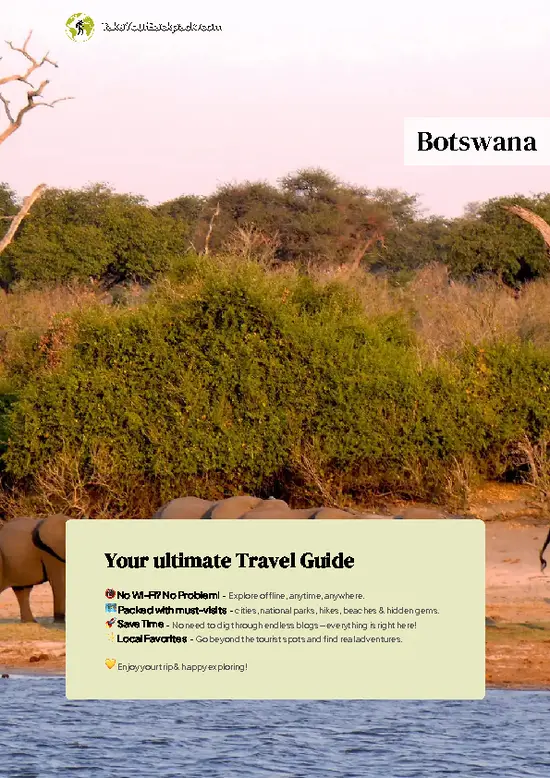
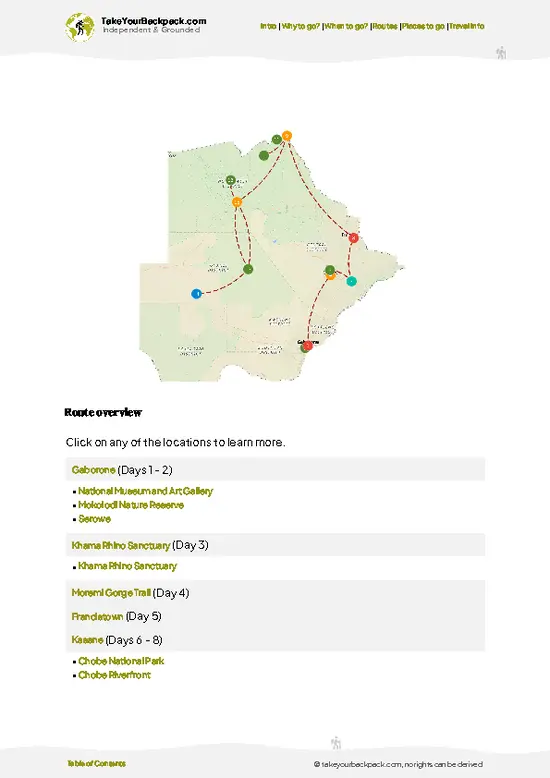
example page 0 from our offline Travel Guide for Botswana
example page 1 from our offline Travel Guide for Botswana
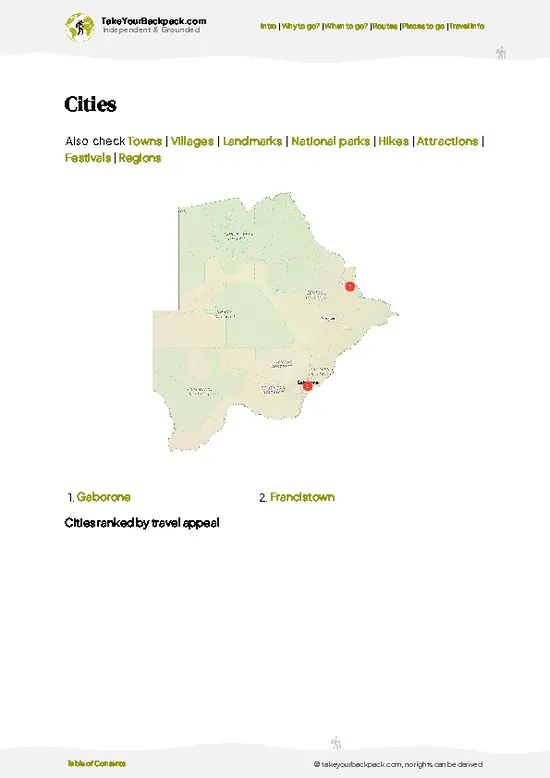
example page 2 from our offline Travel Guide for Botswana
example page 3 from our offline Travel Guide for Botswana
example page 4 from our offline Travel Guide for Botswana
example page 5 from our offline Travel Guide for Botswana
example page 6 from our offline Travel Guide for Botswana
example page 7 from our offline Travel Guide for Botswana
The digital guide (172 pages) contains:
✅ 38 highlights, ranked by travel appeal
✅ Optimized 5, 10 & 15-day travel routes
✅ Cities, national parks, landmarks, beaches
✅ How to get around
✅ Offline-friendly for travel without Wi-Fi
👉 Click to see all 30+ guide features

📅 Plan smarter in minutes, not weeks
✅ Month by month travel advice
✅ Festivals & national holidays
✅ Budget expectations

🗺️ Go to the right places, skip the overrated ones
✅ Honest pros & cons of destinations
✅ Top hikes, parks & viewpoints
✅ Lesser-known places most travelers miss
✅ Clear “worth it vs skip it” guidance

🛏️ Travel smoothly without rookie mistakes
✅ Best areas to stay
✅ Transport systems explained simply
✅ Common scams & safety advice
✅ SIM cards, money & practical tips

🌍 Understand the country, not just visit it
✅ Culture & traditions
✅ 52 Essential phrases & customs
✅ Festivals worth planning around
✅ Traveler-friendly historical context
✅ Insights that make places more meaningful

📱 Built for real travel conditions
✅ Fully downloadable PDF
✅ Works completely offline
✅ Optimized for phone use
✅ Useful in remote areas & buses
✅ Everything in one place
Stop searching, start planning
Get instant access to your full guide. 30‑day money-back guarantee.
+ Add another guide for just

By proceeding you agree to our terms.
Sent to your inbox immediately after payment • 100% Secure Checkout
Best Backpacking Travel Advisor 2025 tourism awardBest Backpacking
Travel Advisor
2025
What others say about Take Your Backpack Guides:
⭐⭐⭐⭐⭐
Fantastic, amazing amount of information!
⭐⭐⭐⭐⭐
My goodness this is amazing, it's what I've been looking for hats off too you!
⭐⭐⭐⭐⭐
I think this is absolutely BRILLIANT
⭐⭐⭐⭐
Very complete and informative. It's still missing places, but I gotta to commend you
⭐⭐⭐⭐⭐
This is truly amazing, thank you, can't wait to explore it with my kids!
⭐⭐⭐⭐⭐
Awesome resource, thank you!
⭐⭐⭐⭐⭐
This is amazing! Can't wait to explore the ones I haven't seen
⭐⭐⭐⭐
I love this! Well done, great idea.
⭐⭐⭐⭐⭐
Thanks for taking the time to make this gem!
⭐⭐⭐⭐⭐
This might be the best website I've ever seen.
⭐⭐⭐⭐⭐
Congratulations, and thank you so much for your work; it's incredibly valuable.
⭐⭐⭐⭐
In all seriousness I think you did a great job pointing out the important spots
⭐⭐⭐⭐⭐
10/10 very good
⭐⭐⭐⭐⭐
As someone who's only just starting to visit regularly this is awesome, thank you.
⭐⭐⭐⭐
Thank you very much! I'm going to visit my dad, it's going to be very useful!
⭐⭐⭐⭐⭐
This is really cool! We'll be travelling for the first time and this definitely come in handy.
⭐⭐⭐⭐⭐
You are now our minister of culture, congratulations 👨‍💼
⭐⭐⭐⭐⭐
Just wanted to tell you that this is a pearl! Going to follow your recommendations.
⭐⭐⭐⭐⭐
This is so cool. I'll definitely be using the resource for my travels soon.
⭐⭐⭐⭐⭐
This is very impressive! Good work.
⭐⭐⭐⭐⭐
This is an amazing and informative site. Very well done!

🛏️ Where to stay?Accommodation Highlights

True hostels are rare in Botswana, so budget travelers mostly stay at backpacker lodges and campsites, with camping or a dorm bed running about BWP 150 to 400 (US$11 to 30) a night. Maun has the widest choice, especially riverside lodges in Matlapaneng along the Thamalakane River, which are close to Okavango Delta mokoro and flight operators and have a social bar scene but sit 10 to 15 minutes by road from town shops. Kasane lines its budget lodges along the Chobe riverfront, a short ride from the national park gate and quiet after dark, while Gaborone offers few backpacker beds and mostly suburban guesthouses in leafy areas like The Village, which are safe and calm but rely on taxis for nightlife. … read more 👉
True hostels are rare in Botswana, so budget travelers mostly stay at backpacker lodges and campsites, with camping or a dorm bed running about BWP 150 to 400 (US$11 to 30) a night. Maun has the widest choice, especially riverside lodges in Matlapaneng along the Thamalakane River, which are close to Okavango Delta mokoro and flight operators and have a social bar scene but sit 10 to 15 minutes by road from town shops. Kasane lines its budget lodges along the Chobe riverfront, a short ride from the national park gate and quiet after dark, while Gaborone offers few backpacker beds and mostly suburban guesthouses in leafy areas like The Village, which are safe and calm but rely on taxis for nightlife.

If you enjoy meeting fellow travelers, consider choosing hostels with high ratings for atmosphere. On the other hand, if you prefer having your own space, a hotel might be a better option.

BotswanaSee More of Botswana

👋 Meet the founderWho’s Behind Take Your Backpack?

Johan, backpacker and founder of TakeYourBackpackHi, I’m Johan (Netherlands 🇳🇱), the creator of TakeYourBackpack. Over the past 3 decades, I’ve backpacked through 90+ countries across six continents, gaining extensive experience with independent travel, long-term trips, and overland routes.

This site is built on a combination of firsthand travel experience and carefully curated insights from other backpackers. Many guides are based on places I’ve personally visited, while others bring together tips, observations, and practical advice shared by trusted travelers I’ve met along the way.

The goal is to provide realistic, experience-driven guidance — not generic itineraries — so you can explore destinations with better context, clearer expectations, and more confidence.