×

Brazil🇧🇷 | regionsBonitoSpring-fed rivers, cave lakes, sinkhole macaws, guided snorkeling | things to do and best time to go

Explore Atol das RocasExplore Costa Verde

Backpacking in Bonito
🏆 Top pickregion ranked #2
By Johan Kruseman 🇳🇱 | Updated October 19, 2026

Bonito was once a sleepy cattle town that few Brazilians could place on a map; today it runs on a tightly managed ecotourism system, and January and July get crowded. It sits in Brazil’s Mato Grosso do Sul state, southwest of Campo Grande. Nearly every river, cave and sinkhole is on private land, so you need an agency voucher and a guide, and prices match across agencies. Experienced travelers book the headline tours a week ahead and spread them over several days, because daily visitor caps fill fast. Skip the souvenir strip and paid photo add-ons. Choose the rivers, since the water is clear enough that fish seem to hang in air. On my bus from Campo Grande, the driver braked for a giant anteater ambling across the highway, and everyone crowded the windows in silence. Unlike the Pantanal to the north, where you hunt wildlife across muddy floodplains, Bonito offers clear water and order, with far fewer surprises.

Discover everything you want to know in the 📖 Brazil Travel Guide.


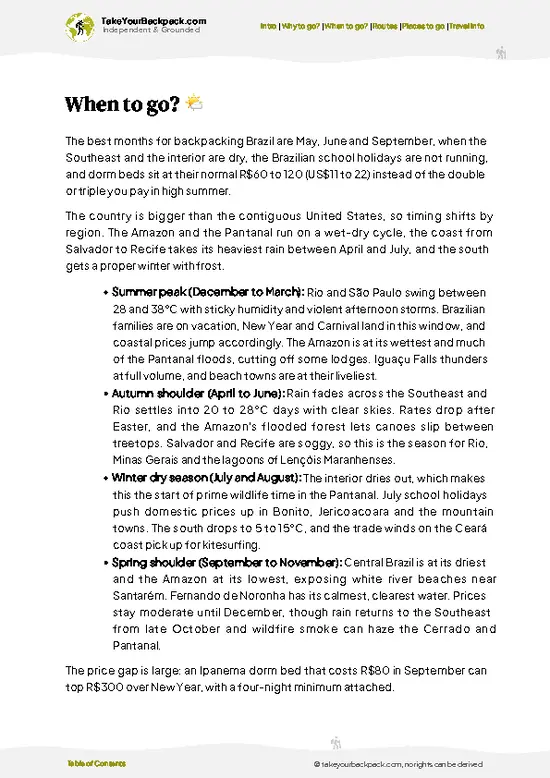
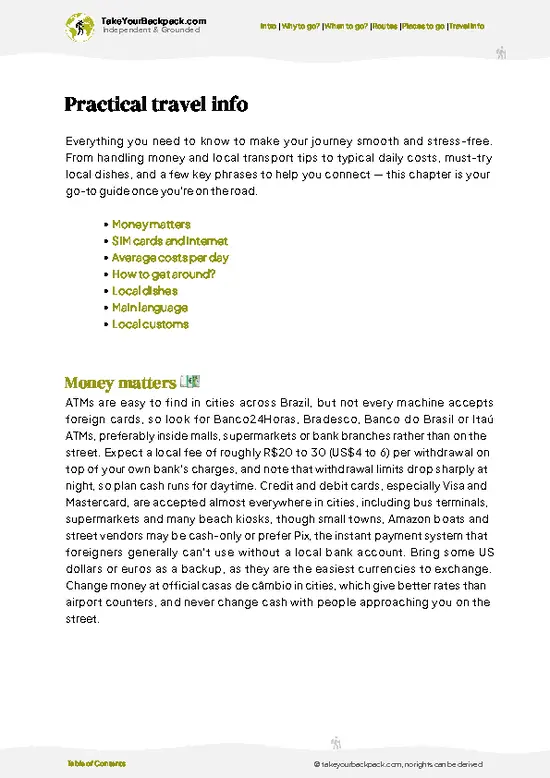
example page 0 from our offline Travel Guide for Brazil
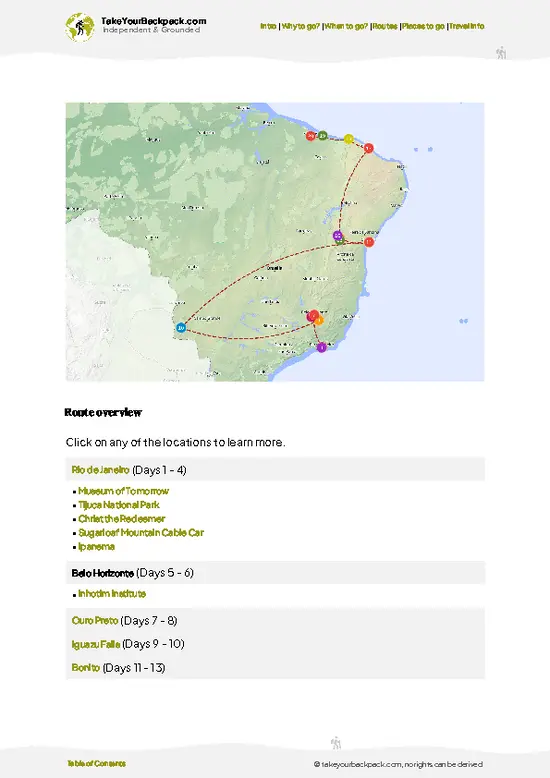
example page 1 from our offline Travel Guide for Brazil
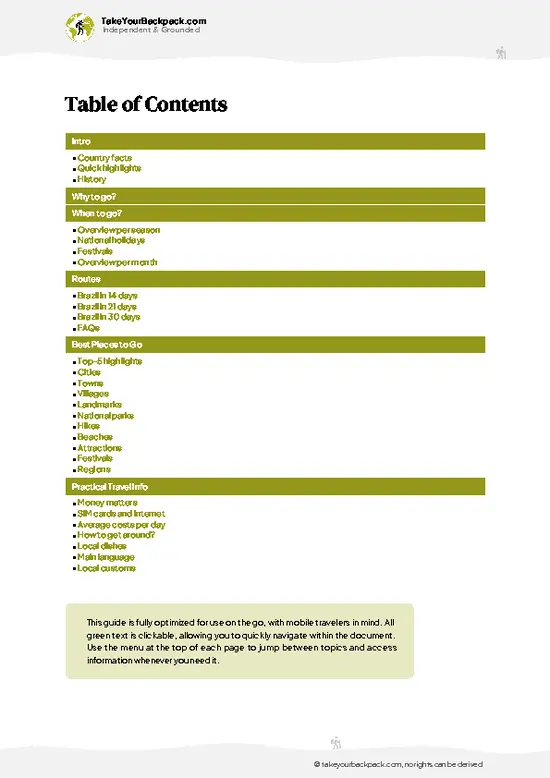
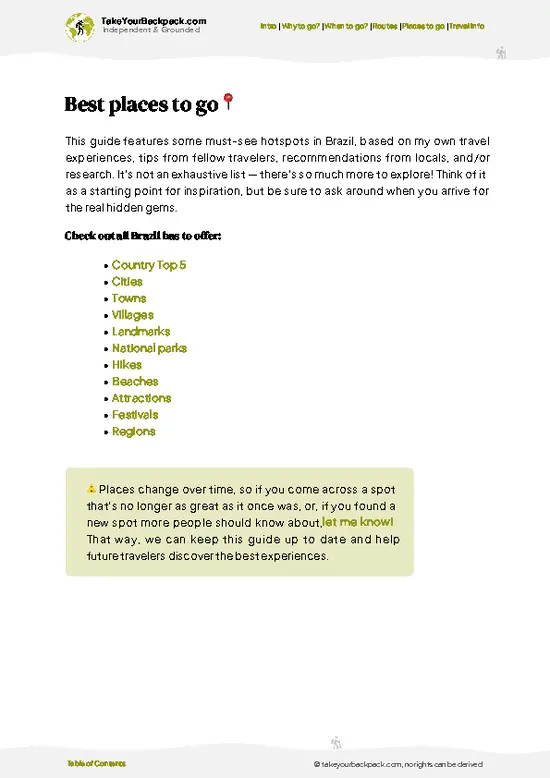
example page 2 from our offline Travel Guide for Brazil
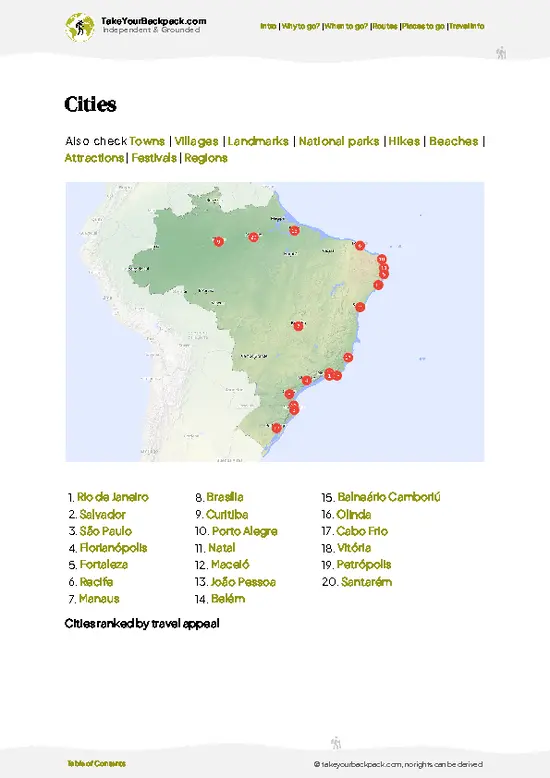
example page 3 from our offline Travel Guide for Brazil
example page 4 from our offline Travel Guide for Brazil
example page 5 from our offline Travel Guide for Brazil
example page 6 from our offline Travel Guide for Brazil
example page 7 from our offline Travel Guide for Brazil
Loading the map 🌍
CLICK TO FILTER
cities
towns
villages
landmarks
national parks
hikes
beaches
attractions
festivals
regions
SHOW COUNTRY’S BESTSHOW ALL

✨ Why go?
Ranked #2 region in Brazil
What sets this place apart

Bonito works because one small town puts a dozen very different excursions within a short ride. You can float a spring-fed river one morning, rappel into a cave the next and watch macaws at a sinkhole after that, all without packing your bag. Nobody needs a new bed every night, which makes slow travel easy.
The second reason is the water itself. The Rio da Prata snorkel and the Rio Sucuri drift are floats rather than swims, so you hang motionless over turquoise springs while dourado and piraputanga fish pass beneath you. Confident swimmers and first-timers get the same experience, since a wetsuit and a guide do the work.
The third reason is access. Operators handle pickups from your hotel, so you never need to work out rural roads. That suits solo travelers well, and it makes it simple to split … read more 👉
Bonito works because one small town puts a dozen very different excursions within a short ride. You can float a spring-fed river one morning, rappel into a cave the next and watch macaws at a sinkhole after that, all without packing your bag. Nobody needs a new bed every night, which makes slow travel easy.
The second reason is the water itself. The Rio da Prata snorkel and the Rio Sucuri drift are floats rather than swims, so you hang motionless over turquoise springs while dourado and piraputanga fish pass beneath you. Confident swimmers and first-timers get the same experience, since a wetsuit and a guide do the work.
The third reason is access. Operators handle pickups from your hotel, so you never need to work out rural roads. That suits solo travelers well, and it makes it simple to split a van with other guests from your hostel. Add a cave like Gruta do Lago Azul for a change of pace, and a few days here give you nature and a rhythm that suits the region’s calm.

💡 HighlightsPlaces and moments you shouldn't skip

  1. Gruta do Lago Azul: a collapsed-roof cave with a deep cobalt lake at the bottom of a long staircase. Sunlight angles in best in the early morning during the summer months, and the stalactites are worth a slow look.
  2. Rio Sucuri: a short, calm snorkel drift down a spring-fed river where the bottom is visible all the way, with schools of fish for company.
  3. Recanto Ecológico Rio da Prata: the longest and richest float in the area, with a forest walk first and then a lazy drift past dourado, piraputanga and the occasional caiman on the bank.
  4. Buraco das Araras: a huge sinkhole, about 100 meters deep, where red-and-green macaws nest on the red cliffs. Nothing to swim in, but the trail is easy and the birds are loud.
  5. Abismo Anhumas: you rappel about 72 meters through a cave mouth into a hidden lake and
… read more 👉
  1. Gruta do Lago Azul: a collapsed-roof cave with a deep cobalt lake at the bottom of a long staircase. Sunlight angles in best in the early morning during the summer months, and the stalactites are worth a slow look.
  2. Rio Sucuri: a short, calm snorkel drift down a spring-fed river where the bottom is visible all the way, with schools of fish for company.
  3. Recanto Ecológico Rio da Prata: the longest and richest float in the area, with a forest walk first and then a lazy drift past dourado, piraputanga and the occasional caiman on the bank.
  4. Buraco das Araras: a huge sinkhole, about 100 meters deep, where red-and-green macaws nest on the red cliffs. Nothing to swim in, but the trail is easy and the birds are loud.
  5. Abismo Anhumas: you rappel about 72 meters through a cave mouth into a hidden lake and then snorkel or dive among stalactites. This is the area’s only true adrenaline moment.
  6. Boca da Onça: a ranch reserve with the tallest waterfall in Mato Grosso do Sul, around 156 meters, reached by trails and zip lines. Less visited than the caves, and wilder.
  7. Estância Mimosa: a family-run farm with a chain of small waterfalls and natural pools that suits swimmers who prefer cool freshwater to a mask and snorkel.
  8. Balneário Municipal: the town’s public river beach, where locals swim after work, with a small entry fee and fish you can see from the dock. A good, easy afternoon.
  9. Gruta de São Miguel: a dry cave with walkways and big formations. It is far quieter than Lago Azul and a good rainy-day option.
  10. Aquário Natural: a spring-fed pool in the Baía Bonita river where the snorkel is short but the water is very clear and full of fish. Locals recommend it for beginners.
Pair the early light at Gruta do Lago Azul with an afternoon at Balneário Municipal for a gentle day that costs little.
Spotted a mistake or missing something? Contact us.

⌛️ 5 daysWhat you can realistically do in a week

Day 1: Rio da Prata: Do not skip this one. The Recanto Ecológico floats are the longest and richest in the region, so start here while you are fresh and the river is empty. Agencies run vans from your hotel, because public buses do not reach the farms, so the day is set by pickup times rather than a timetable. Book the vouchers in town the evening before at the latest.
Day 2: Bonito: Spend a day in town. The Balneário Municipal is an easy swim, and you can sort out vouchers for the days ahead. Staying put like this saves money, because you skip a van and pay one entry fee.
Day 3: Gruta do Lago Azul: Go in the morning, when the sun slants in at the lake, then put the afternoon toward Estância Mimosa, where waterfalls make for a cooling finish. The two sit on the same side of town, so one driver … read more 👉
Day 1: Rio da Prata: Do not skip this one. The Recanto Ecológico floats are the longest and richest in the region, so start here while you are fresh and the river is empty. Agencies run vans from your hotel, because public buses do not reach the farms, so the day is set by pickup times rather than a timetable. Book the vouchers in town the evening before at the latest.
Day 2: Bonito: Spend a day in town. The Balneário Municipal is an easy swim, and you can sort out vouchers for the days ahead. Staying put like this saves money, because you skip a van and pay one entry fee.
Day 3: Gruta do Lago Azul: Go in the morning, when the sun slants in at the lake, then put the afternoon toward Estância Mimosa, where waterfalls make for a cooling finish. The two sit on the same side of town, so one driver handles both.
Day 4: Abismo Anhumas: Plan a full day. Agencies group the rappel by time slots with limited places, so reserve early. This is the day I would keep if I could only keep one: dropping through the cave mouth into the lake is something you cannot replicate elsewhere.
Day 5: Buraco das Araras: Finish with the macaw sinkhole in the morning, when the birds are most active, then wind down in town.
For a detour, swap in Boca da Onça for Day 2. It is a full day by agency van, but the 156-meter waterfall and its trails add more than another swim would, and it fits the same pickup system.

🌤️ When to go?Choosing the right time of year

May through September is the most comfortable window for Bonito, with daytime highs around 25 to 29°C (77 to 84°F) and cool nights that can dip to 10 to 15°C (50 to 59°F). Rivers run clearest in the dry months.
  • Dry Season (April to September): Water visibility is at its best for snorkeling and floating in the Rio da Prata and Rio Sucuri. Days run roughly 11 to 12 hours of light. Cold fronts can bring a few chilly, overcast days, so a light fleece helps. Prices climb in July and on long holiday weekends.
  • Wet Season (October to March): Highs reach 32 to 36°C (90 to 97°F) with humid air and heavy afternoon storms. Heavy rain clouds the rivers for a day or two, which cuts snorkeling visibility, though waterfalls and caves stay open. Days stretch to 13 hours of light. Rooms and tours are noticeably
… read more 👉
May through September is the most comfortable window for Bonito, with daytime highs around 25 to 29°C (77 to 84°F) and cool nights that can dip to 10 to 15°C (50 to 59°F). Rivers run clearest in the dry months.
  • Dry Season (April to September): Water visibility is at its best for snorkeling and floating in the Rio da Prata and Rio Sucuri. Days run roughly 11 to 12 hours of light. Cold fronts can bring a few chilly, overcast days, so a light fleece helps. Prices climb in July and on long holiday weekends.
  • Wet Season (October to March): Highs reach 32 to 36°C (90 to 97°F) with humid air and heavy afternoon storms. Heavy rain clouds the rivers for a day or two, which cuts snorkeling visibility, though waterfalls and caves stay open. Days stretch to 13 hours of light. Rooms and tours are noticeably cheaper.
  • Holidays (July, Carnival, Christmas to New Year): Domestic crowds fill tours, and operators sell out days ahead.
Book your main river activities before you arrive if you travel in July or on a holiday weekend.


source: climatestotravel.comJANJanuary: fair for travelingFEBFebruary: fair for travelingMARMarch: fair for travelingAPRApril: good for travelingMAYMay: excellent for travelingJUNJune: excellent for travelingJULJuly: highly recommended for travelingAUGAugust: highly recommended for travelingSEPSeptember: excellent for travelingOCTOctober: fair for travelingNOVNovember: fair for travelingDECDecember: fair for traveling
when-to-go

✈️ The backpacker research shortcutBrazil Travel Guide

An offline-friendly backpacking guide with optimized travel routes, ranked highlights, transport advice, and the best areas to stay.
example page 0 from our offline Travel Guide for Brazil
example page 1 from our offline Travel Guide for Brazil
example page 2 from our offline Travel Guide for Brazil
example page 3 from our offline Travel Guide for Brazil
example page 4 from our offline Travel Guide for Brazil
example page 5 from our offline Travel Guide for Brazil
example page 6 from our offline Travel Guide for Brazil
example page 7 from our offline Travel Guide for Brazil
The digital guide (410 pages) contains:
✅ 146 highlights, ranked by travel appeal
✅ Optimized 14, 21 & 30-day travel routes
✅ Cities, national parks, landmarks, beaches
✅ How to get around
✅ Offline-friendly for travel without Wi-Fi
👉 Click to see all 30+ guide features

📅 Plan smarter in minutes, not weeks
✅ Month by month travel advice
✅ Festivals & national holidays
✅ Budget expectations

🗺️ Go to the right places, skip the overrated ones
✅ Honest pros & cons of destinations
✅ Top hikes, parks & viewpoints
✅ Lesser-known places most travelers miss
✅ Clear “worth it vs skip it” guidance

🛏️ Travel smoothly without rookie mistakes
✅ Best areas to stay
✅ Transport systems explained simply
✅ Common scams & safety advice
✅ SIM cards, money & practical tips

🌍 Understand the country, not just visit it
✅ Culture & traditions
✅ 52 Essential phrases & customs
✅ Festivals worth planning around
✅ Traveler-friendly historical context
✅ Insights that make places more meaningful

📱 Built for real travel conditions
✅ Fully downloadable PDF
✅ Works completely offline
✅ Optimized for phone use
✅ Useful in remote areas & buses
✅ Everything in one place
Stop searching, start planning
Get instant access to your full guide. 30‑day money-back guarantee.
+ Add another guide for just

By proceeding you agree to our terms.
Sent to your inbox immediately after payment • 100% Secure Checkout
Best Backpacking Travel Advisor 2025 tourism awardBest Backpacking
Travel Advisor
2025
What others say about Take Your Backpack Guides:
⭐⭐⭐⭐⭐
Fantastic, amazing amount of information!
⭐⭐⭐⭐⭐
My goodness this is amazing, it's what I've been looking for hats off too you!
⭐⭐⭐⭐⭐
I think this is absolutely BRILLIANT
⭐⭐⭐⭐
Very complete and informative. It's still missing places, but I gotta to commend you
⭐⭐⭐⭐⭐
This is truly amazing, thank you, can't wait to explore it with my kids!
⭐⭐⭐⭐⭐
Awesome resource, thank you!
⭐⭐⭐⭐⭐
This is amazing! Can't wait to explore the ones I haven't seen
⭐⭐⭐⭐
I love this! Well done, great idea.
⭐⭐⭐⭐⭐
Thanks for taking the time to make this gem!
⭐⭐⭐⭐⭐
This might be the best website I've ever seen.
⭐⭐⭐⭐⭐
Congratulations, and thank you so much for your work; it's incredibly valuable.
⭐⭐⭐⭐
In all seriousness I think you did a great job pointing out the important spots
⭐⭐⭐⭐⭐
10/10 very good
⭐⭐⭐⭐⭐
As someone who's only just starting to visit regularly this is awesome, thank you.
⭐⭐⭐⭐
Thank you very much! I'm going to visit my dad, it's going to be very useful!
⭐⭐⭐⭐⭐
This is really cool! We'll be travelling for the first time and this definitely come in handy.
⭐⭐⭐⭐⭐
You are now our minister of culture, congratulations 👨‍💼
⭐⭐⭐⭐⭐
Just wanted to tell you that this is a pearl! Going to follow your recommendations.
⭐⭐⭐⭐⭐
This is so cool. I'll definitely be using the resource for my travels soon.
⭐⭐⭐⭐⭐
This is very impressive! Good work.
⭐⭐⭐⭐⭐
This is an amazing and informative site. Very well done!

🛏️ Where to stay?How to pick the right area

Stay in Bonito town itself, because nothing else in the area offers beds, food and tour agencies within walking distance. The compact center around Rua Pilad Rebuá has a short grid of tour offices, restaurants and bars, so you can book a river trip in the morning and be back for dinner without a taxi. It is flat, quiet, and safe to walk at night, with families and other travelers on the same streets.
Hostels and budget guesthouses cluster within a few blocks of the main street and the central square, and dorm beds usually cost about US$12 to 25. That is where you will meet other solo travelers … read more 👉
Stay in Bonito town itself, because nothing else in the area offers beds, food and tour agencies within walking distance. The compact center around Rua Pilad Rebuá has a short grid of tour offices, restaurants and bars, so you can book a river trip in the morning and be back for dinner without a taxi. It is flat, quiet, and safe to walk at night, with families and other travelers on the same streets.
Hostels and budget guesthouses cluster within a few blocks of the main street and the central square, and dorm beds usually cost about US$12 to 25. That is where you will meet other solo travelers to split transfers or group up for a float, which is the cheapest way to see the rivers. Mornings start early since pickups leave around 7 to 8, so shared kitchens and breakfast tables fill up with people trading tour tips.
Prices are steeper than in most of Mato Grosso do Sul, and July and holiday weekends can double the rate. Rooms on the edge of town near the Rio Formoso cost less and stay quiet, but a walk to the center takes 15 to 20 minutes. Rural lodges out on the ranches suit couples, though they leave you isolated and dependent on transfers.

🚌 Getting aroundHow to get from A to B

The easiest way to get around Bonito is to book river and cave tours that include pickup, because nearly every attraction sits on a private ranch 7 to 55 kilometers (4 to 34 miles) outside town with no public bus. Tour vouchers are sold by agencies in town and cover the entrance fee, equipment and transfer. That setup is reliable and efficient, and it is what almost every backpacker uses.
  • Tour pickup and shuttle: Most operators collect you from your lodging at set times, and the transfer is bundled into the price. Entry to places like Rio da Prata or Gruta do Lago Azul runs roughly US$20 to 120 depending on the activity. Take it, since it saves you a rental and works every day.
  • Taxi: A ride within town costs about US$3 to 6, and to nearby spots like Balneário Municipal about US$8 to 12 each
… read more 👉
The easiest way to get around Bonito is to book river and cave tours that include pickup, because nearly every attraction sits on a private ranch 7 to 55 kilometers (4 to 34 miles) outside town with no public bus. Tour vouchers are sold by agencies in town and cover the entrance fee, equipment and transfer. That setup is reliable and efficient, and it is what almost every backpacker uses.
  • Tour pickup and shuttle: Most operators collect you from your lodging at set times, and the transfer is bundled into the price. Entry to places like Rio da Prata or Gruta do Lago Azul runs roughly US$20 to 120 depending on the activity. Take it, since it saves you a rental and works every day.
  • Taxi: A ride within town costs about US$3 to 6, and to nearby spots like Balneário Municipal about US$8 to 12 each way. Use them for the town and short hops, not for ranches where waits for a ride back stretch long.
  • Rental bike or scooter: Bikes rent for around US$8 to 15 a day and suit the flat center and the 7 km (4 mile) ride to Balneário Municipal. Skip them for distant ranches, where roads are gravel or red dirt and the heat is punishing at midday.
  • Intercity bus: Buses to Campo Grande take about 5 to 6 hours and cost roughly US$20 to 30, and the schedule is limited, so buy ahead in high season. This is the best option to reach Bonito.
  • Rental car: Cars cost about US$50 to 90 a day. Many sights require advance booking and an operator, so a car adds little unless you are splitting the cost among four people.
Buy combined tour packages from one agency for two or three days in a row, since many offer a discount, and ask them to schedule pickups so you do not pay for the same ride twice.

🍲 FoodLocal Flavors for Backpackers

Start with piraputanga, a river fish from the local rivers that arrives fried whole, crisp at the edges and flaky inside, usually with farofa and rice. Another regional staple is carne de sol, sun-cured beef that is salty and chewy, served alongside sweet mandioca. For breakfast or a snack, look for chipa, a chewy cheese bread from nearby Paraguay, and sopa paraguaia, which is actually a dense, moist cornbread with onion and cheese. Pantanal-style pacu grilled on the bone is another one to try.
For drinks, a cold tereré, yerba mate steeped in ice water, is sipped from a shared guampa horn cup in the town square on hot afternoons. Guaraná soda and fresh juices of acerola and cupuaçu cut the heat.
Backpackers eat well at per-kilo buffets where you pile a plate and pay by weight, usually around … read more 👉
Start with piraputanga, a river fish from the local rivers that arrives fried whole, crisp at the edges and flaky inside, usually with farofa and rice. Another regional staple is carne de sol, sun-cured beef that is salty and chewy, served alongside sweet mandioca. For breakfast or a snack, look for chipa, a chewy cheese bread from nearby Paraguay, and sopa paraguaia, which is actually a dense, moist cornbread with onion and cheese. Pantanal-style pacu grilled on the bone is another one to try.
For drinks, a cold tereré, yerba mate steeped in ice water, is sipped from a shared guampa horn cup in the town square on hot afternoons. Guaraná soda and fresh juices of acerola and cupuaçu cut the heat.
Backpackers eat well at per-kilo buffets where you pile a plate and pay by weight, usually around US$8 to 14. Casual grill restaurants in the center offer set lunches, and evening bars along the main street serve beer and snacks like fried cassava. Corner padarias sell coffee and pão de queijo for a few dollars.
Lunch runs from about 11:30 to 2, and many kitchens close in the mid afternoon. Tereré cups are passed around the circle, so wait to be offered and return it with a thanks once you have had enough.

FAQTraveler FAQ

Three days is the practical minimum for Bonito, and four lets you add a second river float without rushing. A typical plan pairs a Rio da Prata snorkel (about US$100 to 120) with the Gruta do Lago Azul cave (about US$15 to 20) and the Boca da Onça waterfalls. Tour pickup times of 7 to 8 each morning mean each day holds one major activity plus a swim or a relaxed afternoon.
Tour transfers are the simplest way to get around Bonito, since ranches sit 7 to 55 kilometers (4 to 34 miles) from the center and no public bus serves them. Agencies include pickup from your lodging in the activity price, and taxis cover town hops for roughly US$3 to 12. Bikes at US$8 to 15 a day work for the flat center and the 7 km ride to Balneário Municipal.
Bonito is known for crystal-clear rivers where you snorkel among fish like piraputanga and dourado, with Rio da Prata and Rio Sucuri as the main float spots. The Gruta do Lago Azul, a limestone cave with a deep blue lake, and the Abismo Anhumas rappel into a cavern are the other big draws. It also offers waterfalls and ecotourism run through regulated ranches, which keeps visitor numbers per day capped.
⚠️ Things can change over time, so always validate details locally before you go.

Other Brazilian regions near Bonito

Explore more nearby:

  • Ilha do Mel—Car-free sand paths, tide-timed walks, lighthouse hill, surf coves| 965 km away
  • Costa Verde—Colonial Paraty, car-free islands, forest trails, fishing hamlets| 1234 km away
  • Ilha Grande—Jungle hiking, Lopes Mendes surf, former prison ruins, boat-only beaches| 1281 km away

💡 Not sure where to go next?
Create a personalized itinerary for Brazil including Bonito and the places that fit your trip.

Generate my itinerary

👉 Discover all regions

Or checkout all Brazil has to offer (think cities, towns, villages, national parks, hikes, beaches, festivals)
Country photo of Brazil

We 💚 feedbackKey takeaways before you go

Bonito suits four to five nights: enough for a river float, a cave and a sinkhole without rushing. Two nights force you to choose and book in a panic, while a week begins to repeat the same blue water. I would reserve the first three activities before arriving and leave the final days open, since rain or a full tour calendar can shift your plans.

✈️ When did I visit Brazil?
Call it good timing or luck, but I was able to celebrate Carnaval in Rio de Janeiro in February 2022, after a round trip in the north and east coast.

✍️ Help improve this page!
The information on this page is based on my own backpacking experience in Brazil, supplemented with up-to-date research and feedback from other travelers. Travel details can change, so if you notice anything outdated or incomplete, feel free to let me know.


🙋‍♂️ Give feedback

👋 Meet the founderWho’s Behind Take Your Backpack?

Johan, backpacker and founder of TakeYourBackpackHi, I’m Johan (Netherlands 🇳🇱), the creator of TakeYourBackpack. Over the past 3 decades, I’ve backpacked through 90+ countries across six continents, gaining extensive experience with independent travel, long-term trips, and overland routes.

This site is built on a combination of firsthand travel experience and carefully curated insights from other backpackers. Many guides are based on places I’ve personally visited, while others bring together tips, observations, and practical advice shared by trusted travelers I’ve met along the way.

The goal is to provide realistic, experience-driven guidance — not generic itineraries — so you can explore destinations with better context, clearer expectations, and more confidence.