×

Brazil🇧🇷 | beachesCopacabanaWave-pattern promenade, footvolley nets, Posto 6, Forte de Copacabana | things to do and best time to go

Explore Canoa QuebradaExplore Fernando de Noronha

Backpacking in Copacabana
🌟 Highlightbeach ranked #6
By Johan Kruseman 🇳🇱 | Updated October 19, 2026

The clack of a hand-held caipirinha cart and the slap of a footvolley ball hit me before I found my spot on the sand near Posto 5. Copacabana beach sits in Rio de Janeiro’s South Zone, in southeastern Brazil, a 4 km crescent facing the open Atlantic. The scenery is the draw: Sugarloaf at one end, the Fort at the other, and the black-and-white wave-pattern promenade between. Swim only when the flag looks calm, because the shorebreak and rip currents are real. Crowds are heavy on weekends, and the water is clean enough for a dip but not for lingering. Surf and snorkeling are poor, so skip both. Cheap kiosks and per-kilo lunch spots sit one block back, and hostels are plentiful. Start with a morning walk from Posto 6 to Leme, then claim sand for the afternoon.

Discover everything you want to know in the 📖 Brazil Travel Guide.


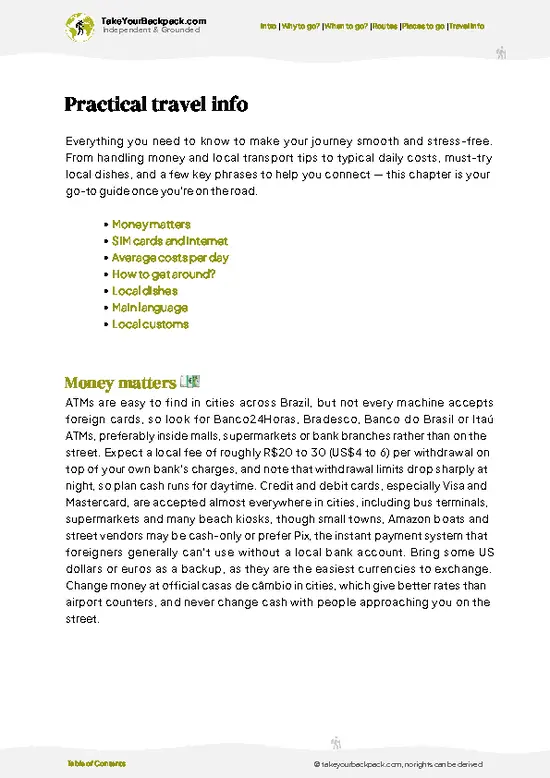
example page 0 from our offline Travel Guide for Brazil
example page 1 from our offline Travel Guide for Brazil
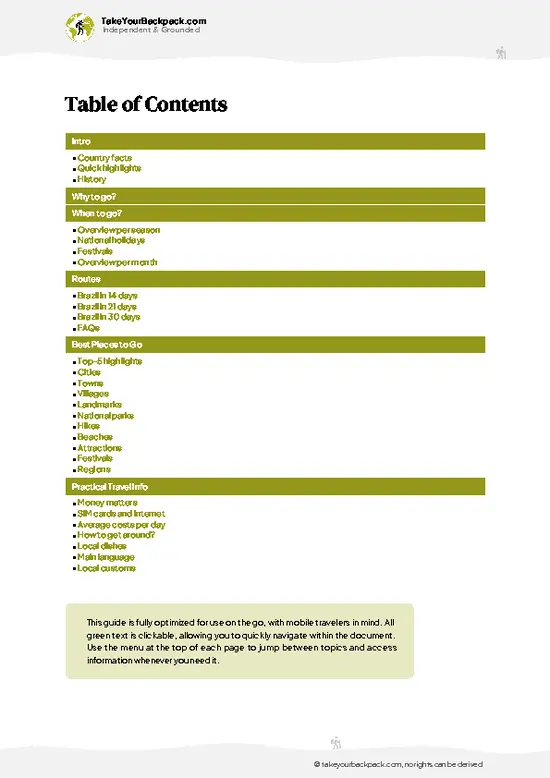
example page 2 from our offline Travel Guide for Brazil
example page 3 from our offline Travel Guide for Brazil
example page 4 from our offline Travel Guide for Brazil
example page 5 from our offline Travel Guide for Brazil
example page 6 from our offline Travel Guide for Brazil
example page 7 from our offline Travel Guide for Brazil
Loading the map 🌍
CLICK TO FILTER
cities
towns
villages
landmarks
national parks
hikes
beaches
attractions
festivals
regions
SHOW COUNTRY’S BESTSHOW ALL

✨ Why go?
Ranked #6 beach in Brazil
What sets this place apart

Copacabana beach works for backpackers because it is the one place in Rio where a hostel bed, a cheap lunch and the sea sit within a few minutes’ walk of each other. Dorms cluster on the streets behind Avenida Atlântica, and the metro stops at Cardeal Arcoverde and Siqueira Campos, so you can reach Ipanema, Lapa and the center without paying for taxis.

The social scene is the second reason. Hostel kitchens fill with people comparing routes up and down the coast, and the sand itself is a meeting ground: volleyball nets, footvolley games and vendors who sell grilled cheese on sticks keep the stretch near the middle lively from late morning. Evenings continue along the promenade, where kiosks stay open with beer and live samba.

It also acts as a pause. Many travelers use it as a base between … read more 👉
Copacabana beach works for backpackers because it is the one place in Rio where a hostel bed, a cheap lunch and the sea sit within a few minutes’ walk of each other. Dorms cluster on the streets behind Avenida Atlântica, and the metro stops at Cardeal Arcoverde and Siqueira Campos, so you can reach Ipanema, Lapa and the center without paying for taxis.

The social scene is the second reason. Hostel kitchens fill with people comparing routes up and down the coast, and the sand itself is a meeting ground: volleyball nets, footvolley games and vendors who sell grilled cheese on sticks keep the stretch near the middle lively from late morning. Evenings continue along the promenade, where kiosks stay open with beer and live samba.

It also acts as a pause. Many travelers use it as a base between Paraty and Búzios or before flying onward, spending several days here while dealing with laundry, bookings and sightseeing at Christ the Redeemer and Sugarloaf.

💡 HighlightsTop highlights of Copacabana

  1. The Copacabana promenade: the wave-pattern pavement, first laid in the early 1900s and redesigned by Burle Marx in 1970, runs the full 4 km. Walk it for the people-watching, the kiosks and the view of the whole curve.
  2. Posto 6 and the Arpoador end: the quieter southern stretch near the fort has the cleanest feel, and locals gather for the evening light over Ipanema.
  3. Footvolley and beach volleyball: nets line the sand, and watching the skilled players keep the ball up with feet and chest is free. Ask to join a casual game.
  4. Forte de Copacabana: this 1914 military fort at the southern end holds a small army museum, cannons and a cafe over the water. Entry is roughly US$1 to 3.
  5. Sunday car-free Avenida Atlântica: one side of the avenue closes to traffic, and cyclists, skaters and runners take over alongside
… read more 👉
  1. The Copacabana promenade: the wave-pattern pavement, first laid in the early 1900s and redesigned by Burle Marx in 1970, runs the full 4 km. Walk it for the people-watching, the kiosks and the view of the whole curve.
  2. Posto 6 and the Arpoador end: the quieter southern stretch near the fort has the cleanest feel, and locals gather for the evening light over Ipanema.
  3. Footvolley and beach volleyball: nets line the sand, and watching the skilled players keep the ball up with feet and chest is free. Ask to join a casual game.
  4. Forte de Copacabana: this 1914 military fort at the southern end holds a small army museum, cannons and a cafe over the water. Entry is roughly US$1 to 3.
  5. Sunday car-free Avenida Atlântica: one side of the avenue closes to traffic, and cyclists, skaters and runners take over alongside beach kiosks. Rent a bike for an easy out-and-back along the sand.
If time is short, skip the fort museum and spend the hour on the sand instead.
Spotted a mistake or missing something? Contact us.

Things to do around Copacabana

Ratings based on Tripadvisor reviews. When you book through this link, you support our work at no extra cost to you.

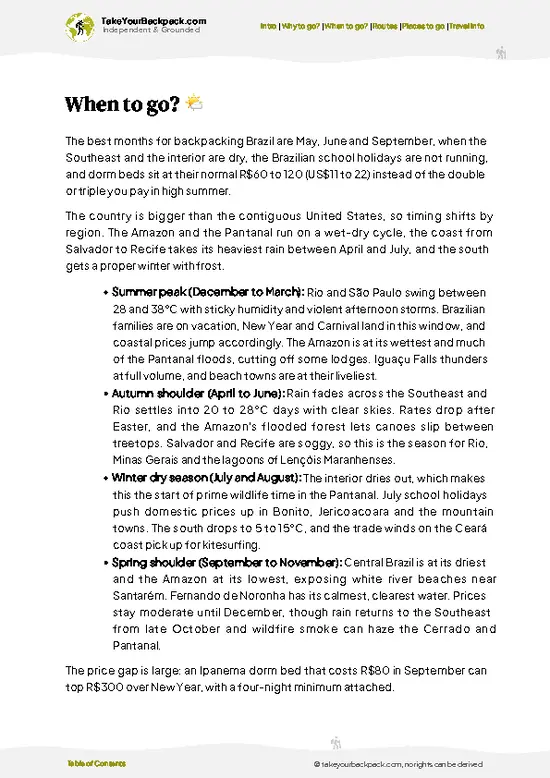
🌤️ When to go?Seasonal considerations and timing

  • Summer (December to March): Hot and humid, with highs of 30 to 35°C (86 to 95°F) and sticky afternoon downpours. Days run about 13.5 hours, the sea reaches 24 to 26°C (75 to 79°F), and Réveillon and Carnival push beds to two or three times normal rates.
  • Autumn (April to June): Highs of 25 to 28°C (77 to 82°F), lower humidity, and a beach that feels roomy on weekdays. Prices drop outside holidays.
  • Winter (July to August): Dry and sunny with highs of 22 to 26°C (72 to 79°F), and a sea of 21 to 22°C (70 to 72°F) that is fine for a quick dip. Days shorten to about 11 hours, and July school holidays fill hostels.
  • Spring (September to November): Warming up, 24 to 29°C (75 to 84°F), with fewer crowds and fair rates before the December rush.
Book Réveillon accommodation months ahead, or aim for late April to May for the best value.

source: climatestotravel.comJANJanuary: fair for travelingFEBFebruary: below average for travelingMARMarch: fair for travelingAPRApril: good for travelingMAYMay: excellent for travelingJUNJune: excellent for travelingJULJuly: excellent for travelingAUGAugust: excellent for travelingSEPSeptember: excellent for travelingOCTOctober: highly recommended for travelingNOVNovember: good for travelingDECDecember: fair for traveling
brazil-beach-copacabana
© Google | Carlos Monarca

✈️ The backpacker research shortcutBrazil Travel Guide

An offline-friendly backpacking guide with optimized travel routes, ranked highlights, transport advice, and the best areas to stay.
example page 0 from our offline Travel Guide for Brazil
example page 1 from our offline Travel Guide for Brazil
example page 2 from our offline Travel Guide for Brazil
example page 3 from our offline Travel Guide for Brazil
example page 4 from our offline Travel Guide for Brazil
example page 5 from our offline Travel Guide for Brazil
example page 6 from our offline Travel Guide for Brazil
example page 7 from our offline Travel Guide for Brazil
The digital guide (410 pages) contains:
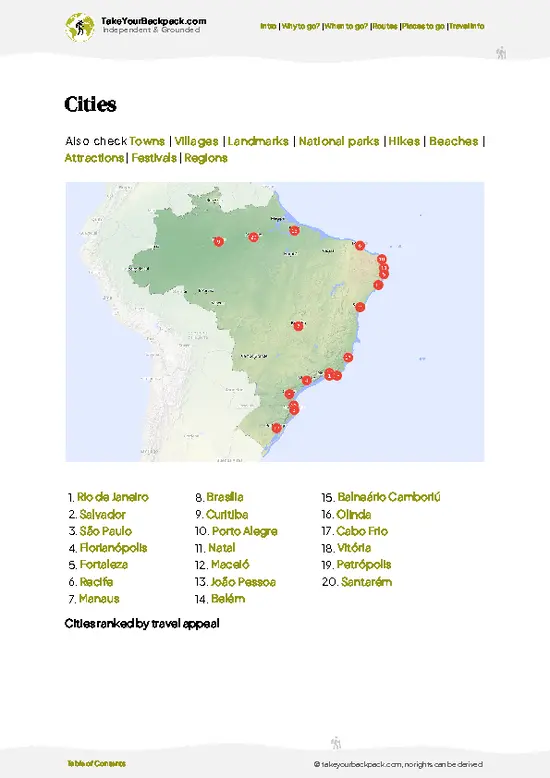
✅ 146 highlights, ranked by travel appeal
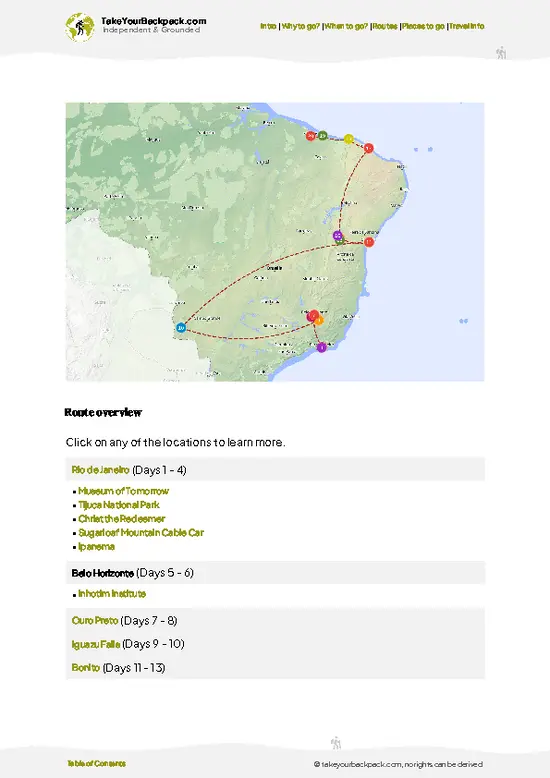
✅ Optimized 14, 21 & 30-day travel routes
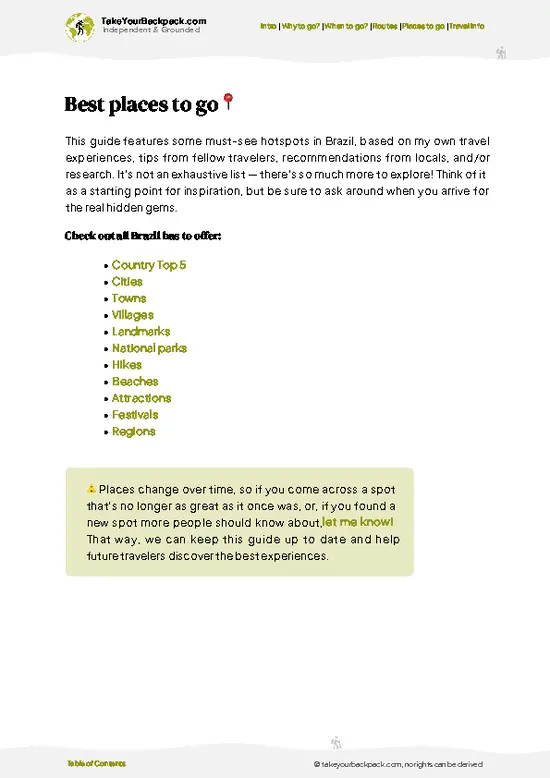
✅ Cities, national parks, landmarks, beaches
✅ How to get around
✅ Offline-friendly for travel without Wi-Fi
👉 Click to see all 30+ guide features

📅 Plan smarter in minutes, not weeks
✅ Month by month travel advice
✅ Festivals & national holidays
✅ Budget expectations

🗺️ Go to the right places, skip the overrated ones
✅ Honest pros & cons of destinations
✅ Top hikes, parks & viewpoints
✅ Lesser-known places most travelers miss
✅ Clear “worth it vs skip it” guidance

🛏️ Travel smoothly without rookie mistakes
✅ Best areas to stay
✅ Transport systems explained simply
✅ Common scams & safety advice
✅ SIM cards, money & practical tips

🌍 Understand the country, not just visit it
✅ Culture & traditions
✅ 52 Essential phrases & customs
✅ Festivals worth planning around
✅ Traveler-friendly historical context
✅ Insights that make places more meaningful

📱 Built for real travel conditions
✅ Fully downloadable PDF
✅ Works completely offline
✅ Optimized for phone use
✅ Useful in remote areas & buses
✅ Everything in one place
Stop searching, start planning
Get instant access to your full guide. 30‑day money-back guarantee.
+ Add another guide for just

By proceeding you agree to our terms.
Sent to your inbox immediately after payment • 100% Secure Checkout
Best Backpacking Travel Advisor 2025 tourism awardBest Backpacking
Travel Advisor
2025
What others say about Take Your Backpack Guides:
⭐⭐⭐⭐⭐
Fantastic, amazing amount of information!
⭐⭐⭐⭐⭐
My goodness this is amazing, it's what I've been looking for hats off too you!
⭐⭐⭐⭐⭐
I think this is absolutely BRILLIANT
⭐⭐⭐⭐
Very complete and informative. It's still missing places, but I gotta to commend you
⭐⭐⭐⭐⭐
This is truly amazing, thank you, can't wait to explore it with my kids!
⭐⭐⭐⭐⭐
Awesome resource, thank you!
⭐⭐⭐⭐⭐
This is amazing! Can't wait to explore the ones I haven't seen
⭐⭐⭐⭐
I love this! Well done, great idea.
⭐⭐⭐⭐⭐
Thanks for taking the time to make this gem!
⭐⭐⭐⭐⭐
This might be the best website I've ever seen.
⭐⭐⭐⭐⭐
Congratulations, and thank you so much for your work; it's incredibly valuable.
⭐⭐⭐⭐
In all seriousness I think you did a great job pointing out the important spots
⭐⭐⭐⭐⭐
10/10 very good
⭐⭐⭐⭐⭐
As someone who's only just starting to visit regularly this is awesome, thank you.
⭐⭐⭐⭐
Thank you very much! I'm going to visit my dad, it's going to be very useful!
⭐⭐⭐⭐⭐
This is really cool! We'll be travelling for the first time and this definitely come in handy.
⭐⭐⭐⭐⭐
You are now our minister of culture, congratulations 👨‍💼
⭐⭐⭐⭐⭐
Just wanted to tell you that this is a pearl! Going to follow your recommendations.
⭐⭐⭐⭐⭐
This is so cool. I'll definitely be using the resource for my travels soon.
⭐⭐⭐⭐⭐
This is very impressive! Good work.
⭐⭐⭐⭐⭐
This is an amazing and informative site. Very well done!

🛏️ Where to stay?How to pick the right area

The best base for most backpackers is Copacabana itself, in the blocks between the beach and Avenida Nossa Senhora de Copacabana, roughly Posto 2 to Posto 5. Hostels cluster here, dorm beds run about US$10 to 25 a night, and you can walk to the sand in five minutes.
The streets around Posto 2 and Posto 3 are the most social. Cheap kilo restaurants, bars, and a metro station (Cardeal Arcoverde and Siqueira Campos) keep you connected to Lapa, Santa Teresa, and the Christ the Redeemer train. These blocks stay lit and busy late, which suits solo travelers coming home after dark.
Leme, at the quieter … read more 👉
The best base for most backpackers is Copacabana itself, in the blocks between the beach and Avenida Nossa Senhora de Copacabana, roughly Posto 2 to Posto 5. Hostels cluster here, dorm beds run about US$10 to 25 a night, and you can walk to the sand in five minutes.
The streets around Posto 2 and Posto 3 are the most social. Cheap kilo restaurants, bars, and a metro station (Cardeal Arcoverde and Siqueira Campos) keep you connected to Lapa, Santa Teresa, and the Christ the Redeemer train. These blocks stay lit and busy late, which suits solo travelers coming home after dark.
Leme, at the quieter eastern end, has a calmer feel, a short stroll to Pedra do Leme, and slightly lower prices. Stay here if you want sleep over nightlife.
Ipanema, a 15 to 20 minute walk or one metro stop from the western end, is pricier (dorms from US$18 to 35) but has a more polished crowd and a relaxed sunset scene at Arpoador.
Skip the streets close to the hillside favelas at the edges of the neighborhood and the dim side streets behind Avenida Princesa Isabel.

🛡️ SafetySafety Tips and Common Scams in Copacabana

Copacabana beach is well patrolled and busy from morning to night, so daytime visits are easy and low-stress. The surf can be strong, especially near Posto 6 and Leme, where rips form and the shore break dumps hard on bigger swell days. Swim between the lifeguard posts, watch the flags, and follow where locals are in the water. There are no notable jellyfish or shark concerns here.
Sun is the bigger risk. Midday UV is intense year-round, so bring reef-safe SPF 50 and shade up between 11 a.m. and 2 p.m.
Phone grabs and bag snatching are the realistic theft problems, particularly at crowded weekends and on the promenade. Carry only cash and a phone you can keep in a pocket, and leave valuables at your hostel. Avoid the beach alone late at night, when it empties and lighting is patchy.

FAQTraveler FAQ

Take the metro to Cardeal Arcoverde or Siqueira Campos station, both a 5 to 10 minute walk from the sand, for about US$1. From Galeão airport, a ride-hailing car takes 40 to 60 minutes and costs roughly US$15 to 25, and the Santos Dumont airport is about 20 minutes away. Buses from Centro and Botafogo also run along Avenida Nossa Senhora de Copacabana.
Copacabana beach is good for swimming on calm days, with lifeguard posts spaced along the 4 km (2.5 mile) curve, though waves can be strong at the Leme end. Surfing is possible in front of Posto 6 and at nearby Arpoador, and board lessons run about US$25 to 40. Snorkeling is poor because the water is usually murky, so head to Ilha Grande or Arraial do Cabo (a few hours away) instead.
Yes, Copacabana beach is a public beach with no entry fee, and the promenade and sand are open around the clock. Chair and umbrella rental from vendors costs about US$4 to 8 for the day, and a coconut water runs US$1.50 to 3. Public showers and toilets are limited, so budget a little for kiosk bathrooms.
⚠️ Things can change over time, so always validate details locally before you go.

Other Brazilian beaches near Copacabana

Explore more nearby:

  • Ipanema—Arpoador applause, Posto 9, Dois Irmãos, Hippie Fair| 2 km away
  • Praia de Lopes Mendes—Squeaking quartz sand, forest backdrop, Abraão trail, Atlantic surf| 99 km away
  • Praia das Dunas—White dunes, kite sails, sandboarding, Forte São Mateus| 118 km away

💡 Not sure where to go next?
Create a personalized itinerary for Brazil including Copacabana and the places that fit your trip.

Generate my itinerary

👉 Discover all beaches

Or checkout all Brazil has to offer (think cities, towns, villages, national parks, hikes, beaches, festivals)
Country photo of Brazil

We 💚 feedbackKey takeaways before you go

Copacabana beach is best paired with Ipanema and Arpoador next door, then a day on Sugarloaf or Christ the Redeemer before moving on to Paraty or Ilha Grande. I would sleep here two or three nights, swim only in front of lifeguard posts, and leave valuables at the hostel.

✈️ When did I visit Brazil?
Call it good timing or luck, but I was able to celebrate Carnaval in Rio de Janeiro in February 2022, after a round trip in the north and east coast.

✍️ Help improve this page!
The information on this page is based on my own backpacking experience in Brazil, supplemented with up-to-date research and feedback from other travelers. Travel details can change, so if you notice anything outdated or incomplete, feel free to let me know.


🙋‍♂️ Give feedback

👋 Meet the founderWho’s Behind Take Your Backpack?

Johan, backpacker and founder of TakeYourBackpackHi, I’m Johan (Netherlands 🇳🇱), the creator of TakeYourBackpack. Over the past 3 decades, I’ve backpacked through 90+ countries across six continents, gaining extensive experience with independent travel, long-term trips, and overland routes.

This site is built on a combination of firsthand travel experience and carefully curated insights from other backpackers. Many guides are based on places I’ve personally visited, while others bring together tips, observations, and practical advice shared by trusted travelers I’ve met along the way.

The goal is to provide realistic, experience-driven guidance — not generic itineraries — so you can explore destinations with better context, clearer expectations, and more confidence.