×

Brazil🇧🇷 | national parksFernando de Noronha Marine National ParkSpinner dolphins, tide-pool walks, turtle bays, volcanic peak | things to do and best time to go

Explore Tijuca National ParkExplore Serra do Mar State Park

Backpacking in Fernando de Noronha Marine
By Johan Kruseman 🇳🇱 | Updated October 19, 2026

Most of the archipelago’s 21 islands are off-limits to visitors, and the main island is where you actually live, eat and sleep, while the marine park covers the sea, the islets and the main island outside its urban area. Fernando de Noronha Marine National Park sits in the Atlantic, roughly 350 kilometers off the northeast coast of Brazil. Hiking is short and coastal, so you will not trek for days, and I would skip any boat tour that mostly sells sunset drinks. The sea is the reason to come: spinner dolphins, sea turtles and reef sharks, with Baía do Sancho the best beach in the country by my measure. I expected a resort playground. Instead, wading into a tide pool at Atalaia, I found a turtle nosing past my ankles, with a ranger counting visitors at the gate so the pool stayed nearly empty. Those caps exist because the reef is fragile, so experienced travelers book the Atalaia slot and park permits early. Buy your park pass and reserve tide-pool times before you fly.

Discover everything you want to know in the 📖 Brazil Travel Guide.


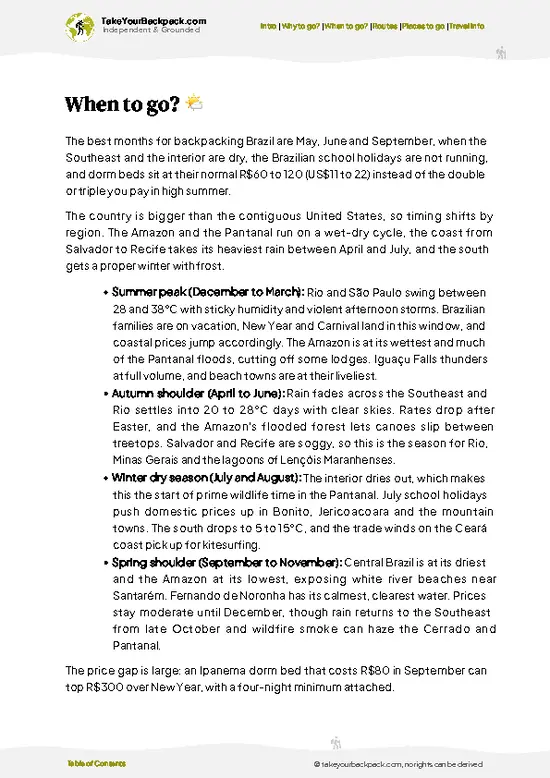
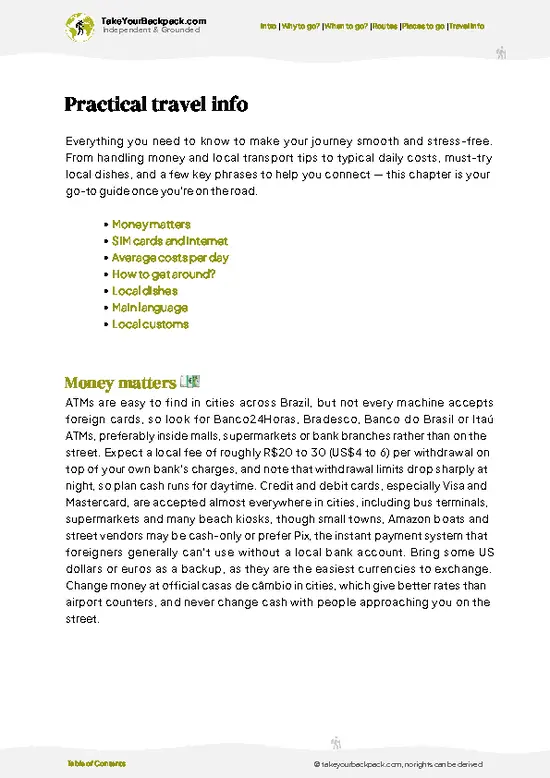
example page 0 from our offline Travel Guide for Brazil
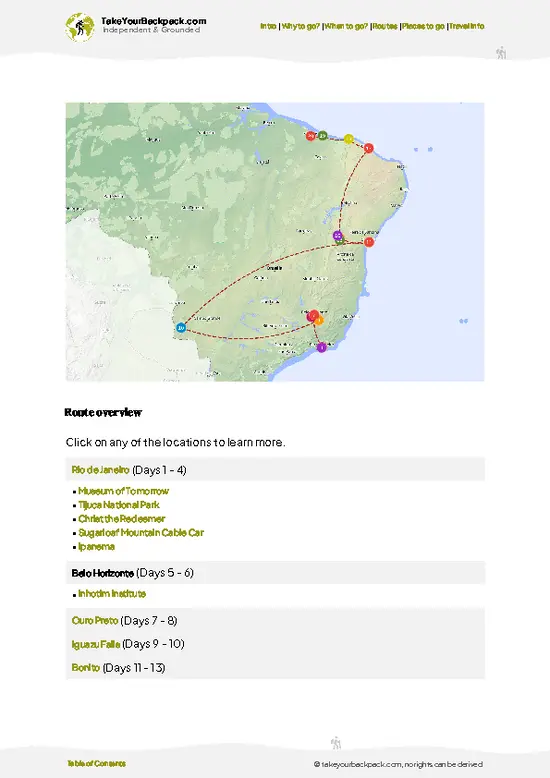
example page 1 from our offline Travel Guide for Brazil
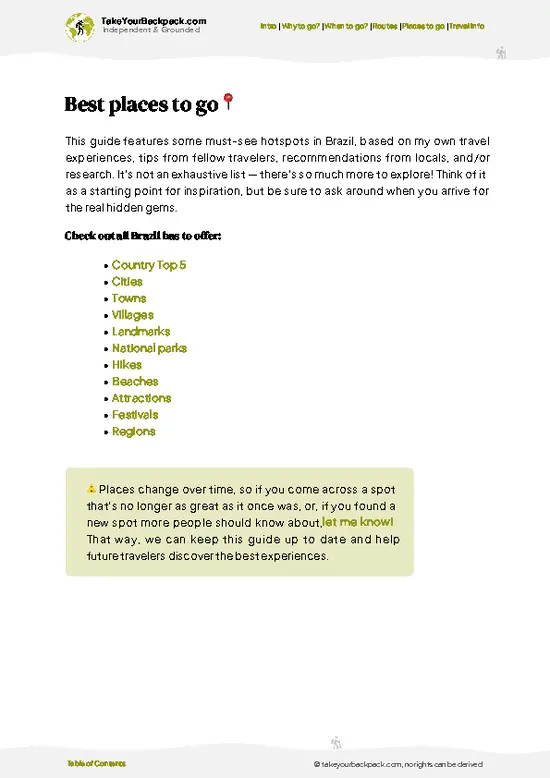
example page 2 from our offline Travel Guide for Brazil
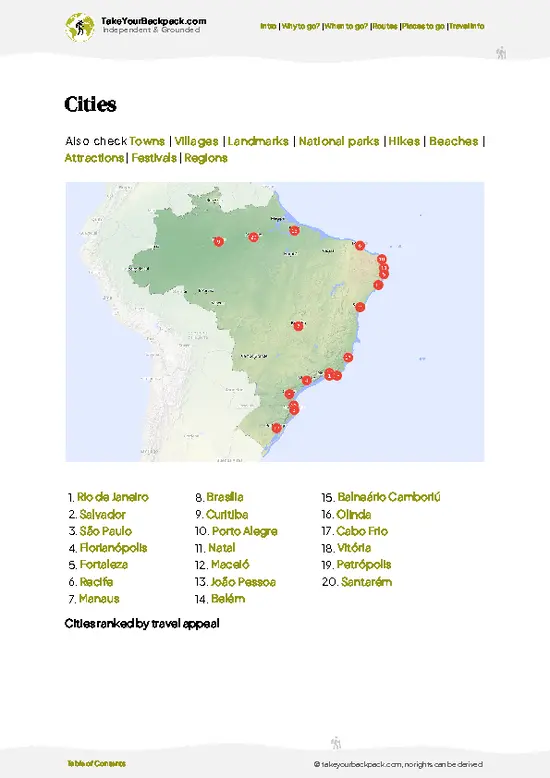
example page 3 from our offline Travel Guide for Brazil
example page 4 from our offline Travel Guide for Brazil
example page 5 from our offline Travel Guide for Brazil
example page 6 from our offline Travel Guide for Brazil
example page 7 from our offline Travel Guide for Brazil
Loading the map 🌍
CLICK TO FILTER
cities
towns
villages
landmarks
national parks
hikes
beaches
attractions
festivals
regions
SHOW COUNTRY’S BESTSHOW ALL

✨ Why go?
Ranked #99 national park in Brazil
Why visitors keep coming back

Fernando de Noronha Marine National Park suits backpackers who want to build their own days instead of buying a package. The island is small enough that Trilha do Atalaia, the Sancho Bay descent through a rock crevice with a steel ladder and the sunset crowd at Forte dos Remédios can all be reached on foot, by shared buggy or by the island’s public bus. That bus runs along the main road and costs very little, so you can hop between beaches on your own timing. The other draw is the water itself. Snorkeling with turtles and rays at the Baía do Sueste needs no guide and no boat, only a mask. Tours still matter for diving and the boat trip to see dolphins, but most of what makes the island special sits within a short walk of the road. If you like planning your own route and carrying your own gear, … read more 👉
Fernando de Noronha Marine National Park suits backpackers who want to build their own days instead of buying a package. The island is small enough that Trilha do Atalaia, the Sancho Bay descent through a rock crevice with a steel ladder and the sunset crowd at Forte dos Remédios can all be reached on foot, by shared buggy or by the island’s public bus. That bus runs along the main road and costs very little, so you can hop between beaches on your own timing. The other draw is the water itself. Snorkeling with turtles and rays at the Baía do Sueste needs no guide and no boat, only a mask. Tours still matter for diving and the boat trip to see dolphins, but most of what makes the island special sits within a short walk of the road. If you like planning your own route and carrying your own gear, the park rewards you more than a package ever would.

💡 HighlightsMust-see experiences and standout moments

  1. Baía do Sancho: The island’s best-known beach, reached by a narrow rock crevice and a short steel ladder. Cliffs frame the bay, and the water is clear enough to see fish from the sand.
  2. Baía dos Porcos: Natural tide pools between volcanic rocks, ideal for snorkeling at low tide with small reef fish and the odd turtle.
  3. Baía dos Golfinhos: A lookout over the bay where spinner dolphins gather in the morning. Visitors watch from the cliff, as entering the water here is forbidden.
  4. Praia do Leão: A long beach with a rocky backdrop, a nesting area for sea turtles. Access to the sand is restricted at night during nesting season.
  5. Baía do Sueste: A calm, shallow bay where green turtles and blacktip reef sharks swim close to shore. Good for independent snorkeling, with a mangrove nearby.
  6. Trilha do Atalaia:
… read more 👉
  1. Baía do Sancho: The island’s best-known beach, reached by a narrow rock crevice and a short steel ladder. Cliffs frame the bay, and the water is clear enough to see fish from the sand.
  2. Baía dos Porcos: Natural tide pools between volcanic rocks, ideal for snorkeling at low tide with small reef fish and the odd turtle.
  3. Baía dos Golfinhos: A lookout over the bay where spinner dolphins gather in the morning. Visitors watch from the cliff, as entering the water here is forbidden.
  4. Praia do Leão: A long beach with a rocky backdrop, a nesting area for sea turtles. Access to the sand is restricted at night during nesting season.
  5. Baía do Sueste: A calm, shallow bay where green turtles and blacktip reef sharks swim close to shore. Good for independent snorkeling, with a mangrove nearby.
  6. Trilha do Atalaia: A guided-only tide pool walk with limited daily numbers, where you can see starfish, eels and small reef fish in clear natural pools.
  7. Morro do Pico: The island’s volcanic peak, a landmark that rises sharply above the interior and appears from nearly every viewpoint.
Baía do Sancho and Baía dos Porcos combine well in one day, since both sit on the same side of the park and the walk between them is short.
Spotted a mistake or missing something? Contact us.

Things to do around Fernando de Noronha Marine National Park

Ratings based on Tripadvisor reviews. When you book through this link, you support our work at no extra cost to you.

🌤️ When to go?Choosing the right time of year

  • Dry Season (August to January): Calm, clear water gives 25 to 50 m (80 to 160 ft) of visibility for diving and snorkeling. Air temperatures run 24 to 30°C (75 to 86°F), with water around 26 to 28°C (79 to 82°F).
  • Rainy Season (February to July): Showers are frequent, peaking March to June, though days still reach 26 to 31°C (79 to 88°F). Visibility drops, but the island turns green and prices soften.
  • Swell Season (December to March): Big north-shore swells draw surfers to Cacimba do Padre and close some northern beaches.
  • Peak Crowds and Prices: December to February, Carnival and July school holidays are the most expensive and booked up. Flights and posadas can cost 30 to 50 percent more.
  • Daylight: Close to the equator, days stay at roughly 12 hours all year, so timing never changes your hiking
… read more 👉
  • Dry Season (August to January): Calm, clear water gives 25 to 50 m (80 to 160 ft) of visibility for diving and snorkeling. Air temperatures run 24 to 30°C (75 to 86°F), with water around 26 to 28°C (79 to 82°F).
  • Rainy Season (February to July): Showers are frequent, peaking March to June, though days still reach 26 to 31°C (79 to 88°F). Visibility drops, but the island turns green and prices soften.
  • Swell Season (December to March): Big north-shore swells draw surfers to Cacimba do Padre and close some northern beaches.
  • Peak Crowds and Prices: December to February, Carnival and July school holidays are the most expensive and booked up. Flights and posadas can cost 30 to 50 percent more.
  • Daylight: Close to the equator, days stay at roughly 12 hours all year, so timing never changes your hiking window.
Book September or October for the best mix of clear water, thinner crowds and lower rates.


source: climatestotravel.comJANJanuary: highly recommended for travelingFEBFebruary: highly recommended for travelingMARMarch: fair for travelingAPRApril: fair for travelingMAYMay: fair for travelingJUNJune: fair for travelingJULJuly: fair for travelingAUGAugust: excellent for travelingSEPSeptember: excellent for travelingOCTOctober: excellent for travelingNOVNovember: highly recommended for travelingDECDecember: highly recommended for traveling
when-to-go

✈️ The backpacker research shortcutBrazil Travel Guide

An offline-friendly backpacking guide with optimized travel routes, ranked highlights, transport advice, and the best areas to stay.
example page 0 from our offline Travel Guide for Brazil
example page 1 from our offline Travel Guide for Brazil
example page 2 from our offline Travel Guide for Brazil
example page 3 from our offline Travel Guide for Brazil
example page 4 from our offline Travel Guide for Brazil
example page 5 from our offline Travel Guide for Brazil
example page 6 from our offline Travel Guide for Brazil
example page 7 from our offline Travel Guide for Brazil
The digital guide (410 pages) contains:
✅ 146 highlights, ranked by travel appeal
✅ Optimized 14, 21 & 30-day travel routes
✅ Cities, national parks, landmarks, beaches
✅ How to get around
✅ Offline-friendly for travel without Wi-Fi
👉 Click to see all 30+ guide features

📅 Plan smarter in minutes, not weeks
✅ Month by month travel advice
✅ Festivals & national holidays
✅ Budget expectations

🗺️ Go to the right places, skip the overrated ones
✅ Honest pros & cons of destinations
✅ Top hikes, parks & viewpoints
✅ Lesser-known places most travelers miss
✅ Clear “worth it vs skip it” guidance

🛏️ Travel smoothly without rookie mistakes
✅ Best areas to stay
✅ Transport systems explained simply
✅ Common scams & safety advice
✅ SIM cards, money & practical tips

🌍 Understand the country, not just visit it
✅ Culture & traditions
✅ 52 Essential phrases & customs
✅ Festivals worth planning around
✅ Traveler-friendly historical context
✅ Insights that make places more meaningful

📱 Built for real travel conditions
✅ Fully downloadable PDF
✅ Works completely offline
✅ Optimized for phone use
✅ Useful in remote areas & buses
✅ Everything in one place
Stop searching, start planning
Get instant access to your full guide. 30‑day money-back guarantee.
+ Add another guide for just

By proceeding you agree to our terms.
Sent to your inbox immediately after payment • 100% Secure Checkout
Best Backpacking Travel Advisor 2025 tourism awardBest Backpacking
Travel Advisor
2025
What others say about Take Your Backpack Guides:
⭐⭐⭐⭐⭐
Fantastic, amazing amount of information!
⭐⭐⭐⭐⭐
My goodness this is amazing, it's what I've been looking for hats off too you!
⭐⭐⭐⭐⭐
I think this is absolutely BRILLIANT
⭐⭐⭐⭐
Very complete and informative. It's still missing places, but I gotta to commend you
⭐⭐⭐⭐⭐
This is truly amazing, thank you, can't wait to explore it with my kids!
⭐⭐⭐⭐⭐
Awesome resource, thank you!
⭐⭐⭐⭐⭐
This is amazing! Can't wait to explore the ones I haven't seen
⭐⭐⭐⭐
I love this! Well done, great idea.
⭐⭐⭐⭐⭐
Thanks for taking the time to make this gem!
⭐⭐⭐⭐⭐
This might be the best website I've ever seen.
⭐⭐⭐⭐⭐
Congratulations, and thank you so much for your work; it's incredibly valuable.
⭐⭐⭐⭐
In all seriousness I think you did a great job pointing out the important spots
⭐⭐⭐⭐⭐
10/10 very good
⭐⭐⭐⭐⭐
As someone who's only just starting to visit regularly this is awesome, thank you.
⭐⭐⭐⭐
Thank you very much! I'm going to visit my dad, it's going to be very useful!
⭐⭐⭐⭐⭐
This is really cool! We'll be travelling for the first time and this definitely come in handy.
⭐⭐⭐⭐⭐
You are now our minister of culture, congratulations 👨‍💼
⭐⭐⭐⭐⭐
Just wanted to tell you that this is a pearl! Going to follow your recommendations.
⭐⭐⭐⭐⭐
This is so cool. I'll definitely be using the resource for my travels soon.
⭐⭐⭐⭐⭐
This is very impressive! Good work.
⭐⭐⭐⭐⭐
This is an amazing and informative site. Very well done!

🛏️ Where to stay?Where staying makes the most sense

All beds are on the main island, inside the park's wider protected area, and nearly every posada sits in Vila dos Remédios or its neighborhoods, with a few near Floresta Velha and Boldró. Nothing inside the marine park itself, such as the Sancho or Baía do Sueste beach zones, offers lodging.
Budget travelers do best with simple posadas and hostel-style rooms in Vila dos Remédios, typically US$60 to 120 a night for a double in high season. Most include breakfast, and the walk to the bus line, restaurants and the Vila's markets is short. Mid-range posadas with a pool run US$150 to 300. Luxury lodges … read more 👉
All beds are on the main island, inside the park's wider protected area, and nearly every posada sits in Vila dos Remédios or its neighborhoods, with a few near Floresta Velha and Boldró. Nothing inside the marine park itself, such as the Sancho or Baía do Sueste beach zones, offers lodging.
Budget travelers do best with simple posadas and hostel-style rooms in Vila dos Remédios, typically US$60 to 120 a night for a double in high season. Most include breakfast, and the walk to the bus line, restaurants and the Vila's markets is short. Mid-range posadas with a pool run US$150 to 300. Luxury lodges near Praia do Sueste or Boldró often start above US$400.
An environmental preservation fee is charged per day of stay, so shorter visits save money. Camping is not permitted, so every night needs a booking. Reserve three to six months ahead for December to February.
Recife and Natal are the mainland gateway cities, with direct flights to the island. Staying a night there makes sense only if connections force it. Choose a place near the Vila's central bus stop, since the island's single main road (BR-363) links most beaches and trailheads.

👛 Costs (as of 19 October 2026)Typical daily expenses

A backpacker can expect about US$190 a day at Fernando de Noronha Marine National Park, with lodging and the park fees as the biggest items.
CategoryBudget RangeLocal Reality
Park entrance (ICMBio)About US$70 per visit (US$35 for Brazilians)Ticket valid up to 10 days, sold online by ICMBio.
Environmental preservation fee (TPA)About US$19 a dayCharged per day of stay and rises with length; paid before or at the airport.
Accommodation (high season)US$60 to 120Basic posadas in Vila dos Remédios with breakfast; low season is often 30 percent cheaper.
Local transportUS$5 to 25Public bus on the main road costs a couple of dollars per ride; buggy rentals run US$80 to 130 a day and are best shared.
Food and suppliesUS$20 to 40Island prices are high because goods arrive by plane or ship; self-catering and
… read more 👉
A backpacker can expect about US$190 a day at Fernando de Noronha Marine National Park, with lodging and the park fees as the biggest items.
CategoryBudget RangeLocal Reality
Park entrance (ICMBio)About US$70 per visit (US$35 for Brazilians)Ticket valid up to 10 days, sold online by ICMBio.
Environmental preservation fee (TPA)About US$19 a dayCharged per day of stay and rises with length; paid before or at the airport.
Accommodation (high season)US$60 to 120Basic posadas in Vila dos Remédios with breakfast; low season is often 30 percent cheaper.
Local transportUS$5 to 25Public bus on the main road costs a couple of dollars per ride; buggy rentals run US$80 to 130 a day and are best shared.
Food and suppliesUS$20 to 40Island prices are high because goods arrive by plane or ship; self-catering and prato feito lunches save the most.
ActivitiesUS$0 to 25Most beaches and trails are free with the park ticket; boat tours and snorkel trips cost extra.
Total Daily BudgetAbout US$190Excludes flights, which are usually the largest single expense.


source: gov.br
⚠️ Prices can change and everyone travels differently, so take this as a rough guide. Hope it helps you plan your adventure!

🥾 TrailsWhere to hike in Fernando de Noronha Marine: trails for every level

Fernando de Noronha Marine National Park offers short coastal walks rather than long treks, and most can be finished in a morning. Terrain is a mix of sandy tracks, volcanic rock and steep descents, so sturdy sandals or light shoes are more useful than boots.
  • Trilha do Sancho: About 1 km, 30 to 45 minutes each way, moderate. It ends with a narrow rock crevice and a steel ladder down to the beach, with cliffs and seabirds along the route.
  • Trilha do Atalaia: Short and easy, around 1 hour, with a limited number of visitors per day and a guide required. It passes tide pools full of fish, starfish and
… read more 👉
Fernando de Noronha Marine National Park offers short coastal walks rather than long treks, and most can be finished in a morning. Terrain is a mix of sandy tracks, volcanic rock and steep descents, so sturdy sandals or light shoes are more useful than boots.
  • Trilha do Sancho: About 1 km, 30 to 45 minutes each way, moderate. It ends with a narrow rock crevice and a steel ladder down to the beach, with cliffs and seabirds along the route.
  • Trilha do Atalaia: Short and easy, around 1 hour, with a limited number of visitors per day and a guide required. It passes tide pools full of fish, starfish and small reef sharks.
  • Trilha Capim-Açu: About 8 km, 6 to 8 hours, hard, with a mandatory guide. It runs from the Sancho checkpoint to Praia do Leão with open views, hot sun and little shade.
  • Trilha Praia do Leão: A short, easy walk to a wide beach where turtles nest. Closed to the public after dark.
Wildlife includes green turtles, spinner dolphins, rays, blacktip reef sharks and many seabirds. Carry water, as shade is scarce and the tracks are exposed. Visitors reach the park by flight to the island, then by taxi, bus or buggy. The park charges an entrance ticket valid for 10 days, about US$70 for foreigners and US$35 for Brazilians, plus the separate island environmental fee of about US$19 a day. Crowds stay moderate because daily numbers are controlled, but the main beaches fill by midday, so start early.
⚠️ Hiking info can sometimes be outdated or inaccurate. Before you hit the trail, check the latest conditions with locals. If you do spot anything that's off, I'd love to hear from you, so I can update it for fellow travelers.

🛡️ SafetySafety Tips and Common Scams in Fernando de Noronha Marine

Fernando de Noronha is among Brazil's calmer destinations, with low crime and well-managed trails. The main hazards are sun and water. At roughly 3.9 degrees south, UV is intense, so wear reef-safe sunscreen (required near the marine park), a hat and a long-sleeve rash guard.
Trails like Sancho and Atalaia are short but include steep ladders and slippery rock. Wear closed shoes or sturdy sandals. Carry 1.5 to 2 liters of water, as shade is thin on the open coastal paths.
Currents and swell can be strong on north-shore beaches in the winter months, and the lifeguard flag system is clear. Follow it. Atalaia limits visitors and requires a guide for tidal-pool visits.
Spinner dolphins, turtles, sharks and rays share the water. Keep a distance of several meters, never touch or feed them, and do not … read more 👉
Fernando de Noronha is among Brazil's calmer destinations, with low crime and well-managed trails. The main hazards are sun and water. At roughly 3.9 degrees south, UV is intense, so wear reef-safe sunscreen (required near the marine park), a hat and a long-sleeve rash guard.
Trails like Sancho and Atalaia are short but include steep ladders and slippery rock. Wear closed shoes or sturdy sandals. Carry 1.5 to 2 liters of water, as shade is thin on the open coastal paths.
Currents and swell can be strong on north-shore beaches in the winter months, and the lifeguard flag system is clear. Follow it. Atalaia limits visitors and requires a guide for tidal-pool visits.
Spinner dolphins, turtles, sharks and rays share the water. Keep a distance of several meters, never touch or feed them, and do not step on corals. Tides shift quickly, so check the schedule before crossing rocky stretches.

FAQFrequently asked questions about Fernando de Noronha Marine

Plan four to five days for Fernando de Noronha Marine National Park. That gives you time for the Sancho and Atalaia beaches, a boat trip around Baía dos Golfinhos, and a snorkel or dive session. Weather delays can cut into shorter stays, and the minimum most posadas accept is often three nights.
Yes, you can see Fernando de Noronha Marine National Park without a car. A public bus runs along the main road BR-363 between Vila dos Remédios and the southern beaches for about US$2 per ride. Taxis and shared buggy rentals (US$80 to 130 a day) fill the gaps, and many trailheads are reachable on foot from the Vila.
Yes, Fernando de Noronha Marine National Park charges an entrance fee, about US$70 for foreigners and US$35 for Brazilians. The ticket is valid for up to 10 days and is sold online by ICMBio. A separate environmental preservation fee of roughly US$19 per day is also collected for each day on the island, and some sites like Atalaia require advance booking.
⚠️ Things can change over time, so always validate details locally before you go.

Other Brazilian national parks near Fernando de Noronha Marine

Explore more nearby:


💡 Not sure where to go next?
Create a personalized itinerary for Brazil including Fernando de Noronha Marine and the places that fit your trip.

Generate my itinerary

👉 Discover all national parks

Or checkout all Brazil has to offer (think cities, towns, villages, national parks, hikes, beaches, festivals)
Country photo of Brazil

We 💚 feedbackSumming up the experience

Fernando de Noronha Marine National Park works best as the final stop on a longer northeastern Brazil route, after cheaper beach towns like Recife or Jericoacoara have stretched your budget. Keep your stay to four or five days, since the daily fee climbs. I would pack reef-safe sunscreen and a snorkel mask, and skip the pricey boat tours.

✈️ When did I visit Brazil?
Call it good timing or luck, but I was able to celebrate Carnaval in Rio de Janeiro in February 2022, after a round trip in the north and east coast.

✍️ Help improve this page!
The information on this page is based on my own backpacking experience in Brazil, supplemented with up-to-date research and feedback from other travelers. Travel details can change, so if you notice anything outdated or incomplete, feel free to let me know.


🙋‍♂️ Give feedback

👋 Meet the founderWho’s Behind Take Your Backpack?

Johan, backpacker and founder of TakeYourBackpackHi, I’m Johan (Netherlands 🇳🇱), the creator of TakeYourBackpack. Over the past 3 decades, I’ve backpacked through 90+ countries across six continents, gaining extensive experience with independent travel, long-term trips, and overland routes.

This site is built on a combination of firsthand travel experience and carefully curated insights from other backpackers. Many guides are based on places I’ve personally visited, while others bring together tips, observations, and practical advice shared by trusted travelers I’ve met along the way.

The goal is to provide realistic, experience-driven guidance — not generic itineraries — so you can explore destinations with better context, clearer expectations, and more confidence.