×

Brazil🇧🇷 | national parksParque Estadual do JalapãoFervedouro springs, rust-colored dunes, 4x4 sand tracks, Tocantins cerrado | things to do and best time to go

Explore Parque Estadual Turístico do Alto RibeiraExplore Pedra Azul State Park

Backpacking in Parque Estadual do Jalapão
🌟 Highlightnational park ranked #8
By Johan Kruseman 🇳🇱 | Updated October 19, 2026

Jalapão is not a national park but a state park, run by Tocantins, and it sits inside a much larger region of the same name that you cannot cross without a 4x4. The park lies in the east of Tocantins, in the north of Brazil, a long day of dirt road from Palmas. The sand tracks are rough, the signage is thin, and tours cost more than the beaches justify. Skip hopping between every waterfall in two days. Choose the fervedouros (spring pools that push you up like a cork), the Jalapão dunes at dusk and the Serra do Espírito Santo, because each is distinct and worth the bumps. At a roadside stop a driver handed me a cup of buriti juice and said, “Sand is the road here, drink first.” It tasted tart and orange, and I understood the pace. Book a local driver with a 4x4 before you arrive.

Discover everything you want to know in the 📖 Brazil Travel Guide.


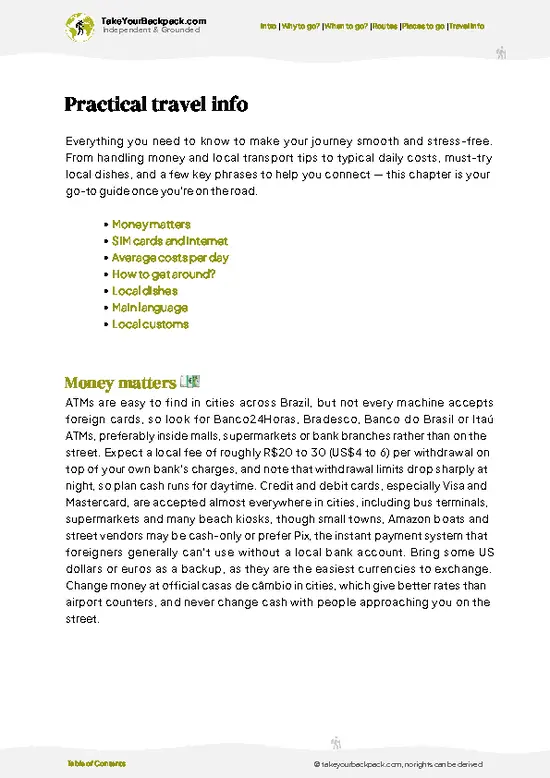
example page 0 from our offline Travel Guide for Brazil
example page 1 from our offline Travel Guide for Brazil
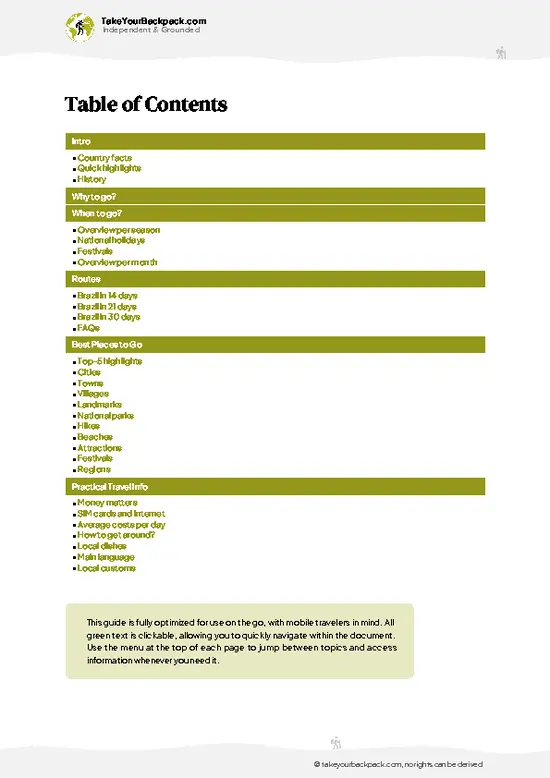
example page 2 from our offline Travel Guide for Brazil
example page 3 from our offline Travel Guide for Brazil
example page 4 from our offline Travel Guide for Brazil
example page 5 from our offline Travel Guide for Brazil
example page 6 from our offline Travel Guide for Brazil
example page 7 from our offline Travel Guide for Brazil
Loading the map 🌍
CLICK TO FILTER
cities
towns
villages
landmarks
national parks
hikes
beaches
attractions
festivals
regions
SHOW COUNTRY’S BESTSHOW ALL

✨ Why go?
Ranked #8 national park in Brazil
Why Parque Estadual do Jalapão should be on your travel list

Parque Estadual do Jalapão suits backpackers who like earning their views on their own terms. Nothing here is packaged: you arrange a driver in Mateiros or Ponte Alta do Tocantins, split the fuel and guide costs with other travelers at a pousada, and decide each morning whether the day is dunes, springs or canyon walls. Camping is simple and often next to the water, which keeps things easy on the wallet. What sets it apart is variety within a small radius: the Fervedouro pools where you float without effort, the Dunas do Jalapão in golden-orange sand with a cerrado backdrop, and the Cachoeira da Velha, a wide, horseshoe-shaped falls on the Rio Novo. Most spots are short walks from where the vehicle stops, so you get a lot without heavy trekking. Self-guided travel works only for the sights; the roads need a local.

💡 HighlightsTop highlights of Parque Estadual do Jalapão

  1. Fervedouros: Natural springs where sand-bottomed upwelling water keeps you afloat. Bela Vista and Alecrim are the best known, and entry is small, around US$5 to 10.
  2. Dunas do Jalapão: Rust-colored dunes near Mateiros, best for a late-afternoon climb with the cerrado spread behind you.
  3. Cachoeira da Velha: A broad, curved waterfall on the Rio Novo, seen from a viewing platform; swimming is not allowed at the falls, but the Prainha do Rio Novo a few meters downstream is a calm swim spot.
  4. Serra do Espírito Santo: A flat-topped sandstone ridge with a viewpoint over the plateau and cerrado.
  5. Cachoeira do Formiga: A small waterfall dropping into a clear emerald pool that is good for a cooling swim.
  6. Pedra Furada: A rock formation with a natural hole, reached by a short walk and popular at sunset.
  7. Rio Sono:
… read more 👉
  1. Fervedouros: Natural springs where sand-bottomed upwelling water keeps you afloat. Bela Vista and Alecrim are the best known, and entry is small, around US$5 to 10.
  2. Dunas do Jalapão: Rust-colored dunes near Mateiros, best for a late-afternoon climb with the cerrado spread behind you.
  3. Cachoeira da Velha: A broad, curved waterfall on the Rio Novo, seen from a viewing platform; swimming is not allowed at the falls, but the Prainha do Rio Novo a few meters downstream is a calm swim spot.
  4. Serra do Espírito Santo: A flat-topped sandstone ridge with a viewpoint over the plateau and cerrado.
  5. Cachoeira do Formiga: A small waterfall dropping into a clear emerald pool that is good for a cooling swim.
  6. Pedra Furada: A rock formation with a natural hole, reached by a short walk and popular at sunset.
  7. Rio Sono: Sandbars and clear water where you can float or relax on a quiet beach.
The list takes a minimum of three full days, and four or five days is more comfortable given the distances on sand roads.
Spotted a mistake or missing something? Contact us.

🌤️ When to go?When to go for the best experience

  • Dry Season (May to September): Rivers run clear, the dunes are firm underfoot and roads are passable. Days reach 30 to 35°C (86 to 95°F), nights drop to 18 to 22°C (64 to 72°F). Daylight lasts roughly 11.5 to 12.5 hours. Crowds and prices peak in July and during Brazilian holiday weeks.
  • Transition (October to November): Heat climbs past 38°C (100°F) and first storms arrive. Fewer visitors, lower lodging rates, and the Fervedouros are still swimmable.
  • Rainy Season (December to April): Afternoon downpours of 25 to 30°C (77 to 86°F) turn sandy tracks to mud and swell rivers. Waterfalls look full but many routes close to vehicles, and tour operators discount or pause trips.
Book your 4x4 and guide for June or August at least a month ahead, or aim for early September to get dry roads with thinner crowds.

source: climatestotravel.comJANJanuary: fair for travelingFEBFebruary: fair for travelingMARMarch: fair for travelingAPRApril: fair for travelingMAYMay: excellent for travelingJUNJune: excellent for travelingJULJuly: excellent for travelingAUGAugust: excellent for travelingSEPSeptember: highly recommended for travelingOCTOctober: fair for travelingNOVNovember: fair for travelingDECDecember: fair for traveling
brazil-national-park-parque-estadual-do-jalapao
© Google | Rosilea Ignes Reis

✈️ The backpacker research shortcutBrazil Travel Guide

An offline-friendly backpacking guide with optimized travel routes, ranked highlights, transport advice, and the best areas to stay.
example page 0 from our offline Travel Guide for Brazil
example page 1 from our offline Travel Guide for Brazil
example page 2 from our offline Travel Guide for Brazil
example page 3 from our offline Travel Guide for Brazil
example page 4 from our offline Travel Guide for Brazil
example page 5 from our offline Travel Guide for Brazil
example page 6 from our offline Travel Guide for Brazil
example page 7 from our offline Travel Guide for Brazil
The digital guide (410 pages) contains:
✅ 146 highlights, ranked by travel appeal
✅ Optimized 14, 21 & 30-day travel routes
✅ Cities, national parks, landmarks, beaches
✅ How to get around
✅ Offline-friendly for travel without Wi-Fi
👉 Click to see all 30+ guide features

📅 Plan smarter in minutes, not weeks
✅ Month by month travel advice
✅ Festivals & national holidays
✅ Budget expectations

🗺️ Go to the right places, skip the overrated ones
✅ Honest pros & cons of destinations
✅ Top hikes, parks & viewpoints
✅ Lesser-known places most travelers miss
✅ Clear “worth it vs skip it” guidance

🛏️ Travel smoothly without rookie mistakes
✅ Best areas to stay
✅ Transport systems explained simply
✅ Common scams & safety advice
✅ SIM cards, money & practical tips

🌍 Understand the country, not just visit it
✅ Culture & traditions
✅ 52 Essential phrases & customs
✅ Festivals worth planning around
✅ Traveler-friendly historical context
✅ Insights that make places more meaningful

📱 Built for real travel conditions
✅ Fully downloadable PDF
✅ Works completely offline
✅ Optimized for phone use
✅ Useful in remote areas & buses
✅ Everything in one place
Stop searching, start planning
Get instant access to your full guide. 30‑day money-back guarantee.
+ Add another guide for just

By proceeding you agree to our terms.
Sent to your inbox immediately after payment • 100% Secure Checkout
Best Backpacking Travel Advisor 2025 tourism awardBest Backpacking
Travel Advisor
2025
What others say about Take Your Backpack Guides:
⭐⭐⭐⭐⭐
Fantastic, amazing amount of information!
⭐⭐⭐⭐⭐
My goodness this is amazing, it's what I've been looking for hats off too you!
⭐⭐⭐⭐⭐
I think this is absolutely BRILLIANT
⭐⭐⭐⭐
Very complete and informative. It's still missing places, but I gotta to commend you
⭐⭐⭐⭐⭐
This is truly amazing, thank you, can't wait to explore it with my kids!
⭐⭐⭐⭐⭐
Awesome resource, thank you!
⭐⭐⭐⭐⭐
This is amazing! Can't wait to explore the ones I haven't seen
⭐⭐⭐⭐
I love this! Well done, great idea.
⭐⭐⭐⭐⭐
Thanks for taking the time to make this gem!
⭐⭐⭐⭐⭐
This might be the best website I've ever seen.
⭐⭐⭐⭐⭐
Congratulations, and thank you so much for your work; it's incredibly valuable.
⭐⭐⭐⭐
In all seriousness I think you did a great job pointing out the important spots
⭐⭐⭐⭐⭐
10/10 very good
⭐⭐⭐⭐⭐
As someone who's only just starting to visit regularly this is awesome, thank you.
⭐⭐⭐⭐
Thank you very much! I'm going to visit my dad, it's going to be very useful!
⭐⭐⭐⭐⭐
This is really cool! We'll be travelling for the first time and this definitely come in handy.
⭐⭐⭐⭐⭐
You are now our minister of culture, congratulations 👨‍💼
⭐⭐⭐⭐⭐
Just wanted to tell you that this is a pearl! Going to follow your recommendations.
⭐⭐⭐⭐⭐
This is so cool. I'll definitely be using the resource for my travels soon.
⭐⭐⭐⭐⭐
This is very impressive! Good work.
⭐⭐⭐⭐⭐
This is an amazing and informative site. Very well done!

🛏️ Where to stay?Where staying makes the most sense

Most backpackers sleep in Mateiros or São Félix do Tocantins, the two villages at the park’s edges, since lodging inside the park is limited to a few campsites and simple pousadas near attractions like the Fervedouros. Mateiros is the best base: it sits near the Dunas, Cachoeira da Velha and Fervedouro do Ceiçal, and has a handful of pousadas with fan or air-conditioned rooms at roughly US$25 to 60 a night. Some pousadas have hammock or camping space for about US$8 to 15. São Félix, on the Rio Sono, suits those entering from the west and offers similar rooms at US$20 to 50. Ponte Alta do Tocantins … read more 👉
Most backpackers sleep in Mateiros or São Félix do Tocantins, the two villages at the park’s edges, since lodging inside the park is limited to a few campsites and simple pousadas near attractions like the Fervedouros. Mateiros is the best base: it sits near the Dunas, Cachoeira da Velha and Fervedouro do Ceiçal, and has a handful of pousadas with fan or air-conditioned rooms at roughly US$25 to 60 a night. Some pousadas have hammock or camping space for about US$8 to 15. São Félix, on the Rio Sono, suits those entering from the west and offers similar rooms at US$20 to 50. Ponte Alta do Tocantins is a quieter third option on the road in from Palmas, with budget guesthouses. Palmas, the state capital, is where most travelers arrive and stock up on groceries and cash. Reserve in July and August, because small towns fill quickly and options are few.

👛 Costs (as of 19 October 2026)Money, prices, and spending tips

Budget about US$67 to 118 a day for Parque Estadual do Jalapão, with a guide or shared 4x4 being the biggest expense. The total below uses high-season rates and a shared vehicle.
CategoryBudget RangeLocal Reality
Entrance feesUS$2 to 8 per sitePrivate attractions like Fervedouros and Cachoeira da Velha charge small fees, paid in reais, often in cash.
Accommodation (high season)US$20 to 45Basic pousada rooms in Mateiros or São Félix; camping or hammocks cost less at US$8 to 15.
Accommodation (low season)US$15 to 35Discounts are modest and many tours run less often.
Local transport and toursUS$25 to 45Shared 4x4 day tours with a driver split among 4 to 6 people; private vehicles cost much more.
Food and suppliesUS$12 to 20Simple meals in village restaurants cost US$5 to 8; stock groceries in Palmas,
… read more 👉
Budget about US$67 to 118 a day for Parque Estadual do Jalapão, with a guide or shared 4x4 being the biggest expense. The total below uses high-season rates and a shared vehicle.
CategoryBudget RangeLocal Reality
Entrance feesUS$2 to 8 per sitePrivate attractions like Fervedouros and Cachoeira da Velha charge small fees, paid in reais, often in cash.
Accommodation (high season)US$20 to 45Basic pousada rooms in Mateiros or São Félix; camping or hammocks cost less at US$8 to 15.
Accommodation (low season)US$15 to 35Discounts are modest and many tours run less often.
Local transport and toursUS$25 to 45Shared 4x4 day tours with a driver split among 4 to 6 people; private vehicles cost much more.
Food and suppliesUS$12 to 20Simple meals in village restaurants cost US$5 to 8; stock groceries in Palmas, as prices rise locally.
Total Daily BudgetUS$67 to 118Counting high-season lodging, shared tours and a few entry fees.
⚠️ Prices can change and everyone travels differently, so take this as a rough guide. Hope it helps you plan your adventure!

🥾 TrailsScenic routes and wildlife spotting in Parque Estadual do Jalapão

Parque Estadual do Jalapão covers roughly 1,600 square kilometers of the eastern Tocantins savanna, and most walking here means short hops from a vehicle track rather than long through-hikes. Terrain is flat to gently rolling cerrado, golden grass dunes, sandy tracks, flat-topped mesas and clear rivers. Expect loose sand underfoot, little shade and a lot of sun.

  • Cachoeira da Velha: Cachoeira da Velha is a wide, roughly 100-meter-long curtain of water on the Rio Novo, reached by a short, easy walk of about 10 to 15 minutes on sand and rock. Allow an hour for swimming and photos.
  • Fervedouros: the
… read more 👉
Parque Estadual do Jalapão covers roughly 1,600 square kilometers of the eastern Tocantins savanna, and most walking here means short hops from a vehicle track rather than long through-hikes. Terrain is flat to gently rolling cerrado, golden grass dunes, sandy tracks, flat-topped mesas and clear rivers. Expect loose sand underfoot, little shade and a lot of sun.

  • Cachoeira da Velha: Cachoeira da Velha is a wide, roughly 100-meter-long curtain of water on the Rio Novo, reached by a short, easy walk of about 10 to 15 minutes on sand and rock. Allow an hour for swimming and photos.
  • Fervedouros: the Fervedouro springs are sandy-bottomed pools where upwelling water keeps you afloat. Boardwalk or sand paths run a few minutes from the parking areas, easy for any fitness level. Plan 1 to 2 hours, since you will want to float.
  • Dunas do Jalapão: the Serra do Espírito Santo dunes are orange sand dunes backed by a mesa. The climb is a steep, loose-sand scramble of about 20 to 40 minutes, moderate in effort, and the top gives a wide view over the cerrado at golden hour.
  • Pedra Furada: Pedra Furada is a rock arch on a plateau, reached by a walk of about 30 to 45 minutes on a gently rising sandy and rocky path, rated easy to moderate. The arch frames the plains below.
  • Rio Sono and Rio Novo banks: riverside strolls of 30 to 60 minutes lead to quiet beaches with tea-colored water, flat and easy, good for a swim after a hot morning.

Wildlife includes the maned wolf, giant anteater, rheas, toucans and macaws, with the best chances early in the morning along quiet tracks. Capim dourado, the golden grass used in local handicrafts, covers open fields.

Practical details: Parque Estadual do Jalapão has no real public transport inside it, and the nearest bus links reach towns outside such as Mateiros and São Félix do Tocantins, so most backpackers join a shared tour or hire a 4x4 with a driver, since sandy tracks swallow ordinary cars. Going independently takes a capable vehicle and a local guide. Crowds stay thin outside school holidays and long weekends, and trails never feel packed. Some attractions sit on private land or charge their own small entry fees, usually a few US dollars, paid in cash in reais, so carry small notes. Bring plenty of water, sun protection and shoes you can get wet.
⚠️ Hiking info can sometimes be outdated or inaccurate. Before you hit the trail, check the latest conditions with locals. If you do spot anything that's off, I'd love to hear from you, so I can update it for fellow travelers.

🛡️ SafetyStaying Safe: What Travelers Should Know

Jalapão is straightforward but remote, and the main issues are heat, distance and sand. Daytime temperatures often pass 35°C (95°F), so carry 3 to 4 liters of water per person, wear a hat and reapply sunscreen after swims. Most roads are deep sand that needs a high-clearance 4x4 and an experienced driver, which is why many travelers hire a local guide. Phone signal is patchy to absent, so download offline maps and tell your pousada your plan. Fire is common in the dry season; follow guide instructions and never light your own. Wildlife such as maned wolves, anteaters and rattlesnakes is shy, so watch your footing and keep distance. In the rainy season, flooded tracks can strand vehicles for hours. Bring a first-aid kit and insect repellent.

FAQTraveler FAQ

Plan four to six days for Parque Estadual do Jalapão. That gives time for the Fervedouros, the Dunas, Cachoeira da Velha and the Rio Novo area, with long drives between sights on sandy tracks. Three days is the minimum if you base yourself in Mateiros, and travel from Palmas takes about 8 hours.
Visiting Parque Estadual do Jalapão without your own vehicle is possible but only through organized tours. Public transport does not reach the sights, so most travelers join shared 4x4 tours from Palmas or Mateiros, costing roughly US$25 to 45 a day per person. Buses from Palmas to Ponte Alta or Mateiros run only a few times a week.
Parque Estadual do Jalapão has no single main entrance gate, but many attractions charge small fees of about US$2 to 8 each, paid in cash. Fervedouros and some waterfalls are on private or managed land with their own tickets. Guides are strongly recommended, and a guide or tour operator usually handles the paperwork.
⚠️ Things can change over time, so always validate details locally before you go.

Other Brazilian national parks near Parque Estadual do Jalapão

Explore more nearby:


💡 Not sure where to go next?
Create a personalized itinerary for Brazil including Parque Estadual do Jalapão and the places that fit your trip.

Generate my itinerary

👉 Discover all national parks

Or checkout all Brazil has to offer (think cities, towns, villages, national parks, hikes, beaches, festivals)
Country photo of Brazil

We 💚 feedbackWhat to keep in mind

Parque Estadual do Jalapão pairs well with a few days in Palmas at the start and the Chapada dos Veadeiros in Goiás afterward, giving you sand, springs and then canyons on one loop. I would keep a spare day in the schedule for road delays and bring cash and plenty of water.

✈️ When did I visit Brazil?
Call it good timing or luck, but I was able to celebrate Carnaval in Rio de Janeiro in February 2022, after a round trip in the north and east coast.

✍️ Help improve this page!
The information on this page is based on my own backpacking experience in Brazil, supplemented with up-to-date research and feedback from other travelers. Travel details can change, so if you notice anything outdated or incomplete, feel free to let me know.


🙋‍♂️ Give feedback

👋 Meet the founderWho’s Behind Take Your Backpack?

Johan, backpacker and founder of TakeYourBackpackHi, I’m Johan (Netherlands 🇳🇱), the creator of TakeYourBackpack. Over the past 3 decades, I’ve backpacked through 90+ countries across six continents, gaining extensive experience with independent travel, long-term trips, and overland routes.

This site is built on a combination of firsthand travel experience and carefully curated insights from other backpackers. Many guides are based on places I’ve personally visited, while others bring together tips, observations, and practical advice shared by trusted travelers I’ve met along the way.

The goal is to provide realistic, experience-driven guidance — not generic itineraries — so you can explore destinations with better context, clearer expectations, and more confidence.