×

Brazil🇧🇷 | citiesPorto Alegre1869 market, Guaíba sunset, chimarrão, Cidade Baixa bars | things to do and best time to go

Explore Belo HorizonteExplore Natal

Backpacking in Porto Alegre
🌟 Highlightcity ranked #10
By Johan Kruseman 🇳🇱 | Updated October 19, 2026

Porto Alegre’s old Mercado Público hides a sacred spot: followers of Afro-Brazilian religions believe Bará, the orixá who opens paths, is seated at the center of the building, marked by a mosaic in the floor. Porto Alegre sits in the south of Brazil, on the Guaíba lake. I once booked a bed in the airport zone because it looked close to everything, and spent an hour a day on the road. Sleep in Centro Histórico, Cidade Baixa or Moinhos de Vento instead, because that is where the walking, eating and bars are. Skip the shopping malls; they are not worth your time. Catch the sunset on the Guaíba waterfront. It suits culture, food and nightlife travelers and doesn’t suit beach or adventure seekers.

Discover everything you want to know in the 📖 Brazil Travel Guide.


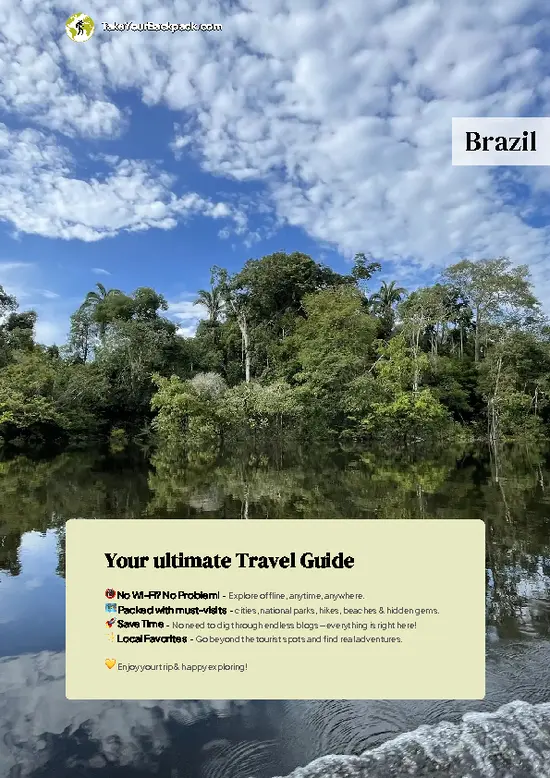
example page 0 from our offline Travel Guide for Brazil
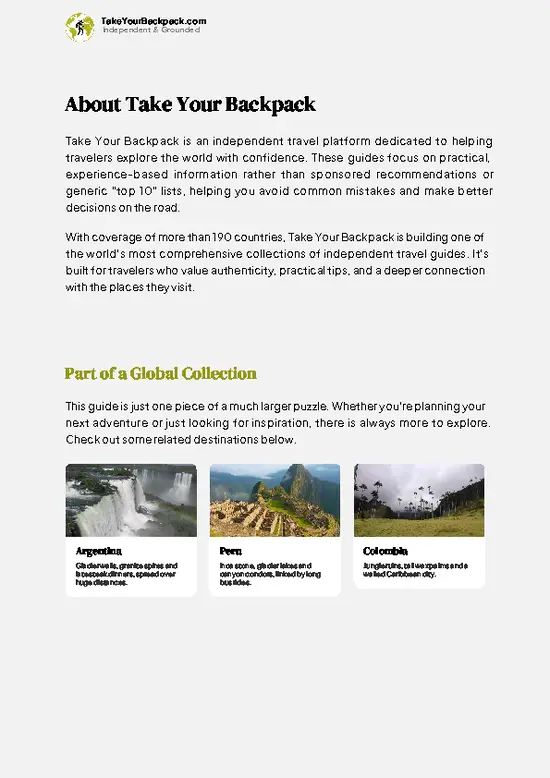
example page 1 from our offline Travel Guide for Brazil
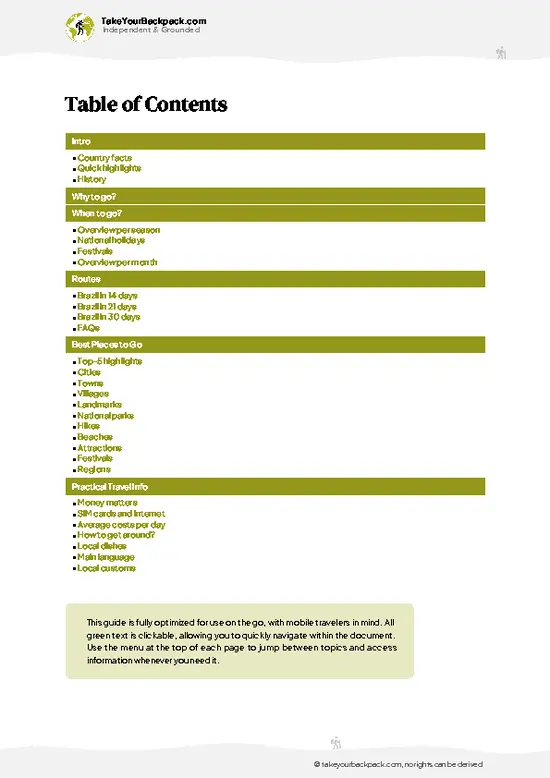
example page 2 from our offline Travel Guide for Brazil
example page 3 from our offline Travel Guide for Brazil
example page 4 from our offline Travel Guide for Brazil
example page 5 from our offline Travel Guide for Brazil
example page 6 from our offline Travel Guide for Brazil
example page 7 from our offline Travel Guide for Brazil
Loading the map 🌍
CLICK TO FILTER
cities
towns
villages
landmarks
national parks
hikes
beaches
attractions
festivals
regions
SHOW COUNTRY’S BESTSHOW ALL

✨ Why go?
Ranked #10 city in Brazil
Why visitors keep coming back

Porto Alegre earns a place on a southern Brazil route because it is the region’s big-city counterweight to the beaches and mountains. The reasons are practical. You get a dense center with a famous 1869 market, a lakeside sunset ritual on the Orla do Guaíba, and a nightlife scene concentrated in Cidade Baixa, where bars spill onto the sidewalks most evenings. Churrasco culture is strongest here, so a rodízio steakhouse is a real regional experience rather than a tourist gimmick. Hostels cluster in a few walkable neighborhoods, and the Rodoviária and airport link you onward to Uruguay, Florianópolis and the Serra Gaúcha. Give it two days. Stay longer only if you want a base for the wine country, and skip it if all you want is sand.

💡 HighlightsKey sights and experiences for travelers

  1. Mercado Público Central: The 1869 market is the city’s best-known landmark, with cheese, cachaça, spices and lunch counters. Go in the morning on a weekday. Entry is free and you need 1 to 2 hours.
  2. Usina do Gasômetro: A former power plant turned cultural center on the waterfront, with exhibitions, reopened in 2025 after a long restoration. Arrive late afternoon for the sunset. Free entry, 1 to 2 hours.
  3. Orla do Guaíba: A revitalized lakeside promenade for walking and cycling, with locals sipping chimarrão at dusk. Go around sunset. Free, 1 to 2 hours.
  4. Praça da Matriz: The political heart, with the Palácio Piratini, the Assembly and the Metropolitan Cathedral. Visit on weekday mornings. Free, 45 minutes.
  5. Casa de Cultura Mario Quintana: A poet’s old hotel turned arts center, with a rooftop café and
… read more 👉
  1. Mercado Público Central: The 1869 market is the city’s best-known landmark, with cheese, cachaça, spices and lunch counters. Go in the morning on a weekday. Entry is free and you need 1 to 2 hours.
  2. Usina do Gasômetro: A former power plant turned cultural center on the waterfront, with exhibitions, reopened in 2025 after a long restoration. Arrive late afternoon for the sunset. Free entry, 1 to 2 hours.
  3. Orla do Guaíba: A revitalized lakeside promenade for walking and cycling, with locals sipping chimarrão at dusk. Go around sunset. Free, 1 to 2 hours.
  4. Praça da Matriz: The political heart, with the Palácio Piratini, the Assembly and the Metropolitan Cathedral. Visit on weekday mornings. Free, 45 minutes.
  5. Casa de Cultura Mario Quintana: A poet’s old hotel turned arts center, with a rooftop café and cinema. Free entry, 1 hour. Come in the afternoon.
  6. Parque Farroupilha (Redenção): The city’s main park, and its Sunday brique market sells antiques and crafts. Go Sunday morning. Free, 1 to 2 hours.
  7. Fundação Iberê Camargo: An Álvaro Siza concrete building by the lake, holding the painter’s work. Visit afternoons, Wednesday to Sunday. Around US$3 to 4, 1.5 hours.
Day trips from the city include Gramado and Canela in the Serra Gaúcha, the Vale dos Vinhedos wine region and the German-heritage town of São Leopoldo. Together the sights take about a full day and a half.
Spotted a mistake or missing something? Contact us.

Things to do in Porto Alegre

Ratings based on Tripadvisor reviews. When you book through this link, you support our work at no extra cost to you.

🏘️ NeighborhoodsNeighborhood guide to Porto Alegre

Porto Alegre sprawls along the Guaíba lake, and the areas worth your time sit within a few kilometers of each other.
  • Centro Histórico: Museums, the Mercado Público and the Praça da Matriz cluster here, and it is walkable on weekdays. Eat a quick lunch inside the market. Skip it after dark, when the streets empty and the place feels rough.
  • Cidade Baixa: The nightlife district, packed with bars, live music and cheap pubs along Rua José do Patrocínio and João Alfredo. It is flat and walkable, and busiest Thursday to Saturday. Go after 9 p.m., because it is quiet before then.
  • Bom Fim: Home to the Parque da Redenção, where the Saturday morning farmers market and the Sunday antiques fair happen. Student cafés and small bars make it relaxed and easy on foot.
  • Moinhos de Vento: Leafy, upscale, with polished
… read more 👉
Porto Alegre sprawls along the Guaíba lake, and the areas worth your time sit within a few kilometers of each other.
  • Centro Histórico: Museums, the Mercado Público and the Praça da Matriz cluster here, and it is walkable on weekdays. Eat a quick lunch inside the market. Skip it after dark, when the streets empty and the place feels rough.
  • Cidade Baixa: The nightlife district, packed with bars, live music and cheap pubs along Rua José do Patrocínio and João Alfredo. It is flat and walkable, and busiest Thursday to Saturday. Go after 9 p.m., because it is quiet before then.
  • Bom Fim: Home to the Parque da Redenção, where the Saturday morning farmers market and the Sunday antiques fair happen. Student cafés and small bars make it relaxed and easy on foot.
  • Moinhos de Vento: Leafy, upscale, with polished cafés and Parcão park. Food costs more, so visit for an afternoon stroll rather than a meal.
  • Orla do Guaíba: The revitalized waterfront promenade, good for cycling and sunsets. It is long, so rent a bike or ride a bus along it rather than walking the full stretch.

⌛️ 1 dayWhat you can realistically do in a day

8:30 AM, Mercado Público: Start here because the stalls are freshest and the crowds are small. Try a coffee and a slice of cheese, then look for the Bará altar at the center.
10:00 AM, Praça da Matriz: Walk uphill 10 minutes to the political square. The cathedral and the Palácio Piratini show the city’s Farroupilha pride.
11:30 AM, Casa de Cultura Mario Quintana: Walk down toward the old center. Browse the exhibits and the rooftop for a view of the city.
1:00 PM, Lunch in Cidade Baixa: Take a short ride, then eat a regional plate at a neighborhood restaurant, away from the tourist strip.
3:00 PM, Fundação Iberê Camargo: This is the less common stop. Siza’s ramps and concrete forms are worth the ride, even if you are not into painting.
5:30 PM, Orla do Guaíba: Walk or cycle the promenade and watch … read more 👉
8:30 AM, Mercado Público: Start here because the stalls are freshest and the crowds are small. Try a coffee and a slice of cheese, then look for the Bará altar at the center.
10:00 AM, Praça da Matriz: Walk uphill 10 minutes to the political square. The cathedral and the Palácio Piratini show the city’s Farroupilha pride.
11:30 AM, Casa de Cultura Mario Quintana: Walk down toward the old center. Browse the exhibits and the rooftop for a view of the city.
1:00 PM, Lunch in Cidade Baixa: Take a short ride, then eat a regional plate at a neighborhood restaurant, away from the tourist strip.
3:00 PM, Fundação Iberê Camargo: This is the less common stop. Siza’s ramps and concrete forms are worth the ride, even if you are not into painting.
5:30 PM, Orla do Guaíba: Walk or cycle the promenade and watch the sun go down over the lake, the local way, with a cuia of chimarrão.
8:00 PM, Cidade Baixa: End the day at a sidewalk bar on Rua da República with live music.

🌤️ When to go?Weather, crowds, and seasonal trade-offs

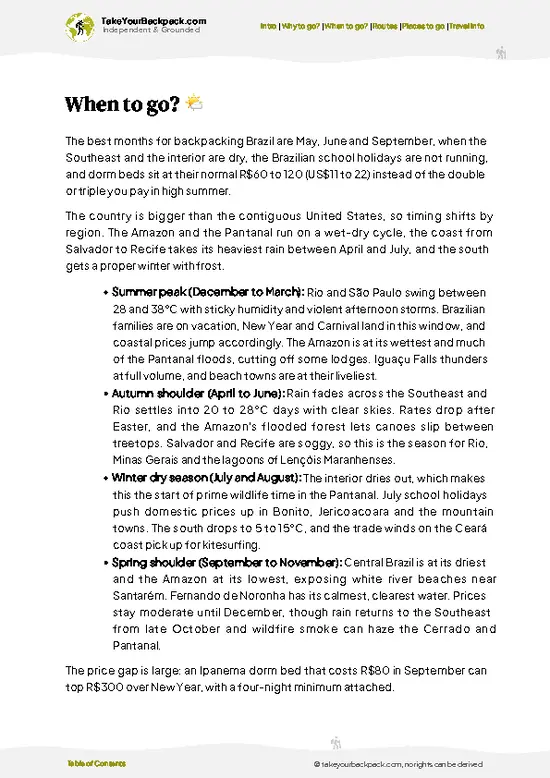
Spring (September to November) and autumn (March to May) are the most comfortable times for backpacking here.
  • Spring and Autumn: Highs of 20 to 27°C (68 to 81°F), mild nights and plenty of outdoor events. Prices stay moderate.
  • Summer (December to February): Hot and sticky, 28 to 35°C (82 to 95°F), with heavy afternoon storms. Days are long, about 14 hours of light, and the city thins out as locals head to the coast.
  • Winter (June to August): Damp and cold, 8 to 18°C (46 to 64°F), with occasional frost. Daylight drops to about 10 hours. Hostel prices are lowest.
Avoid booking around the Expointer fair in late August to early September if you want cheap beds.

source: climatestotravel.comJANJanuary: good for travelingFEBFebruary: good for travelingMARMarch: highly recommended for travelingAPRApril: highly recommended for travelingMAYMay: highly recommended for travelingJUNJune: good for travelingJULJuly: good for travelingAUGAugust: good for travelingSEPSeptember: excellent for travelingOCTOctober: excellent for travelingNOVNovember: excellent for travelingDECDecember: good for traveling
when-to-go

✈️ The backpacker research shortcutBrazil Travel Guide

An offline-friendly backpacking guide with optimized travel routes, ranked highlights, transport advice, and the best areas to stay.
example page 0 from our offline Travel Guide for Brazil
example page 1 from our offline Travel Guide for Brazil
example page 2 from our offline Travel Guide for Brazil
example page 3 from our offline Travel Guide for Brazil
example page 4 from our offline Travel Guide for Brazil
example page 5 from our offline Travel Guide for Brazil
example page 6 from our offline Travel Guide for Brazil
example page 7 from our offline Travel Guide for Brazil
The digital guide (410 pages) contains:
✅ 146 highlights, ranked by travel appeal
✅ Optimized 14, 21 & 30-day travel routes
✅ Cities, national parks, landmarks, beaches
✅ How to get around
✅ Offline-friendly for travel without Wi-Fi
👉 Click to see all 30+ guide features

📅 Plan smarter in minutes, not weeks
✅ Month by month travel advice
✅ Festivals & national holidays
✅ Budget expectations

🗺️ Go to the right places, skip the overrated ones
✅ Honest pros & cons of destinations
✅ Top hikes, parks & viewpoints
✅ Lesser-known places most travelers miss
✅ Clear “worth it vs skip it” guidance

🛏️ Travel smoothly without rookie mistakes
✅ Best areas to stay
✅ Transport systems explained simply
✅ Common scams & safety advice
✅ SIM cards, money & practical tips

🌍 Understand the country, not just visit it
✅ Culture & traditions
✅ 52 Essential phrases & customs
✅ Festivals worth planning around
✅ Traveler-friendly historical context
✅ Insights that make places more meaningful

📱 Built for real travel conditions
✅ Fully downloadable PDF
✅ Works completely offline
✅ Optimized for phone use
✅ Useful in remote areas & buses
✅ Everything in one place
Stop searching, start planning
Get instant access to your full guide. 30‑day money-back guarantee.
+ Add another guide for just

By proceeding you agree to our terms.
Sent to your inbox immediately after payment • 100% Secure Checkout
Best Backpacking Travel Advisor 2025 tourism awardBest Backpacking
Travel Advisor
2025
What others say about Take Your Backpack Guides:
⭐⭐⭐⭐⭐
Fantastic, amazing amount of information!
⭐⭐⭐⭐⭐
My goodness this is amazing, it's what I've been looking for hats off too you!
⭐⭐⭐⭐⭐
I think this is absolutely BRILLIANT
⭐⭐⭐⭐
Very complete and informative. It's still missing places, but I gotta to commend you
⭐⭐⭐⭐⭐
This is truly amazing, thank you, can't wait to explore it with my kids!
⭐⭐⭐⭐⭐
Awesome resource, thank you!
⭐⭐⭐⭐⭐
This is amazing! Can't wait to explore the ones I haven't seen
⭐⭐⭐⭐
I love this! Well done, great idea.
⭐⭐⭐⭐⭐
Thanks for taking the time to make this gem!
⭐⭐⭐⭐⭐
This might be the best website I've ever seen.
⭐⭐⭐⭐⭐
Congratulations, and thank you so much for your work; it's incredibly valuable.
⭐⭐⭐⭐
In all seriousness I think you did a great job pointing out the important spots
⭐⭐⭐⭐⭐
10/10 very good
⭐⭐⭐⭐⭐
As someone who's only just starting to visit regularly this is awesome, thank you.
⭐⭐⭐⭐
Thank you very much! I'm going to visit my dad, it's going to be very useful!
⭐⭐⭐⭐⭐
This is really cool! We'll be travelling for the first time and this definitely come in handy.
⭐⭐⭐⭐⭐
You are now our minister of culture, congratulations 👨‍💼
⭐⭐⭐⭐⭐
Just wanted to tell you that this is a pearl! Going to follow your recommendations.
⭐⭐⭐⭐⭐
This is so cool. I'll definitely be using the resource for my travels soon.
⭐⭐⭐⭐⭐
This is very impressive! Good work.
⭐⭐⭐⭐⭐
This is an amazing and informative site. Very well done!

🛏️ Where to stay?Choosing the right base

Cidade Baixa and Bom Fim are the best neighborhoods for a budget bed, with the most hostels and guesthouses at dorm prices of roughly US$10 to 20 a night.
Cidade Baixa puts you beside the bars and pubs, so it suits anyone who wants to meet other travelers, though weekend noise can carry late into the night. Use ride-hailing for the last stretch home after dark rather than walking quiet blocks.
Bom Fim is calmer, close to the Redenção park, and has a student feel with plenty of cheap places to eat. It is a safer bet if you want sleep. Both areas have frequent buses to the center, and the central … read more 👉
Cidade Baixa and Bom Fim are the best neighborhoods for a budget bed, with the most hostels and guesthouses at dorm prices of roughly US$10 to 20 a night.
Cidade Baixa puts you beside the bars and pubs, so it suits anyone who wants to meet other travelers, though weekend noise can carry late into the night. Use ride-hailing for the last stretch home after dark rather than walking quiet blocks.
Bom Fim is calmer, close to the Redenção park, and has a student feel with plenty of cheap places to eat. It is a safer bet if you want sleep. Both areas have frequent buses to the center, and the central Mercado Público stop is a short ride away. The metro is a bit further, but a bus or Uber covers it easily.
Centro is cheap too but dead and sketchy at night, so skip it.

🚌 Getting aroundTransportation options and practical tips

Taking a taxi from the airport and between every sight burns money fast, because buses, the metro and ride-hailing apps cover nearly everything for a fraction of the cost. The central districts are walkable by day, but the spread-out Orla and Moinhos areas make short rides worthwhile. Traffic jams at rush hours, so plan trips outside 7 to 9 a.m. and 5 to 7 p.m.
  • Walking: Free and the best option for Centro, Cidade Baixa and Bom Fim. Stick to busy streets at night.
  • Trensurb metro: One line, about US$0.90 per ride, running roughly 5 a.m. to 11 p.m. It links the airport and the rodoviária (bus station) to the center, so use it instead of a taxi. It is fast and avoids traffic.
  • City buses: About US$0.90 to 1 per ride, covering everything the metro misses. Routes are confusing at first, so use Google
… read more 👉
Taking a taxi from the airport and between every sight burns money fast, because buses, the metro and ride-hailing apps cover nearly everything for a fraction of the cost. The central districts are walkable by day, but the spread-out Orla and Moinhos areas make short rides worthwhile. Traffic jams at rush hours, so plan trips outside 7 to 9 a.m. and 5 to 7 p.m.
  • Walking: Free and the best option for Centro, Cidade Baixa and Bom Fim. Stick to busy streets at night.
  • Trensurb metro: One line, about US$0.90 per ride, running roughly 5 a.m. to 11 p.m. It links the airport and the rodoviária (bus station) to the center, so use it instead of a taxi. It is fast and avoids traffic.
  • City buses: About US$0.90 to 1 per ride, covering everything the metro misses. Routes are confusing at first, so use Google Maps for live directions. Pay with cash to the conductor or use a rechargeable card.
  • Uber and 99: Typically US$2 to 5 for most in-city rides, safer than street taxis at night and cheaper than hailing one. Split with others for even better value.
  • Bike rental: Shared bikes work well along the Orla do Guaíba, about US$1 to 3 per hour. Not worth it in the hilly, traffic-heavy center.

👛 Costs (as of 19 October 2026)Typical daily expenses

A backpacker in Porto Alegre can expect to spend about US$45 a day in high season.
CategoryBudget RangeLocal Reality
Dorm (high season)US$12 to 20Cidade Baixa and Bom Fim fill up in summer; book ahead.
Dorm (off-season)US$9 to 15Winter months are quieter and cheaper.
MealsUS$10 to 18Per-kilo lunches about US$5 to 8; street snacks cheaper.
Local transportUS$2 to 5Buses and metro cost about US$0.90 per ride.
City transport passUS$3 to 5A rechargeable card saves on cash handling and works on buses and the metro.
Activities and entry feesUS$3 to 8Many museums are cheap or free on certain days.
MiscellaneousUS$3 to 6Beer, SIM card, laundry.
Total Daily BudgetUS$43 to 62About US$45 in a basic setup using the high-season dorm (US$16 midpoint).
Eat your biggest meal at a per-kilo lunch spot and keep dinner light to save the most.
⚠️ Prices can change and everyone travels differently, so take this as a rough guide. Hope it helps you plan your adventure!

🚌 Day tripsBest day trips from Porto Alegre

Porto Alegre works well as a base for day trips, thanks to the Serra Gaúcha wine towns and German-influenced villages within a few hours.
Gramado and Canela: Alpine-style streets, chocolate shops and waterfalls like Caracol in Canela. Buses take 2 to 3 hours each way and cost about US$10 to 18 one way. Go on a weekday, since weekends and holidays are packed, and do not try to see both towns in a rush.
👉 Explore Gramado
Bento Gonçalves: The heart of Brazilian wine country, with vineyards around Vale dos Vinhedos. Buses take about 2 to 2.5 hours and cost US$10 to 15. A tasting tour is US$15 to 40, and many first-timers forget that vineyards are spread out, so book a shuttle or group tour.

São Leopoldo: A German immigration city reached by the Trensurb metro for under US$2 each way. It has a good … read more 👉
Porto Alegre works well as a base for day trips, thanks to the Serra Gaúcha wine towns and German-influenced villages within a few hours.
Gramado and Canela: Alpine-style streets, chocolate shops and waterfalls like Caracol in Canela. Buses take 2 to 3 hours each way and cost about US$10 to 18 one way. Go on a weekday, since weekends and holidays are packed, and do not try to see both towns in a rush.
👉 Explore Gramado
Bento Gonçalves: The heart of Brazilian wine country, with vineyards around Vale dos Vinhedos. Buses take about 2 to 2.5 hours and cost US$10 to 15. A tasting tour is US$15 to 40, and many first-timers forget that vineyards are spread out, so book a shuttle or group tour.

São Leopoldo: A German immigration city reached by the Trensurb metro for under US$2 each way. It has a good immigration museum and works as a relaxed half-day.

🍲 FoodEating & Drinking in Porto Alegre

Porto Alegre is the capital of gaúcho cuisine, built around churrasco, meat grilled slowly over coals, served at churrascarias in rodízio style, where waiters bring skewers to your table. Try the local chimarrão, a bitter herbal mate drunk from a gourd with a metal straw, passed around parks like the Redenção on weekends. Locals carry thermoses and refill it all day.
The Mercado Público is the easiest spot for casual eating, with counters serving the local bergamot-orange flavored treats, coffee and sandwiches. Look for cuca, a German-influenced crumb cake, at bakeries, a nod to the region's immigrant roots. Bars in Cidade Baixa serve cheap draft beer and petiscos (bar snacks) like fried cassava and pastries. For budget lunches, look for self-serve per-kilo places in the center, where you pay … read more 👉
Porto Alegre is the capital of gaúcho cuisine, built around churrasco, meat grilled slowly over coals, served at churrascarias in rodízio style, where waiters bring skewers to your table. Try the local chimarrão, a bitter herbal mate drunk from a gourd with a metal straw, passed around parks like the Redenção on weekends. Locals carry thermoses and refill it all day.
The Mercado Público is the easiest spot for casual eating, with counters serving the local bergamot-orange flavored treats, coffee and sandwiches. Look for cuca, a German-influenced crumb cake, at bakeries, a nod to the region's immigrant roots. Bars in Cidade Baixa serve cheap draft beer and petiscos (bar snacks) like fried cassava and pastries. For budget lunches, look for self-serve per-kilo places in the center, where you pay by weight and can load up on salads and grilled meat.

🛡️ SafetyTraveler Safety Guide

Porto Alegre is manageable for backpackers if you apply big-city habits. Phone snatching and bag theft are the common problems, especially in Centro and around bus stops, so keep your phone out of sight on the street and use it inside shops or cars. Centro empties after dark, so use ride-hailing apps rather than walking there at night. Cidade Baixa is lively and mostly fine on busy streets, but avoid wandering dark side streets late. Solo travelers do fine if they stay in popular areas and avoid showing valuables. Carry only the cash you need for the day, and do not leave belongings visible in parked cars. Scams are rare beyond the occasional overcharging taxi, which is easy to avoid with apps.

FAQFrequently asked questions about Porto Alegre

Two days is enough for Porto Alegre itself, covering the Mercado Público, the Orla do Guaíba and a night in Cidade Baixa. Add one or two more days if you want to do a trip to Bento Gonçalves (about 2.5 hours by bus) or Gramado (about 2 to 3 hours). Most backpackers pass through on the way to the Serra Gaúcha.
Porto Alegre is reasonably safe for solo backpackers if you stick to busy areas and use ride-hailing apps at night, which cost about US$2 to 5 for most rides. Phone and bag snatching in Centro is the main risk, so keep valuables out of sight. Cidade Baixa and Bom Fim are good areas to stay, with other travelers around.
Porto Alegre is known for its gaúcho culture, churrasco barbecue and chimarrão mate. It is the capital of Rio Grande do Sul, with a lively nightlife scene in Cidade Baixa and a waterfront on Guaíba lake famous for sunsets. It also sits close to the Serra Gaúcha wine country, a 2 to 3 hour trip away.
⚠️ Things can change over time, so always validate details locally before you go.

Other Brazilian cities near Porto Alegre

Explore more nearby:

  • Florianópolis—Island beaches, lagoon sandboarding, Azorean villages, oyster farms| 375 km away
  • Blumenau—Oktoberfest grounds, German facades, brewing history, Itajaí valley| 405 km away
  • Balneário Camboriú—High-rise skyline, gondola ride, Laranjeiras cove, seafront boardwalk| 422 km away

💡 Not sure where to go next?
Create a personalized itinerary for Brazil including Porto Alegre and the places that fit your trip.

Generate my itinerary

👉 Discover all cities

Or checkout all Brazil has to offer (think cities, towns, villages, national parks, hikes, beaches, festivals)
Country photo of Brazil

We 💚 feedbackIs it worth it?

Give Porto Alegre two nights, three if you want a wine country day trip. One night leaves you rushing the market and waterfront, and a week is too much unless you work remotely. I would stay in Cidade Baixa and spend the saved time on the lake at sunset.

✈️ When did I visit Brazil?
Call it good timing or luck, but I was able to celebrate Carnaval in Rio de Janeiro in February 2022, after a round trip in the north and east coast.

✍️ Help improve this page!
The information on this page is based on my own backpacking experience in Brazil, supplemented with up-to-date research and feedback from other travelers. Travel details can change, so if you notice anything outdated or incomplete, feel free to let me know.


🙋‍♂️ Give feedback

👋 Meet the founderWho’s Behind Take Your Backpack?

Johan, backpacker and founder of TakeYourBackpackHi, I’m Johan (Netherlands 🇳🇱), the creator of TakeYourBackpack. Over the past 3 decades, I’ve backpacked through 90+ countries across six continents, gaining extensive experience with independent travel, long-term trips, and overland routes.

This site is built on a combination of firsthand travel experience and carefully curated insights from other backpackers. Many guides are based on places I’ve personally visited, while others bring together tips, observations, and practical advice shared by trusted travelers I’ve met along the way.

The goal is to provide realistic, experience-driven guidance — not generic itineraries — so you can explore destinations with better context, clearer expectations, and more confidence.