×

Burkina Faso🇧🇫 | citiesBobo-DioulassoMud-brick mosque, Kibidwé lanes, instrument museum, railway station | things to do and best time to go

Explore BanforaExplore Koudougou

Backpacking in Bobo-Dioulasso
🏆 Top pickcity ranked #2
By Johan Kruseman 🇳🇱 | Updated October 22, 2026

Bobo-Dioulasso used to be the country’s musical heartland, a city of live bands, night buses and open-door courtyards that drew travelers for weeks. Today it is calmer and thinner on visitors, and the nightlife has shrunk. You’ll find it in the southwest of Burkina Faso, a long way from the capital, with a tree-lined center of low colonial buildings and mud-walled old quarters. It suits curious, self-reliant travelers who like wandering, bargaining and sitting over grilled fish. It does not suit anyone who wants a checklist of big monuments or polished nightlife, because there is none. Skip the modern avenues and head for the old mosque, the Kibidwé quarter and the market, where the city’s real character lives. Before going, read your government’s current travel advice for Burkina Faso and carry enough cash, since cards and ATMs are unreliable.

Discover everything you want to know in the 📖 Burkina Faso Travel Guide.
Safety warning

The current risk level for Burkina Faso is high. Check the advice before going.


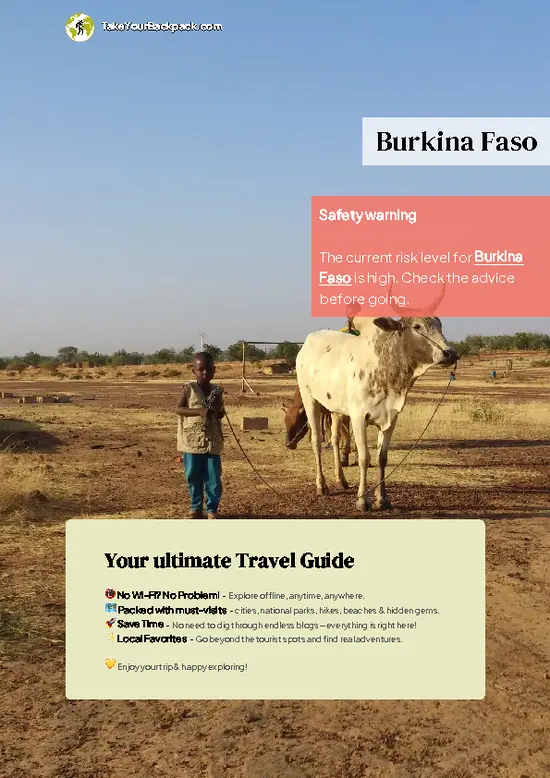
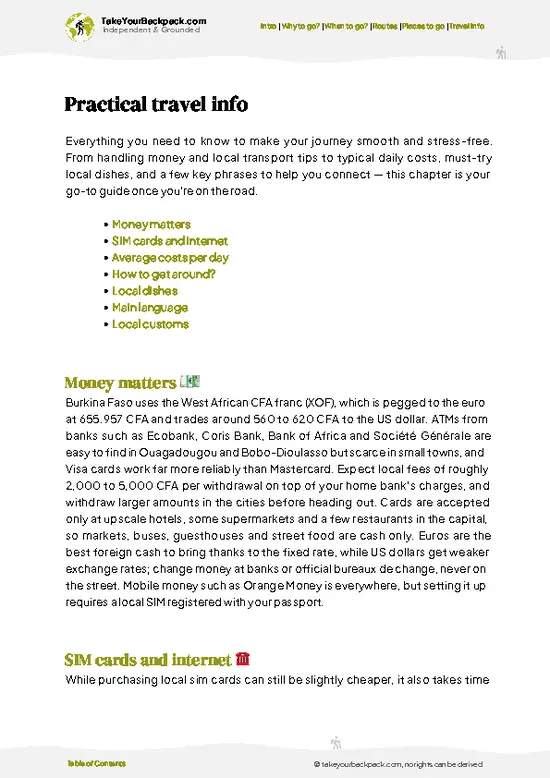
example page 0 from our offline Travel Guide for Burkina Faso
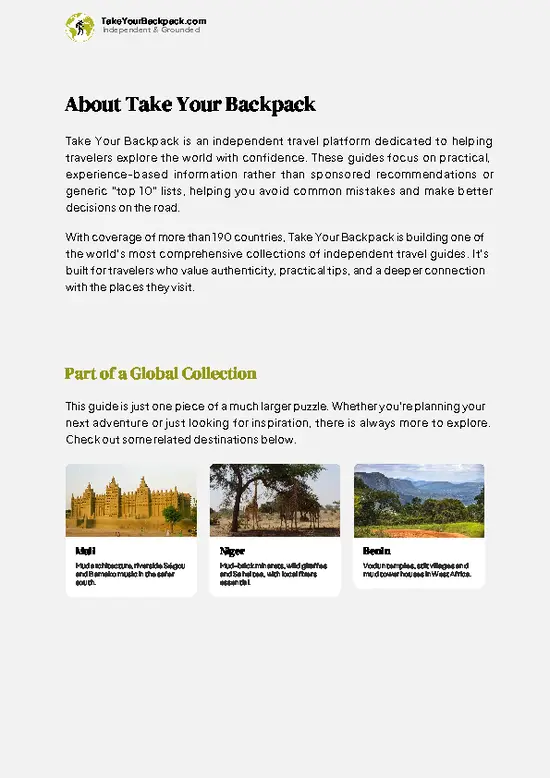
example page 1 from our offline Travel Guide for Burkina Faso
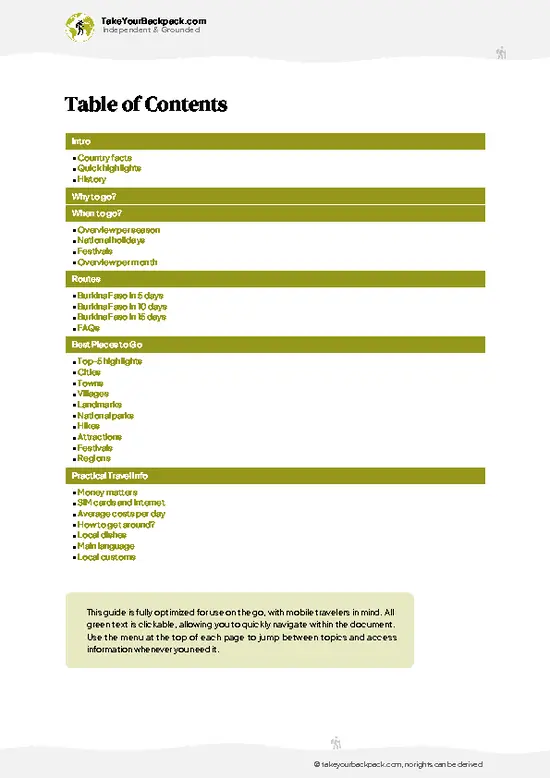
example page 2 from our offline Travel Guide for Burkina Faso
example page 3 from our offline Travel Guide for Burkina Faso
example page 4 from our offline Travel Guide for Burkina Faso
example page 5 from our offline Travel Guide for Burkina Faso
example page 6 from our offline Travel Guide for Burkina Faso
example page 7 from our offline Travel Guide for Burkina Faso
Loading the map 🌍
CLICK TO FILTER
cities
towns
villages
landmarks
national parks
hikes
attractions
festivals
regions
SHOW COUNTRY’S BESTSHOW ALL

✨ Why go?
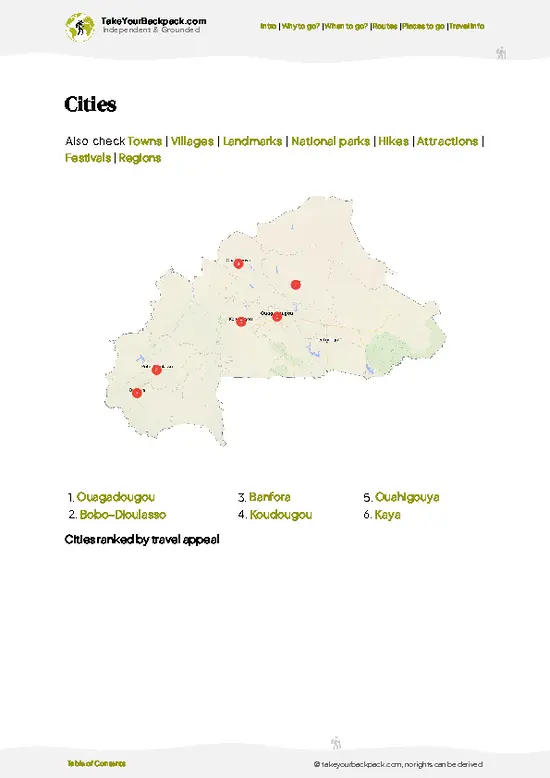
Ranked #2 city in Burkina Faso
Reasons people choose to visit here

Bobo-Dioulasso works for backpackers because it packs a lot of texture into a small, flat center you can cover on foot or by cheap moped taxi. The old quarters, the mud-brick mosque and the music scene give you more to do in two days than most Sahel towns manage in a week, and the evening maquis (open-air bars and restaurants) are the easiest places in the country to meet locals over a cold Brakina beer. As a base it is even better. The green southwest around it, with its waterfalls, sandstone formations and lakes, starts right at the edge of town, so you can sleep in one bed for several nights and still see plenty. The city also sits on the main route toward Mali and Côte d’Ivoire, with regular long-distance coaches from the Gare Routière and a historic railway line that no longer carries … read more 👉
Bobo-Dioulasso works for backpackers because it packs a lot of texture into a small, flat center you can cover on foot or by cheap moped taxi. The old quarters, the mud-brick mosque and the music scene give you more to do in two days than most Sahel towns manage in a week, and the evening maquis (open-air bars and restaurants) are the easiest places in the country to meet locals over a cold Brakina beer. As a base it is even better. The green southwest around it, with its waterfalls, sandstone formations and lakes, starts right at the edge of town, so you can sleep in one bed for several nights and still see plenty. The city also sits on the main route toward Mali and Côte d’Ivoire, with regular long-distance coaches from the Gare Routière and a historic railway line that no longer carries passengers as it once did. Treat it as a two or three night stop, longer if you plan to explore the surrounding region. If you want nightlife on the scale of a regional capital, set your expectations lower.

💡 HighlightsTop highlights of Bobo-Dioulasso

  1. Grande Mosquée de Bobo-Dioulasso: The city’s best-known landmark, a Sudanese-style mud-brick mosque from the late 1800s with wooden beams jutting out of its buttressed walls. Non-Muslims can usually go in with a modest donation (about €1 to 2) and a covered outfit. Go in the morning when the light is soft and the call to prayer carries across the rooftops. Allow 30 to 45 minutes.
  2. Kibidwé Quarter: The oldest part of the city, with narrow mud-walled lanes, family compounds and small artisan workshops. A local guide (about €3 to 6) explains the history of the Bobo people and the sacred sites. Visit early or late afternoon, and allow 1.5 to 2 hours.
  3. Musée de la Musique: A small museum devoted to Burkina Faso’s instruments, including balafons, drums and harps, in a city that built its identity around
… read more 👉
  1. Grande Mosquée de Bobo-Dioulasso: The city’s best-known landmark, a Sudanese-style mud-brick mosque from the late 1800s with wooden beams jutting out of its buttressed walls. Non-Muslims can usually go in with a modest donation (about €1 to 2) and a covered outfit. Go in the morning when the light is soft and the call to prayer carries across the rooftops. Allow 30 to 45 minutes.
  2. Kibidwé Quarter: The oldest part of the city, with narrow mud-walled lanes, family compounds and small artisan workshops. A local guide (about €3 to 6) explains the history of the Bobo people and the sacred sites. Visit early or late afternoon, and allow 1.5 to 2 hours.
  3. Musée de la Musique: A small museum devoted to Burkina Faso’s instruments, including balafons, drums and harps, in a city that built its identity around music. Entry is roughly €1 to 3, and you should plan about an hour. Staff sometimes demonstrate instruments, so go when it’s quiet.
  4. Grand Marché: The main market sells fabric, calabashes, spices, shea butter and everyday goods in a maze of covered stalls. It is best from 8 to 11 am before the heat peaks, it costs nothing to wander, and an hour or two is plenty. Bargain politely and keep your valuables out of sight.
  5. Gare de Bobo-Dioulasso: The colonial-era railway station is one of the best examples of 1930s architecture in the country. Entry is free to look at from outside, and it takes 20 to 30 minutes. Late afternoon gives the best photos.
  6. Bolomakoté Quarter: A lively neighborhood of Dioula traders with its own old mosque and a strong sense of everyday life. It is free to explore, and a walk of around an hour in the late afternoon is perfect, when families are out front and cooking begins.
Beyond the city, the sacred fish pond at Dafra, the Cascades de Karfiguéla, the Domes de Fabédougou and Lake Tengrela near Banfora make good day trips from Bobo-Dioulasso. Start with the Grande Mosquée in the morning, since the light is best then and a visit gives you the context to understand everything else in the old quarters.
Spotted a mistake or missing something? Contact us.

🏘️ NeighborhoodsUnderstanding the local layout

Bobo-Dioulasso is small enough that three or four areas cover everything worth your time, and most of them reward walking or a short moto ride.
  • Kibidwé: The old quarter around the Grande Mosquée is the one area you must not skip. The Sudanese-style mud mosque, built in the late 19th century, sits among narrow lanes, and local guides (around €3 to 6 for a walk) explain the fine details. Go in the morning, when it is cool and quiet. Walkable on foot in an hour or two.
  • Dioulassoba: The old Dioula quarter on a hill by the sacred catfish pond and the Houet river is worth the same visit, since the two sit side by side. Mud-brick houses, sacred catfish and shaded lanes make it atmospheric. Skip it after dark, the lanes are unlit.
  • Centre-ville and the Grand Marché: Grid streets, banks, bus offices and
… read more 👉
Bobo-Dioulasso is small enough that three or four areas cover everything worth your time, and most of them reward walking or a short moto ride.
  • Kibidwé: The old quarter around the Grande Mosquée is the one area you must not skip. The Sudanese-style mud mosque, built in the late 19th century, sits among narrow lanes, and local guides (around €3 to 6 for a walk) explain the fine details. Go in the morning, when it is cool and quiet. Walkable on foot in an hour or two.
  • Dioulassoba: The old Dioula quarter on a hill by the sacred catfish pond and the Houet river is worth the same visit, since the two sit side by side. Mud-brick houses, sacred catfish and shaded lanes make it atmospheric. Skip it after dark, the lanes are unlit.
  • Centre-ville and the Grand Marché: Grid streets, banks, bus offices and the covered market. Useful, loud and dusty, but not a place to linger beyond errands and a cheap lunch of rice and sauce.
  • Secteur 22 and Accart-Ville: Maquis bars with live music, balafon players and grilled chicken tables. This is where the evenings happen, and it is too spread out to walk between venues, so take a moto.
  • Railway station area: Worth a short look for the old colonial-era station building, but little else. Skip it unless you are catching a train.

⌛️ 1 day1-day itinerary for Bobo-Dioulasso

7:30 AM: Grande Mosquée
Start early while the light is soft and the mud-brick walls glow. Spend 30 to 45 minutes looking at the wooden spikes, the buttresses and the narrow interior, and remember to dress modestly. From here it is a short walk into the old quarter.
9:00 AM: Kibidwé Quarter
Hire a local guide at the entrance and wander through the old Bobo lanes, compounds and workshops. This is where the city began, and a guide explains the sacred spots and daily customs you would otherwise pass without noticing. Take about two hours, then walk or take a moped taxi to the market.
11:30 AM: Grand Marché
Browse the fabric stalls, the spice sellers and the calabash carvers before the heat peaks. Buy a few small things such as shea butter or woven cloth, and eat a simple lunch from a market stall of … read more 👉
7:30 AM: Grande Mosquée
Start early while the light is soft and the mud-brick walls glow. Spend 30 to 45 minutes looking at the wooden spikes, the buttresses and the narrow interior, and remember to dress modestly. From here it is a short walk into the old quarter.
9:00 AM: Kibidwé Quarter
Hire a local guide at the entrance and wander through the old Bobo lanes, compounds and workshops. This is where the city began, and a guide explains the sacred spots and daily customs you would otherwise pass without noticing. Take about two hours, then walk or take a moped taxi to the market.
11:30 AM: Grand Marché
Browse the fabric stalls, the spice sellers and the calabash carvers before the heat peaks. Buy a few small things such as shea butter or woven cloth, and eat a simple lunch from a market stall of rice, sauce or grilled fish. Rest in the shade afterward.
2:30 PM: Musée de la Musique
Cool off inside the museum and look at the balafons, drums and harps. It takes about an hour and gives you the background to the live music you may hear in the evening. Ask staff whether any instrument demonstrations are on.
4:30 PM: Bolomakoté Quarter
This neighborhood is rarely on the standard route, which makes it the best place to see ordinary life. Walk slowly through the lanes, past the old mosque, small workshops and cooking fires. People are friendly, but ask before taking photos.
6:30 PM: Maquis Dinner
Finish at one of the open-air maquis with grilled chicken or fish, plantains and a cold local beer. If a band is playing, stay for the music. Take a moped taxi back to your lodging after dark.

🌤️ When to go?Weather, crowds, and seasonal trade-offs

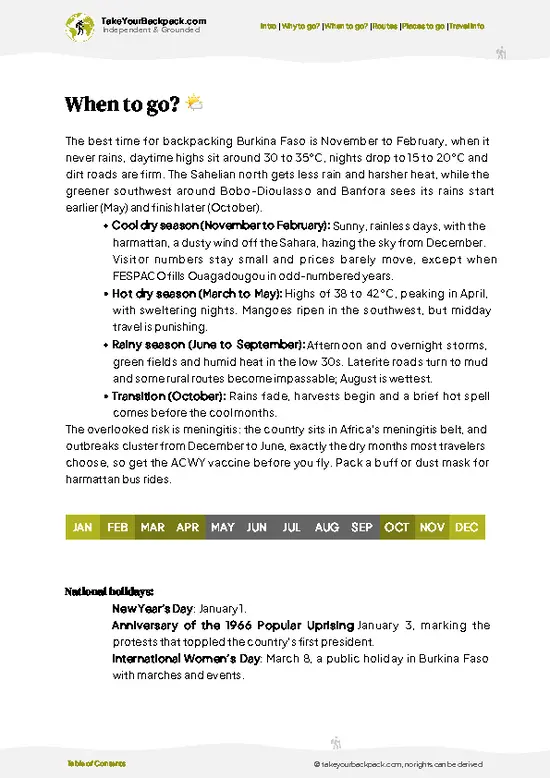
November to February is the most comfortable window, with dry days around 30 to 35°C (86 to 95°F) and cooler nights near 16 to 20°C (61 to 68°F).
  • Cool Dry Season (November to February): Harmattan dust haze blows in from the Sahara and can dull photos, but walking around the old quarters is easy. Guesthouses fill a little around Christmas, and prices barely move.
  • Hot Season (March to May): Afternoons reach 38 to 41°C (100 to 106°F). Plan sightseeing before 10 am and nap midday. Crowds are thin and bargains easier.
  • Rainy Season (June to October): Highs of 29 to 33°C (84 to 91°F), humid, with heavy afternoon downpours. Surrounding waterfalls and fields turn green, and some dirt roads to day-trip sites get muddy. Rooms are at their cheapest.
  • Festivals: The Semaine Nationale de la Culture, a major
… read more 👉
November to February is the most comfortable window, with dry days around 30 to 35°C (86 to 95°F) and cooler nights near 16 to 20°C (61 to 68°F).
  • Cool Dry Season (November to February): Harmattan dust haze blows in from the Sahara and can dull photos, but walking around the old quarters is easy. Guesthouses fill a little around Christmas, and prices barely move.
  • Hot Season (March to May): Afternoons reach 38 to 41°C (100 to 106°F). Plan sightseeing before 10 am and nap midday. Crowds are thin and bargains easier.
  • Rainy Season (June to October): Highs of 29 to 33°C (84 to 91°F), humid, with heavy afternoon downpours. Surrounding waterfalls and fields turn green, and some dirt roads to day-trip sites get muddy. Rooms are at their cheapest.
  • Festivals: The Semaine Nationale de la Culture, a major arts event, is held in Bobo in alternating years, usually in spring, and it pushes beds up in price.
Book a room early if you plan to arrive during any big cultural event.


source: climatestotravel.comJANJanuary: excellent for travelingFEBFebruary: highly recommended for travelingMARMarch: good for travelingAPRApril: good for travelingMAYMay: fair for travelingJUNJune: fair for travelingJULJuly: below average for travelingAUGAugust: below average for travelingSEPSeptember: fair for travelingOCTOctober: good for travelingNOVNovember: highly recommended for travelingDECDecember: excellent for traveling
when-to-go

✈️ The backpacker research shortcutBurkina Faso Travel Guide

An offline-friendly backpacking guide with optimized travel routes, ranked highlights, transport advice, and the best areas to stay.
example page 0 from our offline Travel Guide for Burkina Faso
example page 1 from our offline Travel Guide for Burkina Faso
example page 2 from our offline Travel Guide for Burkina Faso
example page 3 from our offline Travel Guide for Burkina Faso
example page 4 from our offline Travel Guide for Burkina Faso
example page 5 from our offline Travel Guide for Burkina Faso
example page 6 from our offline Travel Guide for Burkina Faso
example page 7 from our offline Travel Guide for Burkina Faso
The digital guide (273 pages) contains:
✅ 63 highlights, ranked by travel appeal
✅ Optimized 5, 10 & 15-day travel routes
✅ Cities, national parks, landmarks, beaches
✅ How to get around
✅ Offline-friendly for travel without Wi-Fi
👉 Click to see all 30+ guide features

📅 Plan smarter in minutes, not weeks
✅ Month by month travel advice
✅ Festivals & national holidays
✅ Budget expectations

🗺️ Go to the right places, skip the overrated ones
✅ Honest pros & cons of destinations
✅ Top hikes, parks & viewpoints
✅ Lesser-known places most travelers miss
✅ Clear “worth it vs skip it” guidance

🛏️ Travel smoothly without rookie mistakes
✅ Best areas to stay
✅ Transport systems explained simply
✅ Common scams & safety advice
✅ SIM cards, money & practical tips

🌍 Understand the country, not just visit it
✅ Culture & traditions
✅ 52 Essential phrases & customs
✅ Festivals worth planning around
✅ Traveler-friendly historical context
✅ Insights that make places more meaningful

📱 Built for real travel conditions
✅ Fully downloadable PDF
✅ Works completely offline
✅ Optimized for phone use
✅ Useful in remote areas & buses
✅ Everything in one place
Stop searching, start planning
Get instant access to your full guide. 30‑day money-back guarantee.
+ Add another guide for just

By proceeding you agree to our terms.
Sent to your inbox immediately after payment • 100% Secure Checkout
Best Backpacking Travel Advisor 2025 tourism awardBest Backpacking
Travel Advisor
2025
What others say about Take Your Backpack Guides:
⭐⭐⭐⭐⭐
Fantastic, amazing amount of information!
⭐⭐⭐⭐⭐
My goodness this is amazing, it's what I've been looking for hats off too you!
⭐⭐⭐⭐⭐
I think this is absolutely BRILLIANT
⭐⭐⭐⭐
Very complete and informative. It's still missing places, but I gotta to commend you
⭐⭐⭐⭐⭐
This is truly amazing, thank you, can't wait to explore it with my kids!
⭐⭐⭐⭐⭐
Awesome resource, thank you!
⭐⭐⭐⭐⭐
This is amazing! Can't wait to explore the ones I haven't seen
⭐⭐⭐⭐
I love this! Well done, great idea.
⭐⭐⭐⭐⭐
Thanks for taking the time to make this gem!
⭐⭐⭐⭐⭐
This might be the best website I've ever seen.
⭐⭐⭐⭐⭐
Congratulations, and thank you so much for your work; it's incredibly valuable.
⭐⭐⭐⭐
In all seriousness I think you did a great job pointing out the important spots
⭐⭐⭐⭐⭐
10/10 very good
⭐⭐⭐⭐⭐
As someone who's only just starting to visit regularly this is awesome, thank you.
⭐⭐⭐⭐
Thank you very much! I'm going to visit my dad, it's going to be very useful!
⭐⭐⭐⭐⭐
This is really cool! We'll be travelling for the first time and this definitely come in handy.
⭐⭐⭐⭐⭐
You are now our minister of culture, congratulations 👨‍💼
⭐⭐⭐⭐⭐
Just wanted to tell you that this is a pearl! Going to follow your recommendations.
⭐⭐⭐⭐⭐
This is so cool. I'll definitely be using the resource for my travels soon.
⭐⭐⭐⭐⭐
This is very impressive! Good work.
⭐⭐⭐⭐⭐
This is an amazing and informative site. Very well done!

🛏️ Where to stay?Best areas and accommodation options

The best area for a budget bed in Bobo-Dioulasso is the center around the Grand Marché and the bus offices, where dorms and basic rooms start from roughly €6 to 10 a night and €12 to 20 for a private room with a fan. It sits close to the market, banks, ATMs and the depots for onward buses, so arrival and departure are simple on foot or a short moto ride. Expect early-morning noise from the market and traffic, and bring earplugs.

The second option is the quieter residential streets near Accart-Ville and toward Secteur 22. Rooms there are often in small guesthouses with courtyards, a bit calmer … read more 👉
The best area for a budget bed in Bobo-Dioulasso is the center around the Grand Marché and the bus offices, where dorms and basic rooms start from roughly €6 to 10 a night and €12 to 20 for a private room with a fan. It sits close to the market, banks, ATMs and the depots for onward buses, so arrival and departure are simple on foot or a short moto ride. Expect early-morning noise from the market and traffic, and bring earplugs.

The second option is the quieter residential streets near Accart-Ville and toward Secteur 22. Rooms there are often in small guesthouses with courtyards, a bit calmer and with easy access to the live-music bars, although a moto or taxi ride gets you into the center. Walking home late is less pleasant, since the streets are poorly lit, so plan a taxi back.

Hostel-style dorms are few. Many travelers end up in simple guesthouses with private rooms, so book ahead in the cool dry season and around festival dates. Check that your room has a working fan or air conditioning, since power cuts do happen and nights from March to May are hot.

🚌 Getting aroundMoving around without the hassle

Bobo-Dioulasso is easiest to cross by motorbike taxi, and a ride across town costs about €0.30 to 0.80, paid in cash in CFA francs at the end of the trip, with the price agreed before you climb on. The city is flat and spread out, so walking works inside the center but not between districts. Traffic is a constant stream of mopeds rather than cars, and there is no usable formal city bus network.
  • Walking: Good for the old quarters, the market and the central streets, all within a 20 to 30 minute radius. Do it early or late, because midday heat is punishing. Not practical between the center and the nightlife districts.
  • Moto taxis: The default choice for everything. Fares are €0.30 to 0.80 in town, slightly more at night. Wave one down, state your destination and the price, and hold on. Helmets
… read more 👉
Bobo-Dioulasso is easiest to cross by motorbike taxi, and a ride across town costs about €0.30 to 0.80, paid in cash in CFA francs at the end of the trip, with the price agreed before you climb on. The city is flat and spread out, so walking works inside the center but not between districts. Traffic is a constant stream of mopeds rather than cars, and there is no usable formal city bus network.
  • Walking: Good for the old quarters, the market and the central streets, all within a 20 to 30 minute radius. Do it early or late, because midday heat is punishing. Not practical between the center and the nightlife districts.
  • Moto taxis: The default choice for everything. Fares are €0.30 to 0.80 in town, slightly more at night. Wave one down, state your destination and the price, and hold on. Helmets are often not offered, so consider bringing one.
  • Green taxis: Cars with a set area of operation, around €1 to 2 for a shared or private short hop, more for night or luggage. They make sense in the rainy season or with a backpack, and they are the better option for a ride after dark.
  • Rental bicycle: Some guesthouses lend or rent bikes for about €3 to 6 a day. The flat roads and the lanes toward the waterfalls make it a good option for day trips, but the heat makes it worth it only in the morning.
  • Intercity buses: Not a city option, but the bus companies have depots in the center. Ouagadougou is roughly 5 to 6 hours away for €8 to 12, and the railway station is not worth planning around.
Skip rental cars. Parking, fuel and navigation add cost and hassle for a town this compact.

👛 Costs (as of 22 October 2026)Money, prices, and spending tips

Bobo-Dioulasso costs most backpackers about €17 to 25 a day if they use dorms or simple rooms and eat local food.
CategoryBudget RangeLocal Reality
Dorm or basic room (high season)€8 to 12Few true dorms exist, so a simple fan room in a guesthouse is the usual choice from November to February.
Dorm or basic room (off-season)€6 to 9Prices ease from June to October, and rooms are easy to find without booking.
Meals€4 to 8Rice, beans and grilled meat at stalls cost €1 to 3, and a maquis dinner with a beer runs €4 to 6.
Local transport€1 to 3Moto taxis cost €0.30 to 0.80 a ride, and taxis around €1 to 2.
City transport passNoneNo pass exists, you pay each ride in cash in CFA francs.
Basic activities and entry fees€2 to 6Guided walks in the old quarter, the mosque and small entry fees at the Cascades.
Miscellaneous€2
… read more 👉
Bobo-Dioulasso costs most backpackers about €17 to 25 a day if they use dorms or simple rooms and eat local food.
CategoryBudget RangeLocal Reality
Dorm or basic room (high season)€8 to 12Few true dorms exist, so a simple fan room in a guesthouse is the usual choice from November to February.
Dorm or basic room (off-season)€6 to 9Prices ease from June to October, and rooms are easy to find without booking.
Meals€4 to 8Rice, beans and grilled meat at stalls cost €1 to 3, and a maquis dinner with a beer runs €4 to 6.
Local transport€1 to 3Moto taxis cost €0.30 to 0.80 a ride, and taxis around €1 to 2.
City transport passNoneNo pass exists, you pay each ride in cash in CFA francs.
Basic activities and entry fees€2 to 6Guided walks in the old quarter, the mosque and small entry fees at the Cascades.
Miscellaneous€2 to 4Water, SIM data, small tips and snacks.
Total Daily Budget€17 to 25Counting a high-season room, meals, transport and activities.
Bring small notes and coins, since change for large bills is hard to find, and eat at street grills in the evening to keep meals cheap.
⚠️ Prices can change and everyone travels differently, so take this as a rough guide. Hope it helps you plan your adventure!

🚌 Day tripsWhere to go beyond the main area

Bobo-Dioulasso works well as a base, since several natural sites lie within an hour or two and can be done on a moto, a rented bike or a shared taxi.
Cascades de Karfiguéla: Roughly 20 to 30 minutes by moto from town, these waterfalls and natural pools sit among sugar cane and mango trees. The flow is best from July to October, and by March the cascades are mostly dry. Budget about €6 to 12 including transport and a small entry fee, and arrive early before crowds and heat build. First-timers often forget to bring swimwear and sandals.
👉 Explore Cascades de Karfiguéla
Banfora and the Domes de Fabedougou: About 80 kilometers away, roughly 1.5 hours by bus, Banfora anchors sandstone domes and Lake Tengrela, where wild hippos live. Hire a moto taxi or guide for a day, for a total of €15 to 30. November … read more 👉
Bobo-Dioulasso works well as a base, since several natural sites lie within an hour or two and can be done on a moto, a rented bike or a shared taxi.
Cascades de Karfiguéla: Roughly 20 to 30 minutes by moto from town, these waterfalls and natural pools sit among sugar cane and mango trees. The flow is best from July to October, and by March the cascades are mostly dry. Budget about €6 to 12 including transport and a small entry fee, and arrive early before crowds and heat build. First-timers often forget to bring swimwear and sandals.
👉 Explore Cascades de Karfiguéla
Banfora and the Domes de Fabedougou: About 80 kilometers away, roughly 1.5 hours by bus, Banfora anchors sandstone domes and Lake Tengrela, where wild hippos live. Hire a moto taxi or guide for a day, for a total of €15 to 30. November to February is the most comfortable season. Many people try to fit in too much, so choose two sites at most.
👉 Explore Banfora
Koro: This hilltop village sits on a rocky outcrop overlooking the plain, about 20 to 30 kilometers away. Allow €8 to 14 for transport and a local guide, and go in the morning for a walk through its stone alleys. Do not arrive after rain, since the track turns slick.

Lac de Bama and the rice fields: Around 30 kilometers away, this is a calm area of rice paddies and a small lake, with a laid-back feel and a restaurant serving fresh fish. A shared taxi plus moto costs about €6 to 10. It looks best after the rains from September.

🍲 FoodLocal Flavors for Backpackers

Bobo-Dioulasso sits in the cotton and fruit-growing southwest, so the food leans on fresh produce and grilled meats that taste different from the north. The best-known local snack is poulet bicyclette, a lean free-range chicken grilled over charcoal, usually with onions and chili, for about €3 to 5. Another is riz gras or to served with a sauce of okra or peanut, and cheap rice and bean plates from stalls cost €0.80 to 1.50.

For drinks, look for dolo, a sour millet beer, served in calabashes at small courtyard stands, mostly in the old quarters. The local brewery’s Brakina beer runs about €1 to 1.50 in a maquis. Fresh mango juice and bissap (hibiscus) are on every corner during the season, especially April to June.

Backpackers usually eat at the market stalls near the Grand Marché, at roadside … read more 👉
Bobo-Dioulasso sits in the cotton and fruit-growing southwest, so the food leans on fresh produce and grilled meats that taste different from the north. The best-known local snack is poulet bicyclette, a lean free-range chicken grilled over charcoal, usually with onions and chili, for about €3 to 5. Another is riz gras or to served with a sauce of okra or peanut, and cheap rice and bean plates from stalls cost €0.80 to 1.50.

For drinks, look for dolo, a sour millet beer, served in calabashes at small courtyard stands, mostly in the old quarters. The local brewery’s Brakina beer runs about €1 to 1.50 in a maquis. Fresh mango juice and bissap (hibiscus) are on every corner during the season, especially April to June.

Backpackers usually eat at the market stalls near the Grand Marché, at roadside grills in the evening, and in the open-air maquis of Accart-Ville and Secteur 22, where tables are shared and the night often ends with live music. Eat where it is busy and the food is cooked in front of you.

🛡️ SafetyScams, Hazards, and Annoyances

Bobo-Dioulasso is considered calmer than most West African cities, and day-to-day trouble mostly means petty theft and persistent touts. Keep your phone and wallet out of sight in the Grand Marché, where crowds and narrow aisles suit pickpockets, and avoid carrying everything in one bag. Agree a moto-taxi fare before you ride, because arguing at the end is the most common annoyance.

Solo travelers, women included, generally move around without drama, though staring and calls from young men are common. After dark, take a taxi rather than walking the unlit streets, especially around Dioulassoba and between nightlife districts. Self-appointed guides near the mosque and the catfish pond may demand more money than agreed, so settle the price first or hire from the official list.

Before traveling, … read more 👉
Bobo-Dioulasso is considered calmer than most West African cities, and day-to-day trouble mostly means petty theft and persistent touts. Keep your phone and wallet out of sight in the Grand Marché, where crowds and narrow aisles suit pickpockets, and avoid carrying everything in one bag. Agree a moto-taxi fare before you ride, because arguing at the end is the most common annoyance.

Solo travelers, women included, generally move around without drama, though staring and calls from young men are common. After dark, take a taxi rather than walking the unlit streets, especially around Dioulassoba and between nightlife districts. Self-appointed guides near the mosque and the catfish pond may demand more money than agreed, so settle the price first or hire from the official list.

Before traveling, check your government’s latest travel advice for Burkina Faso, since the security situation in some regions of the country changes. Use only well-known roads in and out of town, and travel in daylight.

FAQCommon questions from travelers

Two to three days is enough for Bobo-Dioulasso itself. One day covers the Grande Mosquée, Kibidwé and Dioulassoba, and a second can include the Cascades de Karfiguéla, about 20 to 30 minutes by moto. Add a third if you want to continue to Banfora, around 1.5 hours away.
Bobo-Dioulasso is generally considered one of the calmer cities in Burkina Faso, and solo backpackers usually find it manageable. Take a taxi rather than walking after dark, watch your pockets in the Grand Marché, and agree moto-taxi fares first, usually €0.30 to 0.80. Check current government travel advice before you go, and travel on main roads in daylight.
Bobo-Dioulasso is known for its mud-built Grande Mosquée from the late 19th century, the sacred catfish in the Dioulassoba quarter, and a strong live music scene. The Cascades de Karfiguéla lie around 20 to 30 minutes away and are best from July to October. The city is also the country’s cultural capital and hosts the Semaine Nationale de la Culture in alternating years.
⚠️ Things can change over time, so always validate details locally before you go.

Other Burkinabé cities near Bobo-Dioulasso

Explore more nearby:

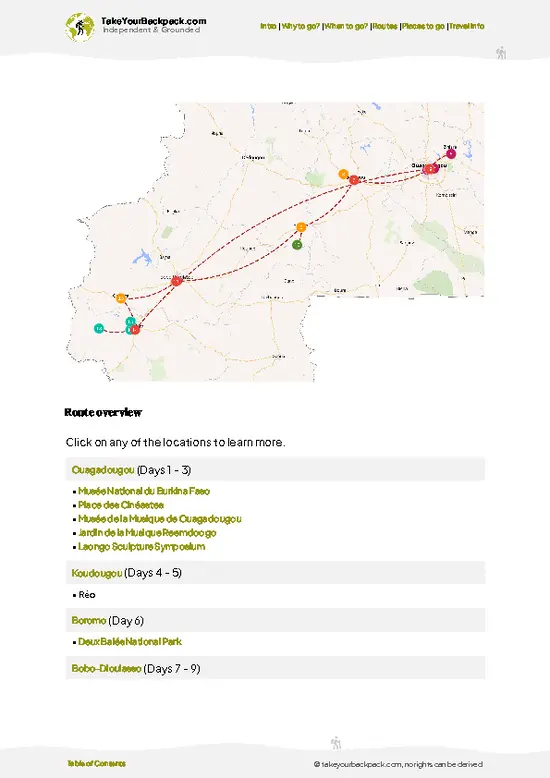
  • Banfora—Tiered waterfalls, sandstone domes, hippo lake, cane-field cycling| 77 km away
  • Koudougou—Former mill town, loom workshops, evening maquis, moped loops| 245 km away
  • Ouagadougou—Capital sprawl, Rood Woko market, granite sculptures, Friday court ritual| 332 km away

💡 Not sure where to go next?
Create a personalized itinerary for Burkina Faso including Bobo-Dioulasso and the places that fit your trip.

Generate my itinerary

👉 Discover all cities

Or checkout all Burkina Faso has to offer (think cities, towns, villages, national parks, hikes, beaches, festivals)
Country photo of Burkina Faso

We 💚 feedbackParting advice and final tips

Bobo-Dioulasso is a city best seen on two wheels, and first-timers overlook how flat and shaded its streets are. I would rent a bicycle or hire a moped taxi for a few hours rather than relying on walking in the midday heat. Carry small bills for tips and guides, bring a scarf for the mosque, and leave your evening open for music.

✍️ Help improve this page!
The information on this page is based on in-depth research, insights shared by experienced travelers, and feedback from the local travel community in Burkina Faso. While every effort is made to keep the information accurate and current, conditions can change — so if you spot anything incorrect or outdated, please get in touch.


🙋‍♂️ Give feedback

👋 Meet the founderWho’s Behind Take Your Backpack?

Johan, backpacker and founder of TakeYourBackpackHi, I’m Johan (Netherlands 🇳🇱), the creator of TakeYourBackpack. Over the past 3 decades, I’ve backpacked through 90+ countries across six continents, gaining extensive experience with independent travel, long-term trips, and overland routes.

This site is built on a combination of firsthand travel experience and carefully curated insights from other backpackers. Many guides are based on places I’ve personally visited, while others bring together tips, observations, and practical advice shared by trusted travelers I’ve met along the way.

The goal is to provide realistic, experience-driven guidance — not generic itineraries — so you can explore destinations with better context, clearer expectations, and more confidence.