×

Burkina Faso🇧🇫 | citiesOuagadougouCapital sprawl, Rood Woko market, granite sculptures, Friday court ritual | things to do and best time to go

Explore KoudougouExplore Ouahigouya

Backpacking in Ouagadougou
🏆 Top pickcity ranked #1
By Johan Kruseman 🇳🇱 | Updated October 22, 2026

Ouagadougou used to be a dusty crossroads that overlanders hit for a visa and a cold beer before moving on. Today it is a sprawling, mostly flat capital of several million people in the center of Burkina Faso, still running on mopeds, but with a serious arts scene, a handful of good museums and a thriving craft economy. Skip the idea of ticking off monuments, because the city has few. What is worth your time is the street life, the live music, the artisan villages and the food at open-air maquis. Distances are long and sun is harsh, so a cheap moped taxi beats walking and costs far less than a rental car. Spend your effort on a few focused areas rather than crossing town repeatedly. Ouagadougou suits culture-minded travelers, festival chasers and anyone who likes a city that feels lived in rather than staged. It will frustrate anyone who wants compact sightseeing, polished nightlife or easy independent hiking. Check current travel advisories before you plan your route.

Discover everything you want to know in the 📖 Burkina Faso Travel Guide.
Safety warning

The current risk level for Burkina Faso is high. Check the advice before going.


example page 0 from our offline Travel Guide for Burkina Faso
example page 1 from our offline Travel Guide for Burkina Faso
example page 2 from our offline Travel Guide for Burkina Faso
example page 3 from our offline Travel Guide for Burkina Faso
example page 4 from our offline Travel Guide for Burkina Faso
example page 5 from our offline Travel Guide for Burkina Faso
example page 6 from our offline Travel Guide for Burkina Faso
example page 7 from our offline Travel Guide for Burkina Faso
Loading the map 🌍
CLICK TO FILTER
cities
towns
villages
landmarks
national parks
hikes
attractions
festivals
regions
SHOW COUNTRY’S BESTSHOW ALL

✨ Why go?
Ranked #1 city in Burkina Faso
The unique appeal for travelers

Ouagadougou earns its place on a West African route because it is the region's practical hinge. Roads, buses and shared taxis radiate from it toward Bobo-Dioulasso, Ghana, Mali, Niger and Togo, and several embassies here handle visas that save you headaches later. It also holds more culture per square kilometer than most capitals in the region. The city hosts FESPACO, Africa's biggest film festival, every two years, and the craft scene around Ouaga 2000 and Gounghin keeps weavers, bronze casters and leatherworkers busy year-round. Food is a second draw. Grilled chicken, riz gras and fresh bissap are everywhere, and the maquis serving cold local beer under trees are a cheap evening out. Hostels are few, so most backpackers use simple guesthouses and mission-run rooms. Walking is not the way … read more 👉
Ouagadougou earns its place on a West African route because it is the region's practical hinge. Roads, buses and shared taxis radiate from it toward Bobo-Dioulasso, Ghana, Mali, Niger and Togo, and several embassies here handle visas that save you headaches later. It also holds more culture per square kilometer than most capitals in the region. The city hosts FESPACO, Africa's biggest film festival, every two years, and the craft scene around Ouaga 2000 and Gounghin keeps weavers, bronze casters and leatherworkers busy year-round. Food is a second draw. Grilled chicken, riz gras and fresh bissap are everywhere, and the maquis serving cold local beer under trees are a cheap evening out. Hostels are few, so most backpackers use simple guesthouses and mission-run rooms. Walking is not the way to see the city, since the sprawl and heat defeat it, but moped taxis make hopping between neighborhoods easy. Give it two or three full days if you like music, markets and art. Use it as a quick logistics stop if you only want landscapes.

💡 HighlightsTop highlights of Ouagadougou

  1. Grand Marché (Rood Woko): The central market, rebuilt after a fire, is the city's commercial heart, with fabric, spices, calabashes and jewelry in tight rows. Go early, from 7 to 10 AM, before the heat. Entry is free, and plan 1 to 2 hours.
  2. Musée National du Burkina Faso: Masks, instruments and textiles from the country's many ethnic groups, clearly laid out. It is the best primer on local cultures. Tickets run around €1 to 2, and 1 to 1.5 hours is enough. Visit in the morning.
  3. Village Artisanal de Ouagadougou: A large crafts center where artisans work bronze, leather, wood and batik in open workshops. Prices are negotiable and the quality varies, so look at several stalls. Entry is free, allow 1 to 2 hours, and go in the morning.
  4. Musée de la Musique: A museum of traditional West African instruments,
… read more 👉
  1. Grand Marché (Rood Woko): The central market, rebuilt after a fire, is the city's commercial heart, with fabric, spices, calabashes and jewelry in tight rows. Go early, from 7 to 10 AM, before the heat. Entry is free, and plan 1 to 2 hours.
  2. Musée National du Burkina Faso: Masks, instruments and textiles from the country's many ethnic groups, clearly laid out. It is the best primer on local cultures. Tickets run around €1 to 2, and 1 to 1.5 hours is enough. Visit in the morning.
  3. Village Artisanal de Ouagadougou: A large crafts center where artisans work bronze, leather, wood and batik in open workshops. Prices are negotiable and the quality varies, so look at several stalls. Entry is free, allow 1 to 2 hours, and go in the morning.
  4. Musée de la Musique: A museum of traditional West African instruments, including balafons, kora and drums, in a quiet setting. Entry is about €1 to 2 and a visit takes about an hour. Mornings are best.
  5. Cathédrale de l'Immaculée Conception: A striking modern cathedral with a curved concrete form near the city center. Outside is easy to appreciate, and the interior depends on mass times. Free, 20 to 30 minutes, best in late afternoon light.
  6. Mogho Naba Ceremony: On Friday mornings the Mogho Naba, the Mossi emperor, holds a short ritual at his palace, with courtiers in red and drums. It lasts only 20 to 30 minutes and starts early, around 6 to 7 AM. Dress respectfully, expect a small donation of about €2 to 5, and ask your guesthouse to confirm the schedule.
  7. Laongo Granite Sculpture Park: A field of carved granite boulders by international sculptors, east of town, with huge shapes against open sky. Count on €1 to 3 for entry and about 1 to 2 hours there. Go late in the afternoon when it is cooler, and arrange a moped or car.
For day trips beyond Ouagadougou, consider the crocodile pools at Sabou, the Gurunsi painted houses of Tiébélé, and the Ruins of Loropéni, all reachable with a planned driver.
The Grand Marché, Village Artisanal and the cathedral cost nothing to enter, so they are the cheapest way to spend a morning.
Spotted a mistake or missing something? Contact us.

Things to do near Ouagadougou

Ratings based on Tripadvisor reviews. When you book through this link, you support our work at no extra cost to you.

🏘️ NeighborhoodsHow different areas shape the experience

Ouagadougou is flat, sprawling and ringed by a road system built for motorbikes, so pick two or three areas and skip the rest.
  • Centre-Ville (Zone du Bois and around Avenue Kwame Nkrumah): Banks, ATMs, bakeries, the Grand Marché area and the cathedral sit within a 20 minute walk of each other. Walk it in the early morning before the heat. The market is a maze of fabric, spices and metalwork, and it repays a couple of hours with a small bargaining budget. Skip the souvenir stalls near the big hotels, where prices start high for no reason.
  • Koulouba and Zogona: Koulouba is the hilltop government quarter with the presidency, quiet and not worth a special trip beyond a short taxi ride. Zogona is the better bet, with cheap maquis (open-air restaurants), grilled chicken and fish, and cold Brakina beer.
… read more 👉
Ouagadougou is flat, sprawling and ringed by a road system built for motorbikes, so pick two or three areas and skip the rest.
  • Centre-Ville (Zone du Bois and around Avenue Kwame Nkrumah): Banks, ATMs, bakeries, the Grand Marché area and the cathedral sit within a 20 minute walk of each other. Walk it in the early morning before the heat. The market is a maze of fabric, spices and metalwork, and it repays a couple of hours with a small bargaining budget. Skip the souvenir stalls near the big hotels, where prices start high for no reason.
  • Koulouba and Zogona: Koulouba is the hilltop government quarter with the presidency, quiet and not worth a special trip beyond a short taxi ride. Zogona is the better bet, with cheap maquis (open-air restaurants), grilled chicken and fish, and cold Brakina beer. Walkable by day, and a short taxi at night.
  • Gounghin and Patte d’Oie: Residential and noisy at night, with local bars and live music rather than polished venues. Patte d’Oie has the Laongo-bound road links and a few crafts shops. Come for an evening, not a day.
  • Ouaga 2000: A modern district of wide avenues, embassies and upscale restaurants about 10 km south. It costs the most in taxi fares and meals and offers the least character. Skip it unless you have an appointment.
  • Bangr-Weoogo Urban Park: A forested park north of the center, good for a shaded morning walk or run. Free to wander, and the best green break in town.

⌛️ 1 dayHow to make the most of one day

6:30 AM: Mogho Naba Palace
On Fridays, start at the palace for the short ceremony with drums and courtiers in red. On other days, begin with breakfast of coffee, bread and omelet from a street stall nearby. Then take a moped taxi to the center.

9:00 AM: Musée National
Spend an hour with the masks, textiles and instruments, which give context for everything you will see later. It is quiet and the exhibits are labeled well enough to follow without a guide.

10:30 AM: Grand Marché
Walk the central lanes for fabric, spices and calabashes. Bargain gently, buy small, and stay aware of your pockets. The covered stalls give shade when the sun climbs, and the market is a good way to see local trade in action.

12:30 PM: Lunch at a maquis
Eat grilled chicken or fish with attiéké or riz gras and a cold … read more 👉
6:30 AM: Mogho Naba Palace
On Fridays, start at the palace for the short ceremony with drums and courtiers in red. On other days, begin with breakfast of coffee, bread and omelet from a street stall nearby. Then take a moped taxi to the center.

9:00 AM: Musée National
Spend an hour with the masks, textiles and instruments, which give context for everything you will see later. It is quiet and the exhibits are labeled well enough to follow without a guide.

10:30 AM: Grand Marché
Walk the central lanes for fabric, spices and calabashes. Bargain gently, buy small, and stay aware of your pockets. The covered stalls give shade when the sun climbs, and the market is a good way to see local trade in action.

12:30 PM: Lunch at a maquis
Eat grilled chicken or fish with attiéké or riz gras and a cold drink under a tree. Choose a busy spot, since turnover keeps food fresh. Rest through the hottest hours.

3:00 PM: Village Artisanal
Browse bronze casters, leather workers and weavers in open workshops. Watching the work gives you a better sense of quality, so you can compare prices before you buy.

5:00 PM: Thomas Sankara Memorial area
This is less visited than the main sights and gives a quiet look at the leader whose legacy still shapes the country. Ask a local for the best route, as signage is thin.

7:30 PM: Live music in a maquis
Finish with a concert, a balafon trio or a dance night in a neighborhood venue. Take a moped taxi back, and agree on the fare before you climb on.

🌤️ When to go?Weather, crowds, and seasonal trade-offs

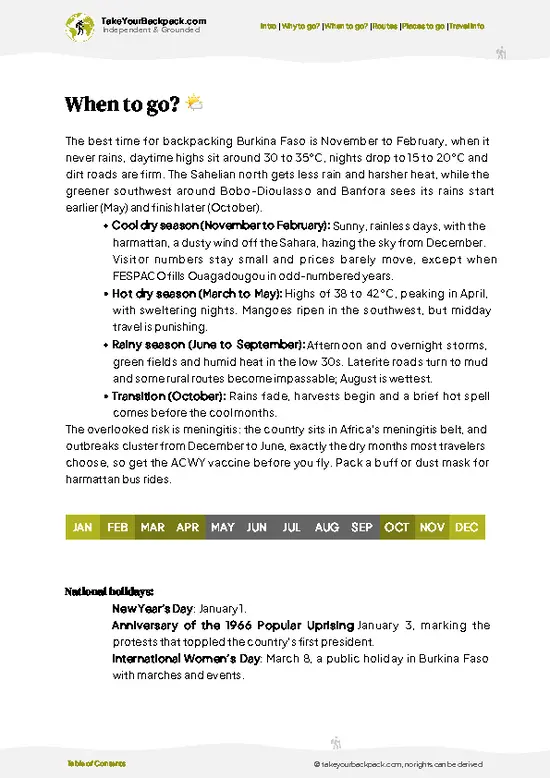
November to February is the most comfortable window, with dry air, cool nights and highs of 30 to 35°C (86 to 95°F).
  • Cool dry season (November to February): Nights can drop to 16 to 20°C (61 to 68°F). Harmattan dust haze often blurs the sky and dries your throat. This is peak time for festivals and film events, so book rooms ahead and expect slightly higher prices.
  • Hot season (March to May): The harshest stretch, with highs of 38 to 43°C (100 to 109°F) and warm nights. Plan sightseeing before 10 am and after 4 pm. Prices ease and crowds thin.
  • Rainy season (June to October): Highs of 29 to 34°C (84 to 93°F) with heavy afternoon storms, especially July to September. Dirt roads turn to mud and some streets flood briefly. Days are green and cheaper, but day trips become slower.
  • Daylight: Days run
… read more 👉
November to February is the most comfortable window, with dry air, cool nights and highs of 30 to 35°C (86 to 95°F).
  • Cool dry season (November to February): Nights can drop to 16 to 20°C (61 to 68°F). Harmattan dust haze often blurs the sky and dries your throat. This is peak time for festivals and film events, so book rooms ahead and expect slightly higher prices.
  • Hot season (March to May): The harshest stretch, with highs of 38 to 43°C (100 to 109°F) and warm nights. Plan sightseeing before 10 am and after 4 pm. Prices ease and crowds thin.
  • Rainy season (June to October): Highs of 29 to 34°C (84 to 93°F) with heavy afternoon storms, especially July to September. Dirt roads turn to mud and some streets flood briefly. Days are green and cheaper, but day trips become slower.
  • Daylight: Days run around 11 to 13 hours across the year, with little variation.
Late October to early November catches the end of the rains with fewer visitors and fresh air.


source: climatestotravel.comJANJanuary: highly recommended for travelingFEBFebruary: highly recommended for travelingMARMarch: highly recommended for travelingAPRApril: good for travelingMAYMay: highly recommended for travelingJUNJune: fair for travelingJULJuly: below average for travelingAUGAugust: below average for travelingSEPSeptember: fair for travelingOCTOctober: fair for travelingNOVNovember: highly recommended for travelingDECDecember: highly recommended for traveling
when-to-go

✈️ The backpacker research shortcutBurkina Faso Travel Guide

An offline-friendly backpacking guide with optimized travel routes, ranked highlights, transport advice, and the best areas to stay.
example page 0 from our offline Travel Guide for Burkina Faso
example page 1 from our offline Travel Guide for Burkina Faso
example page 2 from our offline Travel Guide for Burkina Faso
example page 3 from our offline Travel Guide for Burkina Faso
example page 4 from our offline Travel Guide for Burkina Faso
example page 5 from our offline Travel Guide for Burkina Faso
example page 6 from our offline Travel Guide for Burkina Faso
example page 7 from our offline Travel Guide for Burkina Faso
The digital guide (273 pages) contains:
✅ 63 highlights, ranked by travel appeal
✅ Optimized 5, 10 & 15-day travel routes
✅ Cities, national parks, landmarks, beaches
✅ How to get around
✅ Offline-friendly for travel without Wi-Fi
👉 Click to see all 30+ guide features

📅 Plan smarter in minutes, not weeks
✅ Month by month travel advice
✅ Festivals & national holidays
✅ Budget expectations

🗺️ Go to the right places, skip the overrated ones
✅ Honest pros & cons of destinations
✅ Top hikes, parks & viewpoints
✅ Lesser-known places most travelers miss
✅ Clear “worth it vs skip it” guidance

🛏️ Travel smoothly without rookie mistakes
✅ Best areas to stay
✅ Transport systems explained simply
✅ Common scams & safety advice
✅ SIM cards, money & practical tips

🌍 Understand the country, not just visit it
✅ Culture & traditions
✅ 52 Essential phrases & customs
✅ Festivals worth planning around
✅ Traveler-friendly historical context
✅ Insights that make places more meaningful

📱 Built for real travel conditions
✅ Fully downloadable PDF
✅ Works completely offline
✅ Optimized for phone use
✅ Useful in remote areas & buses
✅ Everything in one place
Stop searching, start planning
Get instant access to your full guide. 30‑day money-back guarantee.
+ Add another guide for just

By proceeding you agree to our terms.
Sent to your inbox immediately after payment • 100% Secure Checkout
Best Backpacking Travel Advisor 2025 tourism awardBest Backpacking
Travel Advisor
2025
What others say about Take Your Backpack Guides:
⭐⭐⭐⭐⭐
Fantastic, amazing amount of information!
⭐⭐⭐⭐⭐
My goodness this is amazing, it's what I've been looking for hats off too you!
⭐⭐⭐⭐⭐
I think this is absolutely BRILLIANT
⭐⭐⭐⭐
Very complete and informative. It's still missing places, but I gotta to commend you
⭐⭐⭐⭐⭐
This is truly amazing, thank you, can't wait to explore it with my kids!
⭐⭐⭐⭐⭐
Awesome resource, thank you!
⭐⭐⭐⭐⭐
This is amazing! Can't wait to explore the ones I haven't seen
⭐⭐⭐⭐
I love this! Well done, great idea.
⭐⭐⭐⭐⭐
Thanks for taking the time to make this gem!
⭐⭐⭐⭐⭐
This might be the best website I've ever seen.
⭐⭐⭐⭐⭐
Congratulations, and thank you so much for your work; it's incredibly valuable.
⭐⭐⭐⭐
In all seriousness I think you did a great job pointing out the important spots
⭐⭐⭐⭐⭐
10/10 very good
⭐⭐⭐⭐⭐
As someone who's only just starting to visit regularly this is awesome, thank you.
⭐⭐⭐⭐
Thank you very much! I'm going to visit my dad, it's going to be very useful!
⭐⭐⭐⭐⭐
This is really cool! We'll be travelling for the first time and this definitely come in handy.
⭐⭐⭐⭐⭐
You are now our minister of culture, congratulations 👨‍💼
⭐⭐⭐⭐⭐
Just wanted to tell you that this is a pearl! Going to follow your recommendations.
⭐⭐⭐⭐⭐
This is so cool. I'll definitely be using the resource for my travels soon.
⭐⭐⭐⭐⭐
This is very impressive! Good work.
⭐⭐⭐⭐⭐
This is an amazing and informative site. Very well done!

🛏️ Where to stay?Best areas to stay in Burkina Faso

Zogona and the Centre-Ville fringe are the best areas for a budget bed, with the widest choice of cheap guesthouses and a few dorm-style options at roughly €8 to 18 a night. Real hostels are scarce in Ouagadougou, so many backpackers end up in simple private rooms, and booking ahead in the cool season saves a lot of walking with a pack.
Zogona works because food and bars are within a short walk, so you rarely need a taxi in the evening. The streets are lively until late, which means some noise, so pack earplugs and ask for a room away from the road. Taxis and motorbikes pass constantly, so getting … read more 👉
Zogona and the Centre-Ville fringe are the best areas for a budget bed, with the widest choice of cheap guesthouses and a few dorm-style options at roughly €8 to 18 a night. Real hostels are scarce in Ouagadougou, so many backpackers end up in simple private rooms, and booking ahead in the cool season saves a lot of walking with a pack.
Zogona works because food and bars are within a short walk, so you rarely need a taxi in the evening. The streets are lively until late, which means some noise, so pack earplugs and ask for a room away from the road. Taxis and motorbikes pass constantly, so getting to bus stations or the center is quick and cheap.
The central area near Avenue Kwame Nkrumah is calmer at night and puts banks, ATMs and markets on foot, which saves money on transport. It is quieter after dark, with fewer places open, so you may want a short taxi to eat in Zogona. Check that rooms have a working fan or air-conditioning, since the hot season makes this the difference between sleeping and not. Power cuts happen, so a headlamp helps.
Avoid staying out in Ouaga 2000. Beds cost more, the area is spread out and you pay for every trip.

🚌 Getting aroundHow to get around Ouagadougou

The costliest error is hopping into an unmarked taxi without agreeing the fare first, which routinely doubles the price for a short ride. Ouagadougou has no metro or tram and city buses are limited, so most backpackers combine walking with motorbike or taxi rides. Traffic is dense with mopeds, and heat makes long walks tiring.
  • Walking: Good for the central grid between the cathedral, Grand Marché and Avenue Kwame Nkrumah, roughly 20 minutes end to end. It is free and the fastest way through the center, but sidewalks are patchy and midday heat is punishing. Walk mornings and evenings only.
  • Green taxis: Shared-style city taxis charge about €0.75 to 2 for a short fixed-area ride if you bargain before you get in. They are slower than a motorbike and often lack air-conditioning, but they carry luggage
… read more 👉
The costliest error is hopping into an unmarked taxi without agreeing the fare first, which routinely doubles the price for a short ride. Ouagadougou has no metro or tram and city buses are limited, so most backpackers combine walking with motorbike or taxi rides. Traffic is dense with mopeds, and heat makes long walks tiring.
  • Walking: Good for the central grid between the cathedral, Grand Marché and Avenue Kwame Nkrumah, roughly 20 minutes end to end. It is free and the fastest way through the center, but sidewalks are patchy and midday heat is punishing. Walk mornings and evenings only.
  • Green taxis: Shared-style city taxis charge about €0.75 to 2 for a short fixed-area ride if you bargain before you get in. They are slower than a motorbike and often lack air-conditioning, but they carry luggage and are the sensible choice after dark. For most trips this is the best balance of comfort and cost.
  • Motorbike taxis: Ride-hailing apps and street riders cost about €0.50 to 1.50 per trip and beat traffic easily. They are the cheapest and quickest way to cross town, but you will inhale dust and exhaust, and helmets are not guaranteed. Use app-booked riders when you can, since the price is set up front.
  • Rented bicycle or scooter: Guesthouses and some shops rent scooters for around €8 to 15 a day. It gives freedom to reach Ouaga 2000 or the park, but traffic is chaotic and fuel and fines add up. Not worth it unless you are confident in West African traffic.
  • Intercity buses: Companies run from private terminals to Bobo-Dioulasso (about 5 to 6 hours, €10 to 16), and a bus station taxi ride gets you there. Book the day before and arrive early, as departure times shift with how full the bus is.

👛 Costs (as of 22 October 2026)What things cost and how to budget

Ouagadougou costs about €32 to 55 a day for a backpacker who sleeps in a basic guesthouse room, eats locally and moves by motorbike and taxi.
CategoryBudget RangeLocal Reality
Dorm or basic bed (high season)€10 to 18True dorms are rare, so a simple fan room in Zogona is the norm.
Dorm or basic bed (off-season)€8 to 14Rainy and hot months bring easier bargaining.
Meals€5 to 10Street grills, tô and maquis plates are cheap; a café or restaurant meal costs more.
Local transport€2 to 5Short motorbike or taxi rides are €0.50 to 2 each.
City transport passNot availableNo pass exists; you pay per ride in cash.
Basic activities and entry fees€2 to 8Museums and parks are cheap; sculpture park visits add transport.
Miscellaneous€3 to 6Water, SIM data, drinks and small tips.
Total Daily Budget€32 to 55About €40
… read more 👉
Ouagadougou costs about €32 to 55 a day for a backpacker who sleeps in a basic guesthouse room, eats locally and moves by motorbike and taxi.
CategoryBudget RangeLocal Reality
Dorm or basic bed (high season)€10 to 18True dorms are rare, so a simple fan room in Zogona is the norm.
Dorm or basic bed (off-season)€8 to 14Rainy and hot months bring easier bargaining.
Meals€5 to 10Street grills, tô and maquis plates are cheap; a café or restaurant meal costs more.
Local transport€2 to 5Short motorbike or taxi rides are €0.50 to 2 each.
City transport passNot availableNo pass exists; you pay per ride in cash.
Basic activities and entry fees€2 to 8Museums and parks are cheap; sculpture park visits add transport.
Miscellaneous€3 to 6Water, SIM data, drinks and small tips.
Total Daily Budget€32 to 55About €40 on a typical day.
Carry small bills and agree prices before you ride or order, since change is hard to find and the first quote is rarely the final one. Cash in West African CFA francs is the norm, and card acceptance is limited outside upscale hotels.
⚠️ Prices can change and everyone travels differently, so take this as a rough guide. Hope it helps you plan your adventure!

🚌 Day tripsWhere to go beyond the main area

Ouagadougou works well as a base for short excursions, because the main sights lie within 1 to 3 hours by road and shared transport leaves from the city.
Laongo Granite Sculpture Park:
Giant granite boulders carved by international sculptors rise from open savanna about 30 km east. Hire a motorbike or taxi for the half-day, roughly €15 to 30 return with waiting time, plus a small entry fee. Go in the cool season, early morning, because there is almost no shade. First-timers often forget water and a hat.

Lac de Loumbila:
A reservoir about 20 km north with birdwatching, simple lakeside restaurants and pirogue rides. A taxi round trip runs around €12 to 22, and the ride takes under an hour. It is best from November to February, when water levels are good and temperatures kinder. Many visitors … read more 👉
Ouagadougou works well as a base for short excursions, because the main sights lie within 1 to 3 hours by road and shared transport leaves from the city.
Laongo Granite Sculpture Park:
Giant granite boulders carved by international sculptors rise from open savanna about 30 km east. Hire a motorbike or taxi for the half-day, roughly €15 to 30 return with waiting time, plus a small entry fee. Go in the cool season, early morning, because there is almost no shade. First-timers often forget water and a hat.

Lac de Loumbila:
A reservoir about 20 km north with birdwatching, simple lakeside restaurants and pirogue rides. A taxi round trip runs around €12 to 22, and the ride takes under an hour. It is best from November to February, when water levels are good and temperatures kinder. Many visitors arrive at midday and find it too hot to enjoy, so go in the morning.

Ziniaré and the Naaba Palace:
About 35 km northeast, Ziniaré has the Mossi chief’s compound and the nearby sculpture workshops. Minibuses leave Ouagadougou for around €1.50 to 3 each way, taking 45 minutes to an hour. Visit mornings, and ask for permission before photographing the court. Combine it with Laongo to save on transport.
👉 Explore Ziniaré
Tiébélé:
The painted Kassena compounds near the Ghana border are the headline trip, but they sit about 3 to 4 hours south, so a same-day return is exhausting. Go with a driver at about €60 to 90 for the car, share it with other travelers, and leave before 6 am. The dry season is best, as roads are firm.

🍲 FoodLocal Flavors for Backpackers

Ouagadougou’s tastes lean toward the Mossi table, built on millet and sorghum. Look for tô, a thick millet or sorghum porridge served with a slippery okra or baobab-leaf sauce, eaten with the right hand from a shared bowl. It is filling and cheap, usually €1 to 2.
The city’s signature street food is poulet bicyclette, a lean, free-range chicken grilled over charcoal with onions and chili, and brochettes of beef or mutton carved from a smoky stand. Try riz gras and haricots (beans) at lunchtime from the women’s stalls near markets, where a plate costs around €1.50 to 3.
For drinks, dolo is the local millet beer, sour and cloudy, poured from calabashes at small neighborhood bars. Brakina is the standard cold lager. Bissap, a deep red hibiscus juice, and ginger or baobab juice are sold in plastic … read more 👉
Ouagadougou’s tastes lean toward the Mossi table, built on millet and sorghum. Look for tô, a thick millet or sorghum porridge served with a slippery okra or baobab-leaf sauce, eaten with the right hand from a shared bowl. It is filling and cheap, usually €1 to 2.
The city’s signature street food is poulet bicyclette, a lean, free-range chicken grilled over charcoal with onions and chili, and brochettes of beef or mutton carved from a smoky stand. Try riz gras and haricots (beans) at lunchtime from the women’s stalls near markets, where a plate costs around €1.50 to 3.
For drinks, dolo is the local millet beer, sour and cloudy, poured from calabashes at small neighborhood bars. Brakina is the standard cold lager. Bissap, a deep red hibiscus juice, and ginger or baobab juice are sold in plastic bags and bottles for pennies.
Backpackers eat best at the open-air maquis in Zogona and Gounghin, where chicken, grilled fish and cold drinks arrive on plastic tables for €3 to 6. Bakeries around Centre-Ville serve fresh baguettes and coffee at breakfast, a legacy of French influence. Eat where the grill is busy and food is cooked in front of you.

🛡️ SafetyStaying Safe: What Travelers Should Know

Ouagadougou is manageable for most travelers by day, but conditions in Burkina Faso change, so check your government’s current travel advice before you go and again before heading outside the city. The main everyday issues are petty. Phone snatching from motorbikes happens on busy roads, so keep your phone away from the curb and carry a small day bag across your body. Pickpockets work the Grand Marché, so carry only what you need and leave your passport copy handy.
At night, take a taxi rather than walking, even short distances, because streets are poorly lit and uneven. Solo women usually report staring and persistent attention more than danger, and a firm, calm refusal works best. Dress modestly to reduce it.
Taxi drivers will quote inflated prices, so agree the fare first. Friendly strangers … read more 👉
Ouagadougou is manageable for most travelers by day, but conditions in Burkina Faso change, so check your government’s current travel advice before you go and again before heading outside the city. The main everyday issues are petty. Phone snatching from motorbikes happens on busy roads, so keep your phone away from the curb and carry a small day bag across your body. Pickpockets work the Grand Marché, so carry only what you need and leave your passport copy handy.
At night, take a taxi rather than walking, even short distances, because streets are poorly lit and uneven. Solo women usually report staring and persistent attention more than danger, and a firm, calm refusal works best. Dress modestly to reduce it.
Taxi drivers will quote inflated prices, so agree the fare first. Friendly strangers offering guide services or showing you a market stall are usually after commission, and a polite no ends it. Police checkpoints can appear, so keep your passport and a photocopy of your visa within reach. Avoid demonstrations and large gatherings.

FAQCommon questions from travelers

Two to three days is enough for Ouagadougou itself. That covers the Grand Marché, the national museum, Bangr-Weoogo park and an evening of live music in Zogona. Add a half day for Laongo sculpture park or Ziniaré, 30 to 35 km out, and extend to four or five days if you plan Tiébélé.
Ouagadougou is manageable for solo travelers who take normal precautions, though conditions in Burkina Faso can shift, so check current government advice before traveling. Use taxis at night, keep phones out of reach of passing motorbikes and avoid large gatherings. Day-to-day problems are petty theft in the Grand Marché and inflated taxi fares, which you avoid by agreeing the price first.
Ouagadougou is known for FESPACO, the biennial pan-African film festival, plus the SIAO craft fair and a strong live music scene. Visitors also come for the Grand Marché, the Laongo granite sculpture park about 30 km east and the grilled poulet bicyclette. It is also the country’s capital and main transport hub, with buses to Bobo-Dioulasso taking 5 to 6 hours.
⚠️ Things can change over time, so always validate details locally before you go.

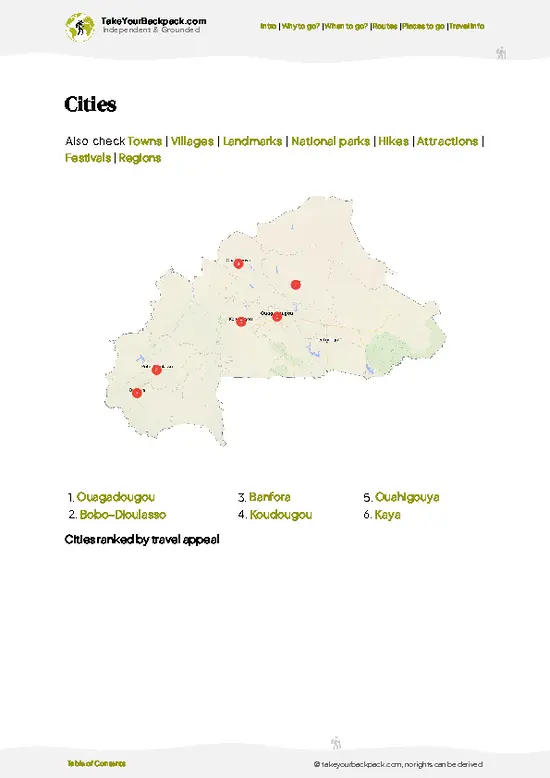
Other Burkinabé cities near Ouagadougou

Explore more nearby:

  • Koudougou—Former mill town, loom workshops, evening maquis, moped loops| 91 km away
  • Kaya—Leather sandals, strip-woven cloth, Mossi trading town, reservoir life| 93 km away
  • Ouahigouya—Yatenga court, indigo dyers, northern market, reservoir dusk| 164 km away

💡 Not sure where to go next?
Create a personalized itinerary for Burkina Faso including Ouagadougou and the places that fit your trip.

Generate my itinerary

👉 Discover all cities

Or checkout all Burkina Faso has to offer (think cities, towns, villages, national parks, hikes, beaches, festivals)
Country photo of Burkina Faso

We 💚 feedbackIs it worth it?

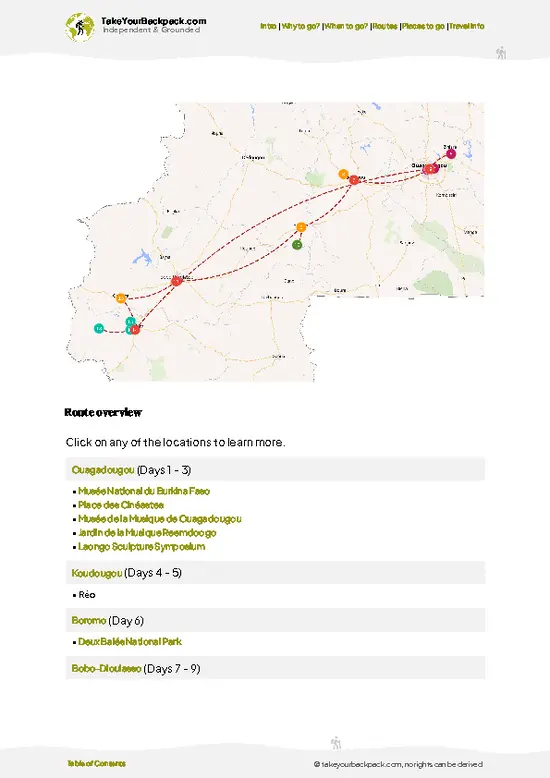
Pair Ouagadougou with Bobo-Dioulasso for a classic loop, using the capital for culture and visas, then heading southwest for music and calmer streets. Add Ghana or Togo if you are going overland. I would keep your stay to two or three days and bring small bills for moped taxis.

✍️ Help improve this page!
The information on this page is based on in-depth research, insights shared by experienced travelers, and feedback from the local travel community in Burkina Faso. While every effort is made to keep the information accurate and current, conditions can change — so if you spot anything incorrect or outdated, please get in touch.


🙋‍♂️ Give feedback

👋 Meet the founderWho’s Behind Take Your Backpack?

Johan, backpacker and founder of TakeYourBackpackHi, I’m Johan (Netherlands 🇳🇱), the creator of TakeYourBackpack. Over the past 3 decades, I’ve backpacked through 90+ countries across six continents, gaining extensive experience with independent travel, long-term trips, and overland routes.

This site is built on a combination of firsthand travel experience and carefully curated insights from other backpackers. Many guides are based on places I’ve personally visited, while others bring together tips, observations, and practical advice shared by trusted travelers I’ve met along the way.

The goal is to provide realistic, experience-driven guidance — not generic itineraries — so you can explore destinations with better context, clearer expectations, and more confidence.