×

Burkina Faso🇧🇫 | best citiesDiscover the 6 Best cities Across Burkina Faso

Cities in Burkina Faso are low-rise, dusty and run on mopeds, with little of the tourist infrastructure you find in coastal West Africa. The differences between regions matter more than the differences between cities. The central plateau holds the capital, with the best choice of guesthouses, restaurants, markets and cultural venues, plus the most traffic and noise. The greener, wetter southwest is calmer, cheaper and easier for independent travel and backpacking, with more music and more walking. The Sahel north and the eastern borderlands are not worth planning around, because of the security situation and the lack of transport. Choose a base by atmosphere and access.

By Johan Kruseman 🇳🇱 | Updated October 23, 2026
Explore the best towns in Burkina Faso

Why go?Why Travelers Love These Spots

Burkina Faso has few big historic cities and no coastline, so its urban life is shaped by inland trade, Mossi and Dioula heritage and a strong arts scene rather than colonial ports or grand monuments. Towns grew around markets, railway and road junctions and chiefdoms, which is why even the largest ones feel like overgrown market towns. If you want skyline, nightlife on a Lagos or Accra scale, or museum-hopping, look elsewhere. If you want live music, cinema, craft workshops and unhurried street life at low prices, the country delivers.

Geography sets the limits. A flat savanna landscape and a single dry season mean cities look dusty and brown for much of the year. Infrastructure is thin: the main paved corridors link the central and western cities, but secondary roads can be rough, and power … read more 👉
Burkina Faso has few big historic cities and no coastline, so its urban life is shaped by inland trade, Mossi and Dioula heritage and a strong arts scene rather than colonial ports or grand monuments. Towns grew around markets, railway and road junctions and chiefdoms, which is why even the largest ones feel like overgrown market towns. If you want skyline, nightlife on a Lagos or Accra scale, or museum-hopping, look elsewhere. If you want live music, cinema, craft workshops and unhurried street life at low prices, the country delivers.

Geography sets the limits. A flat savanna landscape and a single dry season mean cities look dusty and brown for much of the year. Infrastructure is thin: the main paved corridors link the central and western cities, but secondary roads can be rough, and power cuts and water shortages happen.

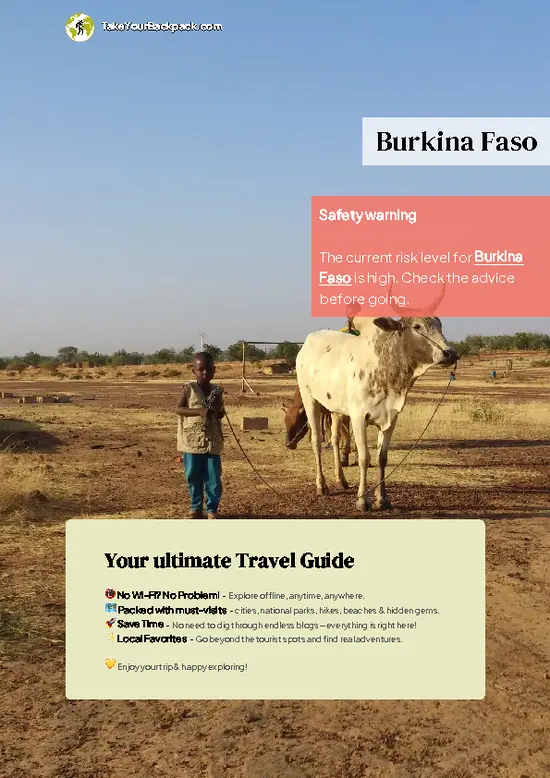
Know before you choose it: security conditions have deteriorated badly across large parts of the country since the mid-2010s, and many governments advise against travel to most regions. Check current advisories, and keep to the main western and central corridors if you go at all. Expect French as the working language, the West African CFA franc (XOF) as the currency, and cash as the default way to pay. Yellow fever vaccination is required for entry.
How the List Was Created
The list of best cities in Burkina Faso is created based on culture, vibe, attractions, transport ease, and local charm. If you feel a city is missing in this list, please let us know.

When to go?Seasonal Guide to Visiting

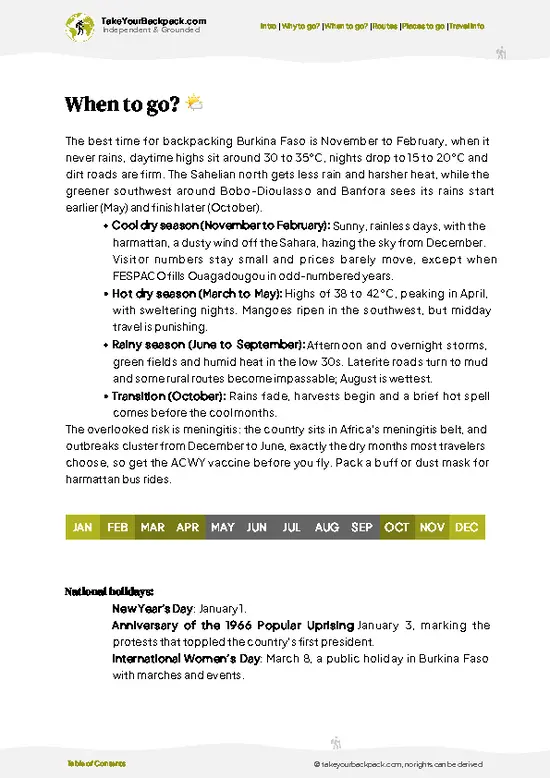
Best months: November to February: The best months for Burkina Faso’s cities are November to February, when rain has stopped, the humidity drops and daytime highs sit around 30 to 35°C, with nights of 15 to 22°C. From December to February the Harmattan, a dry wind off the Sahara, fills the air with fine dust. Skies turn hazy, photographs flatten and throats get sore, but walking around in the day is far more comfortable than at any other time of year.Shoulder season: March to May and October: From March to May it is not worth planning city time. Highs reach 38 to 43°C, especially in the center and north, and by midafternoon the streets empty. October is a decent shoulder month, with the last rains fading and the countryside still green, though dirt roads can stay muddy.Rainy season: June to … read more 👉
Best months: November to February: The best months for Burkina Faso’s cities are November to February, when rain has stopped, the humidity drops and daytime highs sit around 30 to 35°C, with nights of 15 to 22°C. From December to February the Harmattan, a dry wind off the Sahara, fills the air with fine dust. Skies turn hazy, photographs flatten and throats get sore, but walking around in the day is far more comfortable than at any other time of year.Shoulder season: March to May and October: From March to May it is not worth planning city time. Highs reach 38 to 43°C, especially in the center and north, and by midafternoon the streets empty. October is a decent shoulder month, with the last rains fading and the countryside still green, though dirt roads can stay muddy.Rainy season: June to September: The rainy season brings 600 to 1,000 mm in the south and southwest, less than 500 mm toward the Sahel. Downpours flood roads and delay buses, and some unpaved routes become impassable. Humidity makes the heat sticky even when temperatures drop to 28 to 33°C. Accommodation is not meaningfully cheaper in this period, so there is little to gain.Events that change prices: The film festival FESPACO takes place in the capital in odd-numbered years, around late February or early March. Rooms fill and rates rise, often by 30 to 50 percent, so book weeks ahead or avoid those dates.

city hoppingSuggested Travel Strategies

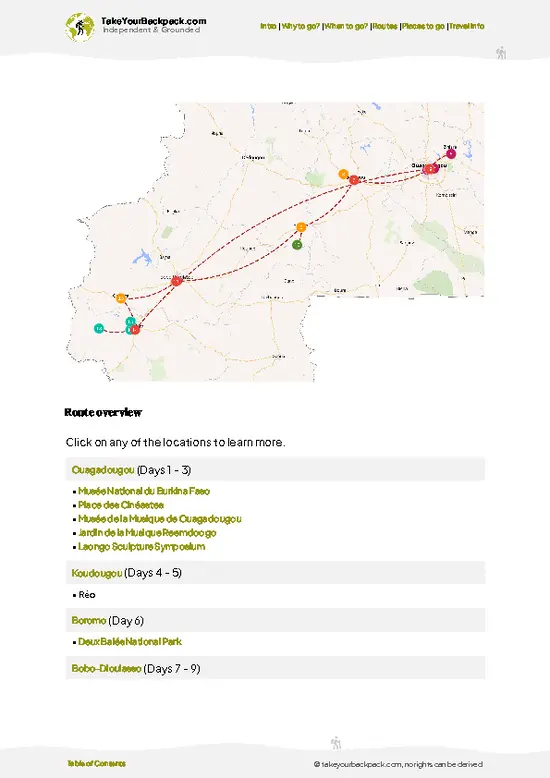
How many days to allow: A trip combining several cities in Burkina Faso needs 7 to 10 days, because overland travel is slow and the sights are spread over long distances. Try to cover too much and you spend the whole trip on a bus.Which regions go together: Only two clusters are practical: the central plateau around Ouagadougou and the southwest around Bobo-Dioulasso. They are linked by one main paved road of roughly 350 km, which takes 5 to 6 hours by coach on a good day and up to 8 with breakdowns and checkpoints. Fly into the capital, spend the first stop there, then move southwest and finish in the west, where a bus to Bamako or Abidjan is the natural exit. Going the other way works too, but you arrive in the busiest, most confusing place first.Time per stop: Allow 3 to 4 days in the capital … read more 👉
How many days to allow: A trip combining several cities in Burkina Faso needs 7 to 10 days, because overland travel is slow and the sights are spread over long distances. Try to cover too much and you spend the whole trip on a bus.Which regions go together: Only two clusters are practical: the central plateau around Ouagadougou and the southwest around Bobo-Dioulasso. They are linked by one main paved road of roughly 350 km, which takes 5 to 6 hours by coach on a good day and up to 8 with breakdowns and checkpoints. Fly into the capital, spend the first stop there, then move southwest and finish in the west, where a bus to Bamako or Abidjan is the natural exit. Going the other way works too, but you arrive in the busiest, most confusing place first.Time per stop: Allow 3 to 4 days in the capital and 3 to 4 days in the southwest. Add a day only if a festival or market day justifies it. Each extra stop beyond these two eats a full travel day for little new, so it is not worth adding.Mistakes to avoid: Travelers often plan a long loop through the north or east on a map that ignores security advisories. Stay on the main corridor instead. Others book a morning meeting after an overnight ride. Travel by daylight, leave a buffer day before flights, and book coach seats a day ahead, since the best companies sell out and depart only when full.

The ListThe Best cities of Burkina Faso

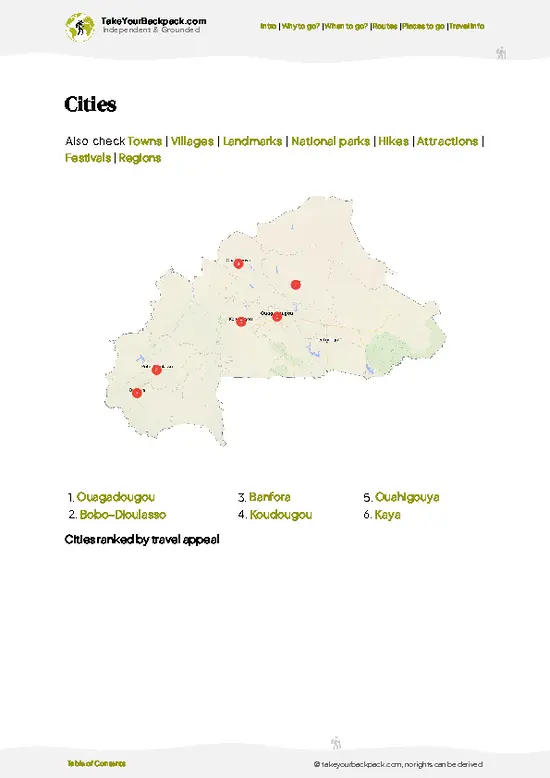
1 Ouagadougou

Capital sprawl, Rood Woko market, granite sculptures, Friday court ritual

Hop a moped taxi between national museums, open-air craft workshops and a granite sculpture field, and rise early for the Mogho Naba ceremony.

2 Bobo-Dioulasso

Mud-brick mosque, Kibidwé lanes, instrument museum, railway station

Wander old Bobo quarters with a local guide, study balafons and drums, and bargain through covered market stalls near an earthen mosque.

3 Banfora

Tiered waterfalls, sandstone domes, hippo lake, cane-field cycling

Pedal out to forest cascades, climb weathered rock towers and paddle a pirogue past hippos, all from one easygoing southwestern base.

4 Koudougou

Former mill town, loom workshops, evening maquis, moped loops

Circle quiet neighborhoods by bicycle, watch cotton strips come off narrow looms and pass the shuttered Faso Fani mill before grilled chicken at dusk.

5 Ouahigouya

Yatenga court, indigo dyers, northern market, reservoir dusk

Greet the Mossi court at the Naaba Kiiba palace, then follow indigo cloth and millet trade through working markets before an evening of grilled meat.

6 Kaya

Leather sandals, strip-woven cloth, Mossi trading town, reservoir life

Watch craftsmen stitch and dye leather by hand, then browse the grain-heavy market and the washing and watering scene at the Dem reservoir.

Loading the map 🌍

Expert viewExpert Commentary on cities

How many cities to visit: Two cities, three at most. Burkina Faso’s roads are slow, departures are unpredictable and daylight travel is the only sensible option, so a third stop costs a full day and rarely adds anything new. Two bases with day trips give you enough time to understand how each place works. Spreading yourself across five towns mostly buys you bus-station experience.

Which kind to prioritize
Pick the big capital for galleries, live music, cinema, restaurants and logistics such as visas, banks and bus tickets. Pick the calmer southwest for walking, markets, craft quarters and cheaper food. Travelers on a tight budget or who dislike traffic should spend most of their time in the southwest. Those interested in contemporary African art and film should lead with the capital. Smaller … read more 👉
How many cities to visit: Two cities, three at most. Burkina Faso’s roads are slow, departures are unpredictable and daylight travel is the only sensible option, so a third stop costs a full day and rarely adds anything new. Two bases with day trips give you enough time to understand how each place works. Spreading yourself across five towns mostly buys you bus-station experience.

Which kind to prioritize
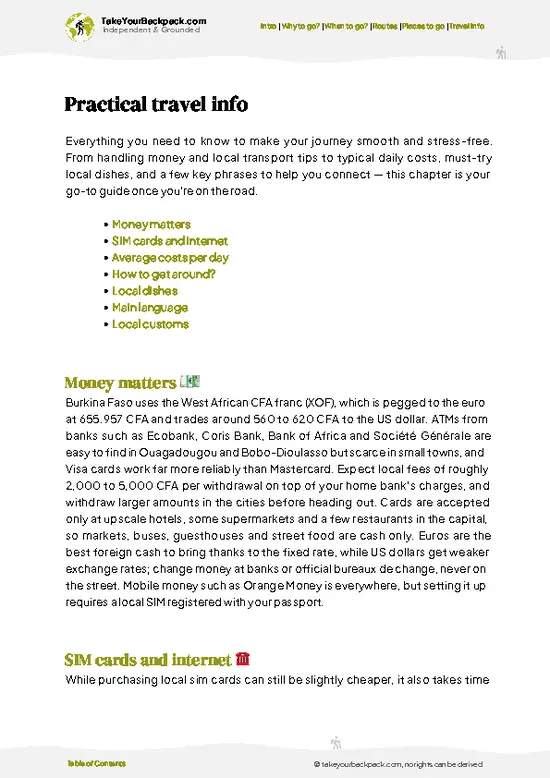
Pick the big capital for galleries, live music, cinema, restaurants and logistics such as visas, banks and bus tickets. Pick the calmer southwest for walking, markets, craft quarters and cheaper food. Travelers on a tight budget or who dislike traffic should spend most of their time in the southwest. Those interested in contemporary African art and film should lead with the capital. Smaller regional towns are not worth a detour unless you have a specific reason, because they have few places to stay and little transport onward.What it costs: A backpacker budget is US$25 to 40 a day (about 15,000 to 25,000 XOF). Guesthouse rooms run 8,000 to 15,000 XOF (US$13 to 25), street meals 1,000 to 2,500 XOF (US$2 to 4), moto taxis 300 to 1,000 XOF per ride. Intercity coaches cost 6,000 to 10,000 XOF (US$10 to 17). Museums and cultural sites usually charge 1,000 to 3,000 XOF, and a local guide is 5,000 to 15,000 XOF a day. Agree the price before you start, because quotes rise once you are committed.

Cash is the trap. ATMs run dry or reject foreign cards, especially at weekends, so carry enough XOF for several days and keep euros as backup. Small notes disappear fast, so break large ones whenever you can.Safety and cultural considerations: Security is the main issue. Large parts of the country are under advisories against travel, and conditions change quickly. Check your government’s guidance before booking, register with your embassy and stay on the main central and western corridors. Do not travel after dark, and expect police and military checkpoints: carry your passport, visa and yellow fever certificate, and stay polite.

Photography is a common source of trouble. Do not photograph soldiers, police, government buildings or bridges, and always ask before photographing people. The country is mostly Muslim in the north and mixed elsewhere, so dress modestly, greet properly (a brief exchange of news is expected before any request) and avoid public displays of affection. Tap water is not safe, so budget for bottled or filtered water and expect heat to drain you faster than distances suggest.

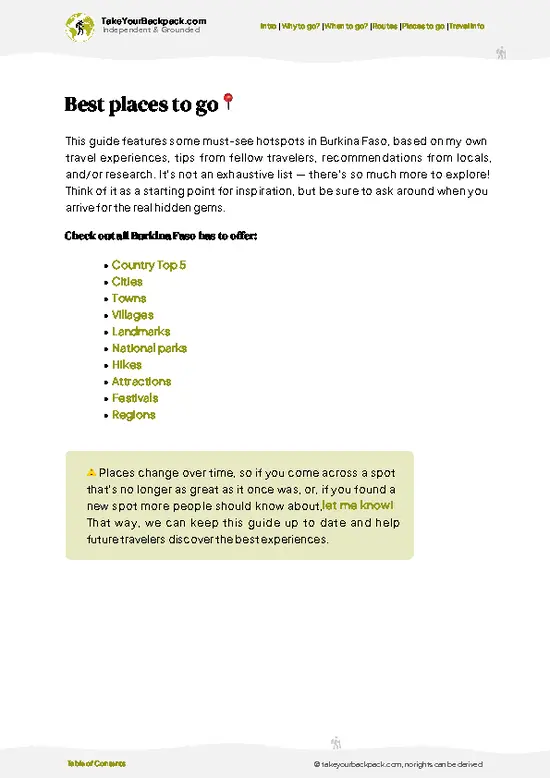
✈️ The backpacker research shortcutBurkina Faso Travel Guide

An offline-friendly backpacking guide with optimized travel routes, ranked highlights, transport advice, and the best areas to stay.
example page 0 from our offline Travel Guide for Burkina Faso
example page 1 from our offline Travel Guide for Burkina Faso
example page 2 from our offline Travel Guide for Burkina Faso
example page 3 from our offline Travel Guide for Burkina Faso
example page 4 from our offline Travel Guide for Burkina Faso
example page 5 from our offline Travel Guide for Burkina Faso
example page 6 from our offline Travel Guide for Burkina Faso
example page 7 from our offline Travel Guide for Burkina Faso
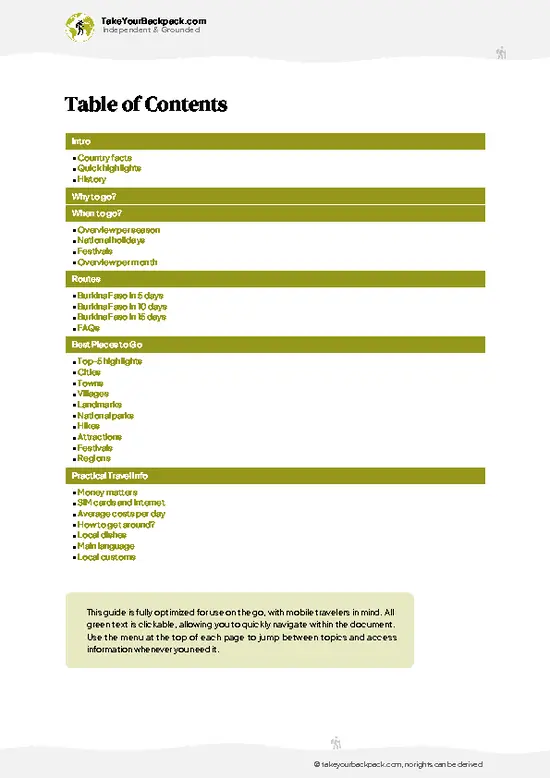
The digital guide (273 pages) contains:
✅ 63 highlights, ranked by travel appeal
✅ Optimized 5, 10 & 15-day travel routes
✅ Cities, national parks, landmarks, beaches
✅ How to get around
✅ Offline-friendly for travel without Wi-Fi
👉 Click to see all 30+ guide features

📅 Plan smarter in minutes, not weeks
✅ Month by month travel advice
✅ Festivals & national holidays
✅ Budget expectations

🗺️ Go to the right places, skip the overrated ones
✅ Honest pros & cons of destinations
✅ Top hikes, parks & viewpoints
✅ Lesser-known places most travelers miss
✅ Clear “worth it vs skip it” guidance

🛏️ Travel smoothly without rookie mistakes
✅ Best areas to stay
✅ Transport systems explained simply
✅ Common scams & safety advice
✅ SIM cards, money & practical tips

🌍 Understand the country, not just visit it
✅ Culture & traditions
✅ 52 Essential phrases & customs
✅ Festivals worth planning around
✅ Traveler-friendly historical context
✅ Insights that make places more meaningful

📱 Built for real travel conditions
✅ Fully downloadable PDF
✅ Works completely offline
✅ Optimized for phone use
✅ Useful in remote areas & buses
✅ Everything in one place
Stop searching, start planning
Get instant access to your full guide. 30‑day money-back guarantee.
+ Add another guide for just

By proceeding you agree to our terms.
Sent to your inbox immediately after payment • 100% Secure Checkout
Best Backpacking Travel Advisor 2025 tourism awardBest Backpacking
Travel Advisor
2025
What others say about Take Your Backpack Guides:
⭐⭐⭐⭐⭐
Fantastic, amazing amount of information!
⭐⭐⭐⭐⭐
My goodness this is amazing, it's what I've been looking for hats off too you!
⭐⭐⭐⭐⭐
I think this is absolutely BRILLIANT
⭐⭐⭐⭐
Very complete and informative. It's still missing places, but I gotta to commend you
⭐⭐⭐⭐⭐
This is truly amazing, thank you, can't wait to explore it with my kids!
⭐⭐⭐⭐⭐
Awesome resource, thank you!
⭐⭐⭐⭐⭐
This is amazing! Can't wait to explore the ones I haven't seen
⭐⭐⭐⭐
I love this! Well done, great idea.
⭐⭐⭐⭐⭐
Thanks for taking the time to make this gem!
⭐⭐⭐⭐⭐
This might be the best website I've ever seen.
⭐⭐⭐⭐⭐
Congratulations, and thank you so much for your work; it's incredibly valuable.
⭐⭐⭐⭐
In all seriousness I think you did a great job pointing out the important spots
⭐⭐⭐⭐⭐
10/10 very good
⭐⭐⭐⭐⭐
As someone who's only just starting to visit regularly this is awesome, thank you.
⭐⭐⭐⭐
Thank you very much! I'm going to visit my dad, it's going to be very useful!
⭐⭐⭐⭐⭐
This is really cool! We'll be travelling for the first time and this definitely come in handy.
⭐⭐⭐⭐⭐
You are now our minister of culture, congratulations 👨‍💼
⭐⭐⭐⭐⭐
Just wanted to tell you that this is a pearl! Going to follow your recommendations.
⭐⭐⭐⭐⭐
This is so cool. I'll definitely be using the resource for my travels soon.
⭐⭐⭐⭐⭐
This is very impressive! Good work.
⭐⭐⭐⭐⭐
This is an amazing and informative site. Very well done!

🛏️ Where to stay?Best Stay Options in Burkina Faso

Backpacker hostels with dorms barely exist in Burkina Faso, so budget travel here means simple auberges, church-run mission guesthouses and basic hotels at roughly 8,000 to 20,000 CFA (US$13 to 33) a night, almost all of them in the two cities still realistic for visitors. In Ouagadougou, the city center around the cathedral and the big avenues puts you near markets, maquis bars and live music but is noisy and dusty. Zone du Bois and Ouaga 2000 are quieter, greener and better guarded, at the cost of higher prices and a taxi ride for everything, while in Bobo-Dioulasso the cheap rooms cluster near the Grand Marché and the train station, walkable to the old Kibidwé quarter and the evening music … read more 👉
Backpacker hostels with dorms barely exist in Burkina Faso, so budget travel here means simple auberges, church-run mission guesthouses and basic hotels at roughly 8,000 to 20,000 CFA (US$13 to 33) a night, almost all of them in the two cities still realistic for visitors. In Ouagadougou, the city center around the cathedral and the big avenues puts you near markets, maquis bars and live music but is noisy and dusty. Zone du Bois and Ouaga 2000 are quieter, greener and better guarded, at the cost of higher prices and a taxi ride for everything, while in Bobo-Dioulasso the cheap rooms cluster near the Grand Marché and the train station, walkable to the old Kibidwé quarter and the evening music scene.

If you enjoy meeting fellow travelers, consider choosing hostels with high ratings for atmosphere. On the other hand, if you prefer having your own space, a hotel might be a better option.

Burkina FasoWhere to Go Next

👋 Meet the founderWho’s Behind Take Your Backpack?

Johan, backpacker and founder of TakeYourBackpackHi, I’m Johan (Netherlands 🇳🇱), the creator of TakeYourBackpack. Over the past 3 decades, I’ve backpacked through 90+ countries across six continents, gaining extensive experience with independent travel, long-term trips, and overland routes.

This site is built on a combination of firsthand travel experience and carefully curated insights from other backpackers. Many guides are based on places I’ve personally visited, while others bring together tips, observations, and practical advice shared by trusted travelers I’ve met along the way.

The goal is to provide realistic, experience-driven guidance — not generic itineraries — so you can explore destinations with better context, clearer expectations, and more confidence.