×

Cameroon🇨🇲 | national parksMefou National ParkRescued apes, mandrill faces, short forest paths, caretaker feeding rounds | things to do and best time to go

Explore Kimbi-Fungom National ParkExplore Bamenda Highlands

Backpacking in Mefou
🌟 Highlightnational park ranked #6
By Johan Kruseman 🇳🇱 | Updated October 22, 2026

Mefou National Park is mostly a primate sanctuary, and the walking here happens on short forest paths between enclosures rather than on a wilderness trail network. It lies in Cameroon, southwest of Yaoundé, in green hills where the air smells of wet earth and ripe fruit. You hear chimps hooting and gorillas thumping long before you see them. Pros are close encounters with rescued apes and a quiet, humid forest; the downside is that the trails are brief and you cannot roam freely. Roads can be rough and slow, and rain turns clay tracks to soup. Avoid wasted money and time by arranging a driver round trip rather than hunting for a ride back at dusk, and by wearing closed shoes and bringing cash. Book your visit ahead, because staff limit numbers.

Discover everything you want to know in the 📖 Cameroon Travel Guide.
Best time to go: October - April
Daily cost: €58
Duration: 2 to 3 hours
Distance: 7 kilometers
Total ascent: 600 meters


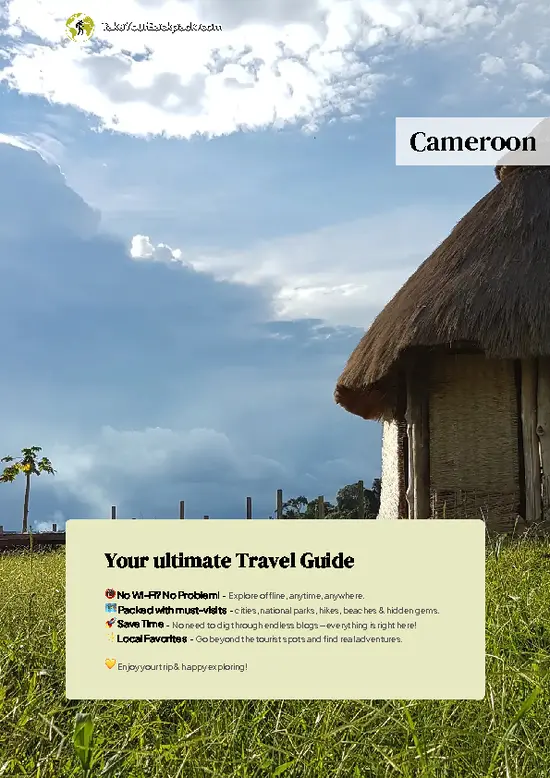
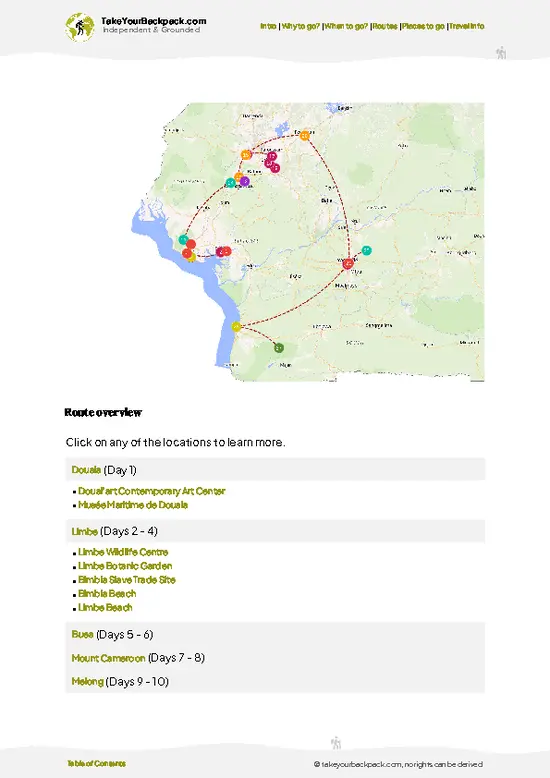
example page 0 from our offline Travel Guide for Cameroon
example page 1 from our offline Travel Guide for Cameroon
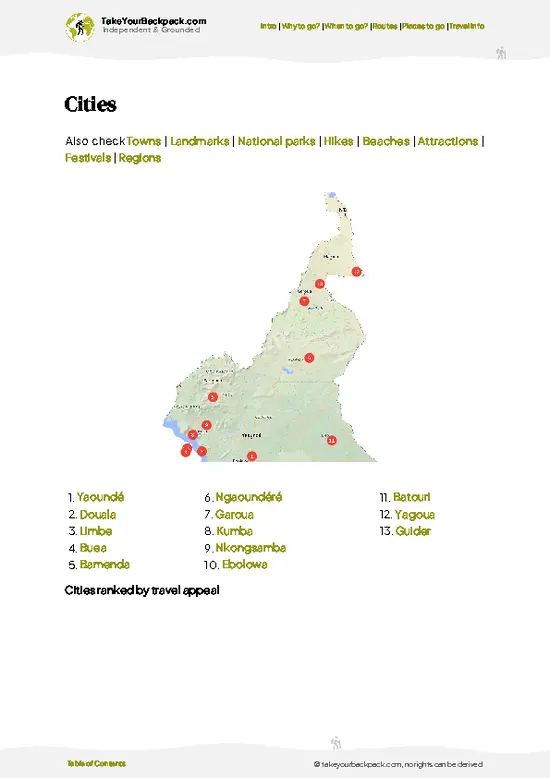
example page 2 from our offline Travel Guide for Cameroon
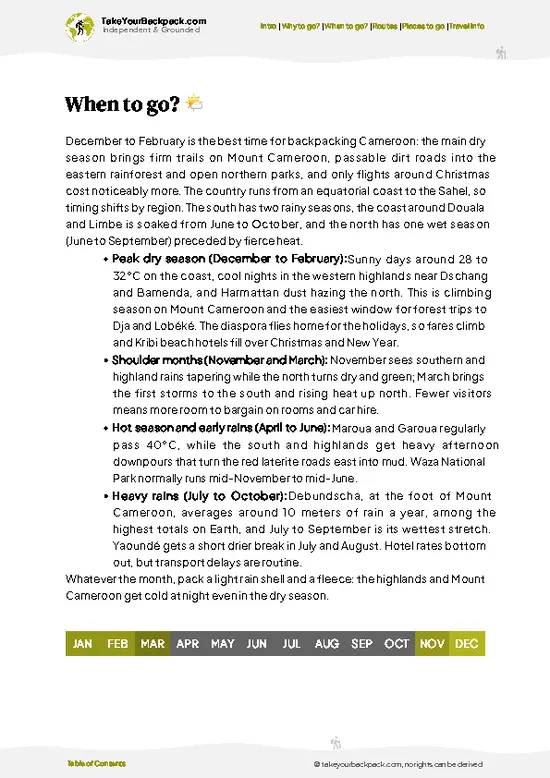
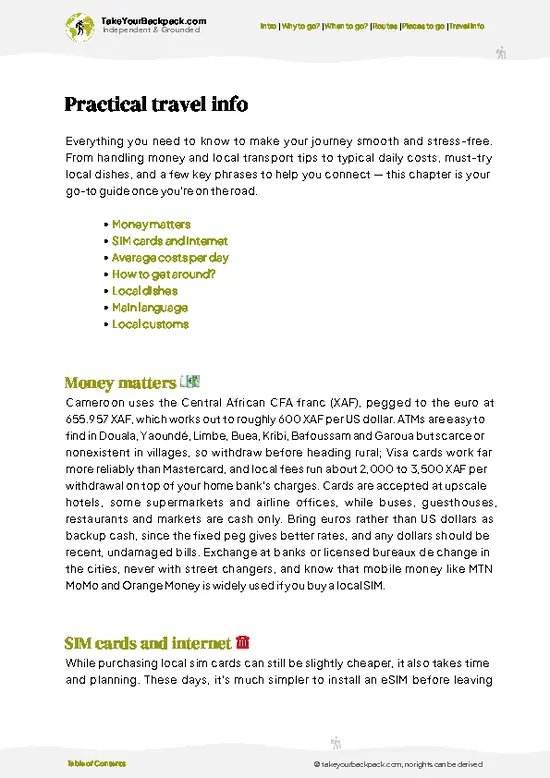
example page 3 from our offline Travel Guide for Cameroon
example page 4 from our offline Travel Guide for Cameroon
example page 5 from our offline Travel Guide for Cameroon
example page 6 from our offline Travel Guide for Cameroon
example page 7 from our offline Travel Guide for Cameroon
Loading the map 🌍
CLICK TO FILTER
cities
towns
landmarks
national parks
hikes
beaches
attractions
festivals
regions
SHOW COUNTRY’S BESTSHOW ALL

✨ Why go?
Ranked #6 national park in Cameroon
What makes this national park worth exploring

Mefou National Park suits backpackers who want wildlife without paying for a safari package. Its main draw is the rescued primates: chimpanzees, gorillas and several monkey species live in forested enclosures, and you see them with a guide who explains each animal’s story. The bush road in is simple enough to sort out yourself from the capital, and the rainforest here feels far wilder than the short distance suggests. Many travelers appreciate the rescued chimpanzee and gorilla enclosures because the visit supports a working sanctuary, so your money goes to animal care. A guided walk through the forest paths between the primate sites gives you sweat, birdsong and red mud underfoot. It is also a half-day outing, so it fits easily around city sightseeing. Self-guided travelers get more flexibility … read more 👉
Mefou National Park suits backpackers who want wildlife without paying for a safari package. Its main draw is the rescued primates: chimpanzees, gorillas and several monkey species live in forested enclosures, and you see them with a guide who explains each animal’s story. The bush road in is simple enough to sort out yourself from the capital, and the rainforest here feels far wilder than the short distance suggests. Many travelers appreciate the rescued chimpanzee and gorilla enclosures because the visit supports a working sanctuary, so your money goes to animal care. A guided walk through the forest paths between the primate sites gives you sweat, birdsong and red mud underfoot. It is also a half-day outing, so it fits easily around city sightseeing. Self-guided travelers get more flexibility than tour groups on timing, though the guided format inside the park is fixed and worth following.

💡 HighlightsDon't-miss highlights and experiences

  1. Chimpanzee enclosures: Large forested enclosures hold orphaned chimps, and you watch grooming, play and hierarchy disputes from a short distance, with caretakers naming each animal.
  2. Gorilla habitat: Western lowland gorillas live here after being confiscated from the bushmeat and pet trades, and the silverbacks are impressive even from behind a barrier.
  3. Monkey enclosures: Mandrills, guenons and other monkeys live in separate areas. Mandrill faces are strikingly colored, red and blue, and easy to photograph.
  4. Guided forest walk: The guide leads you along shaded paths through secondary rainforest, pointing out fruit trees, medicinal plants and the calls of hidden birds.
  5. Mefou River edge: The sanctuary sits close to forested streams where butterflies gather in the damp, and the sound of running water
… read more 👉
  1. Chimpanzee enclosures: Large forested enclosures hold orphaned chimps, and you watch grooming, play and hierarchy disputes from a short distance, with caretakers naming each animal.
  2. Gorilla habitat: Western lowland gorillas live here after being confiscated from the bushmeat and pet trades, and the silverbacks are impressive even from behind a barrier.
  3. Monkey enclosures: Mandrills, guenons and other monkeys live in separate areas. Mandrill faces are strikingly colored, red and blue, and easy to photograph.
  4. Guided forest walk: The guide leads you along shaded paths through secondary rainforest, pointing out fruit trees, medicinal plants and the calls of hidden birds.
  5. Mefou River edge: The sanctuary sits close to forested streams where butterflies gather in the damp, and the sound of running water cuts through the heat.
  6. Caretaker feeding rounds: Watching the keepers prepare fruit and distribute it shows how much daily work the rescue demands, and you will see the animals’ excitement firsthand.
Mefou National Park takes about two to three hours to see in full, so a morning visit leaves the afternoon free.
Spotted a mistake or missing something? Contact us.

Things to do near Mefou National Park

Ratings based on Tripadvisor reviews. When you book through this link, you support our work at no extra cost to you.

🌤️ When to go?Best time to explore Mefou

  • Long dry season (December to February): The most comfortable window for walking the forest trails near the sanctuary, with mornings around 20°C (68°F) and afternoons of 29 to 32°C (84 to 90°F). Roads from Yaoundé stay firm, and the primates are easy to see at feeding times. Expect the most visitors, mainly on weekends.
  • Short rainy season (March to June): Afternoon downpours turn red clay paths slick, with highs of 27 to 30°C (81 to 86°F) and heavy humidity. Fewer groups show up and guesthouses rarely fill.
  • Short dry spell (July to August): Cloudier and slightly cooler at 24 to 28°C (75 to 82°F), with lighter rain and thin crowds. Good for a quieter visit.
  • Big rains (September to November): The wettest stretch, with frequent storms and muddy access tracks. Prices barely change, but trails are
… read more 👉
  • Long dry season (December to February): The most comfortable window for walking the forest trails near the sanctuary, with mornings around 20°C (68°F) and afternoons of 29 to 32°C (84 to 90°F). Roads from Yaoundé stay firm, and the primates are easy to see at feeding times. Expect the most visitors, mainly on weekends.
  • Short rainy season (March to June): Afternoon downpours turn red clay paths slick, with highs of 27 to 30°C (81 to 86°F) and heavy humidity. Fewer groups show up and guesthouses rarely fill.
  • Short dry spell (July to August): Cloudier and slightly cooler at 24 to 28°C (75 to 82°F), with lighter rain and thin crowds. Good for a quieter visit.
  • Big rains (September to November): The wettest stretch, with frequent storms and muddy access tracks. Prices barely change, but trails are hard going.
  • Daylight: Close to the equator, days run about 12 hours all year, so plan to be back before dark.
Book a weekday morning visit in any season to avoid the weekend crowds from Yaoundé.


source: climatestotravel.comJANJanuary: excellent for travelingFEBFebruary: excellent for travelingMARMarch: excellent for travelingAPRApril: highly recommended for travelingMAYMay: fair for travelingJUNJune: fair for travelingJULJuly: fair for travelingAUGAugust: fair for travelingSEPSeptember: fair for travelingOCTOctober: highly recommended for travelingNOVNovember: excellent for travelingDECDecember: excellent for traveling
when-to-go

✈️ The backpacker research shortcutCameroon Travel Guide

An offline-friendly backpacking guide with optimized travel routes, ranked highlights, transport advice, and the best areas to stay.
example page 0 from our offline Travel Guide for Cameroon
example page 1 from our offline Travel Guide for Cameroon
example page 2 from our offline Travel Guide for Cameroon
example page 3 from our offline Travel Guide for Cameroon
example page 4 from our offline Travel Guide for Cameroon
example page 5 from our offline Travel Guide for Cameroon
example page 6 from our offline Travel Guide for Cameroon
example page 7 from our offline Travel Guide for Cameroon
The digital guide (351 pages) contains:
✅ 84 highlights, ranked by travel appeal
✅ Optimized 7, 14 & 21-day travel routes
✅ Cities, national parks, landmarks, beaches
✅ How to get around
✅ Offline-friendly for travel without Wi-Fi
👉 Click to see all 30+ guide features

📅 Plan smarter in minutes, not weeks
✅ Month by month travel advice
✅ Festivals & national holidays
✅ Budget expectations

🗺️ Go to the right places, skip the overrated ones
✅ Honest pros & cons of destinations
✅ Top hikes, parks & viewpoints
✅ Lesser-known places most travelers miss
✅ Clear “worth it vs skip it” guidance

🛏️ Travel smoothly without rookie mistakes
✅ Best areas to stay
✅ Transport systems explained simply
✅ Common scams & safety advice
✅ SIM cards, money & practical tips

🌍 Understand the country, not just visit it
✅ Culture & traditions
✅ 52 Essential phrases & customs
✅ Festivals worth planning around
✅ Traveler-friendly historical context
✅ Insights that make places more meaningful

📱 Built for real travel conditions
✅ Fully downloadable PDF
✅ Works completely offline
✅ Optimized for phone use
✅ Useful in remote areas & buses
✅ Everything in one place
Stop searching, start planning
Get instant access to your full guide. 30‑day money-back guarantee.
+ Add another guide for just

By proceeding you agree to our terms.
Sent to your inbox immediately after payment • 100% Secure Checkout
Best Backpacking Travel Advisor 2025 tourism awardBest Backpacking
Travel Advisor
2025
What others say about Take Your Backpack Guides:
⭐⭐⭐⭐⭐
Fantastic, amazing amount of information!
⭐⭐⭐⭐⭐
My goodness this is amazing, it's what I've been looking for hats off too you!
⭐⭐⭐⭐⭐
I think this is absolutely BRILLIANT
⭐⭐⭐⭐
Very complete and informative. It's still missing places, but I gotta to commend you
⭐⭐⭐⭐⭐
This is truly amazing, thank you, can't wait to explore it with my kids!
⭐⭐⭐⭐⭐
Awesome resource, thank you!
⭐⭐⭐⭐⭐
This is amazing! Can't wait to explore the ones I haven't seen
⭐⭐⭐⭐
I love this! Well done, great idea.
⭐⭐⭐⭐⭐
Thanks for taking the time to make this gem!
⭐⭐⭐⭐⭐
This might be the best website I've ever seen.
⭐⭐⭐⭐⭐
Congratulations, and thank you so much for your work; it's incredibly valuable.
⭐⭐⭐⭐
In all seriousness I think you did a great job pointing out the important spots
⭐⭐⭐⭐⭐
10/10 very good
⭐⭐⭐⭐⭐
As someone who's only just starting to visit regularly this is awesome, thank you.
⭐⭐⭐⭐
Thank you very much! I'm going to visit my dad, it's going to be very useful!
⭐⭐⭐⭐⭐
This is really cool! We'll be travelling for the first time and this definitely come in handy.
⭐⭐⭐⭐⭐
You are now our minister of culture, congratulations 👨‍💼
⭐⭐⭐⭐⭐
Just wanted to tell you that this is a pearl! Going to follow your recommendations.
⭐⭐⭐⭐⭐
This is so cool. I'll definitely be using the resource for my travels soon.
⭐⭐⭐⭐⭐
This is very impressive! Good work.
⭐⭐⭐⭐⭐
This is an amazing and informative site. Very well done!

🛏️ Where to stay?How to pick the right area

Most backpackers sleep in Yaoundé, about 20 to 30 km away, since Mefou National Park has no campground or lodging inside its boundaries for independent travelers. The capital gives you the widest choice, from basic guesthouses at €12 to 25 a night to comfortable mid-range hotels at €35 to 60. Neighborhoods such as Bastos, Mvan and the area around Nlongkak offer restaurants, ATMs and taxis within easy reach, which suits a trip where you want to come and go on your own schedule.
Closer to the park, small family-run lodges and a few eco-style guesthouses around Afamba and the Mefou area take overnight … read more 👉
Most backpackers sleep in Yaoundé, about 20 to 30 km away, since Mefou National Park has no campground or lodging inside its boundaries for independent travelers. The capital gives you the widest choice, from basic guesthouses at €12 to 25 a night to comfortable mid-range hotels at €35 to 60. Neighborhoods such as Bastos, Mvan and the area around Nlongkak offer restaurants, ATMs and taxis within easy reach, which suits a trip where you want to come and go on your own schedule.
Closer to the park, small family-run lodges and a few eco-style guesthouses around Afamba and the Mefou area take overnight guests, usually at €20 to 50 including breakfast. Some sanctuary-linked operations arrange simple rooms for volunteers or researchers, but they are arranged in advance and are not a walk-in option. If you want a forest-edge night with birdsong at dawn, book ahead by phone or WhatsApp and confirm transport, as shared taxis out there are scarce after midday. For a first visit, I would stay in Yaoundé and hire a driver for the morning.

👛 Costs (as of 22 October 2026)Money, prices, and spending tips

A day at Mefou National Park typically costs about €58 per backpacker when you base yourself in Yaoundé and hire a driver for the visit. Everything is paid in Central African francs, and cash is the norm outside the capital.
CategoryBudget RangeLocal Reality
Entrance and guided visit€8 to 15Sanctuary visits are guided, with fees varying by group and nationality.
Accommodation (high season)€15 to 25Basic Yaoundé guesthouse; mid-range rooms run €35 to 60, and low season is slightly cheaper.
Local transport€10 to 20Shared taxis to the area are cheap but slow; a private driver for a half day costs more.
Food and water€6 to 12Street grills and local restaurants are cheap, and simple meals are available near the park.
Extras and tips€2 to 5Small tips for guides and a bit of cash for snacks and bottled
… read more 👉
A day at Mefou National Park typically costs about €58 per backpacker when you base yourself in Yaoundé and hire a driver for the visit. Everything is paid in Central African francs, and cash is the norm outside the capital.
CategoryBudget RangeLocal Reality
Entrance and guided visit€8 to 15Sanctuary visits are guided, with fees varying by group and nationality.
Accommodation (high season)€15 to 25Basic Yaoundé guesthouse; mid-range rooms run €35 to 60, and low season is slightly cheaper.
Local transport€10 to 20Shared taxis to the area are cheap but slow; a private driver for a half day costs more.
Food and water€6 to 12Street grills and local restaurants are cheap, and simple meals are available near the park.
Extras and tips€2 to 5Small tips for guides and a bit of cash for snacks and bottled water.
Total Daily Budget€58Realistic for a day trip from Yaoundé.
⚠️ Prices can change and everyone travels differently, so take this as a rough guide. Hope it helps you plan your adventure!

🥾 TrailsHiking Mefou national park: highlights and difficulty

Mefou National Park has no marked long-distance network, so the hiking is a guided circuit on short forest paths linking the primate areas. The terrain is gentle, with red clay that turns slick after rain, and the walking is easy for almost any fitness level.
  • Guided sanctuary walk: Starts at the reception area and passes the main primate enclosures; about two to three hours at a slow pace, easy difficulty, with some muddy uphill stretches.
  • Forest paths: Short side trails through shaded secondary forest, where you may spot birds, butterflies and the occasional wild monkey; easy, uneven footing.
  • Wildlife:
… read more 👉
Mefou National Park has no marked long-distance network, so the hiking is a guided circuit on short forest paths linking the primate areas. The terrain is gentle, with red clay that turns slick after rain, and the walking is easy for almost any fitness level.
  • Guided sanctuary walk: Starts at the reception area and passes the main primate enclosures; about two to three hours at a slow pace, easy difficulty, with some muddy uphill stretches.
  • Forest paths: Short side trails through shaded secondary forest, where you may spot birds, butterflies and the occasional wild monkey; easy, uneven footing.
  • Wildlife: Chimpanzees, gorillas, mandrills and several guenon species live in the enclosures, and the guides explain each animal’s rescue history.
  • Footwear: Closed shoes with grip are best, because the clay holds water and insects are active near the streams.
Reaching the sanctuary from Yaoundé takes a private car or a taxi arranged for the round trip, since public transport along the final stretch is unreliable. Visits are by reservation, and numbers are kept small, so it rarely feels crowded. An entrance and guide fee applies, usually in the range of €10 to 20, paid in local currency, and cash is the safest way to pay. Mornings are cooler and the animals are livelier then.
⚠️ Hiking info can sometimes be outdated or inaccurate. Before you hit the trail, check the latest conditions with locals. If you do spot anything that's off, I'd love to hear from you, so I can update it for fellow travelers.

🛡️ SafetyScams, Hazards, and Annoyances

Mefou National Park is a low-risk place to walk, provided you treat the forest and the sanctuary rules seriously. The main trail issues are heat, humidity and slippery red clay after rain, so wear shoes with real grip, carry at least 2 liters of water and start early. Paths are short and mostly marked, but go with a guide so you do not wander onto unmarked tracks. Mosquitoes are active at dawn and dusk, so bring repellent and check your malaria prevention with a doctor before you leave.
The apes and monkeys are the wildlife you will meet. Keep your distance, never feed them, and keep bags zipped, as primates grab snacks and bottles. Visitors with a cold or cough should stay away from them, since diseases pass easily to great apes. In Yaoundé, take registered taxis and keep phones out of sight.

FAQFrequently asked questions about Mefou

One day is enough for Mefou National Park, since the guided sanctuary visit takes about two to three hours. Add a second day if you want to stay near the forest edge or combine it with Yaoundé sights. From the capital, the drive is roughly 45 to 90 minutes depending on traffic.
Mefou National Park can be reached without a car, but it takes planning. Shared taxis run from Yaoundé toward the Mefou area for a few euros, and you then finish by moto-taxi at around €1 to 3. Most backpackers hire a driver for a half day at about €20 to 40, which saves time and avoids stranded returns.
Yes, Mefou National Park charges a fee for guided visits, usually about €8 to 15 per person depending on the group and your nationality. No separate hiking permit is normally needed for the standard sanctuary tour, but you should book ahead by phone or message, especially on weekends. Bring cash, as card payments are rare.
⚠️ Things can change over time, so always validate details locally before you go.

Other Cameroonian national parks near Mefou

Explore more nearby:


💡 Not sure where to go next?
Create a personalized itinerary for Cameroon including Mefou and the places that fit your trip.

Generate my itinerary

👉 Discover all national parks

Or checkout all Cameroon has to offer (think cities, towns, villages, national parks, hikes, beaches, festivals)
Country photo of Cameroon

We 💚 feedbackFinal thoughts on exploring Mefou

Mefou National Park rewards those who watch the caretakers as closely as the apes. The daily feeding and care routines show how much work sits behind each animal’s rescue, and the keepers answer questions gladly. I would arrive early, wear boots you do not mind staining red, and keep your phone in a zip bag against the humidity.

✍️ Help improve this page!
The information on this page is based on in-depth research, insights shared by experienced travelers, and feedback from the local travel community in Cameroon. While every effort is made to keep the information accurate and current, conditions can change — so if you spot anything incorrect or outdated, please get in touch.


🙋‍♂️ Give feedback

👋 Meet the founderWho’s Behind Take Your Backpack?

Johan, backpacker and founder of TakeYourBackpackHi, I’m Johan (Netherlands 🇳🇱), the creator of TakeYourBackpack. Over the past 3 decades, I’ve backpacked through 90+ countries across six continents, gaining extensive experience with independent travel, long-term trips, and overland routes.

This site is built on a combination of firsthand travel experience and carefully curated insights from other backpackers. Many guides are based on places I’ve personally visited, while others bring together tips, observations, and practical advice shared by trusted travelers I’ve met along the way.

The goal is to provide realistic, experience-driven guidance — not generic itineraries — so you can explore destinations with better context, clearer expectations, and more confidence.