×

Cameroon🇨🇲 | national parksNki National ParkForest clearings, Congo Basin interior, swamp crossings, tent camping | things to do and best time to go

Explore Lobéké National ParkExplore Deng Deng National Park

Backpacking in Nki
👌 Worth visitingnational park ranked #10
By Johan Kruseman 🇳🇱 | Updated October 22, 2026

Nki National Park has no tourist infrastructure at all, so you arrive with every meal, filter and permit already sorted. It sits in the far southeast of Cameroon, in the East Region, along the Congo border and the Dja and Boumba Bek forest belt. The reason is simple: the park is remote, rarely visited and built for researchers and conservation teams, so go through a Yaoundé operator or the conservation office and hire a local guide. Inside, the light is green and filtered, the air smells of wet leaf litter, and the dawn chorus of hornbills and monkeys is loud. Mud sticks to everything, and the humidity soaks your pack. Forest elephants, gorillas and chimpanzees live here, but you hear them far more often than you see them. Expect thick vines, buzzing sweat bees and the hush of the canopy.

Discover everything you want to know in the 📖 Cameroon Travel Guide.


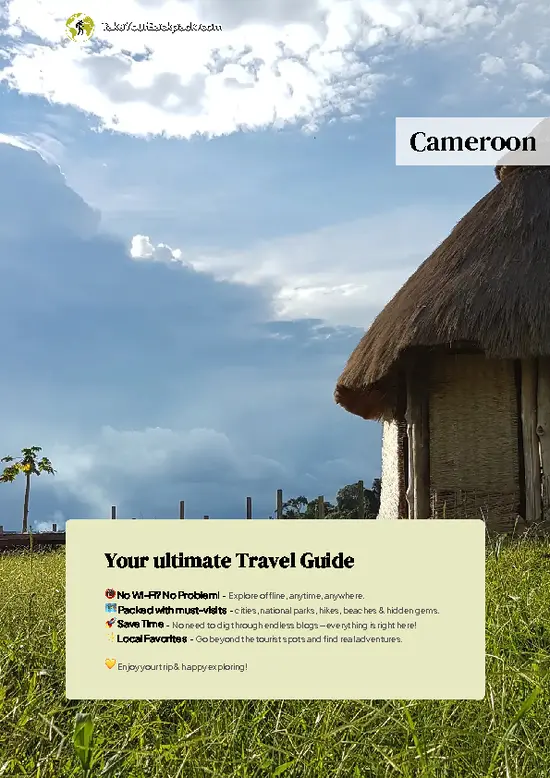
example page 0 from our offline Travel Guide for Cameroon
example page 1 from our offline Travel Guide for Cameroon
example page 2 from our offline Travel Guide for Cameroon
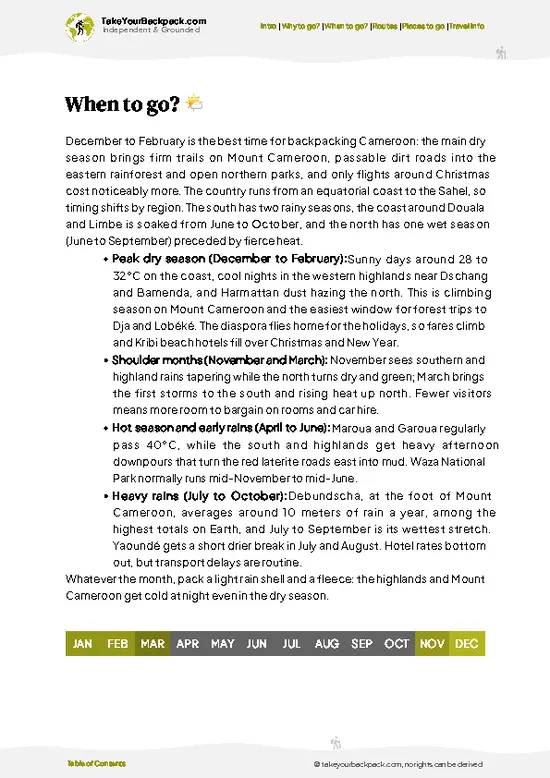
example page 3 from our offline Travel Guide for Cameroon
example page 4 from our offline Travel Guide for Cameroon
example page 5 from our offline Travel Guide for Cameroon
example page 6 from our offline Travel Guide for Cameroon
example page 7 from our offline Travel Guide for Cameroon
Loading the map 🌍
CLICK TO FILTER
cities
towns
landmarks
national parks
hikes
beaches
attractions
festivals
regions
SHOW COUNTRY’S BESTSHOW ALL

✨ Why go?
Ranked #10 national park in Cameroon
Why visitors keep coming back

Nki National Park is for travelers who want primary rainforest without another group in sight. The park is part of the Sangha Trinational landscape, and the forest here is dense, wet and almost untouched. Independent travelers choose it because the experience is built around self-sufficiency: you carry a tent, cook on a stove and walk with a tracker rather than join a coach tour. A local guide and tracker team is the realistic way in, and they read footprints, dung and fruit trees in a way no map can. The reward is the chance of forest elephants at a clearing and the sound of gorillas and chimpanzees moving through the understory. If you want a trail marked every 200 meters and a café at the end, this is the wrong park. If you want silence and real forest, it is the right one.

💡 HighlightsKey sights and experiences for travelers

  1. Forest elephants at the clearings: Elephants come to mineral-rich openings in the forest, and watching from cover is the park’s signature wildlife moment.
  2. Western lowland gorillas: Groups live in the dense understory, and trackers follow nests, feeding signs and calls rather than fixed routes.
  3. Chimpanzees: Their pant-hoots carry across the canopy at dawn, and fruiting trees are where trackers search first.
  4. Primary rainforest walking: Buttressed trunks, hanging lianas and a dim floor of leaf litter give you a true Congo Basin forest on foot.
  5. Rivers and swamp forest: Seasonally flooded stretches and streams hold dwarf crocodiles, fish and waterbirds, and crossings are part of the walk.
  6. Forest birds and monkeys: Hornbills, parrots and several monkey species are easiest to hear and spot along river
… read more 👉
  1. Forest elephants at the clearings: Elephants come to mineral-rich openings in the forest, and watching from cover is the park’s signature wildlife moment.
  2. Western lowland gorillas: Groups live in the dense understory, and trackers follow nests, feeding signs and calls rather than fixed routes.
  3. Chimpanzees: Their pant-hoots carry across the canopy at dawn, and fruiting trees are where trackers search first.
  4. Primary rainforest walking: Buttressed trunks, hanging lianas and a dim floor of leaf litter give you a true Congo Basin forest on foot.
  5. Rivers and swamp forest: Seasonally flooded stretches and streams hold dwarf crocodiles, fish and waterbirds, and crossings are part of the walk.
  6. Forest birds and monkeys: Hornbills, parrots and several monkey species are easiest to hear and spot along river edges and fruiting trees.
  7. Night sounds in camp: Tree hyraxes shriek, frogs chorus and insects hum around your tent in complete darkness, with no light pollution at all.
For a first visit, choose the elephant clearings, because they give the most reliable wildlife encounter in this thick forest.
Spotted a mistake or missing something? Contact us.

🌤️ When to go?When to go for the best experience

  • Main Dry Season (December to February): Rain eases and forest tracks firm up, so trekking is most comfortable. Days reach 28 to 31°C (82 to 88°F), nights drop to about 20°C (68°F). Expect roughly 12 hours of daylight all year.
  • Short Dry Spell (July to August): Cloud is thick and showers still come, but river levels are manageable. Temperatures sit around 25 to 28°C (77 to 82°F).
  • Wet Seasons (March to June, September to November): Downpours are near daily, trails turn to mud, and rivers rise. Leeches and sweat bees multiply.
  • Crowds and Prices: Nki sees only a handful of visitors, so crowds are not a factor. Guide and vehicle hire cost the same year-round, though availability tightens in the dry months.
Book your guide and transport weeks ahead for a December or January trip.

source: climatestotravel.comJANJanuary: excellent for travelingFEBFebruary: excellent for travelingMARMarch: fair for travelingAPRApril: fair for travelingMAYMay: fair for travelingJUNJune: fair for travelingJULJuly: fair for travelingAUGAugust: fair for travelingSEPSeptember: fair for travelingOCTOctober: fair for travelingNOVNovember: excellent for travelingDECDecember: excellent for traveling
when-to-go

✈️ The backpacker research shortcutCameroon Travel Guide

An offline-friendly backpacking guide with optimized travel routes, ranked highlights, transport advice, and the best areas to stay.
example page 0 from our offline Travel Guide for Cameroon
example page 1 from our offline Travel Guide for Cameroon
example page 2 from our offline Travel Guide for Cameroon
example page 3 from our offline Travel Guide for Cameroon
example page 4 from our offline Travel Guide for Cameroon
example page 5 from our offline Travel Guide for Cameroon
example page 6 from our offline Travel Guide for Cameroon
example page 7 from our offline Travel Guide for Cameroon
The digital guide (351 pages) contains:
✅ 84 highlights, ranked by travel appeal
✅ Optimized 7, 14 & 21-day travel routes
✅ Cities, national parks, landmarks, beaches
✅ How to get around
✅ Offline-friendly for travel without Wi-Fi
👉 Click to see all 30+ guide features

📅 Plan smarter in minutes, not weeks
✅ Month by month travel advice
✅ Festivals & national holidays
✅ Budget expectations

🗺️ Go to the right places, skip the overrated ones
✅ Honest pros & cons of destinations
✅ Top hikes, parks & viewpoints
✅ Lesser-known places most travelers miss
✅ Clear “worth it vs skip it” guidance

🛏️ Travel smoothly without rookie mistakes
✅ Best areas to stay
✅ Transport systems explained simply
✅ Common scams & safety advice
✅ SIM cards, money & practical tips

🌍 Understand the country, not just visit it
✅ Culture & traditions
✅ 52 Essential phrases & customs
✅ Festivals worth planning around
✅ Traveler-friendly historical context
✅ Insights that make places more meaningful

📱 Built for real travel conditions
✅ Fully downloadable PDF
✅ Works completely offline
✅ Optimized for phone use
✅ Useful in remote areas & buses
✅ Everything in one place
Stop searching, start planning
Get instant access to your full guide. 30‑day money-back guarantee.
+ Add another guide for just

By proceeding you agree to our terms.
Sent to your inbox immediately after payment • 100% Secure Checkout
Best Backpacking Travel Advisor 2025 tourism awardBest Backpacking
Travel Advisor
2025
What others say about Take Your Backpack Guides:
⭐⭐⭐⭐⭐
Fantastic, amazing amount of information!
⭐⭐⭐⭐⭐
My goodness this is amazing, it's what I've been looking for hats off too you!
⭐⭐⭐⭐⭐
I think this is absolutely BRILLIANT
⭐⭐⭐⭐
Very complete and informative. It's still missing places, but I gotta to commend you
⭐⭐⭐⭐⭐
This is truly amazing, thank you, can't wait to explore it with my kids!
⭐⭐⭐⭐⭐
Awesome resource, thank you!
⭐⭐⭐⭐⭐
This is amazing! Can't wait to explore the ones I haven't seen
⭐⭐⭐⭐
I love this! Well done, great idea.
⭐⭐⭐⭐⭐
Thanks for taking the time to make this gem!
⭐⭐⭐⭐⭐
This might be the best website I've ever seen.
⭐⭐⭐⭐⭐
Congratulations, and thank you so much for your work; it's incredibly valuable.
⭐⭐⭐⭐
In all seriousness I think you did a great job pointing out the important spots
⭐⭐⭐⭐⭐
10/10 very good
⭐⭐⭐⭐⭐
As someone who's only just starting to visit regularly this is awesome, thank you.
⭐⭐⭐⭐
Thank you very much! I'm going to visit my dad, it's going to be very useful!
⭐⭐⭐⭐⭐
This is really cool! We'll be travelling for the first time and this definitely come in handy.
⭐⭐⭐⭐⭐
You are now our minister of culture, congratulations 👨‍💼
⭐⭐⭐⭐⭐
Just wanted to tell you that this is a pearl! Going to follow your recommendations.
⭐⭐⭐⭐⭐
This is so cool. I'll definitely be using the resource for my travels soon.
⭐⭐⭐⭐⭐
This is very impressive! Good work.
⭐⭐⭐⭐⭐
This is an amazing and informative site. Very well done!

🛏️ Where to stay?Best areas and accommodation options

No hotels exist inside Nki National Park, so you sleep in tents or basic camps arranged through your guide. Wild camping near the Ndjangui or Ngoïla-linked entry points is the usual backpacker approach, and you carry your own shelter, mosquito protection and cooking gear. Some village hosts on the park edge will let you pitch a tent or offer a plain room for about €5 to 10.

The real bases are towns on the approach. Yokadouma and Mouloundou are the nearest hubs from the east side, with simple guesthouses at €8 to 20 a night, fans, and sometimes generators only in the evening. Abong-Mbang and Lomié … read more 👉
No hotels exist inside Nki National Park, so you sleep in tents or basic camps arranged through your guide. Wild camping near the Ndjangui or Ngoïla-linked entry points is the usual backpacker approach, and you carry your own shelter, mosquito protection and cooking gear. Some village hosts on the park edge will let you pitch a tent or offer a plain room for about €5 to 10.

The real bases are towns on the approach. Yokadouma and Mouloundou are the nearest hubs from the east side, with simple guesthouses at €8 to 20 a night, fans, and sometimes generators only in the evening. Abong-Mbang and Lomié sit further west and serve as supply stops where you buy rice, tinned fish, fuel and batteries. Yaoundé is the last place for proper gear and cash, with hostels and budget hotels from €15 to 35. Arrange everything through WWF or the conservator’s office before you leave town.

👛 Costs (as of 22 October 2026)How expensive it really is

Nki National Park costs roughly €5 to 10 a day for a guided backpacking trip, with the Total Daily Budget row at about €62. Costs are driven by guide and transport, not entry. Everything is paid in cash, so carry it from Yaoundé.
CategoryBudget RangeLocal Reality
Entrance and permits€5 to 10Paid through park authorities or WWF office, usually arranged ahead
Accommodation (high season)€5 to 20Own tent at the edge, or a basic guesthouse in Yokadouma or Lomié
Guide and porters€15 to 25Local guide essential, porters cost extra per day
Local transport€10 to 20Shared bush taxis or motorbikes to trailheads, rates vary with road condition
Food and supplies€7 to 12Rice, bread, tinned fish and market produce, little available in the forest
Total Daily Budget€62Higher if you hire a private vehicle


source: wwf.org
⚠️ Prices can change and everyone travels differently, so take this as a rough guide. Hope it helps you plan your adventure!

🥾 TrailsPlan your hike in Nki: routes, terrain, and sights

Nki National Park has no signposted trails, so hikes follow tracker paths, animal routes and rivers rather than named, measured routes. Most walks begin at the camp or the forest edge near the park boundary and push into dense forest.
  • Elephant clearing walks: Several hours of walking through wet forest to open mineral clearings, where you wait quietly in cover. Moderate to hard because of mud and humidity.
  • Gorilla and chimp tracking: Full days following signs with a guide. Terrain is uneven, with roots, vines and stream crossings, so fitness matters more than speed.
  • River and swamp forest routes:
… read more 👉
Nki National Park has no signposted trails, so hikes follow tracker paths, animal routes and rivers rather than named, measured routes. Most walks begin at the camp or the forest edge near the park boundary and push into dense forest.
  • Elephant clearing walks: Several hours of walking through wet forest to open mineral clearings, where you wait quietly in cover. Moderate to hard because of mud and humidity.
  • Gorilla and chimp tracking: Full days following signs with a guide. Terrain is uneven, with roots, vines and stream crossings, so fitness matters more than speed.
  • River and swamp forest routes: Slower going, often with wading, where you look for birds, monkeys and dwarf crocodiles.
  • Overnight forest treks: Multi-day walks with a tent, carried food and water filtration, for those with forest experience.
Getting there is the hard part. Public transport reaches the East Region towns, but the final stretch is by 4x4 on rough forest tracks, and there is no regular service to the park. Plan the journey through an operator or the conservation office, and expect almost no other visitors. An entry fee and guide charges apply, and you should arrange them in advance. Rain turns tracks to mud, and insects, leeches and heat are constant, so wear long sleeves and sturdy boots.
⚠️ Hiking info can sometimes be outdated or inaccurate. Before you hit the trail, check the latest conditions with locals. If you do spot anything that's off, I'd love to hear from you, so I can update it for fellow travelers.

🛡️ SafetyTraveler Safety Guide

Nki National Park is remote rainforest, so the main risks are logistical rather than dramatic. Go with a local guide, because trails are faint, signs are absent, and phone signal is nonexistent. Footing is slippery and stream crossings swell fast after rain, so waterproof boots, a dry bag and an early start matter. Heat and humidity drain you quickly; carry purification tablets and drink steadily. Malaria is present, so start prophylaxis and use a treated net. Forest elephants, gorillas and buffalo live here, and your guide will set the behavior: stay quiet, keep your distance, and never run. Bring a full first-aid kit, since the nearest clinic is hours away by rough road.

FAQCommon questions from travelers

Plan on 5 to 7 days for Nki National Park once you count travel. The approach from Yaoundé to Yokadouma or Lomié takes a full day or more by road, and a forest trek with a guide needs 2 to 4 days on foot. Wet months add delay because tracks become impassable.
Reaching Nki National Park without a car is possible but slow. Buses run from Yaoundé to Abong-Mbang or Yokadouma (roughly 8 to 14 hours), then bush taxis or motorbikes cover the last stretch to villages near the boundary for about €10 to 20. Inside the park you walk with a guide, so no vehicle is needed there.
Yes, Nki National Park requires an entry arrangement, usually about €5 to 10, plus a mandatory guide at roughly €15 to 25 a day. Organize it through the conservator’s office or WWF in Yokadouma or Yaoundé before you travel. Carry cash and your passport copies for checkpoints on the way.
⚠️ Things can change over time, so always validate details locally before you go.

Other Cameroonian national parks near Nki

Explore more nearby:

  • Sangha Trinational—Djangui Bai, tri-border Sangha, canopy trackers' trails, Baka visits| 67 km away
  • Lobéké National Park—Lobéké Bai, Sangha pirogues, Mambélé gateway, Baka trackers| 126 km away
  • Dja Faunal Reserve—Dja River loop, bai platforms, Baka trekking, UNESCO rainforest| 190 km away

💡 Not sure where to go next?
Create a personalized itinerary for Cameroon including Nki and the places that fit your trip.

Generate my itinerary

👉 Discover all national parks

Or checkout all Cameroon has to offer (think cities, towns, villages, national parks, hikes, beaches, festivals)
Country photo of Cameroon

We 💚 feedbackParting advice and final tips

Nki National Park punishes travelers who show up without arrangements, so the usual mistake is treating it like a drop-in reserve. Book a guide and logistics well ahead, bring far more food and insect protection than seems sensible, and keep your first walk short. Go quietly, and the forest will show you more.

✍️ Help improve this page!
The information on this page is based on in-depth research, insights shared by experienced travelers, and feedback from the local travel community in Cameroon. While every effort is made to keep the information accurate and current, conditions can change — so if you spot anything incorrect or outdated, please get in touch.


🙋‍♂️ Give feedback

👋 Meet the founderWho’s Behind Take Your Backpack?

Johan, backpacker and founder of TakeYourBackpackHi, I’m Johan (Netherlands 🇳🇱), the creator of TakeYourBackpack. Over the past 3 decades, I’ve backpacked through 90+ countries across six continents, gaining extensive experience with independent travel, long-term trips, and overland routes.

This site is built on a combination of firsthand travel experience and carefully curated insights from other backpackers. Many guides are based on places I’ve personally visited, while others bring together tips, observations, and practical advice shared by trusted travelers I’ve met along the way.

The goal is to provide realistic, experience-driven guidance — not generic itineraries — so you can explore destinations with better context, clearer expectations, and more confidence.