×

Cameroon🇨🇲 | national parksSangha TrinationalDjangui Bai, tri-border Sangha, canopy trackers' trails, Baka visits | things to do and best time to go

Explore Korup National ParkExplore Waza National Park

Backpacking in Sangha Trinational
UNESCO World Heritage site
👍 Recommendednational park ranked #8
By Johan Kruseman 🇳🇱 | Updated October 22, 2026

The decision that shapes a trip to Sangha Trinational is whether you book a guided visit with a specialist operator or try to piece it together alone; go guided, because tracking permits, boat transfers and ranger escorts rarely work for a lone walker. The park sits in the far southeast of Cameroon, around the Sangha River where Cameroon, Congo and the Central African Republic meet. Expect wet, green air, the hum of cicadas, mud that sucks at your boots and the sweet rot of leaf litter. Forest elephants and gorillas live here, but sightings are never promised, and roads are slow and rough. Carry cash, since no ATMs wait nearby, and allow spare days for delays. A first day usually means a long bumpy approach, a ranger briefing and a short test walk under the canopy.

Discover everything you want to know in the 📖 Cameroon Travel Guide.


example page 0 from our offline Travel Guide for Cameroon
example page 1 from our offline Travel Guide for Cameroon
example page 2 from our offline Travel Guide for Cameroon
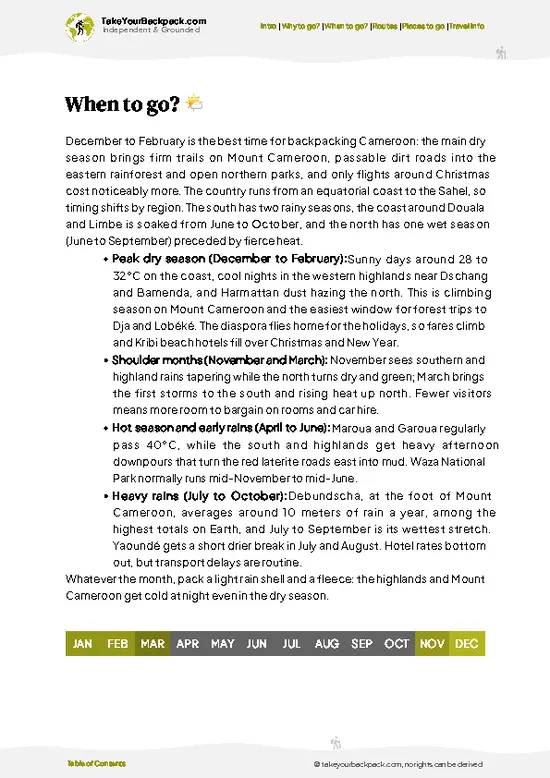
example page 3 from our offline Travel Guide for Cameroon
example page 4 from our offline Travel Guide for Cameroon
example page 5 from our offline Travel Guide for Cameroon
example page 6 from our offline Travel Guide for Cameroon
example page 7 from our offline Travel Guide for Cameroon
Loading the map 🌍
CLICK TO FILTER
cities
towns
landmarks
national parks
hikes
beaches
attractions
festivals
regions
SHOW COUNTRY’S BESTSHOW ALL

✨ Why go?
Ranked #8 national park in Cameroon
What sets this place apart

Sangha Trinational draws backpackers who want dense Congo Basin rainforest without a tour-bus crowd. Here you share trails with rangers and trackers, not a stream of day-trippers, and the silence between bird calls is a luxury few parks offer anymore. The park forms one part of a protected zone shared across three countries, so the forest stretches on far beyond what you can walk. Its Lobéké sector holds clearings where forest elephants gather, and bais (open swampy glades) let you watch wildlife from a platform rather than chase it through undergrowth. Independent travelers will find it demanding, since you need local guides and a flexible schedule, but that very effort keeps the place raw. Camping is basic and the cost stays modest once you reach the area. Pick this park if you value patient … read more 👉
Sangha Trinational draws backpackers who want dense Congo Basin rainforest without a tour-bus crowd. Here you share trails with rangers and trackers, not a stream of day-trippers, and the silence between bird calls is a luxury few parks offer anymore. The park forms one part of a protected zone shared across three countries, so the forest stretches on far beyond what you can walk. Its Lobéké sector holds clearings where forest elephants gather, and bais (open swampy glades) let you watch wildlife from a platform rather than chase it through undergrowth. Independent travelers will find it demanding, since you need local guides and a flexible schedule, but that very effort keeps the place raw. Camping is basic and the cost stays modest once you reach the area. Pick this park if you value patient observation over ticking boxes, and if red mud on your clothes sounds like a fair trade for solitude.

💡 HighlightsDon't-miss highlights and experiences

  1. Lobéké Forest Elephants: The sector is best known for elephants that come to mineral-rich clearings, often in family groups, with a platform view that keeps you at a respectful distance.
  2. Djangui Bai: A wide forest clearing where elephants, buffalo and sitatunga antelope may appear, and where the evening chorus of frogs and insects is loud.
  3. Western Lowland Gorillas: Groups live in the forest here, though sightings depend on trackers and luck, and a good view is a real reward.
  4. Sangha River: The broad brown waterway marks the border zone; dugout canoes slip past riverbanks full of kingfishers and hornbills.
  5. Forest Birdlife: Grey parrots, hornbills and turacos call from the canopy, and early mornings bring the best chorus.
  6. Baka Community Visits: Local Baka people share forest knowledge, from medicinal
… read more 👉
  1. Lobéké Forest Elephants: The sector is best known for elephants that come to mineral-rich clearings, often in family groups, with a platform view that keeps you at a respectful distance.
  2. Djangui Bai: A wide forest clearing where elephants, buffalo and sitatunga antelope may appear, and where the evening chorus of frogs and insects is loud.
  3. Western Lowland Gorillas: Groups live in the forest here, though sightings depend on trackers and luck, and a good view is a real reward.
  4. Sangha River: The broad brown waterway marks the border zone; dugout canoes slip past riverbanks full of kingfishers and hornbills.
  5. Forest Birdlife: Grey parrots, hornbills and turacos call from the canopy, and early mornings bring the best chorus.
  6. Baka Community Visits: Local Baka people share forest knowledge, from medicinal plants to net hunting methods, offering context that turns a walk into a lesson.
  7. Canopy Walks and Trackers’ Trails: Narrow paths wind through giant trees, past buttress roots and fruiting figs, with rangers pointing out dung, nests and footprints.
Plan on three to five days to take in all of this at an unhurried pace.
Spotted a mistake or missing something? Contact us.

🌤️ When to go?Seasonal considerations and timing

  • Main Dry Season (December to February): Logging roads and forest paths are firmest, and days run roughly 24 to 31°C (75 to 88°F) with cooler nights near 20°C (68°F). Gorilla and elephant viewing at Dzanga Bai clearing is most reliable, and this is when most visitors come.
  • Short Dry Spell (July to August): Rain eases a little, with highs near 27°C (81°F). Fewer travelers arrive, and lodging rarely needs advance booking.
  • Wet Months (March to June, September to November): Heavy afternoon downpours turn tracks to mud, rivers rise and boat transfers slow. Humidity stays high, and daytime temperatures hold around 25 to 30°C (77 to 86°F).
  • Daylight: Close to the equator, days are about 12 hours year-round, so plan treks to finish by late afternoon.
  • Prices: Guides, vehicle hire and fuel cost more in the
… read more 👉
  • Main Dry Season (December to February): Logging roads and forest paths are firmest, and days run roughly 24 to 31°C (75 to 88°F) with cooler nights near 20°C (68°F). Gorilla and elephant viewing at Dzanga Bai clearing is most reliable, and this is when most visitors come.
  • Short Dry Spell (July to August): Rain eases a little, with highs near 27°C (81°F). Fewer travelers arrive, and lodging rarely needs advance booking.
  • Wet Months (March to June, September to November): Heavy afternoon downpours turn tracks to mud, rivers rise and boat transfers slow. Humidity stays high, and daytime temperatures hold around 25 to 30°C (77 to 86°F).
  • Daylight: Close to the equator, days are about 12 hours year-round, so plan treks to finish by late afternoon.
  • Prices: Guides, vehicle hire and fuel cost more in the dry peak and ease in the wet months.
Book your guide and transport a month ahead for January and February.


source: climatestotravel.comJANJanuary: excellent for travelingFEBFebruary: excellent for travelingMARMarch: highly recommended for travelingAPRApril: fair for travelingMAYMay: fair for travelingJUNJune: fair for travelingJULJuly: fair for travelingAUGAugust: fair for travelingSEPSeptember: fair for travelingOCTOctober: fair for travelingNOVNovember: highly recommended for travelingDECDecember: excellent for traveling
when-to-go

✈️ The backpacker research shortcutCameroon Travel Guide

An offline-friendly backpacking guide with optimized travel routes, ranked highlights, transport advice, and the best areas to stay.
example page 0 from our offline Travel Guide for Cameroon
example page 1 from our offline Travel Guide for Cameroon
example page 2 from our offline Travel Guide for Cameroon
example page 3 from our offline Travel Guide for Cameroon
example page 4 from our offline Travel Guide for Cameroon
example page 5 from our offline Travel Guide for Cameroon
example page 6 from our offline Travel Guide for Cameroon
example page 7 from our offline Travel Guide for Cameroon
The digital guide (351 pages) contains:
✅ 84 highlights, ranked by travel appeal
✅ Optimized 7, 14 & 21-day travel routes
✅ Cities, national parks, landmarks, beaches
✅ How to get around
✅ Offline-friendly for travel without Wi-Fi
👉 Click to see all 30+ guide features

📅 Plan smarter in minutes, not weeks
✅ Month by month travel advice
✅ Festivals & national holidays
✅ Budget expectations

🗺️ Go to the right places, skip the overrated ones
✅ Honest pros & cons of destinations
✅ Top hikes, parks & viewpoints
✅ Lesser-known places most travelers miss
✅ Clear “worth it vs skip it” guidance

🛏️ Travel smoothly without rookie mistakes
✅ Best areas to stay
✅ Transport systems explained simply
✅ Common scams & safety advice
✅ SIM cards, money & practical tips

🌍 Understand the country, not just visit it
✅ Culture & traditions
✅ 52 Essential phrases & customs
✅ Festivals worth planning around
✅ Traveler-friendly historical context
✅ Insights that make places more meaningful

📱 Built for real travel conditions
✅ Fully downloadable PDF
✅ Works completely offline
✅ Optimized for phone use
✅ Useful in remote areas & buses
✅ Everything in one place
Stop searching, start planning
Get instant access to your full guide. 30‑day money-back guarantee.
+ Add another guide for just

By proceeding you agree to our terms.
Sent to your inbox immediately after payment • 100% Secure Checkout
Best Backpacking Travel Advisor 2025 tourism awardBest Backpacking
Travel Advisor
2025
What others say about Take Your Backpack Guides:
⭐⭐⭐⭐⭐
Fantastic, amazing amount of information!
⭐⭐⭐⭐⭐
My goodness this is amazing, it's what I've been looking for hats off too you!
⭐⭐⭐⭐⭐
I think this is absolutely BRILLIANT
⭐⭐⭐⭐
Very complete and informative. It's still missing places, but I gotta to commend you
⭐⭐⭐⭐⭐
This is truly amazing, thank you, can't wait to explore it with my kids!
⭐⭐⭐⭐⭐
Awesome resource, thank you!
⭐⭐⭐⭐⭐
This is amazing! Can't wait to explore the ones I haven't seen
⭐⭐⭐⭐
I love this! Well done, great idea.
⭐⭐⭐⭐⭐
Thanks for taking the time to make this gem!
⭐⭐⭐⭐⭐
This might be the best website I've ever seen.
⭐⭐⭐⭐⭐
Congratulations, and thank you so much for your work; it's incredibly valuable.
⭐⭐⭐⭐
In all seriousness I think you did a great job pointing out the important spots
⭐⭐⭐⭐⭐
10/10 very good
⭐⭐⭐⭐⭐
As someone who's only just starting to visit regularly this is awesome, thank you.
⭐⭐⭐⭐
Thank you very much! I'm going to visit my dad, it's going to be very useful!
⭐⭐⭐⭐⭐
This is really cool! We'll be travelling for the first time and this definitely come in handy.
⭐⭐⭐⭐⭐
You are now our minister of culture, congratulations 👨‍💼
⭐⭐⭐⭐⭐
Just wanted to tell you that this is a pearl! Going to follow your recommendations.
⭐⭐⭐⭐⭐
This is so cool. I'll definitely be using the resource for my travels soon.
⭐⭐⭐⭐⭐
This is very impressive! Good work.
⭐⭐⭐⭐⭐
This is an amazing and informative site. Very well done!

🛏️ Where to stay?Where staying makes the most sense

The most practical base is Lomié-style forest living is not on offer here, so use Yokadouma, the main town nearby, for supplies and a simple bed. Inside the Cameroon section, Lobéké National Park has basic ecolodge-style camps near Mambélé and Lobéké, run with the park and local communities, where you sleep in simple huts or tents and eat with your guides. Reaching them needs permission from the park conservator, so start in town. Yokadouma has small guesthouses and auberges with fan rooms, patchy electricity and bucket showers, usually €8 to 20 a night. Many travelers also continue to Socambo, … read more 👉
The most practical base is Lomié-style forest living is not on offer here, so use Yokadouma, the main town nearby, for supplies and a simple bed. Inside the Cameroon section, Lobéké National Park has basic ecolodge-style camps near Mambélé and Lobéké, run with the park and local communities, where you sleep in simple huts or tents and eat with your guides. Reaching them needs permission from the park conservator, so start in town. Yokadouma has small guesthouses and auberges with fan rooms, patchy electricity and bucket showers, usually €8 to 20 a night. Many travelers also continue to Socambo, Mambélé or Bayanga across the border in the Central African Republic, where Dzanga-Sangha has riverside lodges and a budget camp near Bayanga. Congo’s Nouabalé-Ndoki side is reached from Ouesso and is pricey, and mostly aimed at organized visits. Whatever you choose, carry cash, since cards and mobile signal are unreliable.

👛 Costs (as of 22 October 2026)Money, prices, and spending tips

Sangha Trinational costs roughly €58 to 135 a day for a backpacker, mainly because guides, transport and permits are expensive in this remote corner.
CategoryBudget RangeLocal Reality
Entrance and permits€10 to 30Park and community fees per day, usually paid in cash; separate rules apply in each country.
Guide and tracker€15 to 30Compulsory for forest walks, priced per day.
Accommodation (high season)€10 to 25Guesthouse in Yokadouma or basic camps in the forest.
Local transport€15 to 35Shared taxis and motorbikes on rough roads; private 4x4 hire costs far more per day.
Food and supplies€8 to 15Simple rice, plantain and fish meals; bring snacks and water treatment from town.
Total Daily Budget€58 to 135Roughly €90 on a typical day.
⚠️ Prices can change and everyone travels differently, so take this as a rough guide. Hope it helps you plan your adventure!

🥾 TrailsDiscover Sangha Trinational's top trails and natural wonders

Sangha Trinational has no marked, signposted trail network, so most walking is done with rangers and trackers from a camp or village. Routes shift with wildlife movement and the season.
  • Bai platform walks: Short forest walks of about 1 to 3 hours lead to clearings with viewing platforms. Terrain is flat to gently rolling, often muddy, with fallen logs and stream crossings. Difficulty is easy to moderate.
  • Gorilla tracking: Treks follow trackers into dense forest and can last from a few hours to a full day. The ground is steep in places, with tangled undergrowth and heavy humidity. Difficulty is moderate
… read more 👉
Sangha Trinational has no marked, signposted trail network, so most walking is done with rangers and trackers from a camp or village. Routes shift with wildlife movement and the season.
  • Bai platform walks: Short forest walks of about 1 to 3 hours lead to clearings with viewing platforms. Terrain is flat to gently rolling, often muddy, with fallen logs and stream crossings. Difficulty is easy to moderate.
  • Gorilla tracking: Treks follow trackers into dense forest and can last from a few hours to a full day. The ground is steep in places, with tangled undergrowth and heavy humidity. Difficulty is moderate to hard.
  • River and village excursions: Dugout canoe trips along the Sangha River pass sandbanks, birds and fishing camps, usually taking half a day. Difficulty is easy.
  • Multi-day forest camping: Longer walks link camps through primary forest, with elephant sign, monkeys and a constant insect hum. Expect basic conditions and a hard, sweaty pace.
Public transport to the park is limited, so most travelers arrive by hired 4x4 or arranged transfer over rough tracks, especially after rain. Crowds are almost nonexistent. Entry and guide fees apply and are usually organized through park offices or operators, with payment in local currency or cash. Bring waterproof gear, long sleeves, and sturdy boots.
⚠️ Hiking info can sometimes be outdated or inaccurate. Before you hit the trail, check the latest conditions with locals. If you do spot anything that's off, I'd love to hear from you, so I can update it for fellow travelers.

🛡️ SafetyTraveler Safety Guide

Sangha Trinational is remote rainforest, so the main risks are logistical rather than dramatic. Malaria is present year-round, so take prophylaxis, treat clothing with permethrin and sleep under a net. Forest tracks are slippery and muddy, and river crossings by pirogue should be done with life jackets when available. Walk with an armed or trained park guide, which is required anyway. Forest elephants and gorillas are the real wildlife concerns: keep at least 7 meters from gorillas, follow your tracker’s pace and never run. Buffalo and snakes are best avoided by staying on the trail. Carry more water and purification than you expect, a first aid kit, and a satellite or offline map, as phone coverage is minimal. Check current conditions on the road to Yokadouma and near borders before you travel, and keep your papers handy for checkpoints.

FAQCommon questions from travelers

Plan four to six days for Sangha Trinational if you want forest walks and a gorilla or elephant outing. Reaching Yokadouma from Yaoundé takes a long day or two by road, and the park camps are another few hours by track. Add extra days in the wet months, when roads slow down.
Sangha Trinational is hard to visit without a car, but not impossible. Buses and shared taxis run from Yaoundé to Yokadouma, then motorbikes or hired 4x4 cover the rough tracks to the camps for roughly €15 to 35 a day. Inside the forest you walk with a guide anyway.
Yes, Sangha Trinational requires park fees and, for forest walks, a guide. Expect roughly €10 to 30 a day for entry and community fees, plus €15 to 30 for the tracker. Permits are arranged through the conservator’s office in Yokadouma, and each country in the trinational area has its own rules.
⚠️ Things can change over time, so always validate details locally before you go.

Other Cameroonian national parks near Sangha Trinational

Explore more nearby:

  • Lobéké National Park—Lobéké Bai, Sangha pirogues, Mambélé gateway, Baka trackers| 59 km away
  • Nki National Park—Forest clearings, Congo Basin interior, swamp crossings, tent camping| 67 km away
  • Dja Faunal Reserve—Dja River loop, bai platforms, Baka trekking, UNESCO rainforest| 254 km away

💡 Not sure where to go next?
Create a personalized itinerary for Cameroon including Sangha Trinational and the places that fit your trip.

Generate my itinerary

👉 Discover all national parks

Or checkout all Cameroon has to offer (think cities, towns, villages, national parks, hikes, beaches, festivals)
Country photo of Cameroon

We 💚 feedbackSumming up the experience

Sangha Trinational rewards the early riser in the drier months, when forest paths firm up and elephants favor the clearings at dawn and dusk. I would bring waterproof socks, a headlamp and plenty of patience, because the forest decides the schedule. Skip the rainy peak if mud and swollen streams worry you.

✍️ Help improve this page!
The information on this page is based on in-depth research, insights shared by experienced travelers, and feedback from the local travel community in Cameroon. While every effort is made to keep the information accurate and current, conditions can change — so if you spot anything incorrect or outdated, please get in touch.


🙋‍♂️ Give feedback

👋 Meet the founderWho’s Behind Take Your Backpack?

Johan, backpacker and founder of TakeYourBackpackHi, I’m Johan (Netherlands 🇳🇱), the creator of TakeYourBackpack. Over the past 3 decades, I’ve backpacked through 90+ countries across six continents, gaining extensive experience with independent travel, long-term trips, and overland routes.

This site is built on a combination of firsthand travel experience and carefully curated insights from other backpackers. Many guides are based on places I’ve personally visited, while others bring together tips, observations, and practical advice shared by trusted travelers I’ve met along the way.

The goal is to provide realistic, experience-driven guidance — not generic itineraries — so you can explore destinations with better context, clearer expectations, and more confidence.