×

Cayman Islands🇰🇾 | best national parksExplore the 3 Best national parks in Cayman Islands

Cayman Islands national parks are small, mostly run by the National Trust and the Department of Environment, and they work best as short, sharp stops. Grand Cayman has easy roads and low entry fees. Cayman Brac and Little Cayman are quiet, with few visitors and flights to plan around. Independent travelers should expect high island prices but little crowding on the trails, especially early morning.

By Johan Kruseman 🇳🇱 | Updated October 20, 2026
Explore the best hikes in Cayman Islands

Why go?Why These national park Stand Out

The Cayman Islands are low, flat limestone islands with no mountains and no rivers, so the protected land is dry forest, mangrove wetland and coastal bluff, plus a long record of marine protection that predates most Caribbean neighbors. Conservation here is run largely by the National Trust and government marine zones, not by a single national park service, which means rules, fees and opening hours differ from site to site. Think compact visits of one to three hours, not multi-day wilderness treks.

Before you choose the islands for this, know that costs are among the highest in the Caribbean, trails are short, and the best wildlife often lives in the water. Go for variety and easy access, then pack insect repellent and sturdy shoes for the sharp rock.
How the List Was Created
The list of best national parks in Cayman Islands is created based on landscapes, wildlife, adventure opportunities, facilities, and overall experience. If you feel a national park is missing in this list, please let us know.

When to go?Timing Your Visit for the Best Experience

Best months: The best months are mid-November to April, when daytime highs sit around 26 to 30°C (79 to 86°F), humidity eases and rain is light, usually under 70 mm a month. Trails are dry underfoot and mosquitoes are far fewer.Shoulder and wet seasons: May and early November are the useful shoulder months, with fewer visitors and lodging often 15 to 30 percent cheaper than the Christmas to Easter peak. From June to October, expect 30 to 33°C (86 to 91°F), heavy humidity, afternoon downpours of 150 to 200 mm a month and standing water on wetland paths. Hurricane season runs June to November, with the highest risk in August to October, so book flexible fares if you travel then. Start walks at sunrise in any season and you will miss the worst heat.

national park hoppingHow to Combine national parks Into One Trip

Days needed: A trip linking several parks needs 4 to 5 days on Grand Cayman alone, or 7 to 9 days if you add the sister islands. Group Grand Cayman by area: the West End and George Town around the airport, then drive east toward East End (about 45 to 60 minutes). Finish on the quiet side before flying out.Pacing and the sister islands: Give each stop 1 to 3 hours and pair no more than two per day, since heat slows walking. Cayman Airways flies Grand Cayman to Cayman Brac in about 45 minutes, and Brac to Little Cayman in roughly 15 minutes. A common mistake is a same-day round trip to the sister islands, which leaves almost no time on the ground. Stay at least two nights per island and keep a spare day in case weather disrupts the small planes.

The ListThe Best national parks of Cayman Islands

1 Queen Elizabeth II Botanic Park

Blue iguanas, orchid boardwalk, Caymanian homestead, lakeside benches

Meet endemic blue iguanas at the breeding facility, then stroll shaded paths past orchids, a re-created cottage, color-themed beds, and a quiet heron pond.

cayman-islands-national-park-queen-elizabeth-ii-botanic-park
© Google |

2 Barkers National Park

Empty west-facing beach, kitesurfing, coastal scrub, sea grape shade-free walk

Walk a long, undeveloped shoreline where trade winds fill kites, hermit crabs cross sandy scrub tracks, and the sun sets over an unbroken horizon.

cayman-islands-national-park-barkers-national-park
© Google |

3 East End Marine Park

Wade-in barrier reef, drop-off dives, turtle seagrass, Ten Sail shoreline

Wade from the sand over shallow coral and parrotfish, then follow the coast to blowholes, mangrove birds, and the memorial for the 1794 wrecks.

cayman-islands-national-park-east-end-marine-park
© Google | Ell Waters
Loading the map 🌍

Expert viewPro Tips for Exploring the Best

How many to visit: Plan on four to six protected areas across a week. That is enough to see dry forest, mangrove and coastline without repeating yourself, since most sites take only one to three hours.Which kind to prioritize: If you are on a budget, put your time into National Trust walking sites and free public shoreline. If you love wildlife, choose mangrove and wetland reserves and book a guided walk for birds and iguanas. Divers and snorkelers should rank the marine parks first, because the reefs are the real headline here.What it costs: Cayman is expensive. A frugal backpacker should budget US$130 to 220 a day (CI$110 to 185) for a basic guesthouse bed, groceries and a bus pass. Entry to the staffed sites usually runs CI$5 to 15 (US$6 to 18), and many trails are free. Guided walks cost … read more 👉
How many to visit: Plan on four to six protected areas across a week. That is enough to see dry forest, mangrove and coastline without repeating yourself, since most sites take only one to three hours.Which kind to prioritize: If you are on a budget, put your time into National Trust walking sites and free public shoreline. If you love wildlife, choose mangrove and wetland reserves and book a guided walk for birds and iguanas. Divers and snorkelers should rank the marine parks first, because the reefs are the real headline here.What it costs: Cayman is expensive. A frugal backpacker should budget US$130 to 220 a day (CI$110 to 185) for a basic guesthouse bed, groceries and a bus pass. Entry to the staffed sites usually runs CI$5 to 15 (US$6 to 18), and many trails are free. Guided walks cost around US$30 to 90, and snorkel trips from US$40 to 80. A rental car is about US$45 to 70 a day, public buses cost around CI$2.50 (US$3) a ride and are far less flexible.Safety and etiquette: The rock underfoot is razor-sharp ironshore, so wear closed shoes and carry more water than you expect. Learn to recognize poisonwood, whose sap causes a nasty rash, and never lean on unfamiliar trees. Sun and dehydration cause more trouble than any animal. Use reef-safe sunscreen, and do not touch coral or remove shells and conch, because marine park rules are enforced with real fines. Keep your distance from the protected iguanas. Drive on the left, dress modestly away from the beach, and expect Sundays to be quiet, with some sites closed or on short hours. Check hours at the National Trust before heading out.

✈️ The backpacker research shortcutCayman Islands Travel Guide

An offline-friendly backpacking guide with optimized travel routes, ranked highlights, transport advice, and the best areas to stay.
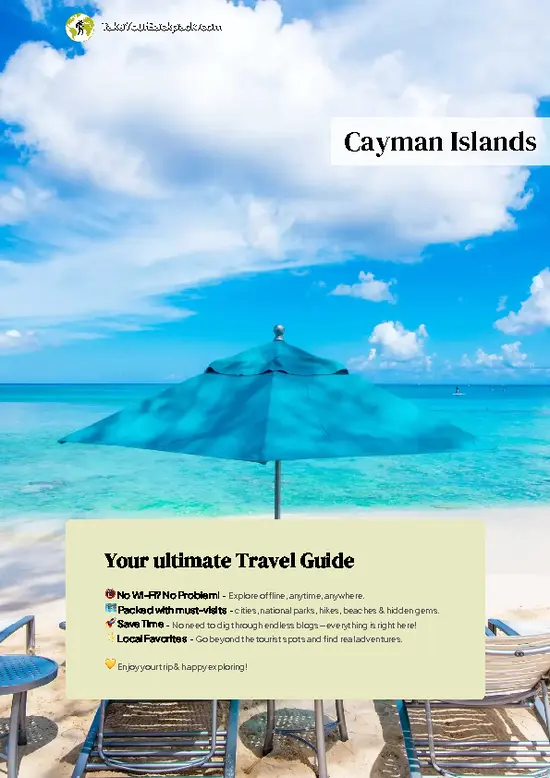
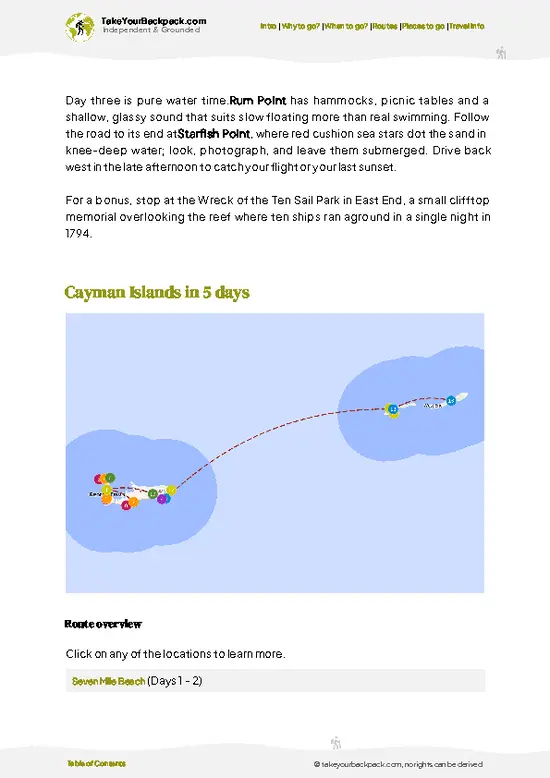
example page 0 from our offline Travel Guide for Cayman Islands
example page 1 from our offline Travel Guide for Cayman Islands
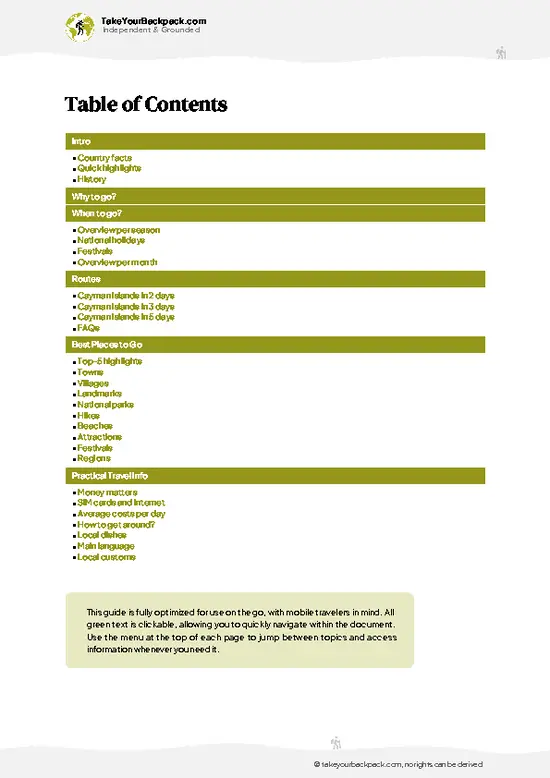
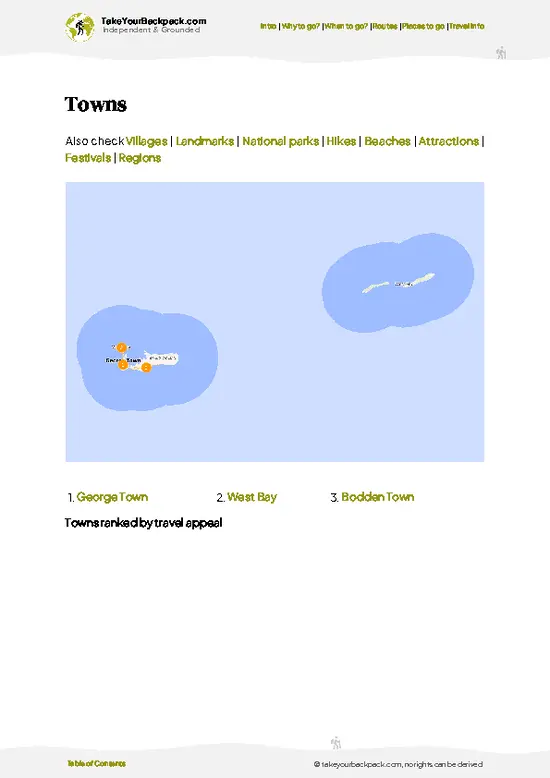
example page 2 from our offline Travel Guide for Cayman Islands
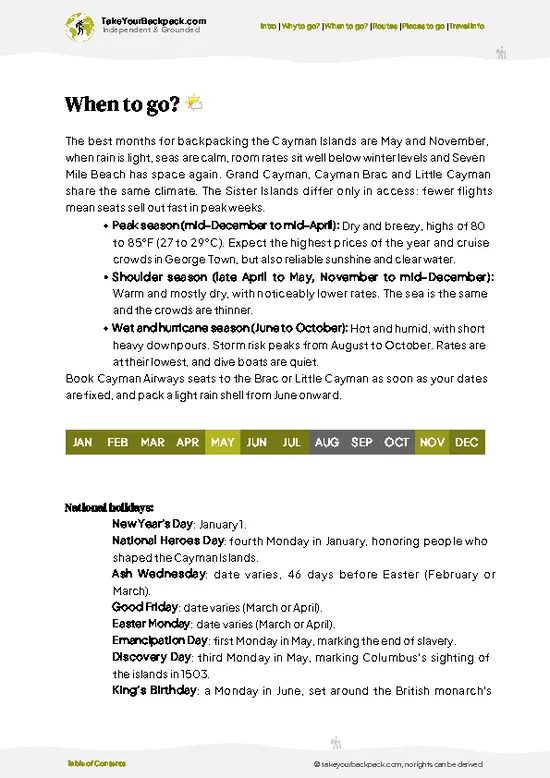
example page 3 from our offline Travel Guide for Cayman Islands
example page 4 from our offline Travel Guide for Cayman Islands
example page 5 from our offline Travel Guide for Cayman Islands
example page 6 from our offline Travel Guide for Cayman Islands
example page 7 from our offline Travel Guide for Cayman Islands
The digital guide (140 pages) contains:
✅ 33 highlights, ranked by travel appeal
✅ Optimized 2, 3 & 5-day travel routes
✅ Cities, national parks, landmarks, beaches
✅ How to get around
✅ Offline-friendly for travel without Wi-Fi
👉 Click to see all 30+ guide features

📅 Plan smarter in minutes, not weeks
✅ Month by month travel advice
✅ Festivals & national holidays
✅ Budget expectations

🗺️ Go to the right places, skip the overrated ones
✅ Honest pros & cons of destinations
✅ Top hikes, parks & viewpoints
✅ Lesser-known places most travelers miss
✅ Clear “worth it vs skip it” guidance

🛏️ Travel smoothly without rookie mistakes
✅ Best areas to stay
✅ Transport systems explained simply
✅ Common scams & safety advice
✅ SIM cards, money & practical tips

🌍 Understand the country, not just visit it
✅ Culture & traditions
✅ Local customs
✅ Festivals worth planning around
✅ Traveler-friendly historical context
✅ Insights that make places more meaningful

📱 Built for real travel conditions
✅ Fully downloadable PDF
✅ Works completely offline
✅ Optimized for phone use
✅ Useful in remote areas & buses
✅ Everything in one place
Stop searching, start planning
Get instant access to your full guide. 30‑day money-back guarantee.
+ Add another guide for just

By proceeding you agree to our terms.
Sent to your inbox immediately after payment • 100% Secure Checkout
Best Backpacking Travel Advisor 2025 tourism awardBest Backpacking
Travel Advisor
2025
What others say about Take Your Backpack Guides:
⭐⭐⭐⭐⭐
Fantastic, amazing amount of information!
⭐⭐⭐⭐⭐
My goodness this is amazing, it's what I've been looking for hats off too you!
⭐⭐⭐⭐⭐
I think this is absolutely BRILLIANT
⭐⭐⭐⭐
Very complete and informative. It's still missing places, but I gotta to commend you
⭐⭐⭐⭐⭐
This is truly amazing, thank you, can't wait to explore it with my kids!
⭐⭐⭐⭐⭐
Awesome resource, thank you!
⭐⭐⭐⭐⭐
This is amazing! Can't wait to explore the ones I haven't seen
⭐⭐⭐⭐
I love this! Well done, great idea.
⭐⭐⭐⭐⭐
Thanks for taking the time to make this gem!
⭐⭐⭐⭐⭐
This might be the best website I've ever seen.
⭐⭐⭐⭐⭐
Congratulations, and thank you so much for your work; it's incredibly valuable.
⭐⭐⭐⭐
In all seriousness I think you did a great job pointing out the important spots
⭐⭐⭐⭐⭐
10/10 very good
⭐⭐⭐⭐⭐
As someone who's only just starting to visit regularly this is awesome, thank you.
⭐⭐⭐⭐
Thank you very much! I'm going to visit my dad, it's going to be very useful!
⭐⭐⭐⭐⭐
This is really cool! We'll be travelling for the first time and this definitely come in handy.
⭐⭐⭐⭐⭐
You are now our minister of culture, congratulations 👨‍💼
⭐⭐⭐⭐⭐
Just wanted to tell you that this is a pearl! Going to follow your recommendations.
⭐⭐⭐⭐⭐
This is so cool. I'll definitely be using the resource for my travels soon.
⭐⭐⭐⭐⭐
This is very impressive! Good work.
⭐⭐⭐⭐⭐
This is an amazing and informative site. Very well done!

🛏️ Where to stay?Top Places to Consider Staying

The Cayman Islands have no real hostel scene (rare dorm beds come and go), so budget travelers here end up in guesthouses, small family-run inns and private rooms or studio apartments, which usually start around CI$100 to 165 (US$120 to 200) a night. George Town and the strip of Seven Mile Beach just north of it have the widest choice, with buses, supermarkets, bars and the cruise port all close, though beachfront rooms cost the most and the main road gets busy. West Bay is quieter and a little cheaper, while Bodden Town and East End are the calmest and best value for long stays, but there is almost no nightlife and you will want a car.

If you enjoy meeting fellow travelers, consider choosing … read more 👉
The Cayman Islands have no real hostel scene (rare dorm beds come and go), so budget travelers here end up in guesthouses, small family-run inns and private rooms or studio apartments, which usually start around CI$100 to 165 (US$120 to 200) a night. George Town and the strip of Seven Mile Beach just north of it have the widest choice, with buses, supermarkets, bars and the cruise port all close, though beachfront rooms cost the most and the main road gets busy. West Bay is quieter and a little cheaper, while Bodden Town and East End are the calmest and best value for long stays, but there is almost no nightlife and you will want a car.

If you enjoy meeting fellow travelers, consider choosing hostels with high ratings for atmosphere. On the other hand, if you prefer having your own space, a hotel might be a better option.

Cayman IslandsMore Places Across Cayman Islands

👋 Meet the founderWho’s Behind Take Your Backpack?

Johan, backpacker and founder of TakeYourBackpackHi, I’m Johan (Netherlands 🇳🇱), the creator of TakeYourBackpack. Over the past 3 decades, I’ve backpacked through 90+ countries across six continents, gaining extensive experience with independent travel, long-term trips, and overland routes.

This site is built on a combination of firsthand travel experience and carefully curated insights from other backpackers. Many guides are based on places I’ve personally visited, while others bring together tips, observations, and practical advice shared by trusted travelers I’ve met along the way.

The goal is to provide realistic, experience-driven guidance — not generic itineraries — so you can explore destinations with better context, clearer expectations, and more confidence.