×

Central African Republic🇨🇫 | landmarksBoali Waterfalls50-meter Mbali plunge, rainbow spray, rim viewpoint, hydroelectric station, rainy-season flow | things to do and best time to go

Explore BayangaExplore Boganda National Museum

Backpacking in Boali Waterfalls
🏆 Top pickunique site ranked #1
By Johan Kruseman 🇳🇱 | Updated October 22, 2026

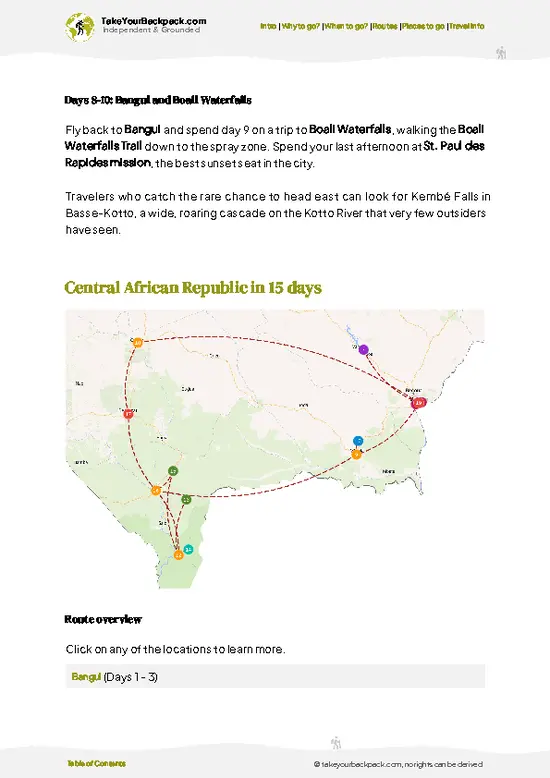
Spray hits your face a full minute before you see the water, cool and loud, and then the Mbali River comes over the lip in one white sheet with a roar you feel in your sternum. Boali Waterfalls sits northwest of Bangui, along the road toward Cameroon in the Central African Republic. The drop is around 50 meters, and in full flow it is a real spectacle, with rainbows hanging in the mist. Skip it in the driest months, when the hydroelectric intake takes much of the river and the curtain thins to streaks. Go when the rains have filled the Mbali. Facilities are minimal, the road demands a sturdy vehicle, and security conditions outside the capital call for a trusted local driver. Photographers get a lot for little effort. Compared with Kembé Falls in the far southeast, which spreads across a wide stretch of rapids, Boali is one tall plunge you can reach from the capital.

Discover everything you want to know in the 📖 Central African Republic Travel Guide.
Safety warning

The current risk level for Central African Republic is high. Check the advice before going.


example page 0 from our offline Travel Guide for Central African Republic
example page 1 from our offline Travel Guide for Central African Republic
example page 2 from our offline Travel Guide for Central African Republic
example page 3 from our offline Travel Guide for Central African Republic
example page 4 from our offline Travel Guide for Central African Republic
example page 5 from our offline Travel Guide for Central African Republic
example page 6 from our offline Travel Guide for Central African Republic
example page 7 from our offline Travel Guide for Central African Republic
Loading the map 🌍
CLICK TO FILTER
cities
towns
landmarks
national parks
hikes
attractions
regions
SHOW COUNTRY’S BESTSHOW ALL

✨ Why go?
Ranked #1 unique site in Central African Republic
Why Boali Waterfalls should be on your travel list

Boali Waterfalls is the one natural spectacle in the Central African Republic that you can reach from the capital without a multi-day expedition, and that alone makes it worth the detour. The Mbali River drops roughly 50 meters in a broad white curtain, and in the wet months the spray reaches the viewing rocks and the air tastes of wet stone. The falls sit on the road northwest of Bangui, so the trip fits naturally into time spent in the capital.

The other reason is power and scale. Hydroelectric stations built at the falls have supplied much of the capital’s electricity for decades, so you are looking at a working river as well as a pretty one. The upper cascade, Boali 1, is the one with the classic drop, and a short walk lets you compare it with the lower Boali 2 and Boali 3 stages.

Third, … read more 👉
Boali Waterfalls is the one natural spectacle in the Central African Republic that you can reach from the capital without a multi-day expedition, and that alone makes it worth the detour. The Mbali River drops roughly 50 meters in a broad white curtain, and in the wet months the spray reaches the viewing rocks and the air tastes of wet stone. The falls sit on the road northwest of Bangui, so the trip fits naturally into time spent in the capital.

The other reason is power and scale. Hydroelectric stations built at the falls have supplied much of the capital’s electricity for decades, so you are looking at a working river as well as a pretty one. The upper cascade, Boali 1, is the one with the classic drop, and a short walk lets you compare it with the lower Boali 2 and Boali 3 stages.

Third, there are very few crowds. Expect local families, a few expats and perhaps a guard or two, so you can sit on a rock with a cold drink and watch the water for as long as you like. For a backpacker in a country with few sights, the falls give an easy, low-cost day out. Check the current security situation on the Bangui road before you set off.

💡 HighlightsWhat this place is best known for

  1. The Main Cascade: The fall everyone comes for. The Mbali River drops about 50 meters over a broad basalt-and-sandstone edge into a boiling pool. In high water the whole face is white and the noise carries well up the path.
  2. The Rainbow Mist: Spray rises from the base and, when the sun is high enough, throws bows across the gorge. It is the best photo opportunity on site, and you need a dry bag or a plastic sleeve for your camera.
  3. The Viewpoint at the Rim: A short walk puts you at the top, looking along the line where the river tips over. You see how far the water spreads before the drop, and the forest below stretches out toward the plain.
  4. The Boali Hydroelectric Station: Beside the falls stands the power complex that has fed Bangui from the Mbali for decades, with newer stages added upstream
… read more 👉
  1. The Main Cascade: The fall everyone comes for. The Mbali River drops about 50 meters over a broad basalt-and-sandstone edge into a boiling pool. In high water the whole face is white and the noise carries well up the path.
  2. The Rainbow Mist: Spray rises from the base and, when the sun is high enough, throws bows across the gorge. It is the best photo opportunity on site, and you need a dry bag or a plastic sleeve for your camera.
  3. The Viewpoint at the Rim: A short walk puts you at the top, looking along the line where the river tips over. You see how far the water spreads before the drop, and the forest below stretches out toward the plain.
  4. The Boali Hydroelectric Station: Beside the falls stands the power complex that has fed Bangui from the Mbali for decades, with newer stages added upstream over the years. The pipes and buildings explain why the flow changes with the season, and they make the site more interesting than a plain scenic stop.
  5. The Plunge Pool and Rocks Below: Scramble carefully along the rocks near the base for the closest view of the churning water. Currents are strong and the stone is slick, so watch your footing and keep to the places local guides show you.
  6. The Upper Mbali Rapids: Upstream of the main drop the river runs over broken rock in a series of smaller cascades. They are quieter than the headline fall, and a good place to sit with the sound of water and watch the river gather itself before it leaps.
  7. The Forest and Village Edge: The approach through Boali village and the green fringe around the gorge brings birds and butterflies. Children and vendors along the route give a human scale to the visit.
Boali Waterfalls has no formal ticketing system that needs booking ahead, but a local guide or driver arranged beforehand in Bangui makes the visit far smoother.
Spotted a mistake or missing something? Contact us.

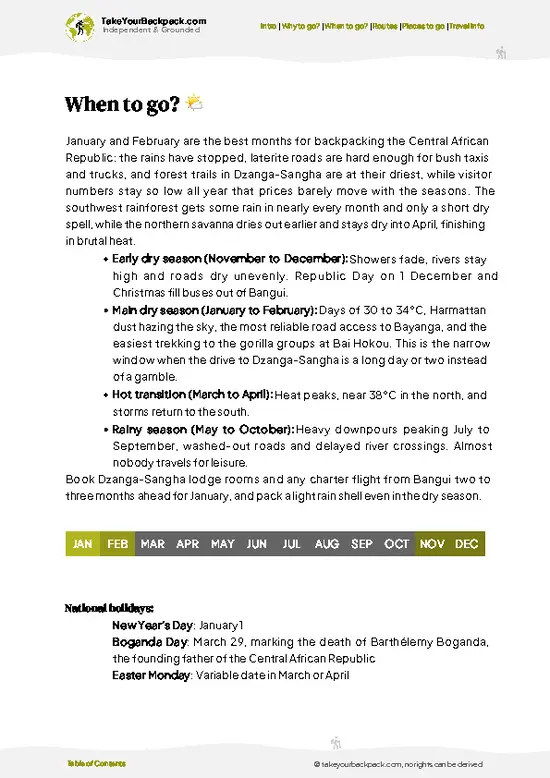
🌤️ When to go?Best time to visit Boali Waterfalls

  • Late Rainy Season (September to November): Water volume peaks and the falls on the Mbali River roar, with mist drifting over the viewing rocks. Temperatures run 22 to 31°C (72 to 88°F), dirt roads from Bangui turn slick, and the paths down to the base get muddy.
  • Early Dry Season (December to February): Skies clear, the flow is still strong and the harmattan haze softens distant views. Days reach 30 to 34°C (86 to 93°F), nights drop to about 20°C (68°F). Weekends bring Bangui families, so expect some company at the pools.
  • Late Dry Season (March to April): Heat builds to 33 to 36°C (91 to 97°F) and the flow thins noticeably, exposing rock ledges. Swimming is easier, but views are less dramatic.
  • Early Rainy Season (May to August): Afternoon downpours, 23 to 30°C (73 to 86°F), and a rising river.
… read more 👉
  • Late Rainy Season (September to November): Water volume peaks and the falls on the Mbali River roar, with mist drifting over the viewing rocks. Temperatures run 22 to 31°C (72 to 88°F), dirt roads from Bangui turn slick, and the paths down to the base get muddy.
  • Early Dry Season (December to February): Skies clear, the flow is still strong and the harmattan haze softens distant views. Days reach 30 to 34°C (86 to 93°F), nights drop to about 20°C (68°F). Weekends bring Bangui families, so expect some company at the pools.
  • Late Dry Season (March to April): Heat builds to 33 to 36°C (91 to 97°F) and the flow thins noticeably, exposing rock ledges. Swimming is easier, but views are less dramatic.
  • Early Rainy Season (May to August): Afternoon downpours, 23 to 30°C (73 to 86°F), and a rising river. Mornings are usually clearer. Days stay close to 12 hours long all year.
Aim for December or January, and leave Bangui early to see the falls before the midday haze.


source: climatestotravel.comJANJanuary: fair for travelingFEBFebruary: fair for travelingMARMarch: fair for travelingAPRApril: fair for travelingMAYMay: highly recommended for travelingJUNJune: excellent for travelingJULJuly: excellent for travelingAUGAugust: excellent for travelingSEPSeptember: excellent for travelingOCTOctober: highly recommended for travelingNOVNovember: below average for travelingDECDecember: below average for traveling
central-african-republic-unique-site-boali-waterfalls
© Google |

✈️ The backpacker research shortcutCentral African Republic Travel Guide

An offline-friendly backpacking guide with optimized travel routes, ranked highlights, transport advice, and the best areas to stay.
example page 0 from our offline Travel Guide for Central African Republic
example page 1 from our offline Travel Guide for Central African Republic
example page 2 from our offline Travel Guide for Central African Republic
example page 3 from our offline Travel Guide for Central African Republic
example page 4 from our offline Travel Guide for Central African Republic
example page 5 from our offline Travel Guide for Central African Republic
example page 6 from our offline Travel Guide for Central African Republic
example page 7 from our offline Travel Guide for Central African Republic
The digital guide (210 pages) contains:
✅ 42 highlights, ranked by travel appeal
✅ Optimized 5, 10 & 15-day travel routes
✅ Cities, national parks, landmarks, beaches
✅ How to get around
✅ Offline-friendly for travel without Wi-Fi
👉 Click to see all 30+ guide features

📅 Plan smarter in minutes, not weeks
✅ Month by month travel advice
✅ Festivals & national holidays
✅ Budget expectations

🗺️ Go to the right places, skip the overrated ones
✅ Honest pros & cons of destinations
✅ Top hikes, parks & viewpoints
✅ Lesser-known places most travelers miss
✅ Clear “worth it vs skip it” guidance

🛏️ Travel smoothly without rookie mistakes
✅ Best areas to stay
✅ Transport systems explained simply
✅ Common scams & safety advice
✅ SIM cards, money & practical tips

🌍 Understand the country, not just visit it
✅ Culture & traditions
✅ 52 Essential phrases & customs
✅ Festivals worth planning around
✅ Traveler-friendly historical context
✅ Insights that make places more meaningful

📱 Built for real travel conditions
✅ Fully downloadable PDF
✅ Works completely offline
✅ Optimized for phone use
✅ Useful in remote areas & buses
✅ Everything in one place
Stop searching, start planning
Get instant access to your full guide. 30‑day money-back guarantee.
+ Add another guide for just

By proceeding you agree to our terms.
Sent to your inbox immediately after payment • 100% Secure Checkout
Best Backpacking Travel Advisor 2025 tourism awardBest Backpacking
Travel Advisor
2025
What others say about Take Your Backpack Guides:
⭐⭐⭐⭐⭐
Fantastic, amazing amount of information!
⭐⭐⭐⭐⭐
My goodness this is amazing, it's what I've been looking for hats off too you!
⭐⭐⭐⭐⭐
I think this is absolutely BRILLIANT
⭐⭐⭐⭐
Very complete and informative. It's still missing places, but I gotta to commend you
⭐⭐⭐⭐⭐
This is truly amazing, thank you, can't wait to explore it with my kids!
⭐⭐⭐⭐⭐
Awesome resource, thank you!
⭐⭐⭐⭐⭐
This is amazing! Can't wait to explore the ones I haven't seen
⭐⭐⭐⭐
I love this! Well done, great idea.
⭐⭐⭐⭐⭐
Thanks for taking the time to make this gem!
⭐⭐⭐⭐⭐
This might be the best website I've ever seen.
⭐⭐⭐⭐⭐
Congratulations, and thank you so much for your work; it's incredibly valuable.
⭐⭐⭐⭐
In all seriousness I think you did a great job pointing out the important spots
⭐⭐⭐⭐⭐
10/10 very good
⭐⭐⭐⭐⭐
As someone who's only just starting to visit regularly this is awesome, thank you.
⭐⭐⭐⭐
Thank you very much! I'm going to visit my dad, it's going to be very useful!
⭐⭐⭐⭐⭐
This is really cool! We'll be travelling for the first time and this definitely come in handy.
⭐⭐⭐⭐⭐
You are now our minister of culture, congratulations 👨‍💼
⭐⭐⭐⭐⭐
Just wanted to tell you that this is a pearl! Going to follow your recommendations.
⭐⭐⭐⭐⭐
This is so cool. I'll definitely be using the resource for my travels soon.
⭐⭐⭐⭐⭐
This is very impressive! Good work.
⭐⭐⭐⭐⭐
This is an amazing and informative site. Very well done!

🛏️ Where to stay?Where staying makes the most sense

Bangui is the practical base for Boali Waterfalls, roughly 100 kilometers north of the falls and reachable in about 2 to 3 hours by road. Most backpackers sleep in the capital and go out for the day, because the village of Boali itself has very limited lodging.

Within Bangui, look at the central districts around Avenue des Martyrs and the neighborhoods near the Oubangui riverfront. These areas have guesthouses and small missions that welcome budget travelers, and you can find other foreigners, NGO workers and drivers willing to share a ride out to the falls. Shared costs matter here, since transport … read more 👉
Bangui is the practical base for Boali Waterfalls, roughly 100 kilometers north of the falls and reachable in about 2 to 3 hours by road. Most backpackers sleep in the capital and go out for the day, because the village of Boali itself has very limited lodging.

Within Bangui, look at the central districts around Avenue des Martyrs and the neighborhoods near the Oubangui riverfront. These areas have guesthouses and small missions that welcome budget travelers, and you can find other foreigners, NGO workers and drivers willing to share a ride out to the falls. Shared costs matter here, since transport is the biggest expense. The riverside has restaurants where you can pick up current road conditions from locals.

Staying closer is possible. Boali town has a few basic rooms and occasional church or community lodging, which gets you to the falls at opening hours and away from the heat of the afternoon. Expect no hostel social scene, no reliable nightlife and a simple meal at a roadside stall. Arrive with cash and a charged phone, as electricity can be patchy.

For safety, security around Bangui and along the main road toward Boali can change quickly, so ask your lodging host and a local driver about the situation on the day you travel. Return to Bangui before dark whenever possible, and avoid walking at night.

👛 Costs (as of 22 October 2026)Typical daily expenses

Boali Waterfalls costs roughly €49 to 106 per day for a backpacker based in Bangui, mostly because of private transport. Everything is paid in cash, and card payments are rare outside upscale hotels.
CategoryBudget RangeLocal Reality
Site entry and guide€2 to 6Small informal fees for access and a local guide to the viewing points and pools.
Transport to and from Bangui€20 to 45Hiring a car with driver is the usual option; shared rides and minibuses are cheaper but less frequent.
Food and drink€5 to 10Grilled fish, cassava, rice and sauces from roadside stalls; bottled water adds up.
Accommodation (low season)€15 to 30Basic guesthouse or mission room in Bangui.
Accommodation (high season)€20 to 40December to February sees more aid workers, so prices rise and rooms fill.
Extras and tips€2 to 5Small
… read more 👉
Boali Waterfalls costs roughly €49 to 106 per day for a backpacker based in Bangui, mostly because of private transport. Everything is paid in cash, and card payments are rare outside upscale hotels.
CategoryBudget RangeLocal Reality
Site entry and guide€2 to 6Small informal fees for access and a local guide to the viewing points and pools.
Transport to and from Bangui€20 to 45Hiring a car with driver is the usual option; shared rides and minibuses are cheaper but less frequent.
Food and drink€5 to 10Grilled fish, cassava, rice and sauces from roadside stalls; bottled water adds up.
Accommodation (low season)€15 to 30Basic guesthouse or mission room in Bangui.
Accommodation (high season)€20 to 40December to February sees more aid workers, so prices rise and rooms fill.
Extras and tips€2 to 5Small tips for guides, parking helpers and snacks.
Total Daily Budget€49 to 106Roughly €50 to 105 with high season lodging; splitting a car cuts this sharply.


source: worldbank.org
⚠️ Prices can change and everyone travels differently, so take this as a rough guide. Hope it helps you plan your adventure!

FAQFrequently asked questions about Boali Waterfalls

Boali Waterfalls is a set of cascades on the Mbali River, the best known waterfalls in the Central African Republic. The main drop is about 50 meters high, and the falls also feed a hydroelectric station that supplies power to Bangui. The viewing areas and rock pools sit just outside Boali town, west of the capital.
Boali Waterfalls needs about half a day to a full day from Bangui. The drive takes roughly 2 to 3 hours each way, and you will want 1 to 2 hours at the site for viewpoints and a swim. An overnight stay in Boali town is possible but rarely necessary.
Boali Waterfalls lies about 100 kilometers northwest of Bangui along the paved road toward Cameroon (the RN1), then a short turn into Boali town. Hire a car with driver for roughly €20 to 45 round trip, or look for shared minibuses heading to Boali from Bangui. Check the security situation locally before leaving, and start early to return before dark.
⚠️ Things can change over time, so always validate details locally before you go.

More places to explore across Central African Republic

Boali Waterfalls isn’t the only highlight in Central African Republic. Explore all what Central African Republic has to offer.
Country photo of Central African Republic

We 💚 feedbackParting advice and final tips

Boali Waterfalls suits travelers who like their wonders loud and wet: photographers chasing rainbows, hikers who enjoy a scramble over slick rock, and anyone curious about how a river powers a capital. I would go after the rains, bring a dry bag, and hire a reliable local driver rather than improvise. If you want a polished park with cafés, skip it.

✍️ Help improve this page!
The information on this page is based on in-depth research, insights shared by experienced travelers, and feedback from the local travel community in Central African Republic. While every effort is made to keep the information accurate and current, conditions can change — so if you spot anything incorrect or outdated, please get in touch.


🙋‍♂️ Give feedback

👋 Meet the founderWho’s Behind Take Your Backpack?

Johan, backpacker and founder of TakeYourBackpackHi, I’m Johan (Netherlands 🇳🇱), the creator of TakeYourBackpack. Over the past 3 decades, I’ve backpacked through 90+ countries across six continents, gaining extensive experience with independent travel, long-term trips, and overland routes.

This site is built on a combination of firsthand travel experience and carefully curated insights from other backpackers. Many guides are based on places I’ve personally visited, while others bring together tips, observations, and practical advice shared by trusted travelers I’ve met along the way.

The goal is to provide realistic, experience-driven guidance — not generic itineraries — so you can explore destinations with better context, clearer expectations, and more confidence.