×

Central African Republic🇨🇫 | best landmarksBest landmarks in Central African Republic

Central African Republic has landmarks of a very different kind from its neighbors: rainforest reserves, river rapids and colonial-era relics rather than ticketed monuments with gift shops. In the southwest, around Bangui and the Sangha river, access is easiest and costs are lowest, though still higher than you expect because every trip needs a vehicle and a local fixer. The northeast and the far east hold the wildest sites, and they are not worth planning around unless security has settled. Independent backpacking here means improvising with local contacts, since there are no hostel circuits. Expect no crowds, almost no signage and few facilities.

By Johan Kruseman 🇳🇱 | Updated October 23, 2026
Explore the best national parks in Central African Republic

Why go?Why These unique site Stand Out

Central African Republic is poorly suited to casual sightseeing and very well suited to travelers who want remote, uncrowded places with no tourism machinery. The geography explains both sides. The country sits on a plateau between the Congo basin forest in the south and dry savanna in the north, so the natural sites are spread across enormous distances, and the rainforest of the southwest is among the least visited in Africa.

The infrastructure is the main limit. Paved roads barely extend beyond Bangui and a short stretch west, laterite tracks wash out in the rains, and fuel is scarce and expensive outside the capital. There are few official tourist services, so independent travel depends on local guides, church missions and private lodges that you must arrange in advance.

History matters … read more 👉
Central African Republic is poorly suited to casual sightseeing and very well suited to travelers who want remote, uncrowded places with no tourism machinery. The geography explains both sides. The country sits on a plateau between the Congo basin forest in the south and dry savanna in the north, so the natural sites are spread across enormous distances, and the rainforest of the southwest is among the least visited in Africa.

The infrastructure is the main limit. Paved roads barely extend beyond Bangui and a short stretch west, laterite tracks wash out in the rains, and fuel is scarce and expensive outside the capital. There are few official tourist services, so independent travel depends on local guides, church missions and private lodges that you must arrange in advance.

History matters too. Years of armed conflict have kept large areas under armed groups, and the security picture changes by prefecture, sometimes within weeks. Government travel advisories are strict for most of the country. Before choosing it for landmarks, accept that the list you can actually visit is short, that plans often change, and that you need current local advice, medical evacuation insurance and a visa arranged in advance. If you want easy access and polished sites, go to Rwanda or Tanzania instead.
Our Approach to Ranking
The list of best unique sites in Central African Republic is created based on history or culture, wow factor, atmosphere, quirks, and memorability. If you feel a unique site is missing in this list, please let us know.

When to go?Timing Your Visit for the Best Experience

Best months: dry season: The best months are December to February, when rainfall is lowest and laterite roads are firm enough to reach remote sites. In the south and the Bangui region, rain falls from roughly April to October, with annual totals of about 1,400 to 1,800 mm, and tracks become slow or impassable.

Shoulder seasons and heat: March and November are workable shoulder months. March is the hottest, with daytime temperatures of 33 to 36°C in the north and the savanna, and the first storms can already cut roads. November still has residual rain but better road conditions than midyear. The southwest forest stays humid at about 24 to 30°C year-round, so there is no cool season to wait for.

Months to avoid: June to September is not worth the effort for landmarks outside the capital. River … read more 👉
Best months: dry season: The best months are December to February, when rainfall is lowest and laterite roads are firm enough to reach remote sites. In the south and the Bangui region, rain falls from roughly April to October, with annual totals of about 1,400 to 1,800 mm, and tracks become slow or impassable.

Shoulder seasons and heat: March and November are workable shoulder months. March is the hottest, with daytime temperatures of 33 to 36°C in the north and the savanna, and the first storms can already cut roads. November still has residual rain but better road conditions than midyear. The southwest forest stays humid at about 24 to 30°C year-round, so there is no cool season to wait for.

Months to avoid: June to September is not worth the effort for landmarks outside the capital. River crossings flood, vehicles bog down, and a trip that takes a day in January can take three. The northern savanna, which includes the Chinko and Bamingui-Bangoran areas, is drier and opens earlier, but access there depends on security more than weather.

There are no true crowds in any month, so timing affects only access and price. Expect fuel and vehicle hire to cost more in the dry season, when demand from NGOs and logging operations peaks.

unique site hoppingTips for Visiting Multiple Destinations

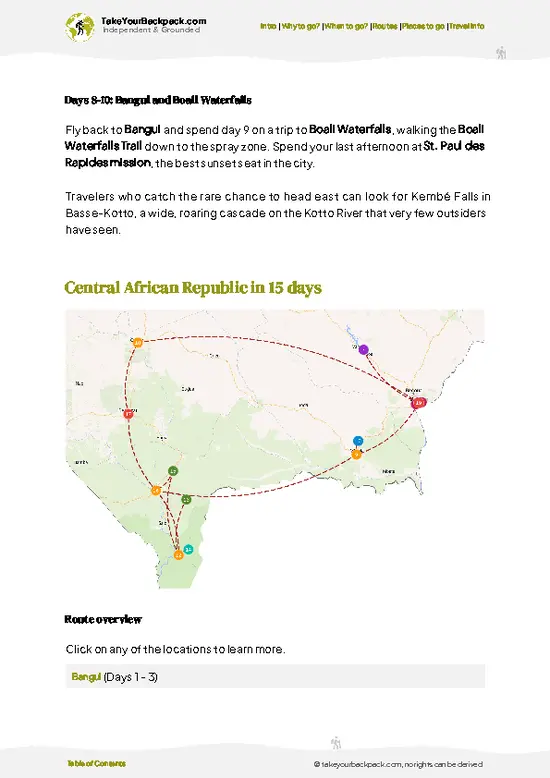
Trip length and structure: A trip linking several landmarks in Central African Republic needs 10 to 14 days, and the extra days should be buffer, not sightseeing. Distances are short on a map but slow on the ground.

The workable cluster is the southwest: Bangui as the hub, then west and south toward Mbaiki, Boda and the Sangha river area. Travel the loop outward by road and return by the same corridor, because few alternative routes exist. Bangui to Mbaiki takes about 3 to 4 hours on the paved and graded road, while onward stretches to the Sangha forest can take 8 to 12 hours or more in a 4x4. Flights from Bangui to regional centers are limited and irregular, so confirm them locally.

Time per stop: Allow 2 to 3 days for each remote forest or river site, including travel in and out. Bangui-area … read more 👉
Trip length and structure: A trip linking several landmarks in Central African Republic needs 10 to 14 days, and the extra days should be buffer, not sightseeing. Distances are short on a map but slow on the ground.

The workable cluster is the southwest: Bangui as the hub, then west and south toward Mbaiki, Boda and the Sangha river area. Travel the loop outward by road and return by the same corridor, because few alternative routes exist. Bangui to Mbaiki takes about 3 to 4 hours on the paved and graded road, while onward stretches to the Sangha forest can take 8 to 12 hours or more in a 4x4. Flights from Bangui to regional centers are limited and irregular, so confirm them locally.

Time per stop: Allow 2 to 3 days for each remote forest or river site, including travel in and out. Bangui-area stops need half a day each.

Planning mistakes: The first mistake is packing in too many regions. The northeast and east are separate expeditions, not add-ons to a southwest trip, and combining them leaves no margin. The second is skipping buffer days, since a single washed-out bridge can cost two days. The third is relying on a fixed fuel plan. Buy and carry extra fuel in Bangui, arrange vehicle and driver before you leave the capital, and confirm security with your local contact each morning.

The ListTop landmarks of Central African Republic

1 Boali Waterfalls

50-meter Mbali plunge, rainbow spray, rim viewpoint, hydroelectric station, rainy-season flow

Follow the path toward the roar to watch the Mbali River drop about 50 meters, with spray, rainbows, and the power station alongside.

central-african-republic-unique-site-boali-waterfalls
© Google |
Loading the map 🌍

Expert viewWhat You Should Know

How many landmarks to visit: Plan on two to four landmarks in total. Each one takes a day or more of difficult travel, permits and a hired vehicle, so a fifth stop adds cost and risk without adding much. Fewer, better-organized visits beat a long list that falls apart at the first flooded road.

Which kind suits you: For a first trip, prioritize southwest forest and river sites, which are the most reachable and the best supported by guides and lodges. Wildlife and reserve visits suit experienced, well-funded travelers who can pay for a guide and private transport. Cultural and colonial-era sites near Bangui suit anyone short on time or money, but they are modest and not worth building a trip around. Skip the far northeast and east unless a recognized operator has confirmed current access.
… read more 👉
How many landmarks to visit: Plan on two to four landmarks in total. Each one takes a day or more of difficult travel, permits and a hired vehicle, so a fifth stop adds cost and risk without adding much. Fewer, better-organized visits beat a long list that falls apart at the first flooded road.

Which kind suits you: For a first trip, prioritize southwest forest and river sites, which are the most reachable and the best supported by guides and lodges. Wildlife and reserve visits suit experienced, well-funded travelers who can pay for a guide and private transport. Cultural and colonial-era sites near Bangui suit anyone short on time or money, but they are modest and not worth building a trip around. Skip the far northeast and east unless a recognized operator has confirmed current access.

What it costs: Budget US$80 to 150 a day for independent travel, far above neighboring countries, because lodging, food and fuel are imported and scarce. Basic Bangui guesthouses run US$30 to 70 a night, and decent hotels more. Vehicle hire with driver for remote trips usually runs US$100 to 200 a day plus fuel. Reserve entry fees and guides typically add US$20 to 80 per visit, and permits or local community contributions may add more. Carry cash in euros or US dollars, in clean recent notes, because cards and ATMs are unreliable outside a few Bangui locations.

Costs and delays that catch travelers out: Fuel shortages stall plans, so carry spare jerrycans from the capital. Unannounced checkpoints can request fees or paperwork, so keep photocopies of your passport, visa and permits and ask your fixer what is normal before you go. Price quotes vary, so agree the total in writing, including driver food and lodging.

Safety and cultural considerations: Check current security advice before booking and again before you leave Bangui, since the situation shifts quickly and large areas are off limits. Travel only in daylight and never alone. Photography needs care. Do not photograph soldiers, checkpoints, bridges or government buildings, and ask permission before photographing people. Visit villages through the local chief or your guide, and dress modestly. Take malaria prophylaxis, a yellow fever certificate and an evacuation-covered insurance policy, since medical care outside Bangui is minimal.

✈️ The backpacker research shortcutCentral African Republic Travel Guide

An offline-friendly backpacking guide with optimized travel routes, ranked highlights, transport advice, and the best areas to stay.
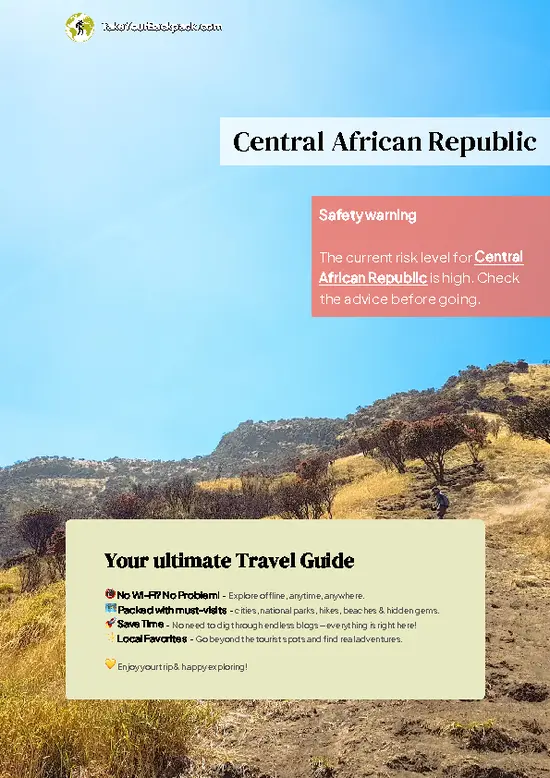
example page 0 from our offline Travel Guide for Central African Republic
example page 1 from our offline Travel Guide for Central African Republic
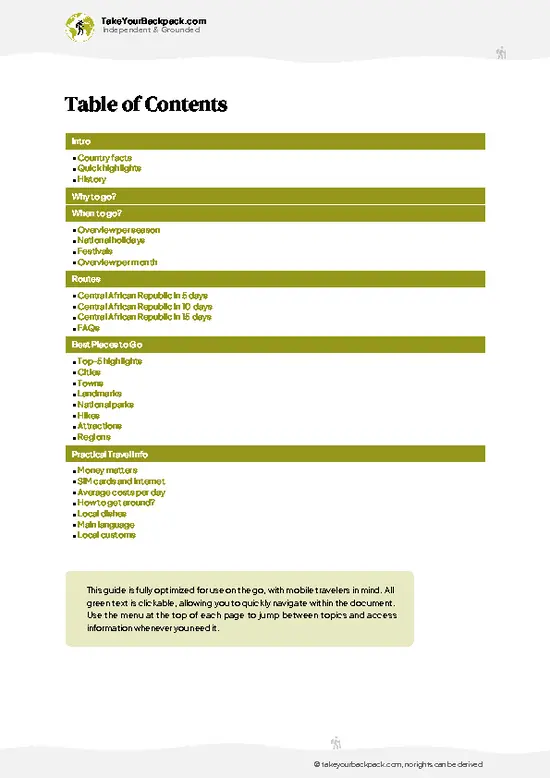
example page 2 from our offline Travel Guide for Central African Republic
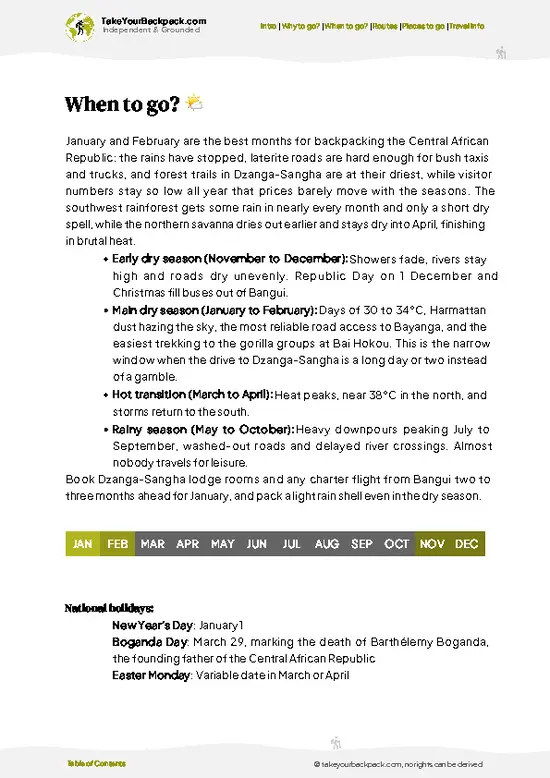
example page 3 from our offline Travel Guide for Central African Republic
example page 4 from our offline Travel Guide for Central African Republic
example page 5 from our offline Travel Guide for Central African Republic
example page 6 from our offline Travel Guide for Central African Republic
example page 7 from our offline Travel Guide for Central African Republic
The digital guide (210 pages) contains:
✅ 42 highlights, ranked by travel appeal
✅ Optimized 5, 10 & 15-day travel routes
✅ Cities, national parks, landmarks, beaches
✅ How to get around
✅ Offline-friendly for travel without Wi-Fi
👉 Click to see all 30+ guide features

📅 Plan smarter in minutes, not weeks
✅ Month by month travel advice
✅ Festivals & national holidays
✅ Budget expectations

🗺️ Go to the right places, skip the overrated ones
✅ Honest pros & cons of destinations
✅ Top hikes, parks & viewpoints
✅ Lesser-known places most travelers miss
✅ Clear “worth it vs skip it” guidance

🛏️ Travel smoothly without rookie mistakes
✅ Best areas to stay
✅ Transport systems explained simply
✅ Common scams & safety advice
✅ SIM cards, money & practical tips

🌍 Understand the country, not just visit it
✅ Culture & traditions
✅ 52 Essential phrases & customs
✅ Festivals worth planning around
✅ Traveler-friendly historical context
✅ Insights that make places more meaningful

📱 Built for real travel conditions
✅ Fully downloadable PDF
✅ Works completely offline
✅ Optimized for phone use
✅ Useful in remote areas & buses
✅ Everything in one place
Stop searching, start planning
Get instant access to your full guide. 30‑day money-back guarantee.
+ Add another guide for just

By proceeding you agree to our terms.
Sent to your inbox immediately after payment • 100% Secure Checkout
Best Backpacking Travel Advisor 2025 tourism awardBest Backpacking
Travel Advisor
2025
What others say about Take Your Backpack Guides:
⭐⭐⭐⭐⭐
Fantastic, amazing amount of information!
⭐⭐⭐⭐⭐
My goodness this is amazing, it's what I've been looking for hats off too you!
⭐⭐⭐⭐⭐
I think this is absolutely BRILLIANT
⭐⭐⭐⭐
Very complete and informative. It's still missing places, but I gotta to commend you
⭐⭐⭐⭐⭐
This is truly amazing, thank you, can't wait to explore it with my kids!
⭐⭐⭐⭐⭐
Awesome resource, thank you!
⭐⭐⭐⭐⭐
This is amazing! Can't wait to explore the ones I haven't seen
⭐⭐⭐⭐
I love this! Well done, great idea.
⭐⭐⭐⭐⭐
Thanks for taking the time to make this gem!
⭐⭐⭐⭐⭐
This might be the best website I've ever seen.
⭐⭐⭐⭐⭐
Congratulations, and thank you so much for your work; it's incredibly valuable.
⭐⭐⭐⭐
In all seriousness I think you did a great job pointing out the important spots
⭐⭐⭐⭐⭐
10/10 very good
⭐⭐⭐⭐⭐
As someone who's only just starting to visit regularly this is awesome, thank you.
⭐⭐⭐⭐
Thank you very much! I'm going to visit my dad, it's going to be very useful!
⭐⭐⭐⭐⭐
This is really cool! We'll be travelling for the first time and this definitely come in handy.
⭐⭐⭐⭐⭐
You are now our minister of culture, congratulations 👨‍💼
⭐⭐⭐⭐⭐
Just wanted to tell you that this is a pearl! Going to follow your recommendations.
⭐⭐⭐⭐⭐
This is so cool. I'll definitely be using the resource for my travels soon.
⭐⭐⭐⭐⭐
This is very impressive! Good work.
⭐⭐⭐⭐⭐
This is an amazing and informative site. Very well done!

🛏️ Where to stay?Accommodation Highlights

There are no true backpacker hostels in the Central African Republic, so budget travel here means simple guesthouses and mission lodgings in Bangui, typically 15,000 to 30,000 XAF (US$25 to 50) a night for a fan room, with anything reliably secure and air-conditioned costing more. Centre-Ville, the downtown grid near the Oubangui River, has the widest choice, the best security, and walking access to restaurants, banks and the few bars, though prices run highest there. Cheaper rooms around PK0 and Lakouanga put you closer to markets and daily street life, but the streets get dark early and need more caution at night, while the quieter area near M’Poko airport suits early flights but leaves you … read more 👉
There are no true backpacker hostels in the Central African Republic, so budget travel here means simple guesthouses and mission lodgings in Bangui, typically 15,000 to 30,000 XAF (US$25 to 50) a night for a fan room, with anything reliably secure and air-conditioned costing more. Centre-Ville, the downtown grid near the Oubangui River, has the widest choice, the best security, and walking access to restaurants, banks and the few bars, though prices run highest there. Cheaper rooms around PK0 and Lakouanga put you closer to markets and daily street life, but the streets get dark early and need more caution at night, while the quieter area near M’Poko airport suits early flights but leaves you a taxi ride from everything.

If you enjoy meeting fellow travelers, consider choosing hostels with high ratings for atmosphere. On the other hand, if you prefer having your own space, a hotel might be a better option.

Central African RepublicSee More of Central African Republic

👋 Meet the founderWho’s Behind Take Your Backpack?

Johan, backpacker and founder of TakeYourBackpackHi, I’m Johan (Netherlands 🇳🇱), the creator of TakeYourBackpack. Over the past 3 decades, I’ve backpacked through 90+ countries across six continents, gaining extensive experience with independent travel, long-term trips, and overland routes.

This site is built on a combination of firsthand travel experience and carefully curated insights from other backpackers. Many guides are based on places I’ve personally visited, while others bring together tips, observations, and practical advice shared by trusted travelers I’ve met along the way.

The goal is to provide realistic, experience-driven guidance — not generic itineraries — so you can explore destinations with better context, clearer expectations, and more confidence.