v2.webp)
- Central Market: The town’s main commercial hub, where farmers bring cassava, peanuts, dried fish and cotton-region produce. Go early, from about 7 to 10 AM, when stalls are busiest. Entry is free and an hour is enough.
- Ouham River banks: Fishing canoes and women washing clothes make this the town’s most scenic spot. Late afternoon is cooler and livelier. It is free and takes about an hour. Ask locals before photographing people.
- Saint-Joseph Cathedral area: The Catholic mission is a long-standing institution in town and shaped local schooling and health care. Visit outside Sunday service times unless you wish to attend. Entry is free, and 30 minutes is enough. Show respect and ask before entering compounds.
- Cotton ginning area: Cotton processing sites reflect the local economy, though access
- Central Market: The town’s main commercial hub, where farmers bring cassava, peanuts, dried fish and cotton-region produce. Go early, from about 7 to 10 AM, when stalls are busiest. Entry is free and an hour is enough.
- Ouham River banks: Fishing canoes and women washing clothes make this the town’s most scenic spot. Late afternoon is cooler and livelier. It is free and takes about an hour. Ask locals before photographing people.
- Saint-Joseph Cathedral area: The Catholic mission is a long-standing institution in town and shaped local schooling and health care. Visit outside Sunday service times unless you wish to attend. Entry is free, and 30 minutes is enough. Show respect and ask before entering compounds.
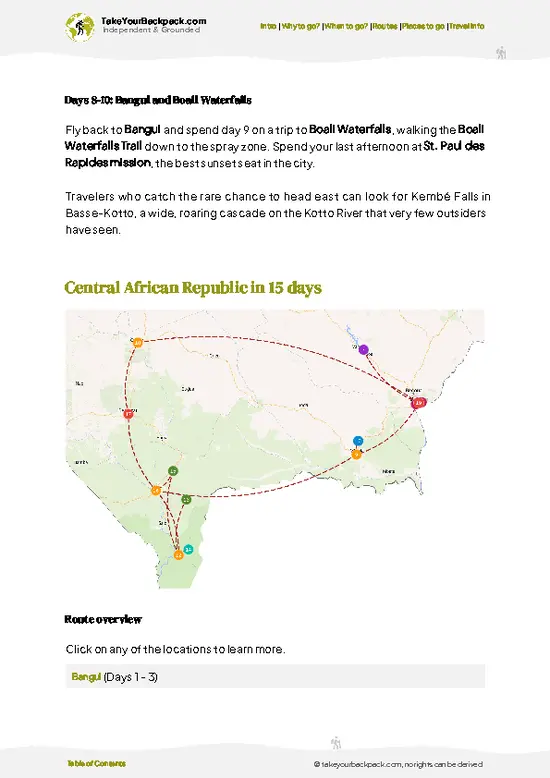
- Cotton ginning area: Cotton processing sites reflect the local economy, though access depends on permission and season. Harvest months are the most active. Costs vary, usually a small gift or nothing, and a visit takes about an hour if allowed.
- Neighborhood walk along the main road: A slow walk past workshops, small shops and tea stalls shows daily life better than any single monument. Morning or late afternoon works best. It is free and takes around 1 to 2 hours.
Spotted a mistake or missing something? Contact us.

 Best Backpacking
.jpg) Hi, I’m Johan (Netherlands 🇳🇱), the creator of TakeYourBackpack. Over the past 3 decades, I’ve backpacked through 90+ countries across six continents, gaining extensive experience with independent travel, long-term trips, and overland routes.
Hi, I’m Johan (Netherlands 🇳🇱), the creator of TakeYourBackpack. Over the past 3 decades, I’ve backpacked through 90+ countries across six continents, gaining extensive experience with independent travel, long-term trips, and overland routes.