×

Central African Republic🇨🇫 | best townsBest 10 towns in Central African Republic

Central African Republic is not a country of tourist towns. Its towns are working crossroads, and the differences between them come down to security and road access. Bangui, on the Ubangi River, is the only place with real infrastructure: flights, banks, a few hotels and restaurants, and higher prices than you expect. The southwest forest belt near Mbaïki and Bayanga is calmer and greener, with few visitors. The center and east are the least accessible and often unsafe. Backpacking in the usual sense is not practical here. Independent travel works only in small, pre-arranged, well-informed hops, and anyone wanting easy hostel-town travel should pick another country.

By Johan Kruseman 🇳🇱 | Updated October 23, 2026
Explore the best landmarks in Central African Republic

Why go?Why These town Stand Out

Central African Republic is poorly suited to casual town-hopping, and that is the first fact to accept. Decades of conflict, a very thin road network (very little of it paved) and a landlocked position far from any port keep costs high and movement slow. Many towns are reached by laterite tracks that turn to mud in the rains, and fuel, food and lodging all cost more than in neighboring countries.

What the country does offer is unfiltered daily life. Towns here grew around the Ubangi River trade, colonial-era concessions, diamond and timber buying, and market routes, so the rhythms are those of river ports, riverside fishing, and Sango-speaking markets rather than sights. There are almost no tourist services, so nothing is staged.

Before choosing the country for its towns, understand the … read more 👉
Central African Republic is poorly suited to casual town-hopping, and that is the first fact to accept. Decades of conflict, a very thin road network (very little of it paved) and a landlocked position far from any port keep costs high and movement slow. Many towns are reached by laterite tracks that turn to mud in the rains, and fuel, food and lodging all cost more than in neighboring countries.

What the country does offer is unfiltered daily life. Towns here grew around the Ubangi River trade, colonial-era concessions, diamond and timber buying, and market routes, so the rhythms are those of river ports, riverside fishing, and Sango-speaking markets rather than sights. There are almost no tourist services, so nothing is staged.

Before choosing the country for its towns, understand the limits. Government control outside Bangui and a few regional centers is patchy, armed groups operate across large areas, and many foreign governments advise against all travel. Mobile coverage is patchy, cash (CFA francs, euros or US dollars in clean notes) is needed almost everywhere, and permits, local contacts and a reliable fixer are not optional extras. Anyone who wants atmosphere without logistics should look at the neighbors instead.
How the List Was Created
The list of best towns in Central African Republic is created based on charm, local culture, atmosphere, hidden gems, and visitor appeal. If you feel a town is missing in this list, please let us know.

When to go?Timing Your Visit for the Best Experience

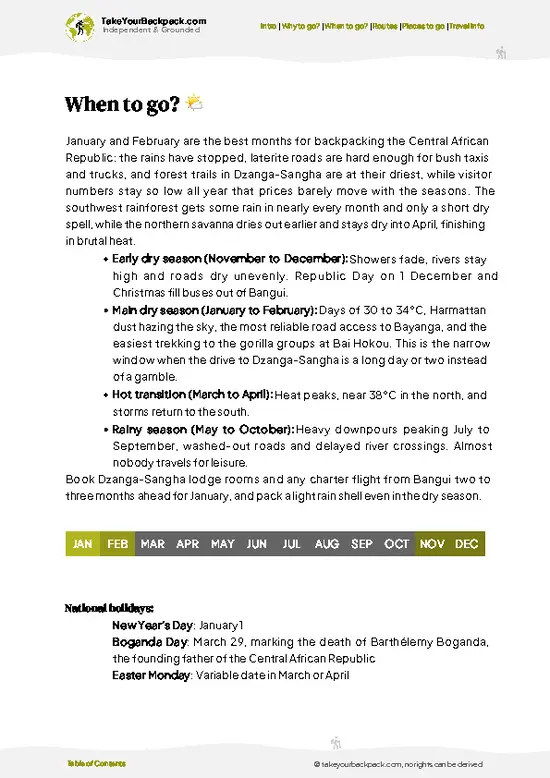
Best months: The best months for towns in Central African Republic are December to February, when the dry season keeps laterite roads firm and river crossings manageable. Days reach 30 to 35°C, nights in the south drop to around 20°C, and the harmattan haze can dull the light.
Shoulder and wet seasons: March and April are hot, often above 35°C, and humid before the rains build. May to October is the rainy season in the south and center, with annual rainfall of roughly 1,300 to 1,800 mm. Tracks become slow or impassable, bridges and ferries fail, and trips that take one day in January can take three. Skip this window for anything beyond Bangui.
Regional differences: The north and northeast have a longer dry season, but that is also where insecurity is greatest, so the better weather does not … read more 👉
Best months: The best months for towns in Central African Republic are December to February, when the dry season keeps laterite roads firm and river crossings manageable. Days reach 30 to 35°C, nights in the south drop to around 20°C, and the harmattan haze can dull the light.
Shoulder and wet seasons: March and April are hot, often above 35°C, and humid before the rains build. May to October is the rainy season in the south and center, with annual rainfall of roughly 1,300 to 1,800 mm. Tracks become slow or impassable, bridges and ferries fail, and trips that take one day in January can take three. Skip this window for anything beyond Bangui.
Regional differences: The north and northeast have a longer dry season, but that is also where insecurity is greatest, so the better weather does not make those towns a sensible choice. The southwest forest has rain almost year-round, with a lull from December to February, so even the best months are damp there.
Crowds and prices: There are no tourist crowds in any month. Prices shift with road conditions instead: transport and food costs rise noticeably in the wet season, often by 20 to 50 percent on remote routes, when fuel and goods are harder to deliver. Book flights and any arranged transport well before the dry season starts.

town hoppingTips for Visiting Multiple Destinations

How many days: A trip combining several towns in Central African Republic needs 10 to 14 days, because every transfer eats a full day and delays are normal. Fewer than that, and you spend the whole trip on the road.
Regions that group well: Everything starts at Bangui, the only real transport hub, with the international airport and the main roads out. The southwest, along the road toward Mbaïki and the forest belt, clusters sensibly and is the most realistic direction. Go out one way and return on the same axis. Linking the southwest to the east or north in one trip is not worth attempting: distances are large, tracks are poor and security changes quickly.
Time per stop: Allow 2 to 3 nights at each stop, including a buffer day. Travel between Bangui and southwestern regional centers typically … read more 👉
How many days: A trip combining several towns in Central African Republic needs 10 to 14 days, because every transfer eats a full day and delays are normal. Fewer than that, and you spend the whole trip on the road.
Regions that group well: Everything starts at Bangui, the only real transport hub, with the international airport and the main roads out. The southwest, along the road toward Mbaïki and the forest belt, clusters sensibly and is the most realistic direction. Go out one way and return on the same axis. Linking the southwest to the east or north in one trip is not worth attempting: distances are large, tracks are poor and security changes quickly.
Time per stop: Allow 2 to 3 nights at each stop, including a buffer day. Travel between Bangui and southwestern regional centers typically takes 3 to 8 hours by road in the dry season, and a full day or more in the rains. Longer legs toward the forest reserves can take 1 to 2 days.
Planning mistakes: The most common error is packing in too many stops on a schedule with no slack. Build in one spare day per two transfers. Another is relying on public transport timings, since minibuses and trucks leave when full. Arrange a vehicle and driver in advance. Finally, travelers arrive without checking checkpoints and permits: get letters and current security information in Bangui before leaving the capital each time.

The ListTop towns of Central African Republic

1 Bayanga

Dzanga Bai elephants, gorilla tracking, BaAka forest walks, Sangha riverside

Sit on a raised platform above a forest clearing as elephants gather, then track gorillas or walk the forest edge with BaAka guides.

2 Bouar

Standing megaliths, Cameroon road plateau, Mbororo cattle, Sango hymns

Hire a local guide to walk among ancient standing stones on the hills, then end the day at the market and cathedral.

3 Nola

Sangha confluence, Kadéï and Mambéré, dugout loading, forest-reserve gateway

Stand where two rivers merge into the Sangha, then paddle with a local boatman past fishing camps and riverside gardens.

4 Bambari

Ouaka River pirogues, Sango choir Sundays, colonial-era bridge, quiet riverside quarters

Watch pirogues launch from the Ouaka banks at dawn, then wander the market and riverside quarters of a calm, slow provincial town.

5 Bossangoa

Cotton and coffee hub, Ouham canoes, Saint-Joseph mission, tea stall strip

Move between the early market, the Ouham canoe landings and the cotton-ginning area for a look at a northwestern farming town.

6 Carnot

Diamond comptoirs, Mambéré washing spots, caterpillar market, drum-led Sunday Mass

Meet traders and diggers around the diamond-buying offices, then catch Sunday choirs and drums at the mission church.

7 Mbaïki

Robusta groves, Lobaye market, cathedral choirs, red soil

Walk through shaded robusta plantations with a farmer, then browse a market stacked with coffee beans, forest leaves and cassava.

8 Bozoum

Carmelite mission, Fulani cattle trade, Ouham banks, football pitches

Visit the Carmelite mission known for sheltering civilians, then follow the cattle trade and river life of a small northwestern town.

central-african-republic-city-bozoum
© Google |

9 Bria

Diamond brokers, Kotto River, UN-flight arrivals, mining-town market

Walk the market, the Kotto banks and the buyers’ streets to see how diamond trade shapes daily routine in this northeastern town.

10 Sibut

Road junction trade, Kémo River, grilled manioc, lamplit main street

Watch trucks load and haggle at the junction, then eat grilled skewers along a lamplit main street after the heat fades.

11 Birao

Sahel trade market, airstrip life, mud-brick compounds, sweet tea stalls

Browse a market stocked with millet, spices and goods hauled from Sudan and Chad, then watch the airstrip draw the whole town.

12 Batangafo

Ouham River crossings, cassava market, former cotton stop, remote north-west

Spend slow hours on the Ouham bank and in the central market, where fishing, washing and pirogue crossings fill the working day.

13 Kaga-Bandoro

Peul cattle market, Gbaya and Banda quarters, charcoal bicycles, northern road stop

Start with the cattle trading at dawn, then walk mud-brick quarters where charcoal-laden bicycles and cassava pounding set the pace.

14 Mobaye

Oubangui ferry landing, rock-ledge rapids, Zongo opposite, fish market

Watch pirogues shuttle toward Zongo, then hire a boatman to fish-watch among the rock ledges upstream of town.

15 Zemio

Zande chief’s compound, Mbomou banks, thatched homes, cassava mats

Meet the Zande chieftaincy through a local introduction, then walk thatched neighborhoods and the Mbomou riverbank at a slow pace.

16 Ndélé

Sultanate quarter, Chad-bound trade, airstrip lifeline, seasonal streams

Trace the legacy of the old sultan’s domain with a local guide, then watch the airstrip that links the town to the world.

17 Yaloke

Highway truck stop, Catholic mission, Fulani herd camps, peanut sellers

Share tea and grilled meat with drivers at the highway strip, then visit the mission compound and herders on the town’s edge.

18 Boda

Coffee sacks, red laterite tracks, main road trade, forest edge paths

Watch coffee sacks weighed and loaded along the main road, then follow red forest-edge paths to farm plots and small villages.

19 Mongoumba

Aka and Bantu fishers, smoking racks, Ubangi canoes, Congo border channels

Watch dugout catches come ashore and onto smoking racks, then cross the channels by canoe for a view of the river’s breadth.

20 Ouadda

Haute-Kotto diamonds, market lanes, stream-bank miners, northeast outpost

Cross the market and the diamond-buying lanes, then follow streams where washing, fishing and small-scale mining share the water.

21 Rafaï

Chinko River, Zande granaries, reserve gateway, southeast frontier

Walk Zande lanes of mud-brick houses and granaries, then sit by the Chinko as canoes cross at the edge of town.

22 Kouango

Ubangi sandbanks, fishing landings, old mission bricks, Congo opposite shore

Follow the Ubangi bank from pirogue loading to net-mending beaches, with the Congolese shore across the water.

Think you know Central African Republic?

Prove you’re a true local — uncover 12 lesser-known towns in Central African Republic that locals tend to keep to themselves.
Loading the map 🌍

Expert viewWhat You Should Know

How many towns: Visit two or three towns at most. Roads are slow, security can shift in days, and each stop needs arranged contacts and paperwork. A fourth stop adds risk and travel days for very little.
Which kind to prioritize: For a first, cautious trip, choose Bangui plus one southwestern forest-belt town. These have the most reliable access, lodging and information. River and market towns suit travelers interested in everyday life and trade, while remote forest-edge or reserve towns suit those with a specific interest such as wildlife or research, and who can afford a guide and a vehicle. Towns in the north, northeast and east are not worth the risk for independent visitors.
What it costs: This is an expensive country for what you get. Budget US$80 to 150 a day in Bangui and regional centers: … read more 👉
How many towns: Visit two or three towns at most. Roads are slow, security can shift in days, and each stop needs arranged contacts and paperwork. A fourth stop adds risk and travel days for very little.
Which kind to prioritize: For a first, cautious trip, choose Bangui plus one southwestern forest-belt town. These have the most reliable access, lodging and information. River and market towns suit travelers interested in everyday life and trade, while remote forest-edge or reserve towns suit those with a specific interest such as wildlife or research, and who can afford a guide and a vehicle. Towns in the north, northeast and east are not worth the risk for independent visitors.
What it costs: This is an expensive country for what you get. Budget US$80 to 150 a day in Bangui and regional centers: basic rooms run US$30 to 70 (mid-range US$80 and up), meals US$5 to 15, and local transport costs vary. A private vehicle and driver for out-of-town trips is roughly US$100 to 200 a day plus fuel. Fixers or guides cost around US$30 to 60 a day. Permits, checkpoint fees and photo permissions may add US$10 to 50 per visit, so carry small notes. Cards are rarely accepted and ATMs are unreliable, so bring enough clean cash in euros or US dollars and change it in small amounts. Fuel and food prices rise in the wet season.
Safety and culture: Check your government’s travel advice and local security updates before every leg, and register with your embassy. Do not travel after dark; ambushes and checkpoints are more likely then. Never photograph soldiers, government buildings, bridges or airports. Carry copies of your passport, visa and yellow fever certificate, and expect repeated document checks. Greet people before asking anything, dress modestly, and ask before photographing individuals in markets. Medical care outside Bangui is very limited, so carry a full kit, malaria prophylaxis and evacuation insurance that explicitly covers the country.
Mistakes to avoid: Arriving without a local contact is the most costly error. Arrange a fixer or hotel pickup beforehand. Do not rely on cash machines, and do not plan tight connections. Avoid the wet season outside Bangui, because delays can add days and money.

✈️ The backpacker research shortcutCentral African Republic Travel Guide

An offline-friendly backpacking guide with optimized travel routes, ranked highlights, transport advice, and the best areas to stay.
example page 0 from our offline Travel Guide for Central African Republic
example page 1 from our offline Travel Guide for Central African Republic
example page 2 from our offline Travel Guide for Central African Republic
example page 3 from our offline Travel Guide for Central African Republic
example page 4 from our offline Travel Guide for Central African Republic
example page 5 from our offline Travel Guide for Central African Republic
example page 6 from our offline Travel Guide for Central African Republic
example page 7 from our offline Travel Guide for Central African Republic
The digital guide (210 pages) contains:
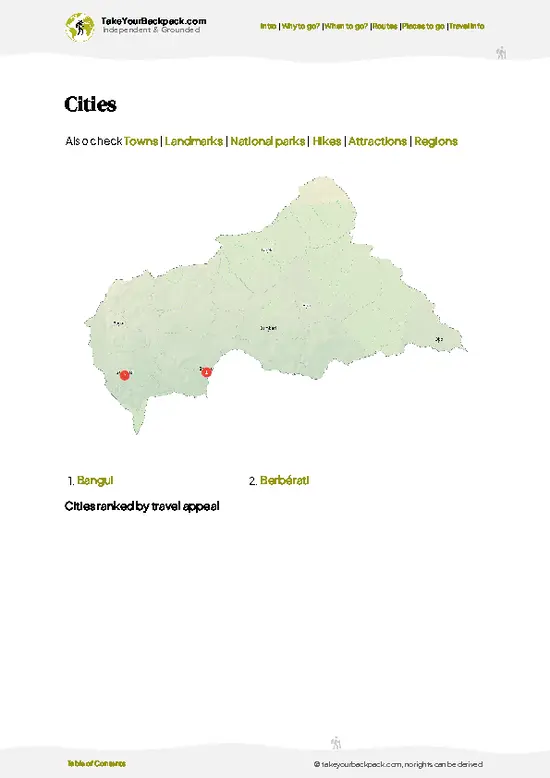
✅ 42 highlights, ranked by travel appeal
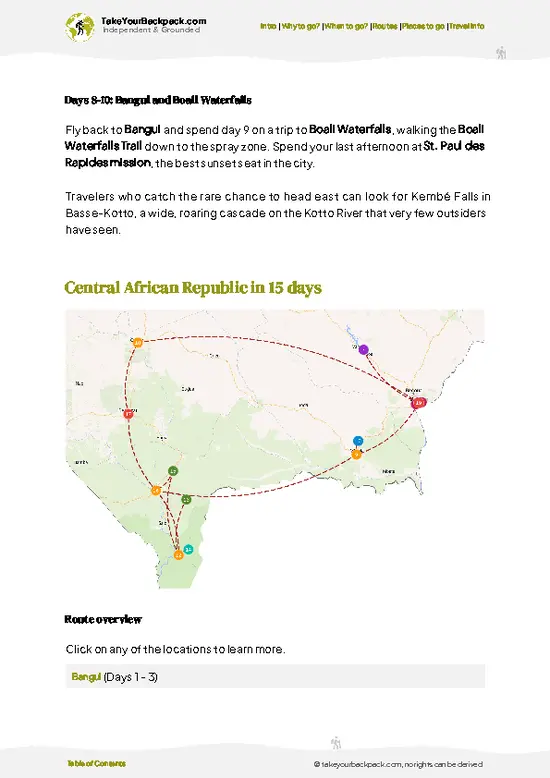
✅ Optimized 5, 10 & 15-day travel routes
✅ Cities, national parks, landmarks, beaches
✅ How to get around
✅ Offline-friendly for travel without Wi-Fi
👉 Click to see all 30+ guide features

📅 Plan smarter in minutes, not weeks
✅ Month by month travel advice
✅ Festivals & national holidays
✅ Budget expectations

🗺️ Go to the right places, skip the overrated ones
✅ Honest pros & cons of destinations
✅ Top hikes, parks & viewpoints
✅ Lesser-known places most travelers miss
✅ Clear “worth it vs skip it” guidance

🛏️ Travel smoothly without rookie mistakes
✅ Best areas to stay
✅ Transport systems explained simply
✅ Common scams & safety advice
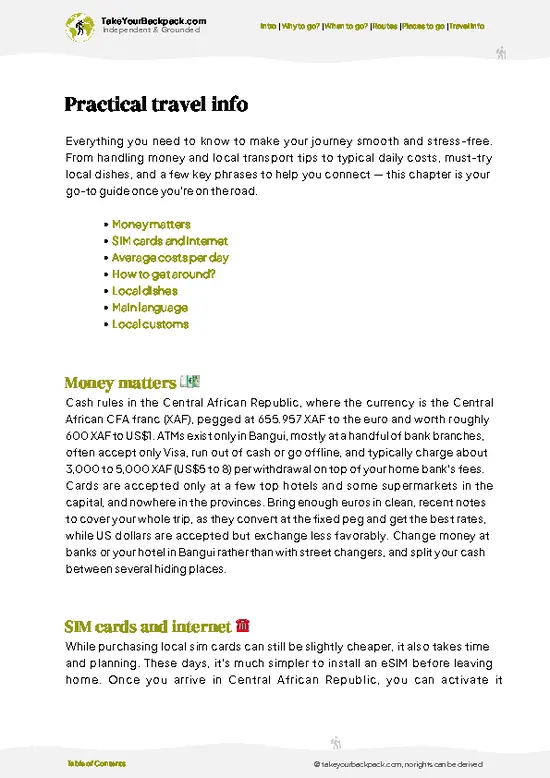
✅ SIM cards, money & practical tips

🌍 Understand the country, not just visit it
✅ Culture & traditions
✅ 52 Essential phrases & customs
✅ Festivals worth planning around
✅ Traveler-friendly historical context
✅ Insights that make places more meaningful

📱 Built for real travel conditions
✅ Fully downloadable PDF
✅ Works completely offline
✅ Optimized for phone use
✅ Useful in remote areas & buses
✅ Everything in one place
Stop searching, start planning
Get instant access to your full guide. 30‑day money-back guarantee.
+ Add another guide for just

By proceeding you agree to our terms.
Sent to your inbox immediately after payment • 100% Secure Checkout
Best Backpacking Travel Advisor 2025 tourism awardBest Backpacking
Travel Advisor
2025
What others say about Take Your Backpack Guides:
⭐⭐⭐⭐⭐
Fantastic, amazing amount of information!
⭐⭐⭐⭐⭐
My goodness this is amazing, it's what I've been looking for hats off too you!
⭐⭐⭐⭐⭐
I think this is absolutely BRILLIANT
⭐⭐⭐⭐
Very complete and informative. It's still missing places, but I gotta to commend you
⭐⭐⭐⭐⭐
This is truly amazing, thank you, can't wait to explore it with my kids!
⭐⭐⭐⭐⭐
Awesome resource, thank you!
⭐⭐⭐⭐⭐
This is amazing! Can't wait to explore the ones I haven't seen
⭐⭐⭐⭐
I love this! Well done, great idea.
⭐⭐⭐⭐⭐
Thanks for taking the time to make this gem!
⭐⭐⭐⭐⭐
This might be the best website I've ever seen.
⭐⭐⭐⭐⭐
Congratulations, and thank you so much for your work; it's incredibly valuable.
⭐⭐⭐⭐
In all seriousness I think you did a great job pointing out the important spots
⭐⭐⭐⭐⭐
10/10 very good
⭐⭐⭐⭐⭐
As someone who's only just starting to visit regularly this is awesome, thank you.
⭐⭐⭐⭐
Thank you very much! I'm going to visit my dad, it's going to be very useful!
⭐⭐⭐⭐⭐
This is really cool! We'll be travelling for the first time and this definitely come in handy.
⭐⭐⭐⭐⭐
You are now our minister of culture, congratulations 👨‍💼
⭐⭐⭐⭐⭐
Just wanted to tell you that this is a pearl! Going to follow your recommendations.
⭐⭐⭐⭐⭐
This is so cool. I'll definitely be using the resource for my travels soon.
⭐⭐⭐⭐⭐
This is very impressive! Good work.
⭐⭐⭐⭐⭐
This is an amazing and informative site. Very well done!

🛏️ Where to stay?Where to Stay in Central African Republic

There are no true backpacker hostels in the Central African Republic, so budget travel here means simple guesthouses and mission lodgings in Bangui, typically 15,000 to 30,000 XAF (US$25 to 50) a night for a fan room, with anything reliably secure and air-conditioned costing more. Centre-Ville, the downtown grid near the Oubangui River, has the widest choice, the best security, and walking access to restaurants, banks and the few bars, though prices run highest there. Cheaper rooms around PK0 and Lakouanga put you closer to markets and daily street life, but the streets get dark early and need more caution at night, while the quieter area near M’Poko airport suits early flights but leaves you … read more 👉
There are no true backpacker hostels in the Central African Republic, so budget travel here means simple guesthouses and mission lodgings in Bangui, typically 15,000 to 30,000 XAF (US$25 to 50) a night for a fan room, with anything reliably secure and air-conditioned costing more. Centre-Ville, the downtown grid near the Oubangui River, has the widest choice, the best security, and walking access to restaurants, banks and the few bars, though prices run highest there. Cheaper rooms around PK0 and Lakouanga put you closer to markets and daily street life, but the streets get dark early and need more caution at night, while the quieter area near M’Poko airport suits early flights but leaves you a taxi ride from everything.

If you enjoy meeting fellow travelers, consider choosing hostels with high ratings for atmosphere. On the other hand, if you prefer having your own space, a hotel might be a better option.

Central African RepublicMore of Central African Republic

👋 Meet the founderWho’s Behind Take Your Backpack?

Johan, backpacker and founder of TakeYourBackpackHi, I’m Johan (Netherlands 🇳🇱), the creator of TakeYourBackpack. Over the past 3 decades, I’ve backpacked through 90+ countries across six continents, gaining extensive experience with independent travel, long-term trips, and overland routes.

This site is built on a combination of firsthand travel experience and carefully curated insights from other backpackers. Many guides are based on places I’ve personally visited, while others bring together tips, observations, and practical advice shared by trusted travelers I’ve met along the way.

The goal is to provide realistic, experience-driven guidance — not generic itineraries — so you can explore destinations with better context, clearer expectations, and more confidence.