×

Central African Republic🇨🇫 | national parksManovo-Gounda St. Floris National ParkGounda floodplain, World Heritage in danger, sandstone hills, hippo pools | things to do and best time to go

Explore Dzanga-Sangha National ParkExplore Sangha Trinational

Backpacking in Manovo-Gounda St. Floris
UNESCO World Heritage site
🏆 Top picknational park ranked #2
By Johan Kruseman 🇳🇱 | Updated October 22, 2026

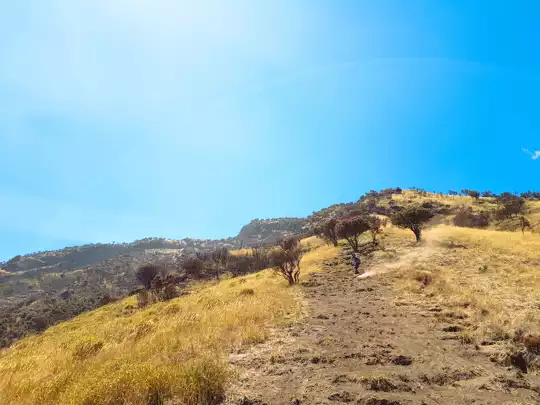
Manovo-Gounda St. Floris is best known as a UNESCO World Heritage Site, listed in 1988 for floodplains that once held some of the densest wildlife in central Africa. It sits in the far north of the Central African Republic. Poaching and armed groups gutted the animal numbers from the 1980s on, and the site has been on the in-danger list since the 1990s. The scenery is still big: flat grassland, seasonal swamps and sandstone hills, with elephants, hippos, buffalo, giraffe and several antelope species surviving in patches. There are no crowds because there is almost no tourism. Do not budget for a casual trip. Overland journeys here can stretch for days after rain, so pad your schedule heavily. Arrange permission, an armed-security assessment and a vehicle with spare fuel before leaving Bangui, since none of that can be bought on the spot. Do not expect lodges. Unlike Zakouma in Chad, which runs a working tourism operation, this park is for expedition-minded travelers.

Discover everything you want to know in the 📖 Central African Republic Travel Guide.
Safety warning

The current risk level for Central African Republic is high. Check the advice before going.


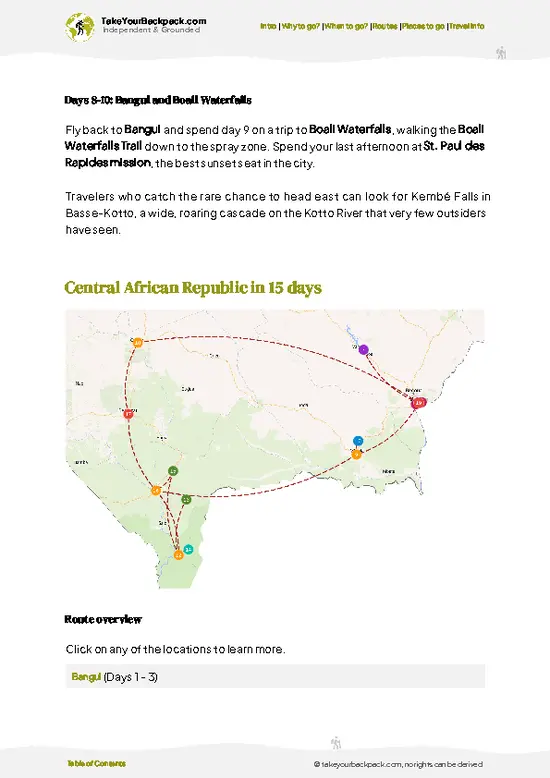
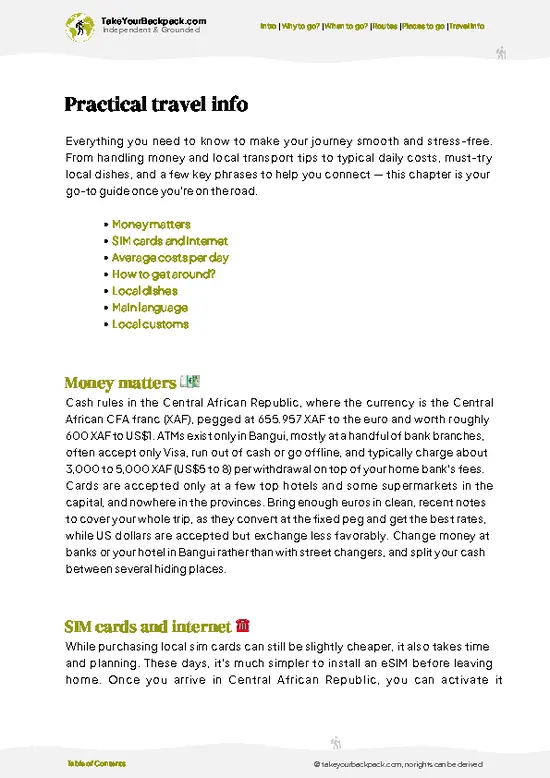
example page 0 from our offline Travel Guide for Central African Republic
example page 1 from our offline Travel Guide for Central African Republic
example page 2 from our offline Travel Guide for Central African Republic
example page 3 from our offline Travel Guide for Central African Republic
example page 4 from our offline Travel Guide for Central African Republic
example page 5 from our offline Travel Guide for Central African Republic
example page 6 from our offline Travel Guide for Central African Republic
example page 7 from our offline Travel Guide for Central African Republic
Loading the map 🌍
CLICK TO FILTER
cities
towns
landmarks
national parks
hikes
attractions
regions
SHOW COUNTRY’S BESTSHOW ALL

✨ Why go?
Ranked #2 national park in Central African Republic
Why Manovo-Gounda St. Floris should be on your travel list

Manovo-Gounda St. Floris National Park suits the backpacker who wants a place with no crowds at all, and who accepts that getting there is an expedition rather than a bus ticket. The park covers roughly 17,400 square kilometers of Sudanian savanna, floodplain and the Bamingui-Bangoran river system, and it is a UNESCO World Heritage Site that has been on the danger list since the 1990s because of poaching and armed groups. That history matters. Going independently is not realistic here: you need a vetted local operator or conservation partner, a vehicle, fuel, a security briefing and current information from people on the ground.

What pulls people in is the chance to see a landscape that few outsiders have laid eyes on. The Gounda floodplains and the sandstone ridges of the Chaîne des Bongo … read more 👉
Manovo-Gounda St. Floris National Park suits the backpacker who wants a place with no crowds at all, and who accepts that getting there is an expedition rather than a bus ticket. The park covers roughly 17,400 square kilometers of Sudanian savanna, floodplain and the Bamingui-Bangoran river system, and it is a UNESCO World Heritage Site that has been on the danger list since the 1990s because of poaching and armed groups. That history matters. Going independently is not realistic here: you need a vetted local operator or conservation partner, a vehicle, fuel, a security briefing and current information from people on the ground.

What pulls people in is the chance to see a landscape that few outsiders have laid eyes on. The Gounda floodplains and the sandstone ridges of the Chaîne des Bongo rise above open grassland, with hippos, buffalo, giraffe and a scatter of antelope still holding on. Elephant and lion numbers are far lower than in the past, so go for the emptiness and the birdlife, not a guaranteed big-game checklist. Veterans who have already done Garamba or Zakouma will find a rawer, rougher place with no lodges to fall back on and no phone signal.

💡 HighlightsWhat this place is best known for

  1. Gounda floodplain: The park’s signature landscape, a broad plain of tall grass and seasonal pools where hippos, buffalo and antelope gather as the water shrinks.
  2. Manovo floodplain: The second of the two river systems that give the park its name, with open grassland and wetlands that are good for spotting waterbirds.
  3. Bahr Aouk River: A watercourse tied to the park’s northern landscape, with riverside woodland that shelters monkeys, baboons and birdlife.
  4. Elephant herds: Elephants remain among the park’s most reliable large mammals, and a sighting here comes with no other vehicles in view.
  5. Hippo pools: Deeper river bends hold hippo pods, and their grunting carries well across the still water.
  6. Sandstone hills of the north: The rocky uplands break up the flat savanna and give you elevated viewpoints
… read more 👉
  1. Gounda floodplain: The park’s signature landscape, a broad plain of tall grass and seasonal pools where hippos, buffalo and antelope gather as the water shrinks.
  2. Manovo floodplain: The second of the two river systems that give the park its name, with open grassland and wetlands that are good for spotting waterbirds.
  3. Bahr Aouk River: A watercourse tied to the park’s northern landscape, with riverside woodland that shelters monkeys, baboons and birdlife.
  4. Elephant herds: Elephants remain among the park’s most reliable large mammals, and a sighting here comes with no other vehicles in view.
  5. Hippo pools: Deeper river bends hold hippo pods, and their grunting carries well across the still water.
  6. Sandstone hills of the north: The rocky uplands break up the flat savanna and give you elevated viewpoints over the plains.
For a first visit, start with the Gounda floodplain, because it gathers the most wildlife in the fewest hours of driving and shows the park at its most characteristic. Manovo-Gounda St. Floris National Park rewards that focus.
Spotted a mistake or missing something? Contact us.

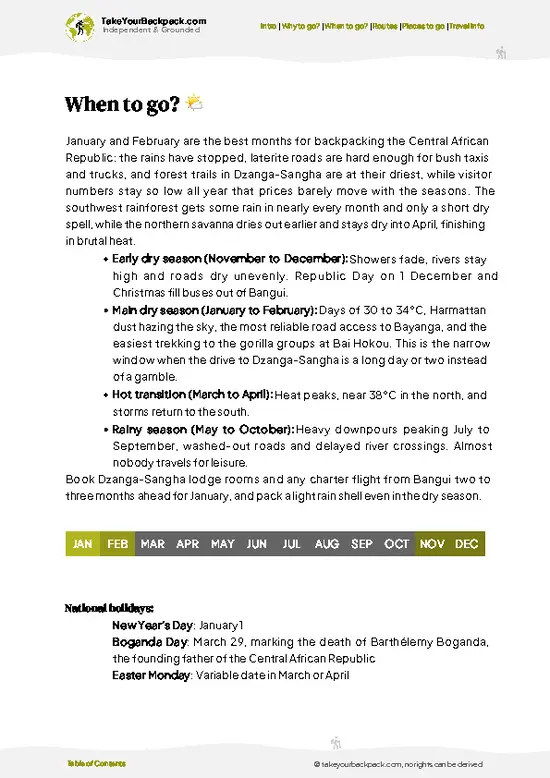
🌤️ When to go?Choosing the right time of year

  • Peak Dry Season (December to February): Grass is burned or dry, roads are passable and animals gather at the Koumbala and Gounda rivers. Days reach 32 to 38°C (90 to 100°F), nights drop to 18 to 22°C (64 to 72°F). Daylight runs roughly 11.5 to 12.5 hours. Harmattan haze can dull photos.
  • Late Dry Season (March to April): Hottest stretch, 36 to 40°C (97 to 104°F). Wildlife is easiest to spot at shrinking waterholes, though heat limits midday walking. First storms can start in April.
  • Rainy Season (May to October): Highs of 28 to 32°C (82 to 90°F), tall grass and flooded tracks. Access is often cut, and operators typically stop running trips. Costs are not a factor because services mostly close.
  • Early Dry Season (November): Tracks begin to firm up, grass is still high, and logistics prices start
… read more 👉
  • Peak Dry Season (December to February): Grass is burned or dry, roads are passable and animals gather at the Koumbala and Gounda rivers. Days reach 32 to 38°C (90 to 100°F), nights drop to 18 to 22°C (64 to 72°F). Daylight runs roughly 11.5 to 12.5 hours. Harmattan haze can dull photos.
  • Late Dry Season (March to April): Hottest stretch, 36 to 40°C (97 to 104°F). Wildlife is easiest to spot at shrinking waterholes, though heat limits midday walking. First storms can start in April.
  • Rainy Season (May to October): Highs of 28 to 32°C (82 to 90°F), tall grass and flooded tracks. Access is often cut, and operators typically stop running trips. Costs are not a factor because services mostly close.
  • Early Dry Season (November): Tracks begin to firm up, grass is still high, and logistics prices start climbing toward their December peak.
Arrange any trip well ahead, since vehicle and guide availability is tightest from December to March.


source: climatestotravel.comJANJanuary: excellent for travelingFEBFebruary: highly recommended for travelingMARMarch: highly recommended for travelingAPRApril: highly recommended for travelingMAYMay: fair for travelingJUNJune: fair for travelingJULJuly: fair for travelingAUGAugust: fair for travelingSEPSeptember: fair for travelingOCTOctober: fair for travelingNOVNovember: excellent for travelingDECDecember: excellent for traveling
when-to-go

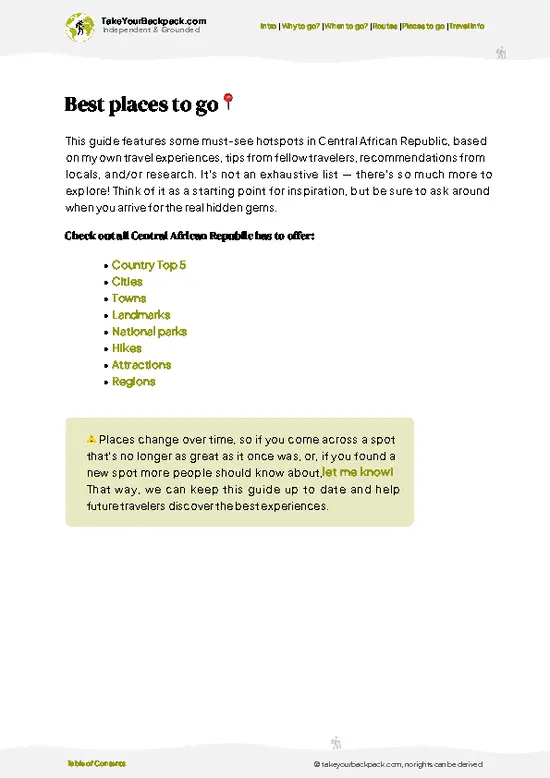
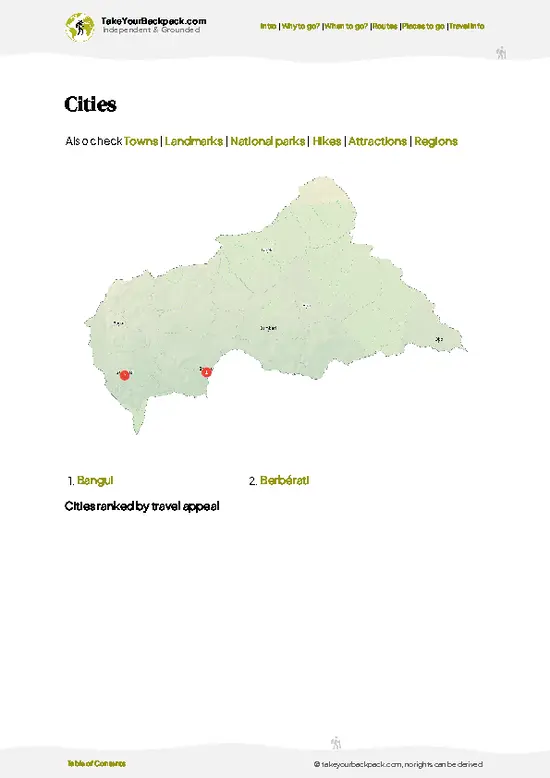
✈️ The backpacker research shortcutCentral African Republic Travel Guide

An offline-friendly backpacking guide with optimized travel routes, ranked highlights, transport advice, and the best areas to stay.
example page 0 from our offline Travel Guide for Central African Republic
example page 1 from our offline Travel Guide for Central African Republic
example page 2 from our offline Travel Guide for Central African Republic
example page 3 from our offline Travel Guide for Central African Republic
example page 4 from our offline Travel Guide for Central African Republic
example page 5 from our offline Travel Guide for Central African Republic
example page 6 from our offline Travel Guide for Central African Republic
example page 7 from our offline Travel Guide for Central African Republic
The digital guide (210 pages) contains:
✅ 42 highlights, ranked by travel appeal
✅ Optimized 5, 10 & 15-day travel routes
✅ Cities, national parks, landmarks, beaches
✅ How to get around
✅ Offline-friendly for travel without Wi-Fi
👉 Click to see all 30+ guide features

📅 Plan smarter in minutes, not weeks
✅ Month by month travel advice
✅ Festivals & national holidays
✅ Budget expectations

🗺️ Go to the right places, skip the overrated ones
✅ Honest pros & cons of destinations
✅ Top hikes, parks & viewpoints
✅ Lesser-known places most travelers miss
✅ Clear “worth it vs skip it” guidance

🛏️ Travel smoothly without rookie mistakes
✅ Best areas to stay
✅ Transport systems explained simply
✅ Common scams & safety advice
✅ SIM cards, money & practical tips

🌍 Understand the country, not just visit it
✅ Culture & traditions
✅ 52 Essential phrases & customs
✅ Festivals worth planning around
✅ Traveler-friendly historical context
✅ Insights that make places more meaningful

📱 Built for real travel conditions
✅ Fully downloadable PDF
✅ Works completely offline
✅ Optimized for phone use
✅ Useful in remote areas & buses
✅ Everything in one place
Stop searching, start planning
Get instant access to your full guide. 30‑day money-back guarantee.
+ Add another guide for just

By proceeding you agree to our terms.
Sent to your inbox immediately after payment • 100% Secure Checkout
Best Backpacking Travel Advisor 2025 tourism awardBest Backpacking
Travel Advisor
2025
What others say about Take Your Backpack Guides:
⭐⭐⭐⭐⭐
Fantastic, amazing amount of information!
⭐⭐⭐⭐⭐
My goodness this is amazing, it's what I've been looking for hats off too you!
⭐⭐⭐⭐⭐
I think this is absolutely BRILLIANT
⭐⭐⭐⭐
Very complete and informative. It's still missing places, but I gotta to commend you
⭐⭐⭐⭐⭐
This is truly amazing, thank you, can't wait to explore it with my kids!
⭐⭐⭐⭐⭐
Awesome resource, thank you!
⭐⭐⭐⭐⭐
This is amazing! Can't wait to explore the ones I haven't seen
⭐⭐⭐⭐
I love this! Well done, great idea.
⭐⭐⭐⭐⭐
Thanks for taking the time to make this gem!
⭐⭐⭐⭐⭐
This might be the best website I've ever seen.
⭐⭐⭐⭐⭐
Congratulations, and thank you so much for your work; it's incredibly valuable.
⭐⭐⭐⭐
In all seriousness I think you did a great job pointing out the important spots
⭐⭐⭐⭐⭐
10/10 very good
⭐⭐⭐⭐⭐
As someone who's only just starting to visit regularly this is awesome, thank you.
⭐⭐⭐⭐
Thank you very much! I'm going to visit my dad, it's going to be very useful!
⭐⭐⭐⭐⭐
This is really cool! We'll be travelling for the first time and this definitely come in handy.
⭐⭐⭐⭐⭐
You are now our minister of culture, congratulations 👨‍💼
⭐⭐⭐⭐⭐
Just wanted to tell you that this is a pearl! Going to follow your recommendations.
⭐⭐⭐⭐⭐
This is so cool. I'll definitely be using the resource for my travels soon.
⭐⭐⭐⭐⭐
This is very impressive! Good work.
⭐⭐⭐⭐⭐
This is an amazing and informative site. Very well done!

🛏️ Where to stay?How to pick the right area

No regular accommodation exists inside Manovo-Gounda St. Floris National Park, so most visitors sleep in Bangui or Bamingui and treat the park as an expedition. The former Camp de Gounda lodge area has long been out of service, and the park has had no steady tourist operation for years. Any overnight stay inside the boundaries means camping, and that only works as part of an arranged trip with a local guide or specialist operator who handles tents, food, water and permission from park authorities.
Bamingui is the closest town to the southern edge of the park and offers very basic lodging, often … read more 👉
No regular accommodation exists inside Manovo-Gounda St. Floris National Park, so most visitors sleep in Bangui or Bamingui and treat the park as an expedition. The former Camp de Gounda lodge area has long been out of service, and the park has had no steady tourist operation for years. Any overnight stay inside the boundaries means camping, and that only works as part of an arranged trip with a local guide or specialist operator who handles tents, food, water and permission from park authorities.
Bamingui is the closest town to the southern edge of the park and offers very basic lodging, often simple rooms or mission-style guesthouses at roughly €5 to 15 a night. Ndélé, to the east, is another small hub with similarly simple options. Bangui has the widest choice, from guesthouses at about €25 to 40 to mid-range hotels at €70 to 120, and is where you will organize permits, vehicles and security advice.
Bring your own sleeping gear, a mosquito net and a water filter wherever you stay. Book through contacts in Bangui rather than turning up unannounced.

👛 Costs (as of 22 October 2026)Travel costs and budget guide for Manovo-Gounda St. Floris

A realistic budget for Manovo-Gounda St. Floris National Park is about €115 to 260 a day, because almost everything runs through an arranged trip from Bangui. Prices below are estimates and vary widely with group size and fuel costs. Travelers pay in Central African CFA francs for local items, though operators often quote in euros.
CategoryBudget RangeLocal Reality
Entrance and permits€10 to 30Paid through the operator or park authorities; no public ticket booth exists.
Accommodation (high season)€5 to 40Basic rooms in Bamingui or Ndélé, or camping in the bush with your own gear.
Guide and ranger escort€30 to 60Required in practice; split among the group.
Local transport€60 to 110Chartered 4x4 and fuel dominate costs; shared rides to Bamingui are rare and slow.
Food and supplies€10 to 20Buy staples
… read more 👉
A realistic budget for Manovo-Gounda St. Floris National Park is about €115 to 260 a day, because almost everything runs through an arranged trip from Bangui. Prices below are estimates and vary widely with group size and fuel costs. Travelers pay in Central African CFA francs for local items, though operators often quote in euros.
CategoryBudget RangeLocal Reality
Entrance and permits€10 to 30Paid through the operator or park authorities; no public ticket booth exists.
Accommodation (high season)€5 to 40Basic rooms in Bamingui or Ndélé, or camping in the bush with your own gear.
Guide and ranger escort€30 to 60Required in practice; split among the group.
Local transport€60 to 110Chartered 4x4 and fuel dominate costs; shared rides to Bamingui are rare and slow.
Food and supplies€10 to 20Buy staples in Bangui, then rice, cassava and grilled meat in small towns.
Total Daily Budget€115 to 260Lower end needs a full vehicle and shared costs.
⚠️ Prices can change and everyone travels differently, so take this as a rough guide. Hope it helps you plan your adventure!

🥾 TrailsScenic routes and wildlife spotting in Manovo-Gounda St. Floris

Manovo-Gounda St. Floris National Park has no signposted trail network, so walking here means guided outings from a camp with an armed ranger or conservation escort, never solo wandering. Distances and times depend on the season and on what the team judges safe that week.
  • Gounda floodplain walks: Short guided walks of one to three hours from the vehicle track onto the open grassland and river edges. Terrain is flat, with tall grass and soft, cracked mud. Difficulty is easy, but the heat is hard work by late morning. Expect hippos, buffalo, kob and plenty of waterbirds.
  • Bamingui riverbank outings:
… read more 👉
Manovo-Gounda St. Floris National Park has no signposted trail network, so walking here means guided outings from a camp with an armed ranger or conservation escort, never solo wandering. Distances and times depend on the season and on what the team judges safe that week.
  • Gounda floodplain walks: Short guided walks of one to three hours from the vehicle track onto the open grassland and river edges. Terrain is flat, with tall grass and soft, cracked mud. Difficulty is easy, but the heat is hard work by late morning. Expect hippos, buffalo, kob and plenty of waterbirds.
  • Bamingui riverbank outings: Half-day walks along the sandy banks and gallery forest. Footing is uneven with roots and steep banks. Difficulty is easy to moderate. Crocodiles and hippos mean you stay behind your guide at all times.
  • Chaîne des Bongo ridge climbs: Scrambles up sandstone outcrops and low hills, usually two to four hours round trip. Loose rock and thorny scrub make it moderate. The view over the savanna is the prize, and the best time for it is early morning when the air is clear.
  • Dawn game drives with short walking stops: The main way to cover ground. Long days on rough tracks, with brief walks to track animals or reach a viewpoint. Giraffe, roan antelope and baboons are the likeliest sightings.
Practical details: reaching the park means a long overland journey by 4x4 from the north of the country, and no public transport serves it. Most travelers arrange access through an experienced operator or conservation organization, and the park is only open at all when security allows, so confirm current conditions before committing. Visitors are rare, so you may see no one else for days. An entrance and ranger fee applies, and you pay in local currency, but the amount varies and is usually folded into an arranged package of roughly €100 to 250 per person per day. Bring all food, water treatment, fuel and medical supplies.
⚠️ Hiking info can sometimes be outdated or inaccurate. Before you hit the trail, check the latest conditions with locals. If you do spot anything that's off, I'd love to hear from you, so I can update it for fellow travelers.

🛡️ SafetySafety Tips and Common Scams in Manovo-Gounda St. Floris

Security is the main variable at Manovo-Gounda St. Floris National Park, far more than trails or terrain. Armed groups and poachers have operated in the north of the country for years, and the park has no regular tourist patrols, so independent hiking is not realistic. Go only with an experienced local operator or guide who tracks current conditions, and check your government’s travel advice before committing.
On the ground, the heat is the everyday hazard. Walk early, rest through midday and carry at least 4 liters of water per person daily. Tracks turn to mud in the rains and vehicles get stuck, so travel with a sturdy 4x4 and spare fuel. Malaria is present, so take prophylaxis and sleep under a net.
Wildlife includes elephants, buffalo, lions and hippos. Keep distance, never walk near rivers … read more 👉
Security is the main variable at Manovo-Gounda St. Floris National Park, far more than trails or terrain. Armed groups and poachers have operated in the north of the country for years, and the park has no regular tourist patrols, so independent hiking is not realistic. Go only with an experienced local operator or guide who tracks current conditions, and check your government’s travel advice before committing.
On the ground, the heat is the everyday hazard. Walk early, rest through midday and carry at least 4 liters of water per person daily. Tracks turn to mud in the rains and vehicles get stuck, so travel with a sturdy 4x4 and spare fuel. Malaria is present, so take prophylaxis and sleep under a net.
Wildlife includes elephants, buffalo, lions and hippos. Keep distance, never walk near rivers at dusk, and follow your guide’s instructions without exception. Bring a satellite communicator, since mobile coverage is absent.

FAQCommon questions from travelers

Plan on 5 to 8 days in total for Manovo-Gounda St. Floris National Park, including the long drive north from Bangui. The road to Bamingui can take two to three days in the dry season, and you need at least two full days inside the park along the Koumbala and Gounda rivers to see wildlife.
Visiting Manovo-Gounda St. Floris National Park without a car is not realistic. The park is roughly 700 km from Bangui over rough tracks, public transport stops at towns like Bamingui and Ndélé, and there is no transport inside the boundaries. Most visitors hire a 4x4 with a driver through an operator in Bangui for about €60 to 110 a day.
Manovo-Gounda St. Floris National Park requires permission from the park authorities and the Ministry in Bangui, usually arranged by your tour operator. Expect fees of roughly €10 to 30 per person, with no standard ticket office on site. Carry copies of your passport and permits, since checkpoints on the road north are frequent.
⚠️ Things can change over time, so always validate details locally before you go.

Other Central African national parks near Manovo-Gounda St. Floris

Explore more nearby:


💡 Not sure where to go next?
Create a personalized itinerary for Central African Republic including Manovo-Gounda St. Floris and the places that fit your trip.

Generate my itinerary

👉 Discover all national parks

Or checkout all Central African Republic has to offer (think cities, towns, villages, national parks, hikes, beaches, festivals)
Country photo of Central African Republic

We 💚 feedbackFinal thoughts on exploring Manovo-Gounda St. Floris

Manovo-Gounda St. Floris National Park works best as the far end of a long northern loop, paired with a stop in Bamingui or Ndélé on the way up and a conservation-minded detour toward Chad’s Zakouma to extend the savanna theme. I would carry far more fuel and water than seems sensible, and I would skip any plan with fixed dates.

✍️ Help improve this page!
The information on this page is based on in-depth research, insights shared by experienced travelers, and feedback from the local travel community in Central African Republic. While every effort is made to keep the information accurate and current, conditions can change — so if you spot anything incorrect or outdated, please get in touch.


🙋‍♂️ Give feedback

👋 Meet the founderWho’s Behind Take Your Backpack?

Johan, backpacker and founder of TakeYourBackpackHi, I’m Johan (Netherlands 🇳🇱), the creator of TakeYourBackpack. Over the past 3 decades, I’ve backpacked through 90+ countries across six continents, gaining extensive experience with independent travel, long-term trips, and overland routes.

This site is built on a combination of firsthand travel experience and carefully curated insights from other backpackers. Many guides are based on places I’ve personally visited, while others bring together tips, observations, and practical advice shared by trusted travelers I’ve met along the way.

The goal is to provide realistic, experience-driven guidance — not generic itineraries — so you can explore destinations with better context, clearer expectations, and more confidence.