×

Central African Republic🇨🇫 | best national parksBest 6 national parks in Central African Republic

National parks in Central African Republic are remote, under-funded and nothing like the polished safari circuits of East Africa. Skip any plan built around easy game drives and lodge packages. The country splits in two. The southwest rainforest around the Sangha River offers lowland gorillas and forest elephants at forest clearings, with a working tourism setup, higher costs and the best access. The north holds savanna parks that are huge, wild and largely off limits because of insecurity and almost no infrastructure. Independent backpacking without a guide or permits does not work in either. Choose the southwest for a realistic trip, and treat the north as one for specialist operators only.

By Johan Kruseman 🇳🇱 | Updated October 23, 2026
Explore the best hikes in Central African Republic

Why go?Why These national park Stand Out

Central African Republic matters for national parks because it holds one of the last large blocks of intact Congo Basin forest and a northern savanna belt with very low human density. That emptiness is the draw and the problem. Decades of conflict, weak state funding and poaching have left infrastructure thin. There are few roads, little public transport, and almost no tourist services outside a handful of managed areas.

The southwest is the exception because conservation there is run through long-term partnerships with NGOs and local communities, including Ba’Aka forest people who work as trackers and guides. That is why you can reach habituated gorillas here, while most of the country cannot support visitors at all.

Before choosing this country, know that logistics decide everything. Expect … read more 👉
Central African Republic matters for national parks because it holds one of the last large blocks of intact Congo Basin forest and a northern savanna belt with very low human density. That emptiness is the draw and the problem. Decades of conflict, weak state funding and poaching have left infrastructure thin. There are few roads, little public transport, and almost no tourist services outside a handful of managed areas.

The southwest is the exception because conservation there is run through long-term partnerships with NGOs and local communities, including Ba’Aka forest people who work as trackers and guides. That is why you can reach habituated gorillas here, while most of the country cannot support visitors at all.

Before choosing this country, know that logistics decide everything. Expect to book through an operator or the park authorities in advance, to pay in CFA francs or euros cash because cards and ATMs are unreliable, and to carry a visa, a yellow fever certificate and strong travel insurance with evacuation cover. Roads turn to mud in the rains. If you want spontaneity, cheap buses and a dozen parks in a week, choose another country. If you want quiet, difficult, real rainforest, this is worth the planning.
Our Approach to Ranking
The list of best national parks in Central African Republic is created based on landscapes, wildlife, adventure opportunities, facilities, and overall experience. If you feel a national park is missing in this list, please let us know.

When to go?Timing Your Visit for the Best Experience

Best months: The best months are December to February, the main dry season, when forest trails are firmest, roads are passable and daytime highs sit around 28 to 32°C. In the southwest, the rainforest around Bayanga stays humid all year, with nights near 20 to 22°C and rainfall of roughly 1,500 to 1,700 mm.

Shoulder seasons and rains: March to May and September to November are the shoulder periods. Rain is frequent, but showers often come in the afternoon, so early morning forest walks still work. Tracks get slick, river crossings slow down and delays of a day or more are common. June to August is a lesser dry spell in the south but still wet. From roughly June to October, the northern savanna gets its heaviest rain, with up to 1,400 mm in some areas, and unpaved roads can become impassable. … read more 👉
Best months: The best months are December to February, the main dry season, when forest trails are firmest, roads are passable and daytime highs sit around 28 to 32°C. In the southwest, the rainforest around Bayanga stays humid all year, with nights near 20 to 22°C and rainfall of roughly 1,500 to 1,700 mm.

Shoulder seasons and rains: March to May and September to November are the shoulder periods. Rain is frequent, but showers often come in the afternoon, so early morning forest walks still work. Tracks get slick, river crossings slow down and delays of a day or more are common. June to August is a lesser dry spell in the south but still wet. From roughly June to October, the northern savanna gets its heaviest rain, with up to 1,400 mm in some areas, and unpaved roads can become impassable. The north is also hotter in the dry season, often above 35°C by March.

Crowds and prices: There are no true crowds anywhere. Visitor numbers are tiny, so peak pricing barely exists. Costs depend more on whether flights and transfers are running than on the month. Book January and February well ahead, because permits and guide teams are limited. Skip the heavy rains unless you accept possible cancellations.

national park hoppingTips for Visiting Multiple Destinations

Trip length: A trip combining several national parks in Central African Republic needs 10 to 14 days, and that is only realistic in the southwest. Linking the south with the north is not worth attempting: the distances are long, security is unreliable and the roads in between are slow even in the dry season.

Grouping and direction: Group stops by access point, not by map distance. Start in Bangui, the only international gateway, then head southwest toward the Sangha-Mbaéré area. Travel by charter flight where possible, which saves about two days compared with the overland route. By road, expect 2 to 3 days of hard driving on unpaved tracks, longer in rain. Plan to return the same way, since looping through other regions adds risk without adding much.

Time per stop: Allow 3 to 4 days at each … read more 👉
Trip length: A trip combining several national parks in Central African Republic needs 10 to 14 days, and that is only realistic in the southwest. Linking the south with the north is not worth attempting: the distances are long, security is unreliable and the roads in between are slow even in the dry season.

Grouping and direction: Group stops by access point, not by map distance. Start in Bangui, the only international gateway, then head southwest toward the Sangha-Mbaéré area. Travel by charter flight where possible, which saves about two days compared with the overland route. By road, expect 2 to 3 days of hard driving on unpaved tracks, longer in rain. Plan to return the same way, since looping through other regions adds risk without adding much.

Time per stop: Allow 3 to 4 days at each forest park, because tracking, travel in and out, and weather buffers eat time quickly. One night at a stop is a waste of an expensive transfer.

Planning mistakes: The first mistake is a tight schedule with no spare days. Add at least two days of slack before an international flight. The second is trusting a map and assuming a short distance means a short drive. Ask your operator for real times. The third is arriving in Bangui without permits, transport and security updates sorted. Arrange these before landing, not after.

The ListTop national parks of Central African Republic

1 Dzanga-Sangha National Park

Dzanga Bai platform, gorilla tracking, Sangha pirogues, Ba’Aka guides

Watch dozens of forest elephants from a raised platform, then trek through swamp to sit near a habituated gorilla family.

central-african-republic-national-park-dzanga-sangha-national-park
© Google |

2 Manovo-Gounda St. Floris National Park

Gounda floodplain, World Heritage in danger, sandstone hills, hippo pools

Cross flat grassland and seasonal wetlands to find hippos, elephants and buffalo, with sandstone ridges giving views over empty plains.

3 Bamingui-Bangoran National Park

Ndélé gateway, Bamingui River, savanna woodland, roan antelope

Track elephants, buffalo and wary antelope on foot through open woodland and river forest, starting from the northern town of Ndélé.

4 Chinko Nature Reserve

Giant eland herds, African Parks reserve, ranger patrols, southeast savanna

Follow rangers on foot through tall grass and gallery forest to find giant eland, forest elephants and recovering lion country.

central-african-republic-national-park-chinko-nature-reserve
© Google |

5 Mbaéré-Bodingué National Park

Lowland rainforest, Mbaéré River, Bayaka trackers, swamp bais

Search dense forest with Bayaka guides for elephant clearings, gorilla signs and river bends where kingfishers and crocodiles show up.

6 Sangha Trinational

Tri-border forest, Dzanga sector, Bayanga base, buttressed trees

Base yourself in Bayanga to reach an elephant clearing, gorilla trackers and forest trails beneath huge buttressed trees near three borders.

Loading the map 🌍

Expert viewWhat You Should Know

How many parks to visit: Visit one park, two at most. Transfers are slow, permits are tied to specific operators and every extra stop adds days of road time and a large fixed cost. Two stops in the same southwestern area make sense. A third rarely justifies the money, and many northern areas are not accessible to independent visitors at all.

Which kind to prioritize: Choose the rainforest parks if you want wildlife encounters you can actually plan around. Gorilla and forest elephant viewing here is organized, guided and relatively reliable. Skip the savanna parks unless you are with a specialist operator who has current security information. Backpackers trying to go alone to remote areas waste time and take real risks for little return.

What it costs: Budget US$100 to 250 a day in the forest, … read more 👉
How many parks to visit: Visit one park, two at most. Transfers are slow, permits are tied to specific operators and every extra stop adds days of road time and a large fixed cost. Two stops in the same southwestern area make sense. A third rarely justifies the money, and many northern areas are not accessible to independent visitors at all.

Which kind to prioritize: Choose the rainforest parks if you want wildlife encounters you can actually plan around. Gorilla and forest elephant viewing here is organized, guided and relatively reliable. Skip the savanna parks unless you are with a specialist operator who has current security information. Backpackers trying to go alone to remote areas waste time and take real risks for little return.

What it costs: Budget US$100 to 250 a day in the forest, far above typical backpacker rates elsewhere, because lodging, guides, vehicles and fuel are all costly. Gorilla permits and park entry fees can add roughly US$100 to 300 per visit depending on the activity, with tracker and guide fees on top at about US$10 to 30 a day. Charter flights cost far more than road transfers but save days. Basic guesthouses in Bangui run about US$30 to 60 a night. Carry cash in euros, since cards rarely work and ATMs are unreliable.

Costs and delays that catch people out: Fuel shortages and road breakdowns can add one to three days, so keep a buffer in both time and money. Last-minute booking can cost you a permit, since daily quotas are small. Pay deposits only through your operator and keep receipts. Roadblocks happen, and small unofficial payments may be requested, so carry small notes.

Safety and culture: Check current security advice from your government and your operator right before travel, because conditions outside Bangui and the southwest change fast. Do not travel overland after dark. Medical care is limited, so carry malaria prophylaxis, a yellow fever certificate and insurance that covers air evacuation. Respect the local forest communities: ask before photographing people, follow your Ba’Aka trackers’ instructions in the forest and keep voices low near animals. Dress modestly in villages, and hire guides locally so the money stays where the forest is protected.

✈️ The backpacker research shortcutCentral African Republic Travel Guide

An offline-friendly backpacking guide with optimized travel routes, ranked highlights, transport advice, and the best areas to stay.
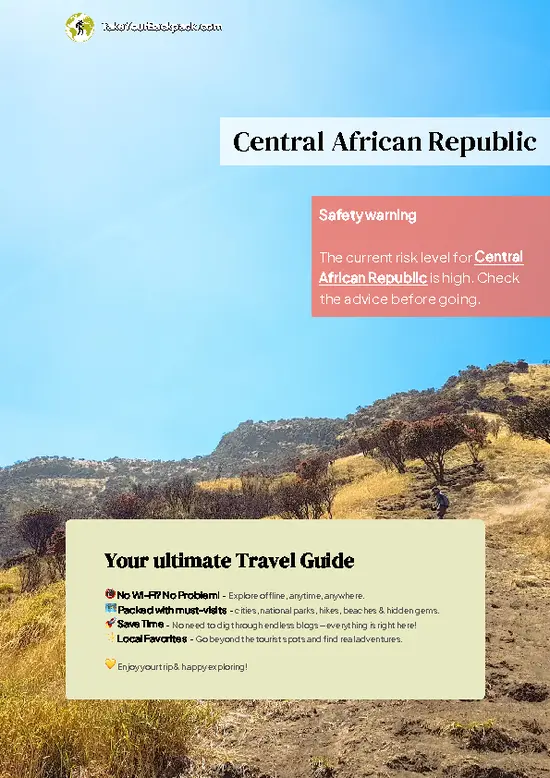
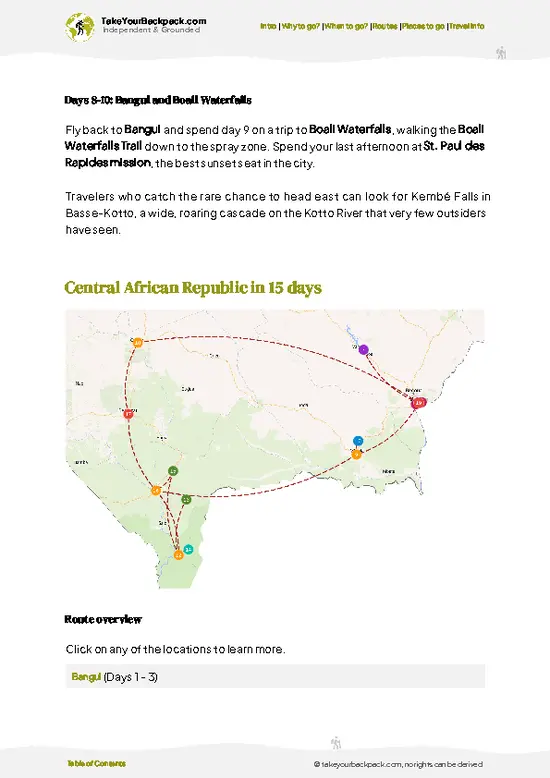
example page 0 from our offline Travel Guide for Central African Republic
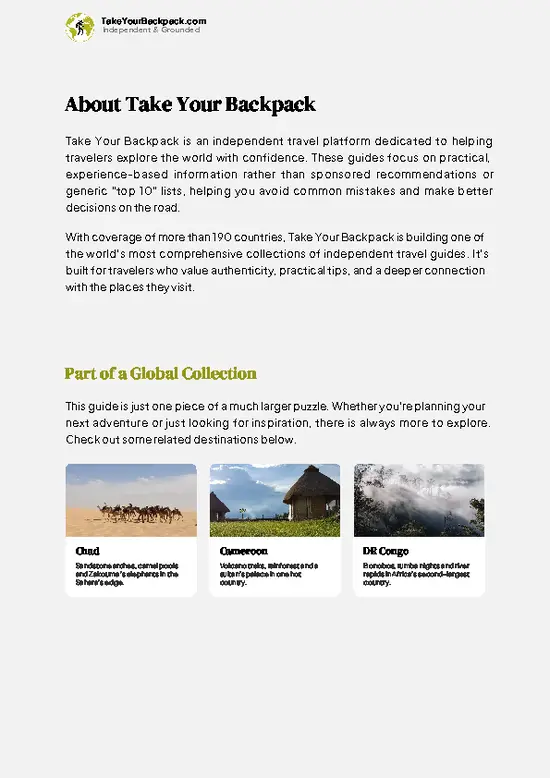
example page 1 from our offline Travel Guide for Central African Republic
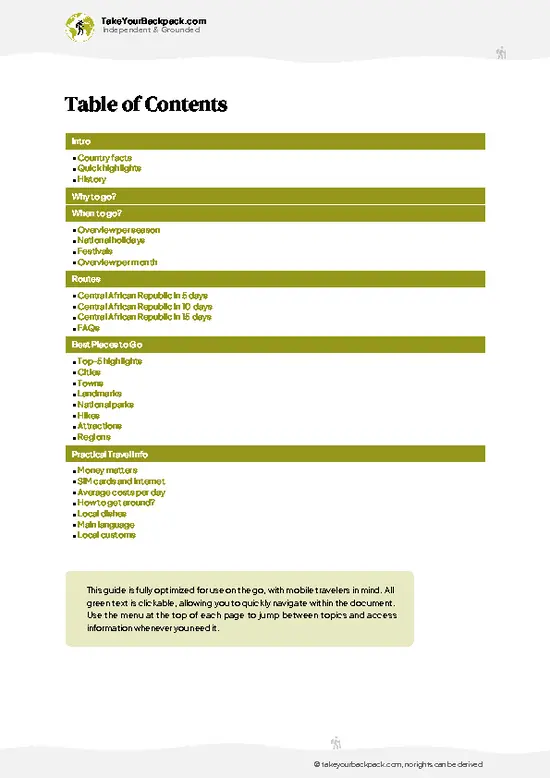
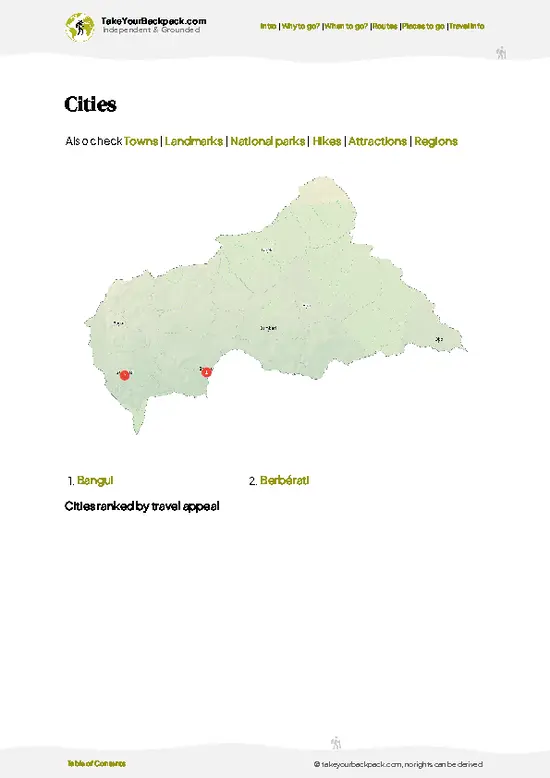
example page 2 from our offline Travel Guide for Central African Republic
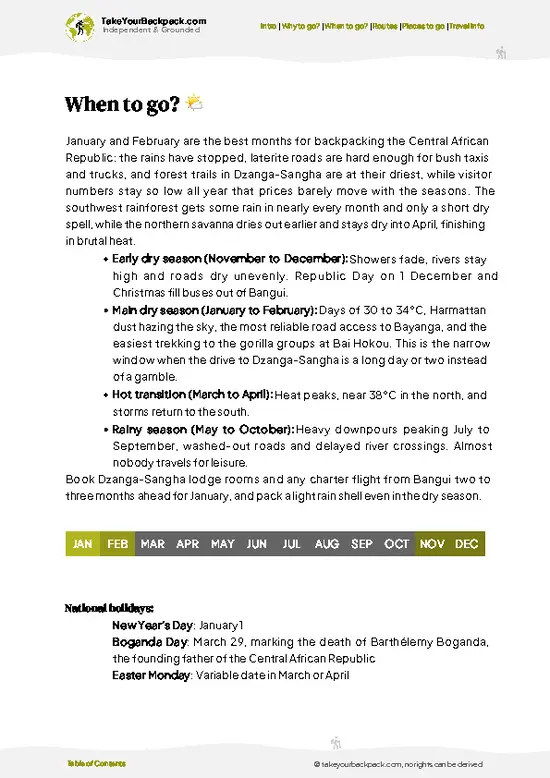
example page 3 from our offline Travel Guide for Central African Republic
example page 4 from our offline Travel Guide for Central African Republic
example page 5 from our offline Travel Guide for Central African Republic
example page 6 from our offline Travel Guide for Central African Republic
example page 7 from our offline Travel Guide for Central African Republic
The digital guide (210 pages) contains:
✅ 42 highlights, ranked by travel appeal
✅ Optimized 5, 10 & 15-day travel routes
✅ Cities, national parks, landmarks, beaches
✅ How to get around
✅ Offline-friendly for travel without Wi-Fi
👉 Click to see all 30+ guide features

📅 Plan smarter in minutes, not weeks
✅ Month by month travel advice
✅ Festivals & national holidays
✅ Budget expectations

🗺️ Go to the right places, skip the overrated ones
✅ Honest pros & cons of destinations
✅ Top hikes, parks & viewpoints
✅ Lesser-known places most travelers miss
✅ Clear “worth it vs skip it” guidance

🛏️ Travel smoothly without rookie mistakes
✅ Best areas to stay
✅ Transport systems explained simply
✅ Common scams & safety advice
✅ SIM cards, money & practical tips

🌍 Understand the country, not just visit it
✅ Culture & traditions
✅ 52 Essential phrases & customs
✅ Festivals worth planning around
✅ Traveler-friendly historical context
✅ Insights that make places more meaningful

📱 Built for real travel conditions
✅ Fully downloadable PDF
✅ Works completely offline
✅ Optimized for phone use
✅ Useful in remote areas & buses
✅ Everything in one place
Stop searching, start planning
Get instant access to your full guide. 30‑day money-back guarantee.
+ Add another guide for just

By proceeding you agree to our terms.
Sent to your inbox immediately after payment • 100% Secure Checkout
Best Backpacking Travel Advisor 2025 tourism awardBest Backpacking
Travel Advisor
2025
What others say about Take Your Backpack Guides:
⭐⭐⭐⭐⭐
Fantastic, amazing amount of information!
⭐⭐⭐⭐⭐
My goodness this is amazing, it's what I've been looking for hats off too you!
⭐⭐⭐⭐⭐
I think this is absolutely BRILLIANT
⭐⭐⭐⭐
Very complete and informative. It's still missing places, but I gotta to commend you
⭐⭐⭐⭐⭐
This is truly amazing, thank you, can't wait to explore it with my kids!
⭐⭐⭐⭐⭐
Awesome resource, thank you!
⭐⭐⭐⭐⭐
This is amazing! Can't wait to explore the ones I haven't seen
⭐⭐⭐⭐
I love this! Well done, great idea.
⭐⭐⭐⭐⭐
Thanks for taking the time to make this gem!
⭐⭐⭐⭐⭐
This might be the best website I've ever seen.
⭐⭐⭐⭐⭐
Congratulations, and thank you so much for your work; it's incredibly valuable.
⭐⭐⭐⭐
In all seriousness I think you did a great job pointing out the important spots
⭐⭐⭐⭐⭐
10/10 very good
⭐⭐⭐⭐⭐
As someone who's only just starting to visit regularly this is awesome, thank you.
⭐⭐⭐⭐
Thank you very much! I'm going to visit my dad, it's going to be very useful!
⭐⭐⭐⭐⭐
This is really cool! We'll be travelling for the first time and this definitely come in handy.
⭐⭐⭐⭐⭐
You are now our minister of culture, congratulations 👨‍💼
⭐⭐⭐⭐⭐
Just wanted to tell you that this is a pearl! Going to follow your recommendations.
⭐⭐⭐⭐⭐
This is so cool. I'll definitely be using the resource for my travels soon.
⭐⭐⭐⭐⭐
This is very impressive! Good work.
⭐⭐⭐⭐⭐
This is an amazing and informative site. Very well done!

🛏️ Where to stay?Accommodation Highlights

There are no true backpacker hostels in the Central African Republic, so budget travel here means simple guesthouses and mission lodgings in Bangui, typically 15,000 to 30,000 XAF (US$25 to 50) a night for a fan room, with anything reliably secure and air-conditioned costing more. Centre-Ville, the downtown grid near the Oubangui River, has the widest choice, the best security, and walking access to restaurants, banks and the few bars, though prices run highest there. Cheaper rooms around PK0 and Lakouanga put you closer to markets and daily street life, but the streets get dark early and need more caution at night, while the quieter area near M’Poko airport suits early flights but leaves you … read more 👉
There are no true backpacker hostels in the Central African Republic, so budget travel here means simple guesthouses and mission lodgings in Bangui, typically 15,000 to 30,000 XAF (US$25 to 50) a night for a fan room, with anything reliably secure and air-conditioned costing more. Centre-Ville, the downtown grid near the Oubangui River, has the widest choice, the best security, and walking access to restaurants, banks and the few bars, though prices run highest there. Cheaper rooms around PK0 and Lakouanga put you closer to markets and daily street life, but the streets get dark early and need more caution at night, while the quieter area near M’Poko airport suits early flights but leaves you a taxi ride from everything.

If you enjoy meeting fellow travelers, consider choosing hostels with high ratings for atmosphere. On the other hand, if you prefer having your own space, a hotel might be a better option.

Central African RepublicSee More of Central African Republic

👋 Meet the founderWho’s Behind Take Your Backpack?

Johan, backpacker and founder of TakeYourBackpackHi, I’m Johan (Netherlands 🇳🇱), the creator of TakeYourBackpack. Over the past 3 decades, I’ve backpacked through 90+ countries across six continents, gaining extensive experience with independent travel, long-term trips, and overland routes.

This site is built on a combination of firsthand travel experience and carefully curated insights from other backpackers. Many guides are based on places I’ve personally visited, while others bring together tips, observations, and practical advice shared by trusted travelers I’ve met along the way.

The goal is to provide realistic, experience-driven guidance — not generic itineraries — so you can explore destinations with better context, clearer expectations, and more confidence.