×

Central African Republic🇨🇫 | attractionsSaint-Paul des RapidesMission church, river rapids, Zongo view, riverbank walk | things to do and best time to go

Explore Bangui RiverfrontExplore Alliance Française de Bangui

Backpacking in Saint-Paul des Rapides
🌟 Highlightattraction ranked #4
By Johan Kruseman 🇳🇱 | Updated October 22, 2026

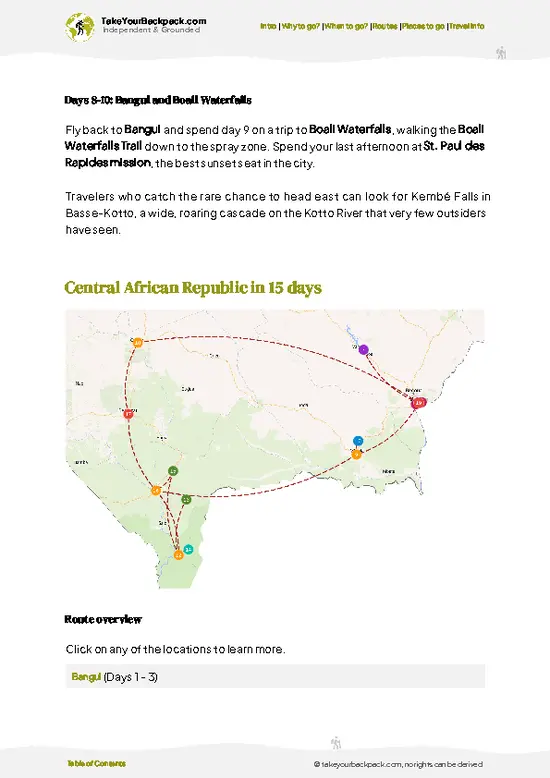
The mission here predates much of Bangui itself as a settled town: Saint-Paul des Rapides began as a Catholic outpost beside the Oubangui River in the 1890s, and the city grew around that riverside foothold. It sits in Bangui, the Central African Republic’s capital, close to the water where the river breaks over rock. Be clear on the limits. There is no ticketed attraction, no tour circuit and no crowd, and a church alone will not fill a day. What makes it worth the trip is the setting: the sound of the rapids, the river traffic and Zongo on the Congolese bank, plus the layered colonial story told by the mission’s own ground. Costs stay low because you spend mostly on local transport and a meal. A first day could go like this: arrive in the morning, walk the grounds, sit by the water, then spend the afternoon in the city’s museum and markets.

Discover everything you want to know in the 📖 Central African Republic Travel Guide.
Safety warning

The current risk level for Central African Republic is high. Check the advice before going.


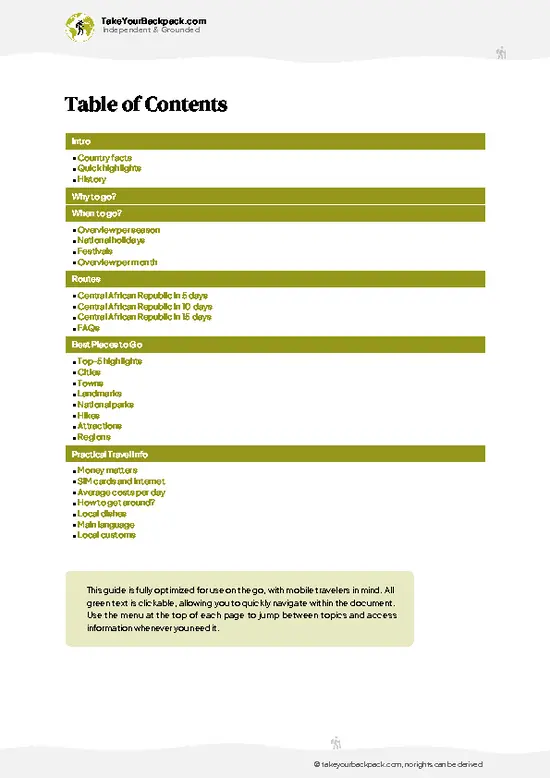
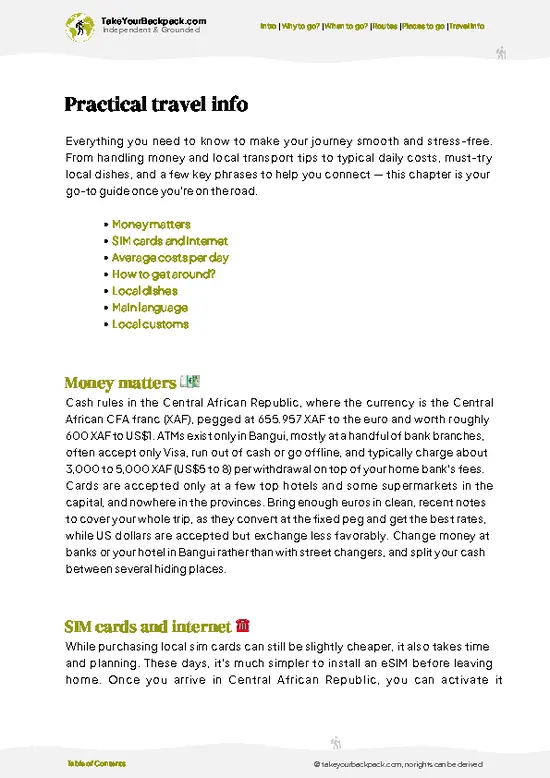
example page 0 from our offline Travel Guide for Central African Republic
example page 1 from our offline Travel Guide for Central African Republic
example page 2 from our offline Travel Guide for Central African Republic
example page 3 from our offline Travel Guide for Central African Republic
example page 4 from our offline Travel Guide for Central African Republic
example page 5 from our offline Travel Guide for Central African Republic
example page 6 from our offline Travel Guide for Central African Republic
example page 7 from our offline Travel Guide for Central African Republic
Loading the map 🌍
CLICK TO FILTER
cities
towns
landmarks
national parks
hikes
attractions
regions
SHOW COUNTRY’S BESTSHOW ALL

✨ Why go?
Ranked #4 attraction in Central African Republic
What makes it a must-see attraction

Saint-Paul des Rapides gives you the starting point of Bangui’s story in a place you can actually stand. The Spiritan mission founded in the 1890s is part of how a river post became a capital, so a visit makes the city’s layout and its French-era roots easier to read. That matters if you plan to spend a few days in town and want more than a list of markets.

The second reason is the river. The Oubangui rapids are the reason for the name and the reason the first settlers stopped here, since boats could go no farther upstream. Watching the water pour over rock, with Zongo on the opposite bank, shows you the border geography of the country better than any map.

Finally, it is a quiet, low-key counterweight to the city’s busier districts. You get space to think, a living parish rather than a staged … read more 👉
Saint-Paul des Rapides gives you the starting point of Bangui’s story in a place you can actually stand. The Spiritan mission founded in the 1890s is part of how a river post became a capital, so a visit makes the city’s layout and its French-era roots easier to read. That matters if you plan to spend a few days in town and want more than a list of markets.

The second reason is the river. The Oubangui rapids are the reason for the name and the reason the first settlers stopped here, since boats could go no farther upstream. Watching the water pour over rock, with Zongo on the opposite bank, shows you the border geography of the country better than any map.

Finally, it is a quiet, low-key counterweight to the city’s busier districts. You get space to think, a living parish rather than a staged sight, and a grounded sense of place in a country few travelers see.

💡 HighlightsThe experiences that define the visit

  1. The Saint-Paul des Rapides mission and parish: the historic Catholic foundation that gave this corner of Bangui its name. Look at the church, the grounds and the way the community still gathers here.
  2. The Oubangui rapids: the stretch where the river turns white over rock and where upstream navigation stopped. It is loud, photogenic and the actual reason the settlement exists.
  3. The Oubangui riverbank: a walk along the water shows fishing pirogues, washing spots and cross-river traffic. Across the water lies Zongo in the Democratic Republic of the Congo.
  4. Musée Barthélemy Boganda: Bangui’s national museum, named for the country’s independence leader, with ethnographic collections on Central African peoples, including traditional instruments and crafts. Entry is small.
  5. Cathédrale Notre-Dame de l’Immaculée
… read more 👉
  1. The Saint-Paul des Rapides mission and parish: the historic Catholic foundation that gave this corner of Bangui its name. Look at the church, the grounds and the way the community still gathers here.
  2. The Oubangui rapids: the stretch where the river turns white over rock and where upstream navigation stopped. It is loud, photogenic and the actual reason the settlement exists.
  3. The Oubangui riverbank: a walk along the water shows fishing pirogues, washing spots and cross-river traffic. Across the water lies Zongo in the Democratic Republic of the Congo.
  4. Musée Barthélemy Boganda: Bangui’s national museum, named for the country’s independence leader, with ethnographic collections on Central African peoples, including traditional instruments and crafts. Entry is small.
  5. Cathédrale Notre-Dame de l’Immaculée Conception: Bangui’s main Catholic cathedral, a large mid-century landmark that puts the mission’s growth into context.
  6. Marché Central: the city’s main market for produce, fabrics, household goods and street food, crowded and loud, good for a short, focused visit.
Saint-Paul des Rapides costs nothing to see from outside, and walking the riverbank beside it is free as well.
Spotted a mistake or missing something? Contact us.

🌤️ When to go?Choosing the right time of year

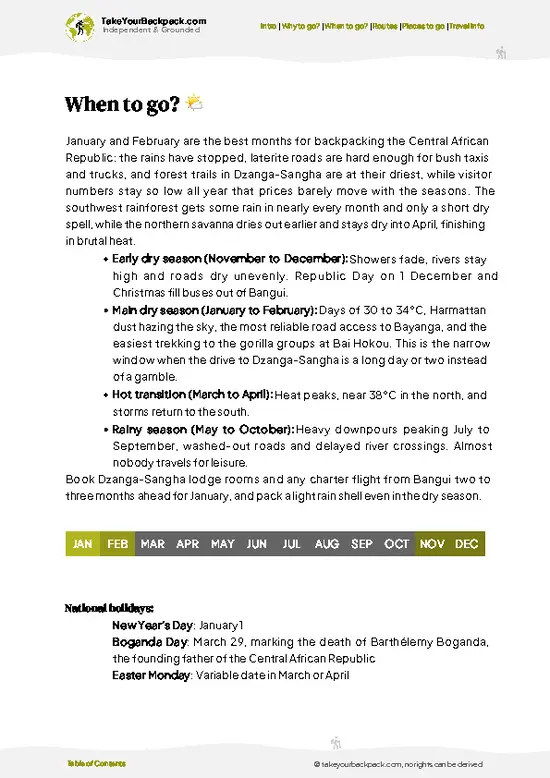
  • Dry Season (December to February): Roads are firmest and river levels drop, which exposes more of the rock shelves at the rapids. Days reach 31 to 34°C (88 to 93°F), nights 20 to 22°C (68 to 72°F). Harmattan dust can haze the sky.
  • Late Dry Season (March): Hottest stretch, often 33 to 36°C (91 to 97°F), with the first storms arriving. Dawn and late afternoon are the comfortable hours.
  • Rainy Season (April to October): Expect 25 to 30°C (77 to 86°F), near-daily downpours and muddy tracks that can strand vehicles. Water runs high and loud. Rooms and drivers are easiest to bargain with, since few outsiders come.
  • Early Dry Season (November): Rain tapers off, vegetation is still green and the water remains full. Daylight stays close to 12 hours all year, so plan to be back before dark.
Aim for December … read more 👉
  • Dry Season (December to February): Roads are firmest and river levels drop, which exposes more of the rock shelves at the rapids. Days reach 31 to 34°C (88 to 93°F), nights 20 to 22°C (68 to 72°F). Harmattan dust can haze the sky.
  • Late Dry Season (March): Hottest stretch, often 33 to 36°C (91 to 97°F), with the first storms arriving. Dawn and late afternoon are the comfortable hours.
  • Rainy Season (April to October): Expect 25 to 30°C (77 to 86°F), near-daily downpours and muddy tracks that can strand vehicles. Water runs high and loud. Rooms and drivers are easiest to bargain with, since few outsiders come.
  • Early Dry Season (November): Rain tapers off, vegetation is still green and the water remains full. Daylight stays close to 12 hours all year, so plan to be back before dark.
Aim for December or January and book a driver a few days ahead, since trips depend on road conditions.


source: climatestotravel.comJANJanuary: highly recommended for travelingFEBFebruary: excellent for travelingMARMarch: good for travelingAPRApril: good for travelingMAYMay: fair for travelingJUNJune: fair for travelingJULJuly: fair for travelingAUGAugust: fair for travelingSEPSeptember: fair for travelingOCTOctober: fair for travelingNOVNovember: excellent for travelingDECDecember: highly recommended for traveling
central-african-republic-attraction-saint-paul-des-rapides
© Google |

✈️ The backpacker research shortcutCentral African Republic Travel Guide

An offline-friendly backpacking guide with optimized travel routes, ranked highlights, transport advice, and the best areas to stay.
example page 0 from our offline Travel Guide for Central African Republic
example page 1 from our offline Travel Guide for Central African Republic
example page 2 from our offline Travel Guide for Central African Republic
example page 3 from our offline Travel Guide for Central African Republic
example page 4 from our offline Travel Guide for Central African Republic
example page 5 from our offline Travel Guide for Central African Republic
example page 6 from our offline Travel Guide for Central African Republic
example page 7 from our offline Travel Guide for Central African Republic
The digital guide (210 pages) contains:
✅ 42 highlights, ranked by travel appeal
✅ Optimized 5, 10 & 15-day travel routes
✅ Cities, national parks, landmarks, beaches
✅ How to get around
✅ Offline-friendly for travel without Wi-Fi
👉 Click to see all 30+ guide features

📅 Plan smarter in minutes, not weeks
✅ Month by month travel advice
✅ Festivals & national holidays
✅ Budget expectations

🗺️ Go to the right places, skip the overrated ones
✅ Honest pros & cons of destinations
✅ Top hikes, parks & viewpoints
✅ Lesser-known places most travelers miss
✅ Clear “worth it vs skip it” guidance

🛏️ Travel smoothly without rookie mistakes
✅ Best areas to stay
✅ Transport systems explained simply
✅ Common scams & safety advice
✅ SIM cards, money & practical tips

🌍 Understand the country, not just visit it
✅ Culture & traditions
✅ 52 Essential phrases & customs
✅ Festivals worth planning around
✅ Traveler-friendly historical context
✅ Insights that make places more meaningful

📱 Built for real travel conditions
✅ Fully downloadable PDF
✅ Works completely offline
✅ Optimized for phone use
✅ Useful in remote areas & buses
✅ Everything in one place
Stop searching, start planning
Get instant access to your full guide. 30‑day money-back guarantee.
+ Add another guide for just

By proceeding you agree to our terms.
Sent to your inbox immediately after payment • 100% Secure Checkout
Best Backpacking Travel Advisor 2025 tourism awardBest Backpacking
Travel Advisor
2025
What others say about Take Your Backpack Guides:
⭐⭐⭐⭐⭐
Fantastic, amazing amount of information!
⭐⭐⭐⭐⭐
My goodness this is amazing, it's what I've been looking for hats off too you!
⭐⭐⭐⭐⭐
I think this is absolutely BRILLIANT
⭐⭐⭐⭐
Very complete and informative. It's still missing places, but I gotta to commend you
⭐⭐⭐⭐⭐
This is truly amazing, thank you, can't wait to explore it with my kids!
⭐⭐⭐⭐⭐
Awesome resource, thank you!
⭐⭐⭐⭐⭐
This is amazing! Can't wait to explore the ones I haven't seen
⭐⭐⭐⭐
I love this! Well done, great idea.
⭐⭐⭐⭐⭐
Thanks for taking the time to make this gem!
⭐⭐⭐⭐⭐
This might be the best website I've ever seen.
⭐⭐⭐⭐⭐
Congratulations, and thank you so much for your work; it's incredibly valuable.
⭐⭐⭐⭐
In all seriousness I think you did a great job pointing out the important spots
⭐⭐⭐⭐⭐
10/10 very good
⭐⭐⭐⭐⭐
As someone who's only just starting to visit regularly this is awesome, thank you.
⭐⭐⭐⭐
Thank you very much! I'm going to visit my dad, it's going to be very useful!
⭐⭐⭐⭐⭐
This is really cool! We'll be travelling for the first time and this definitely come in handy.
⭐⭐⭐⭐⭐
You are now our minister of culture, congratulations 👨‍💼
⭐⭐⭐⭐⭐
Just wanted to tell you that this is a pearl! Going to follow your recommendations.
⭐⭐⭐⭐⭐
This is so cool. I'll definitely be using the resource for my travels soon.
⭐⭐⭐⭐⭐
This is very impressive! Good work.
⭐⭐⭐⭐⭐
This is an amazing and informative site. Very well done!

🛏️ Where to stay?How to pick the right area

The best base is Bangui, the capital, roughly 20 km from the rapids, because it is the only place with a reliable range of rooms, restaurants and transport. Sleeping near the rapids themselves is rarely practical, as there is no established accommodation for visitors.

Within Bangui, the central districts around the Avenue de France and the Ouango area offer the most sensible mix of safety and convenience. These are where guesthouses, small hotels run by missionary and NGO networks, and a few eateries cluster, and where you will meet aid workers, researchers and the occasional overland traveler. … read more 👉
The best base is Bangui, the capital, roughly 20 km from the rapids, because it is the only place with a reliable range of rooms, restaurants and transport. Sleeping near the rapids themselves is rarely practical, as there is no established accommodation for visitors.

Within Bangui, the central districts around the Avenue de France and the Ouango area offer the most sensible mix of safety and convenience. These are where guesthouses, small hotels run by missionary and NGO networks, and a few eateries cluster, and where you will meet aid workers, researchers and the occasional overland traveler. Social life is modest, so expect conversation over a shared meal rather than a hostel party scene.

Stay on the side of the city closest to the road you will use, so a morning departure does not mean crossing town in traffic. Choose a place with a walled compound, a generator and a night guard, and ask the owner to arrange a trusted driver and current advice on which routes are open. Move by vehicle after dark, not on foot. Budget travelers can sometimes find a bed through church-run guesthouses, which tend to be quiet, clean and cheaper than the main hotels.

👛 Costs (as of 22 October 2026)What things cost and how to budget

Saint-Paul des Rapides costs most travelers about €45 to 60 a day, driven almost entirely by transport and lodging in nearby Bangui. The rapids themselves carry no formal ticket, though local guides or village youths may ask for a small contribution.
CategoryBudget RangeLocal Reality
Entrance€0 to 3No official gate. A small payment to a local guide or the village head is customary.
Accommodation (high season)€25 to 35Simple guesthouse in Bangui. Prices drop a little in the rainy season.
Transport€10 to 15Private car or motorbike taxi with a driver for the return trip. Shared taxis cost less but are slower and less predictable.
Food€4 to 8Grilled fish or chicken with cassava or rice at local eateries. Pay in cash.
Water and extras€2 to 4Bottled water and snacks. Bring everything you need, as shops
… read more 👉
Saint-Paul des Rapides costs most travelers about €45 to 60 a day, driven almost entirely by transport and lodging in nearby Bangui. The rapids themselves carry no formal ticket, though local guides or village youths may ask for a small contribution.
CategoryBudget RangeLocal Reality
Entrance€0 to 3No official gate. A small payment to a local guide or the village head is customary.
Accommodation (high season)€25 to 35Simple guesthouse in Bangui. Prices drop a little in the rainy season.
Transport€10 to 15Private car or motorbike taxi with a driver for the return trip. Shared taxis cost less but are slower and less predictable.
Food€4 to 8Grilled fish or chicken with cassava or rice at local eateries. Pay in cash.
Water and extras€2 to 4Bottled water and snacks. Bring everything you need, as shops near the rapids are minimal.
Total Daily Budget€45 to 60Cash only, and euros are the easiest foreign currency to change.


source: worldbank.org
⚠️ Prices can change and everyone travels differently, so take this as a rough guide. Hope it helps you plan your adventure!

FAQCommon questions from travelers

Half a day is enough for Saint-Paul des Rapides, including the drive from Bangui. Allow 1 to 2 hours at the water itself, plus 1 to 2 hours each way depending on road conditions. If you want to wander nearby villages or fish with locals, a full day is more comfortable.
Saint-Paul des Rapides has no formal entrance fee, so the cost is a small gratuity of roughly €0 to 3 to a local guide or village elder. For that, you get open views of the rapids and an unhurried look at river life. The real expense is the driver, around €10 to 15 for the trip from Bangui.
Reach Saint-Paul des Rapides by road from Bangui, roughly 20 km away, in about 1 to 2 hours depending on the state of the track. Hire a private driver or motorbike taxi for €10 to 15 return, which is far more dependable than waiting for shared transport. Go in the dry months and leave early so you are back in the city before dark.
⚠️ Things can change over time, so always validate details locally before you go.

Other Central African attractions near Saint-Paul des Rapides

Explore more nearby:


💡 Not sure where to go next?
Create a personalized itinerary for Central African Republic including Saint-Paul des Rapides and the places that fit your trip.

Generate my itinerary

👉 Discover all attractions

Or checkout all Central African Republic has to offer (think cities, towns, villages, national parks, hikes, beaches, festivals)
Country photo of Central African Republic

We 💚 feedbackWhat to keep in mind

Saint-Paul des Rapides needs about two hours, three if you add a slow walk along the river. I would fold it into a single Bangui day with the museum and the cathedral rather than giving it a stay of its own. Bring small cash and ask permission before photographing people or the grounds.

✍️ Help improve this page!
The information on this page is based on in-depth research, insights shared by experienced travelers, and feedback from the local travel community in Central African Republic. While every effort is made to keep the information accurate and current, conditions can change — so if you spot anything incorrect or outdated, please get in touch.


🙋‍♂️ Give feedback

👋 Meet the founderWho’s Behind Take Your Backpack?

Johan, backpacker and founder of TakeYourBackpackHi, I’m Johan (Netherlands 🇳🇱), the creator of TakeYourBackpack. Over the past 3 decades, I’ve backpacked through 90+ countries across six continents, gaining extensive experience with independent travel, long-term trips, and overland routes.

This site is built on a combination of firsthand travel experience and carefully curated insights from other backpackers. Many guides are based on places I’ve personally visited, while others bring together tips, observations, and practical advice shared by trusted travelers I’ve met along the way.

The goal is to provide realistic, experience-driven guidance — not generic itineraries — so you can explore destinations with better context, clearer expectations, and more confidence.