×

Central African Republic🇨🇫 | best attractionsBest 8 attractions in Central African Republic

Attractions in the Central African Republic are rainforest, rivers and wildlife, not monuments, and almost nothing is set up for casual visitors. The southwest forest around Bayanga is the one region with working tourism: lodges, trackers and permits, at a high price, with few other visitors. The north and northeast have remote savanna parks that are not worth planning around, since access is unreliable and security is poor. Bangui offers markets and river views for little money, but little else. Independent backpacking works only in short, arranged stretches. Skip anything that needs long overland drives. Back the southwest, where the cost buys real access.

By Johan Kruseman 🇳🇱 | Updated October 23, 2026
Explore the best regions in Central African Republic

Why go?Why These attraction Stand Out

The Central African Republic is unusual because its main draw is intact Congo Basin forest in the far southwest, shared across a tri-national protected landscape with Cameroon and Congo. That is where lowland gorillas and forest elephants live, and where habituated groups let visitors approach on foot. Few countries offer that, and almost none offer it with so few other people.

The cost of that remoteness is infrastructure. Paved roads are scarce, the rainy season turns laterite tracks into mud, and the country has had repeated armed conflict since 2012, with armed groups still active across large areas outside the capital and the southwest. Government travel advisories from the US, UK and others warn against nearly all travel. That is the main fact to weigh, ahead of any wish list.

There … read more 👉
The Central African Republic is unusual because its main draw is intact Congo Basin forest in the far southwest, shared across a tri-national protected landscape with Cameroon and Congo. That is where lowland gorillas and forest elephants live, and where habituated groups let visitors approach on foot. Few countries offer that, and almost none offer it with so few other people.

The cost of that remoteness is infrastructure. Paved roads are scarce, the rainy season turns laterite tracks into mud, and the country has had repeated armed conflict since 2012, with armed groups still active across large areas outside the capital and the southwest. Government travel advisories from the US, UK and others warn against nearly all travel. That is the main fact to weigh, ahead of any wish list.

There are no cultural sites developed for tourists, no regular tourist buses, and no budget guesthouse circuit. Travelers who choose this country for attractions should expect to pay for local operators, hire guides and arrange permits well in advance. Anyone expecting to wander and improvise will lose time and money. Anyone happy to book ahead, follow local security advice and accept limited choice will find experiences with almost no crowds.
How the List Was Created
The list of best attractions in Central African Republic is created based on cultural significance or entertainment value. If you feel a attraction is missing in this list, please let us know.

When to go?Timing Your Visit for the Best Experience

Best months and why: The best months are December to February, the heart of the dry season, when forest tracks are firm enough for vehicles and trekking is less muddy. In the southwest around Bayanga, this is also when forest clearings draw more wildlife. Days run roughly 28 to 32°C, nights 20 to 22°C, and humidity stays high.

Shoulder seasons: November and March are workable but unpredictable, with the first or last heavy storms arriving without much warning. Rainfall across the south is around 1,400 to 1,800 mm a year, most of it from April to October. Plan on delays if you travel in these months, and keep buffer days for flights and road closures.

Months to avoid: June to September is not worth the time for most attractions. Roads in the south can become impassable, river crossings slow … read more 👉
Best months and why: The best months are December to February, the heart of the dry season, when forest tracks are firm enough for vehicles and trekking is less muddy. In the southwest around Bayanga, this is also when forest clearings draw more wildlife. Days run roughly 28 to 32°C, nights 20 to 22°C, and humidity stays high.

Shoulder seasons: November and March are workable but unpredictable, with the first or last heavy storms arriving without much warning. Rainfall across the south is around 1,400 to 1,800 mm a year, most of it from April to October. Plan on delays if you travel in these months, and keep buffer days for flights and road closures.

Months to avoid: June to September is not worth the time for most attractions. Roads in the south can become impassable, river crossings slow down, and tracking days are wetter and harder, with leeches and slick trails. The north has a drier, hotter pattern, with temperatures reaching 35 to 40°C in March and April, and its savanna parks are normally unreachable in the rains.

Crowds are not a concern anywhere. Prices are less seasonal than limited supply: lodges and guide services cost the same most of the year, but short dry-season windows fill first, so book several months ahead.

attraction hoppingTips for Visiting Multiple Destinations

How many days to allow: A trip combining several attractions needs 10 to 14 days, and fewer than that leaves you chasing connections instead of seeing anything. Realistically the country supports only one cluster, the southwest forest zone, plus a brief stay in Bangui at either end.

Direction and pacing: Start in Bangui, where permits, briefings and onward logistics are sorted, then head southwest toward the Sangha region. The road from Bangui to Bayanga is long and rough, often 2 to 3 days by 4x4 in the dry season, and flights where available save that time. Allow 3 to 5 days per forest stop, since tracking depends on animal movement and weather. A day in Bangui on each end is enough.

Northern and eastern parks do not combine with the southwest. They are separated by days of difficult travel, … read more 👉
How many days to allow: A trip combining several attractions needs 10 to 14 days, and fewer than that leaves you chasing connections instead of seeing anything. Realistically the country supports only one cluster, the southwest forest zone, plus a brief stay in Bangui at either end.

Direction and pacing: Start in Bangui, where permits, briefings and onward logistics are sorted, then head southwest toward the Sangha region. The road from Bangui to Bayanga is long and rough, often 2 to 3 days by 4x4 in the dry season, and flights where available save that time. Allow 3 to 5 days per forest stop, since tracking depends on animal movement and weather. A day in Bangui on each end is enough.

Northern and eastern parks do not combine with the southwest. They are separated by days of difficult travel, and security there is far less predictable. Leave them out of any realistic plan.

Planning mistakes: The biggest error is scheduling tight flight connections on a network with frequent cancellations. Add 2 to 3 spare days before any international departure. Another is trusting map distances: 200 km can take a full day. Travel by daylight only, and arrange transport before you arrive instead of looking for it on the spot. Finally, do not stack more than two forest stops. Muddy trails and fatigue make a third one a poor use of money.

The ListTop attractions of Central African Republic

1 Bangui Riverfront

Ubangi banks, dugout pirogues, river port, Congo shoreline

Watch fishermen and porters work along the wide Ubangi, with the Congolese bank visible across the water, best in early morning.

2 Boganda National Museum

Ethnographic galleries, forest-hunter nets, masks, instruments

Study carved masks, hunting nets and drums that distinguish the Banda, Gbaya and Ngbaka, and ask the staff how each was used.

3 Notre-Dame of Bangui Cathedral

Twin-towered façade, Holy Door, Sango hymns, Sunday choir

Attend a long Sunday Mass with drums and a full choir, then look for the Holy Door opened by Pope Francis.

central-african-republic-attraction-notre-dame-of-bangui-cathedral
© Google |

4 Saint-Paul des Rapides

Mission church, river rapids, Zongo view, riverbank walk

Walk the old mission grounds, then sit by the rapids where the Oubangui breaks over rock and the Congo shore lies opposite.

central-african-republic-attraction-saint-paul-des-rapides
© Google |

5 Bangui Central Market

Cassava leaves, wax-print cloth, tailor rows, caterpillar sellers

Work through dense alleys of produce, fabric and smoked fish with a trusted local guide, and ask before every photo.

central-african-republic-attraction-bangui-central-market
© Google |

6 PK5 Market

Smoked river fish, moto-parts stalls, money changers, treadle tailors

Walk one loop of the lanes in mid-morning, pausing at tailors and spice sellers, then eat grilled skewers at a roadside stand.

7 Alliance Française de Bangui

French-language events, local artists, film nights, library corner

Check the posted program for concerts, screenings and exhibitions, then settle in the shaded courtyard among local artists, students and readers.

central-african-republic-attraction-alliance-francaise-de-bangui
© Google |

8 Barthélemy Boganda Stadium

Match-day drums, Les Fauves, terraces, grilled snacks

Join a home game of the national team, where drumming, chanting and food vendors outside the gates fill the afternoon.

Loading the map 🌍

Expert viewWhat You Should Know

How many attractions to plan: Plan two or three attractions in total, and no more. Distances are long, travel days eat budget, and every extra stop adds logistics, permits and a security check. Fewer stops mean more time actually spent on the thing you came for, and a margin when a vehicle breaks down or a flight is cancelled.

Which kind to prioritize: For wildlife travelers, forest trekking in the southwest is the only category worth building a trip around. For people interested in everyday culture, Bangui’s markets and riverfront can fill a day or two, but they are secondary. Anyone hoping for national parks in the north or east should skip them: access is unreliable and the cost of private security and aircraft is out of reach for most backpackers. Choose one primary stop and treat the … read more 👉
How many attractions to plan: Plan two or three attractions in total, and no more. Distances are long, travel days eat budget, and every extra stop adds logistics, permits and a security check. Fewer stops mean more time actually spent on the thing you came for, and a margin when a vehicle breaks down or a flight is cancelled.

Which kind to prioritize: For wildlife travelers, forest trekking in the southwest is the only category worth building a trip around. For people interested in everyday culture, Bangui’s markets and riverfront can fill a day or two, but they are secondary. Anyone hoping for national parks in the north or east should skip them: access is unreliable and the cost of private security and aircraft is out of reach for most backpackers. Choose one primary stop and treat the rest as add-ons.

What it costs: Expect US$120 to 250 a day in the southwest once guides, trackers, lodging and meals are counted, which is far above typical backpacker budgets. Gorilla or forest permits and tracker fees commonly run from US$50 to 150 per visit, depending on the activity and group. Vehicle hire with a driver costs roughly US$100 to 200 a day, and fuel is extra. In Bangui, budget US$40 to 80 a day for basic lodging, food and local taxis. Many transactions are in cash, and card machines and ATMs are unreliable, so carry euros or US dollars in clean, recent notes. The official currency is the Central African CFA franc, so keep small bills for tips and market purchases.

Delays and costs that catch travelers out: Booking late is the most common error. Permits, lodges and vehicles are limited, so reserve two to three months ahead through a local operator. Another is skipping a refundable buffer: flights shift, so avoid nonrefundable connections. Do not pay full fees upfront to unknown agents, and ask for written confirmations of what is included. Roadside checkpoints can bring informal fees, so keep small notes accessible and stay calm and polite.

Safety and cultural considerations: Check current government travel advisories before committing, as the security situation outside Bangui and the southwest can change quickly. Do not travel at night, avoid unplanned overland journeys, and register with your embassy if possible. Photographing soldiers, checkpoints, government buildings and airports is forbidden or risky, so ask permission before photographing people. In forest communities, hire local guides through established operators, respect hunting and food customs, and follow guidance on distance from wildlife. Carry yellow fever proof, malaria prophylaxis, and a good medical evacuation policy, since care outside Bangui is very limited.

✈️ The backpacker research shortcutCentral African Republic Travel Guide

An offline-friendly backpacking guide with optimized travel routes, ranked highlights, transport advice, and the best areas to stay.
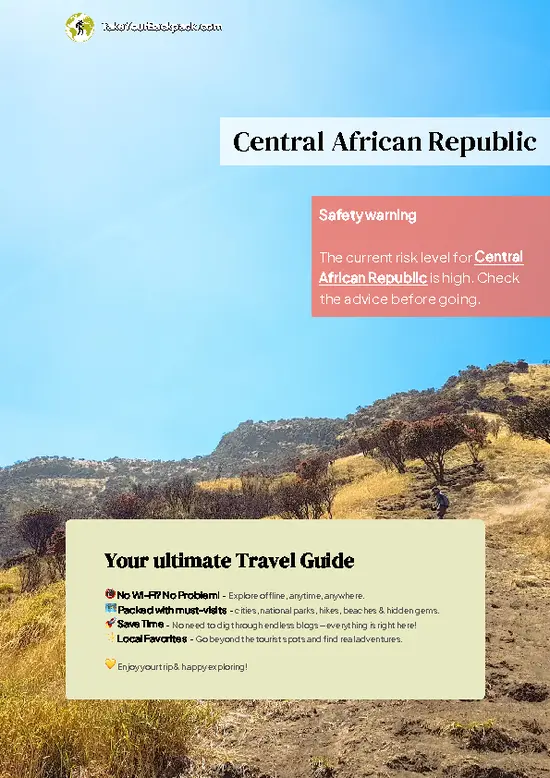
example page 0 from our offline Travel Guide for Central African Republic
example page 1 from our offline Travel Guide for Central African Republic
example page 2 from our offline Travel Guide for Central African Republic
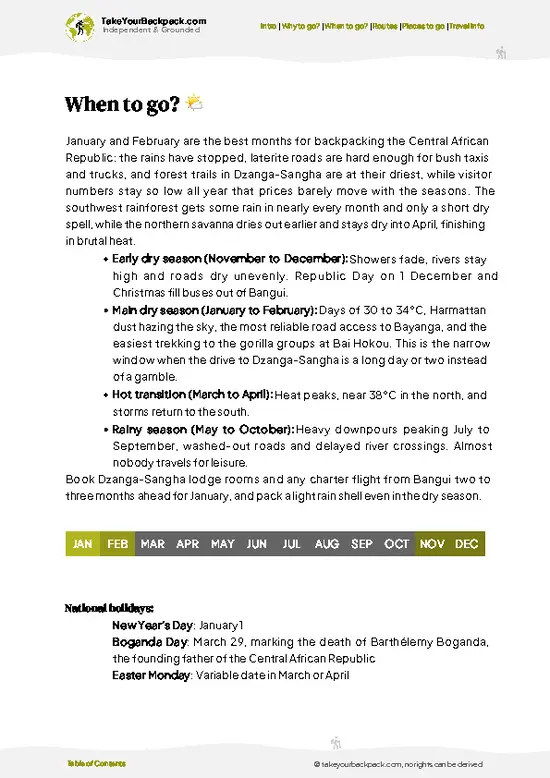
example page 3 from our offline Travel Guide for Central African Republic
example page 4 from our offline Travel Guide for Central African Republic
example page 5 from our offline Travel Guide for Central African Republic
example page 6 from our offline Travel Guide for Central African Republic
example page 7 from our offline Travel Guide for Central African Republic
The digital guide (210 pages) contains:
✅ 42 highlights, ranked by travel appeal
✅ Optimized 5, 10 & 15-day travel routes
✅ Cities, national parks, landmarks, beaches
✅ How to get around
✅ Offline-friendly for travel without Wi-Fi
👉 Click to see all 30+ guide features

📅 Plan smarter in minutes, not weeks
✅ Month by month travel advice
✅ Festivals & national holidays
✅ Budget expectations

🗺️ Go to the right places, skip the overrated ones
✅ Honest pros & cons of destinations
✅ Top hikes, parks & viewpoints
✅ Lesser-known places most travelers miss
✅ Clear “worth it vs skip it” guidance

🛏️ Travel smoothly without rookie mistakes
✅ Best areas to stay
✅ Transport systems explained simply
✅ Common scams & safety advice
✅ SIM cards, money & practical tips

🌍 Understand the country, not just visit it
✅ Culture & traditions
✅ 52 Essential phrases & customs
✅ Festivals worth planning around
✅ Traveler-friendly historical context
✅ Insights that make places more meaningful

📱 Built for real travel conditions
✅ Fully downloadable PDF
✅ Works completely offline
✅ Optimized for phone use
✅ Useful in remote areas & buses
✅ Everything in one place
Stop searching, start planning
Get instant access to your full guide. 30‑day money-back guarantee.
+ Add another guide for just

By proceeding you agree to our terms.
Sent to your inbox immediately after payment • 100% Secure Checkout
Best Backpacking Travel Advisor 2025 tourism awardBest Backpacking
Travel Advisor
2025
What others say about Take Your Backpack Guides:
⭐⭐⭐⭐⭐
Fantastic, amazing amount of information!
⭐⭐⭐⭐⭐
My goodness this is amazing, it's what I've been looking for hats off too you!
⭐⭐⭐⭐⭐
I think this is absolutely BRILLIANT
⭐⭐⭐⭐
Very complete and informative. It's still missing places, but I gotta to commend you
⭐⭐⭐⭐⭐
This is truly amazing, thank you, can't wait to explore it with my kids!
⭐⭐⭐⭐⭐
Awesome resource, thank you!
⭐⭐⭐⭐⭐
This is amazing! Can't wait to explore the ones I haven't seen
⭐⭐⭐⭐
I love this! Well done, great idea.
⭐⭐⭐⭐⭐
Thanks for taking the time to make this gem!
⭐⭐⭐⭐⭐
This might be the best website I've ever seen.
⭐⭐⭐⭐⭐
Congratulations, and thank you so much for your work; it's incredibly valuable.
⭐⭐⭐⭐
In all seriousness I think you did a great job pointing out the important spots
⭐⭐⭐⭐⭐
10/10 very good
⭐⭐⭐⭐⭐
As someone who's only just starting to visit regularly this is awesome, thank you.
⭐⭐⭐⭐
Thank you very much! I'm going to visit my dad, it's going to be very useful!
⭐⭐⭐⭐⭐
This is really cool! We'll be travelling for the first time and this definitely come in handy.
⭐⭐⭐⭐⭐
You are now our minister of culture, congratulations 👨‍💼
⭐⭐⭐⭐⭐
Just wanted to tell you that this is a pearl! Going to follow your recommendations.
⭐⭐⭐⭐⭐
This is so cool. I'll definitely be using the resource for my travels soon.
⭐⭐⭐⭐⭐
This is very impressive! Good work.
⭐⭐⭐⭐⭐
This is an amazing and informative site. Very well done!

🛏️ Where to stay?Top Areas to Stay

There are no true backpacker hostels in the Central African Republic, so budget travel here means simple guesthouses and mission lodgings in Bangui, typically 15,000 to 30,000 XAF (US$25 to 50) a night for a fan room, with anything reliably secure and air-conditioned costing more. Centre-Ville, the downtown grid near the Oubangui River, has the widest choice, the best security, and walking access to restaurants, banks and the few bars, though prices run highest there. Cheaper rooms around PK0 and Lakouanga put you closer to markets and daily street life, but the streets get dark early and need more caution at night, while the quieter area near M’Poko airport suits early flights but leaves you … read more 👉
There are no true backpacker hostels in the Central African Republic, so budget travel here means simple guesthouses and mission lodgings in Bangui, typically 15,000 to 30,000 XAF (US$25 to 50) a night for a fan room, with anything reliably secure and air-conditioned costing more. Centre-Ville, the downtown grid near the Oubangui River, has the widest choice, the best security, and walking access to restaurants, banks and the few bars, though prices run highest there. Cheaper rooms around PK0 and Lakouanga put you closer to markets and daily street life, but the streets get dark early and need more caution at night, while the quieter area near M’Poko airport suits early flights but leaves you a taxi ride from everything.

If you enjoy meeting fellow travelers, consider choosing hostels with high ratings for atmosphere. On the other hand, if you prefer having your own space, a hotel might be a better option.

Central African RepublicDiscover the Country

👋 Meet the founderWho’s Behind Take Your Backpack?

Johan, backpacker and founder of TakeYourBackpackHi, I’m Johan (Netherlands 🇳🇱), the creator of TakeYourBackpack. Over the past 3 decades, I’ve backpacked through 90+ countries across six continents, gaining extensive experience with independent travel, long-term trips, and overland routes.

This site is built on a combination of firsthand travel experience and carefully curated insights from other backpackers. Many guides are based on places I’ve personally visited, while others bring together tips, observations, and practical advice shared by trusted travelers I’ve met along the way.

The goal is to provide realistic, experience-driven guidance — not generic itineraries — so you can explore destinations with better context, clearer expectations, and more confidence.