×

Central African Republic🇨🇫 | attractionsBangui RiverfrontUbangi banks, dugout pirogues, river port, Congo shoreline | things to do and best time to go

Explore PK5 MarketExplore Saint-Paul des Rapides

Backpacking in Bangui Riverfront
🏆 Top pickattraction ranked #1
By Johan Kruseman 🇳🇱 | Updated October 22, 2026

The land across the water is the Democratic Republic of the Congo, so the river here is an international border, not a scenic edge of the city. Bangui Riverfront runs along the Ubangi in the Central African Republic’s capital, on the southern side of town, and it works more than it entertains. There is no polished promenade, no café strip, and nothing to buy. Skip it if you want a stroll with amenities. Crowds are thin, mostly fishermen, porters, and boat crews, and entry costs nothing, though you will pay for a car and a local guide because moving around Bangui needs both. What makes it worth the effort is the sheer width of the Ubangi, the dugout pirogues, and the sight of the Congolese bank a short paddle away. Plan a first day around the early morning light on the water, a slow walk past the port activity, then a late afternoon return when the river turns busy and the heat eases.

Discover everything you want to know in the 📖 Central African Republic Travel Guide.
Safety warning

The current risk level for Central African Republic is high. Check the advice before going.


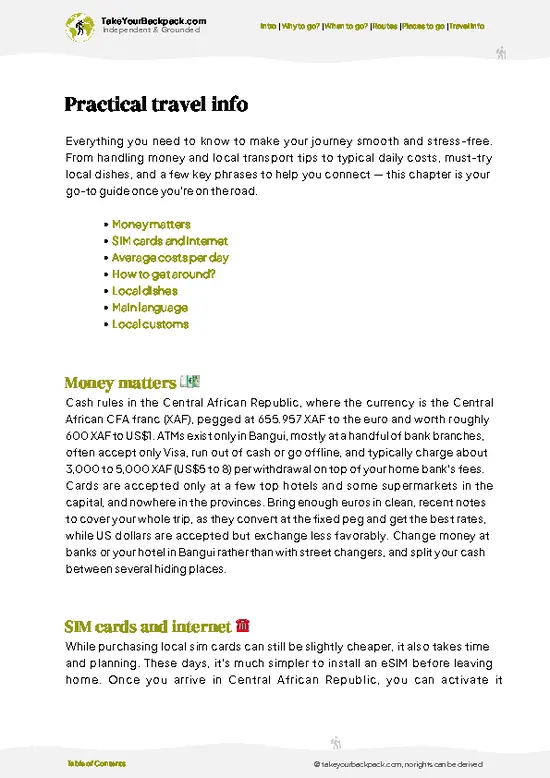
example page 0 from our offline Travel Guide for Central African Republic
example page 1 from our offline Travel Guide for Central African Republic
example page 2 from our offline Travel Guide for Central African Republic
example page 3 from our offline Travel Guide for Central African Republic
example page 4 from our offline Travel Guide for Central African Republic
example page 5 from our offline Travel Guide for Central African Republic
example page 6 from our offline Travel Guide for Central African Republic
example page 7 from our offline Travel Guide for Central African Republic
Loading the map 🌍
CLICK TO FILTER
cities
towns
landmarks
national parks
hikes
attractions
regions
SHOW COUNTRY’S BESTSHOW ALL

✨ Why go?
Ranked #1 attraction in Central African Republic
What makes it a must-see attraction

Bangui Riverfront is the one place in the capital where the geography that made the city becomes visible. The Ubangi River is the reason Bangui exists, and seeing it wide and brown, with dugouts working the current, explains the country better than any museum can. You are also looking at an international frontier, with the Democratic Republic of the Congo sitting on the far bank, close enough to make out buildings and people. That proximity is rare for a capital anywhere in Africa, and it shapes trade, food, and music here.

The second reason is the working port. Barges and boats connect this landlocked country to the Congo River system, and watching cargo move by hand gives you a clear picture of how the economy runs. Photographers will find faces and textures that no other part of town offers, … read more 👉
Bangui Riverfront is the one place in the capital where the geography that made the city becomes visible. The Ubangi River is the reason Bangui exists, and seeing it wide and brown, with dugouts working the current, explains the country better than any museum can. You are also looking at an international frontier, with the Democratic Republic of the Congo sitting on the far bank, close enough to make out buildings and people. That proximity is rare for a capital anywhere in Africa, and it shapes trade, food, and music here.

The second reason is the working port. Barges and boats connect this landlocked country to the Congo River system, and watching cargo move by hand gives you a clear picture of how the economy runs. Photographers will find faces and textures that no other part of town offers, though you should always ask before pointing a lens at anyone.

For a backpacker, this is a short, free, grounding stop that frames everything else you see in the country. Go with a trusted local contact and keep the visit brief and deliberate.

💡 HighlightsKey sights and experiences for travelers

  1. The Ubangi River bank: The main event is the river itself, broad and slow, with sandbars showing at low water. Stand at the edge and the scale of the Ubangi sinks in, along with the sense that this is the city’s main road to the wider Congo basin.
  2. Pirogue fishermen: Dugout canoes slide out along the banks, with men casting nets and hauling small fish. It is quiet, skilled work, and the best moments are early, before the day’s heat builds.
  3. The view across to the Democratic Republic of the Congo: The opposite shore is another country. Few capitals let you look so plainly at a neighboring state from the city center, and it makes a striking photograph.
  4. The river port and cargo landing: Goods arrive by water and are carried off by hand and truck. The noise, shouting, and stacked sacks show the working
… read more 👉
  1. The Ubangi River bank: The main event is the river itself, broad and slow, with sandbars showing at low water. Stand at the edge and the scale of the Ubangi sinks in, along with the sense that this is the city’s main road to the wider Congo basin.
  2. Pirogue fishermen: Dugout canoes slide out along the banks, with men casting nets and hauling small fish. It is quiet, skilled work, and the best moments are early, before the day’s heat builds.
  3. The view across to the Democratic Republic of the Congo: The opposite shore is another country. Few capitals let you look so plainly at a neighboring state from the city center, and it makes a striking photograph.
  4. The river port and cargo landing: Goods arrive by water and are carried off by hand and truck. The noise, shouting, and stacked sacks show the working side of Bangui that visitors rarely get to see.
  5. Riverside market activity: Along the bank, small traders sell fish, produce, and household goods. It is a lively, practical scene rather than a tourist market, so keep your bag close and move on without lingering.
  6. The rapids upstream on the Ubangi: The river was named for these rapids, which gave Bangui its name and blocked large boats from going further. If your guide judges the road safe, seeing the churning water explains why the city sits where it does.
Bangui Riverfront takes about one to two hours at an unhurried pace, or half a day if you add the rapids.
Spotted a mistake or missing something? Contact us.

🌤️ When to go?When to go for the best experience

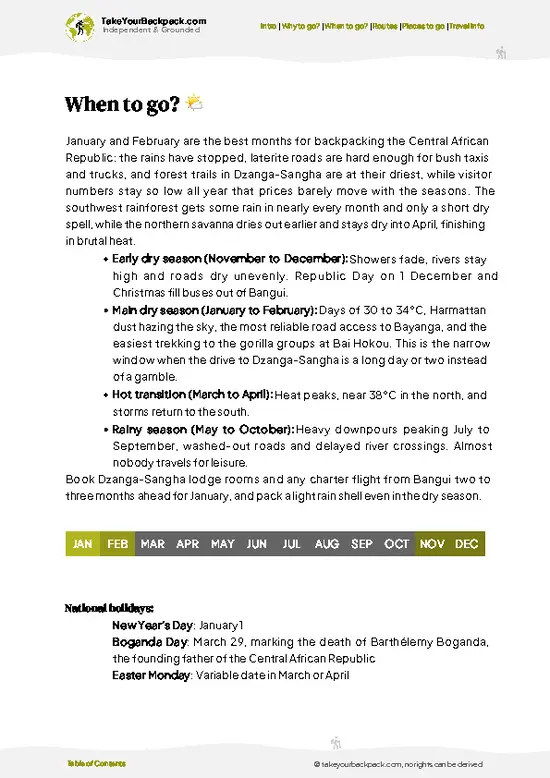
  • Dry Season (December to February): Mornings on the Ubangi bank are clear and dusty with harmattan haze, around 21°C (70°F) at dawn and 33°C (91°F) by afternoon. Roads are passable, river views are open, and this is when most foreign visitors, NGO staff and diplomats move about.
  • Hot Transition (March to May): Afternoons reach 34 to 36°C (93 to 97°F) and humidity climbs. Storms start building late in the day, so walk the bank early.
  • Rainy Season (June to October): Highs of 28 to 31°C (82 to 88°F), heavy downpours, muddy tracks and a swollen river. Pirogue traffic slows and flights and transfers get unreliable.
  • Late Rains (November): Showers ease, skies clear, and the river is still high and brown.
  • Daylight and Prices: Daylight stays close to 12 hours all year. Prices barely move with the seasons,
… read more 👉
  • Dry Season (December to February): Mornings on the Ubangi bank are clear and dusty with harmattan haze, around 21°C (70°F) at dawn and 33°C (91°F) by afternoon. Roads are passable, river views are open, and this is when most foreign visitors, NGO staff and diplomats move about.
  • Hot Transition (March to May): Afternoons reach 34 to 36°C (93 to 97°F) and humidity climbs. Storms start building late in the day, so walk the bank early.
  • Rainy Season (June to October): Highs of 28 to 31°C (82 to 88°F), heavy downpours, muddy tracks and a swollen river. Pirogue traffic slows and flights and transfers get unreliable.
  • Late Rains (November): Showers ease, skies clear, and the river is still high and brown.
  • Daylight and Prices: Daylight stays close to 12 hours all year. Prices barely move with the seasons, though fuel and transport cost more when roads wash out.
Aim for a morning walk in January, when the haze is soft and the heat is still manageable.


source: climatestotravel.comJANJanuary: excellent for travelingFEBFebruary: excellent for travelingMARMarch: highly recommended for travelingAPRApril: good for travelingMAYMay: fair for travelingJUNJune: fair for travelingJULJuly: fair for travelingAUGAugust: fair for travelingSEPSeptember: fair for travelingOCTOctober: fair for travelingNOVNovember: highly recommended for travelingDECDecember: excellent for traveling
when-to-go

✈️ The backpacker research shortcutCentral African Republic Travel Guide

An offline-friendly backpacking guide with optimized travel routes, ranked highlights, transport advice, and the best areas to stay.
example page 0 from our offline Travel Guide for Central African Republic
example page 1 from our offline Travel Guide for Central African Republic
example page 2 from our offline Travel Guide for Central African Republic
example page 3 from our offline Travel Guide for Central African Republic
example page 4 from our offline Travel Guide for Central African Republic
example page 5 from our offline Travel Guide for Central African Republic
example page 6 from our offline Travel Guide for Central African Republic
example page 7 from our offline Travel Guide for Central African Republic
The digital guide (210 pages) contains:
✅ 42 highlights, ranked by travel appeal
✅ Optimized 5, 10 & 15-day travel routes
✅ Cities, national parks, landmarks, beaches
✅ How to get around
✅ Offline-friendly for travel without Wi-Fi
👉 Click to see all 30+ guide features

📅 Plan smarter in minutes, not weeks
✅ Month by month travel advice
✅ Festivals & national holidays
✅ Budget expectations

🗺️ Go to the right places, skip the overrated ones
✅ Honest pros & cons of destinations
✅ Top hikes, parks & viewpoints
✅ Lesser-known places most travelers miss
✅ Clear “worth it vs skip it” guidance

🛏️ Travel smoothly without rookie mistakes
✅ Best areas to stay
✅ Transport systems explained simply
✅ Common scams & safety advice
✅ SIM cards, money & practical tips

🌍 Understand the country, not just visit it
✅ Culture & traditions
✅ 52 Essential phrases & customs
✅ Festivals worth planning around
✅ Traveler-friendly historical context
✅ Insights that make places more meaningful

📱 Built for real travel conditions
✅ Fully downloadable PDF
✅ Works completely offline
✅ Optimized for phone use
✅ Useful in remote areas & buses
✅ Everything in one place
Stop searching, start planning
Get instant access to your full guide. 30‑day money-back guarantee.
+ Add another guide for just

By proceeding you agree to our terms.
Sent to your inbox immediately after payment • 100% Secure Checkout
Best Backpacking Travel Advisor 2025 tourism awardBest Backpacking
Travel Advisor
2025
What others say about Take Your Backpack Guides:
⭐⭐⭐⭐⭐
Fantastic, amazing amount of information!
⭐⭐⭐⭐⭐
My goodness this is amazing, it's what I've been looking for hats off too you!
⭐⭐⭐⭐⭐
I think this is absolutely BRILLIANT
⭐⭐⭐⭐
Very complete and informative. It's still missing places, but I gotta to commend you
⭐⭐⭐⭐⭐
This is truly amazing, thank you, can't wait to explore it with my kids!
⭐⭐⭐⭐⭐
Awesome resource, thank you!
⭐⭐⭐⭐⭐
This is amazing! Can't wait to explore the ones I haven't seen
⭐⭐⭐⭐
I love this! Well done, great idea.
⭐⭐⭐⭐⭐
Thanks for taking the time to make this gem!
⭐⭐⭐⭐⭐
This might be the best website I've ever seen.
⭐⭐⭐⭐⭐
Congratulations, and thank you so much for your work; it's incredibly valuable.
⭐⭐⭐⭐
In all seriousness I think you did a great job pointing out the important spots
⭐⭐⭐⭐⭐
10/10 very good
⭐⭐⭐⭐⭐
As someone who's only just starting to visit regularly this is awesome, thank you.
⭐⭐⭐⭐
Thank you very much! I'm going to visit my dad, it's going to be very useful!
⭐⭐⭐⭐⭐
This is really cool! We'll be travelling for the first time and this definitely come in handy.
⭐⭐⭐⭐⭐
You are now our minister of culture, congratulations 👨‍💼
⭐⭐⭐⭐⭐
Just wanted to tell you that this is a pearl! Going to follow your recommendations.
⭐⭐⭐⭐⭐
This is so cool. I'll definitely be using the resource for my travels soon.
⭐⭐⭐⭐⭐
This is very impressive! Good work.
⭐⭐⭐⭐⭐
This is an amazing and informative site. Very well done!

🛏️ Where to stay?Where staying makes the most sense

The best base for the riverfront is the central districts of Bangui (the Ouango and Centre-Ville area), where the Ubangi bank is a short drive away and the few established guesthouses and small hotels sit. Backpackers are scarce in the capital, so expect a social scene built around aid workers, journalists and researchers rather than a hostel circuit. That means the common areas of mid-range guesthouses are where you will meet people, swap current security updates and find drivers you can trust.
Choose accommodation with a walled compound, a generator and its own transport arrangements. Staying … read more 👉
The best base for the riverfront is the central districts of Bangui (the Ouango and Centre-Ville area), where the Ubangi bank is a short drive away and the few established guesthouses and small hotels sit. Backpackers are scarce in the capital, so expect a social scene built around aid workers, journalists and researchers rather than a hostel circuit. That means the common areas of mid-range guesthouses are where you will meet people, swap current security updates and find drivers you can trust.
Choose accommodation with a walled compound, a generator and its own transport arrangements. Staying within the central districts keeps you close to the river, the main market area and the embassies, and lets you return before dark. Walking between neighborhoods after sunset is a bad idea, so pick a place whose staff will call a vetted taxi.
The Bimbo side and outlying districts are cheaper but sit farther from the water and are harder to reach safely. Couchsurfing is rare, and a local contact or NGO introduction often works better than cold booking. Reserve ahead and confirm airport pickup, since arranging a ride on arrival is easier than hunting one at night.

👛 Costs (as of 22 October 2026)Travel costs and budget guide for Bangui Riverfront

Bangui Riverfront costs about €70 to 130 per day for a traveler staying in a safe central guesthouse, because transport and lodging, not the bank itself, drive the bill. Walking the Ubangi bank is free, and nobody charges entry.
CategoryBudget RangeLocal Reality
Entrance€0No ticket for the riverbank; a guide or escort is advisable.
Accommodation (high season)€35 to 60Walled guesthouse with generator; cheaper rooms exist but are less secure. Rates dip slightly in the rains.
Meals€10 to 20Grilled river fish with cassava or rice at a riverside spot costs €3 to 6; guesthouse dinners cost more.
Local transport€15 to 30Shared taxis are cheap but poorly suited to visitors; most travelers hire a private car with a driver for the day.
Pirogue ride€5 to 10Negotiated per boat for a short trip on the Ubangi;
… read more 👉
Bangui Riverfront costs about €70 to 130 per day for a traveler staying in a safe central guesthouse, because transport and lodging, not the bank itself, drive the bill. Walking the Ubangi bank is free, and nobody charges entry.
CategoryBudget RangeLocal Reality
Entrance€0No ticket for the riverbank; a guide or escort is advisable.
Accommodation (high season)€35 to 60Walled guesthouse with generator; cheaper rooms exist but are less secure. Rates dip slightly in the rains.
Meals€10 to 20Grilled river fish with cassava or rice at a riverside spot costs €3 to 6; guesthouse dinners cost more.
Local transport€15 to 30Shared taxis are cheap but poorly suited to visitors; most travelers hire a private car with a driver for the day.
Pirogue ride€5 to 10Negotiated per boat for a short trip on the Ubangi; confirm security first.
Drinks and extras€5 to 10Beer and bottled water are priced above regional norms. Pay in cash; cards rarely work.
Total Daily Budget€70 to 130Roughly €100 for a typical day.


source: centralafricanrepublictours.com
⚠️ Prices can change and everyone travels differently, so take this as a rough guide. Hope it helps you plan your adventure!

FAQFrequently asked questions about Bangui Riverfront

Two to three hours is enough for Bangui Riverfront, ideally in the morning before the heat peaks. A stroll along the Ubangi bank takes about an hour, and a short pirogue outing or a fish lunch on the water adds another hour or two. Pair it with a half-day in central Bangui, and check current security advice before going.
Bangui Riverfront is free to visit, so there is no entrance fee to weigh. Your real costs are a car and driver (around €15 to 30 a day) and a fish lunch at €3 to 6. The reward is open views across the Ubangi toward the Democratic Republic of the Congo, which makes it one of the easiest and most rewarding stops in the capital.
Bangui Riverfront sits on the southern edge of the capital, 10 to 20 minutes by car from the central districts and about 20 to 30 minutes from Bangui M’Poko airport depending on traffic. A private car with a driver costs roughly €15 to 30 for a day, and your guesthouse can arrange one. Shared taxis run along main roads for a few euros, though they are not advised after dark.
⚠️ Things can change over time, so always validate details locally before you go.

Other Central African attractions near Bangui Riverfront

Explore more nearby:


💡 Not sure where to go next?
Create a personalized itinerary for Central African Republic including Bangui Riverfront and the places that fit your trip.

Generate my itinerary

👉 Discover all attractions

Or checkout all Central African Republic has to offer (think cities, towns, villages, national parks, hikes, beaches, festivals)
Country photo of Central African Republic

We 💚 feedbackSumming up the experience

Bangui Riverfront is best visited early in the morning, but many visitors turn up at midday and wander without a plan. The glare is harsh, the heat flattens the activity, and a stranger on foot draws attention. Go with a local contact, aim for the cooler hours, keep the camera low until you have permission, and leave before the light fades.

✍️ Help improve this page!
The information on this page is based on in-depth research, insights shared by experienced travelers, and feedback from the local travel community in Central African Republic. While every effort is made to keep the information accurate and current, conditions can change — so if you spot anything incorrect or outdated, please get in touch.


🙋‍♂️ Give feedback

👋 Meet the founderWho’s Behind Take Your Backpack?

Johan, backpacker and founder of TakeYourBackpackHi, I’m Johan (Netherlands 🇳🇱), the creator of TakeYourBackpack. Over the past 3 decades, I’ve backpacked through 90+ countries across six continents, gaining extensive experience with independent travel, long-term trips, and overland routes.

This site is built on a combination of firsthand travel experience and carefully curated insights from other backpackers. Many guides are based on places I’ve personally visited, while others bring together tips, observations, and practical advice shared by trusted travelers I’ve met along the way.

The goal is to provide realistic, experience-driven guidance — not generic itineraries — so you can explore destinations with better context, clearer expectations, and more confidence.