×

Central African Republic🇨🇫 | townsSibutRoad junction trade, Kémo River, grilled manioc, lamplit main street | things to do and best time to go

Explore RafaïExplore Yaloke

Backpacking in Sibut
👍 Recommendedtown ranked #10
By Johan Kruseman 🇳🇱 | Updated October 22, 2026

A motorbike taxi idles beside the junction, red dust settles on the mango trees, and someone is grilling manioc under a tin awning while trucks grind through toward the north. That is Sibut, a town on the Kémo River in the center of the Central African Republic, on the main road north of Bangui. Skip the idea of sightseeing here: there are no big monuments, and the museum-and-landmark circuit does not exist. What deserves your time is the river bank, the central market and the road-junction life that shows how goods and people move across the country. It is a working stop, not a social hub, with few places to meet other backpackers. Unlike Bangui, it is small, quiet and slow, with almost no traveler scene.

Discover everything you want to know in the 📖 Central African Republic Travel Guide.
Safety warning

The current risk level for Central African Republic is high. Check the advice before going.


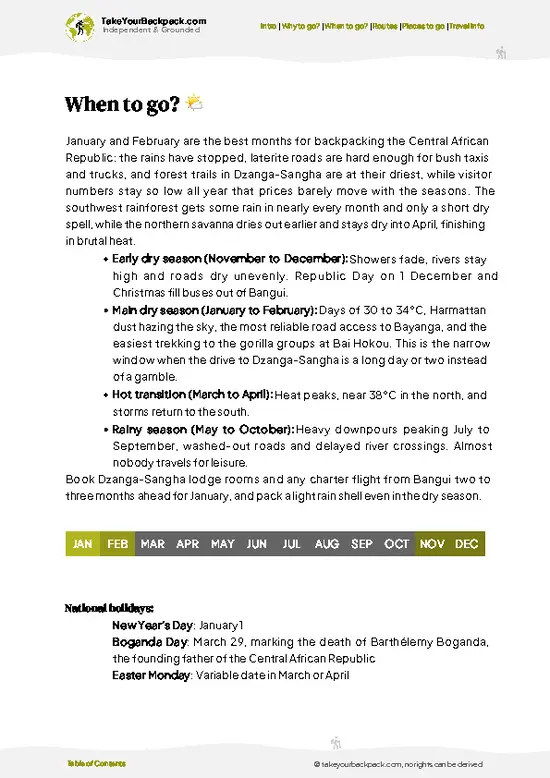
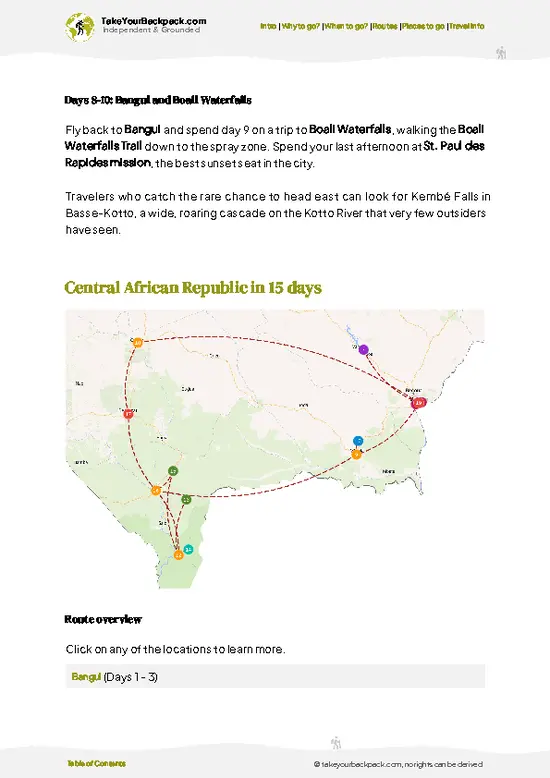
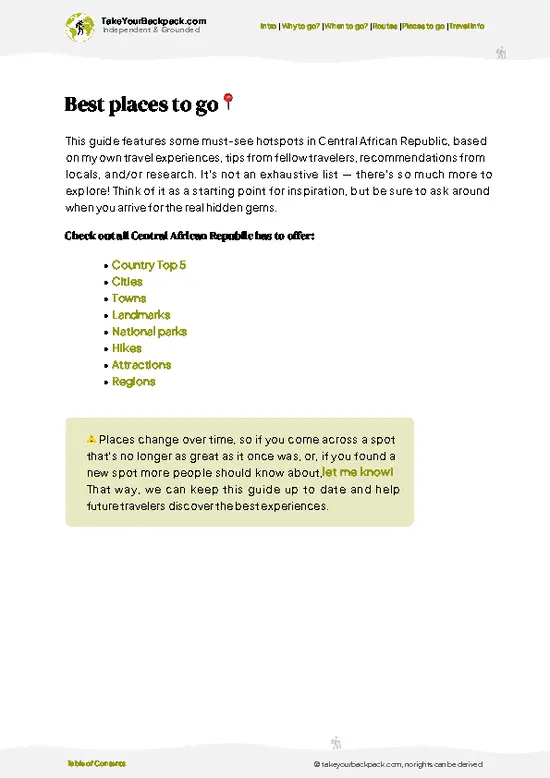
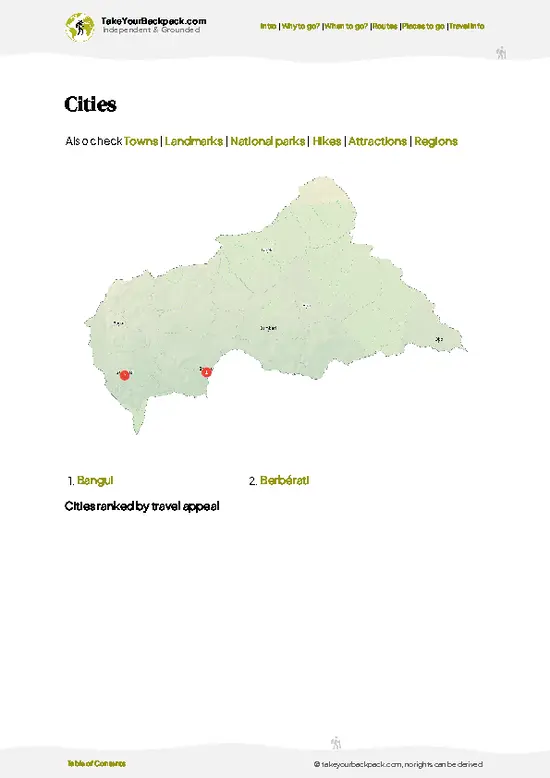
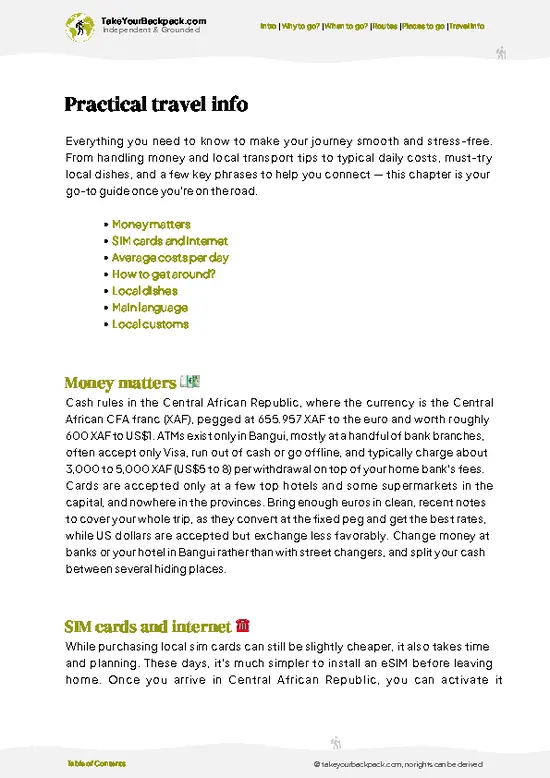
example page 0 from our offline Travel Guide for Central African Republic
example page 1 from our offline Travel Guide for Central African Republic
example page 2 from our offline Travel Guide for Central African Republic
example page 3 from our offline Travel Guide for Central African Republic
example page 4 from our offline Travel Guide for Central African Republic
example page 5 from our offline Travel Guide for Central African Republic
example page 6 from our offline Travel Guide for Central African Republic
example page 7 from our offline Travel Guide for Central African Republic
Loading the map 🌍
CLICK TO FILTER
cities
towns
landmarks
national parks
hikes
attractions
regions
SHOW COUNTRY’S BESTSHOW ALL

✨ Why go?
Ranked #10 town in Central African Republic
The unique appeal for travelers

Sibut earns a stop for the way it shows everyday life in the country’s interior, away from the capital. It sits on the Kémo River at a key road junction, so traders, drivers and farmers from several directions cross paths in a small, walkable center. Most travelers pass through for a night. Slow travelers with local contacts or humanitarian and research work may stay longer, since people here talk readily once you sit down at a market stall or roadside café. Do not expect hostels, a party or a crowd of backpackers. Expect basic guesthouses, grilled fish, cassava and groundnut sauces, and conversations in Sango. Independent, patient, self-sufficient travelers who value ordinary life over attractions will enjoy it most, while anyone wanting organized activities should look elsewhere.

💡 HighlightsTop highlights of Sibut

  1. Kémo River banks: The river is the town’s defining feature, with women washing clothes, fishermen working from dugouts and kids swimming at the edge. Go early in the morning or late afternoon when it is cooler and busiest. Free, and 1 to 2 hours is plenty.
  2. Sibut central market: A loose spread of stalls selling cassava, dried fish, caterpillars in season, palm oil, secondhand clothes and phone credit. Morning is liveliest. Entry is free, a snack costs about €0.50 to 1.50, and you need about an hour.
  3. The road junction: Trucks, minibuses and motorbikes meet here, and watching the loading, repairs and haggling explains how the interior’s trade works. Late morning is busiest. It is free and 30 to 45 minutes is enough.
  4. Catholic mission area: The church and mission grounds are among the older institutions
… read more 👉
  1. Kémo River banks: The river is the town’s defining feature, with women washing clothes, fishermen working from dugouts and kids swimming at the edge. Go early in the morning or late afternoon when it is cooler and busiest. Free, and 1 to 2 hours is plenty.
  2. Sibut central market: A loose spread of stalls selling cassava, dried fish, caterpillars in season, palm oil, secondhand clothes and phone credit. Morning is liveliest. Entry is free, a snack costs about €0.50 to 1.50, and you need about an hour.
  3. The road junction: Trucks, minibuses and motorbikes meet here, and watching the loading, repairs and haggling explains how the interior’s trade works. Late morning is busiest. It is free and 30 to 45 minutes is enough.
  4. Catholic mission area: The church and mission grounds are among the older institutions of the town, and the quiet compound gives a calm break from the dust. Visit between services and ask permission before photographing. Donation optional, about 30 minutes.
  5. Evening stroll along the main street: As the heat drops, stalls light up with lamps, grills smoke and neighbors gather. It is the best time to meet locals over a cheap skewer or sweet tea at about €0.50 to 2. Allow 1 hour.
Sibut works as a base for short trips to nearby towns such as Dékoa, Grimari and Kaga-Bandoro, and for seeing the surrounding savanna and villages. For a first visit, the Kémo River banks give the clearest picture of local life.
Spotted a mistake or missing something? Contact us.

🏘️ NeighborhoodsKey areas and districts to know

Sibut is small enough to read in an afternoon, and the useful parts sit within a few kilometers of each other along the Bangui to Bambari road.
  • Central market and main road: This is where to spend most of your time. Stalls sell cassava, manioc leaves, smoked fish, peanuts and basic hardware, and the roadside stands serve grilled meat and sweet tea. It is fully walkable and busiest in the morning.
  • Riverside by the Kémo: Worth a slow walk for the fishing pirogues and women washing clothes, but skip it after dark. Paths are uneven and unlit. Go with a local who knows the access points.
  • Mission and church quarter: Quiet, shaded and good for a short stroll. There is little to see beyond the buildings, so give it twenty minutes, not an hour.
  • Outer residential quarters: Not worth the time. They are spread
… read more 👉
Sibut is small enough to read in an afternoon, and the useful parts sit within a few kilometers of each other along the Bangui to Bambari road.
  • Central market and main road: This is where to spend most of your time. Stalls sell cassava, manioc leaves, smoked fish, peanuts and basic hardware, and the roadside stands serve grilled meat and sweet tea. It is fully walkable and busiest in the morning.
  • Riverside by the Kémo: Worth a slow walk for the fishing pirogues and women washing clothes, but skip it after dark. Paths are uneven and unlit. Go with a local who knows the access points.
  • Mission and church quarter: Quiet, shaded and good for a short stroll. There is little to see beyond the buildings, so give it twenty minutes, not an hour.
  • Outer residential quarters: Not worth the time. They are spread out, dusty and have no sights or eateries, and you will look conspicuous wandering without a purpose.
Nightlife is minimal: a few bars near the main road with warm beer and music, closing early.

⌛️ 1 dayWhat you can realistically do in a day

This is a river-and-market day, built around ordinary life rather than sights.
7:00 AM, Kémo River bank: Start where the town wakes up, with fishermen, laundry and water carriers. Greet people in Sango, ask before taking photos, then walk back up toward the center.
8:30 AM, Central market: Browse the stalls while they are at their busiest. Try a roasted cassava or grilled fish breakfast and buy water and phone credit. Spend about 90 minutes here.
10:30 AM, Road junction: A short walk takes you to the crossroads. Sit in the shade with tea and watch trucks load, mechanics work and minibuses fill.
12:30 PM, Lunch at a local eatery: Choose a simple spot with a stew of cassava leaves or groundnut sauce with rice. Rest through the heat.
3:00 PM, Catholic mission compound: Less visited, this quiet area … read more 👉
This is a river-and-market day, built around ordinary life rather than sights.
7:00 AM, Kémo River bank: Start where the town wakes up, with fishermen, laundry and water carriers. Greet people in Sango, ask before taking photos, then walk back up toward the center.
8:30 AM, Central market: Browse the stalls while they are at their busiest. Try a roasted cassava or grilled fish breakfast and buy water and phone credit. Spend about 90 minutes here.
10:30 AM, Road junction: A short walk takes you to the crossroads. Sit in the shade with tea and watch trucks load, mechanics work and minibuses fill.
12:30 PM, Lunch at a local eatery: Choose a simple spot with a stew of cassava leaves or groundnut sauce with rice. Rest through the heat.
3:00 PM, Catholic mission compound: Less visited, this quiet area is away from the standard stops. Ask politely at the gate, walk the grounds and talk with anyone willing.
5:00 PM, Main street at dusk: Stroll slowly as lamps and grills come on, eat a skewer, and finish with sweet tea before heading to your guesthouse.

🌤️ When to go?When to go for the best experience

  • Dry season (November to March): Roads are firmest and travel is easiest. Days reach 32 to 35°C (90 to 95°F), nights drop to 18 to 22°C (64 to 72°F), and harmattan haze can dull the skies.
  • Transition (April and October): Storms build in the afternoon, humidity climbs and temperatures sit around 30 to 33°C (86 to 91°F). Mornings are still usable for getting around.
  • Rainy season (May to September): Expect 27 to 31°C (81 to 88°F), heavy downpours, muddy tracks and slow, unpredictable transport. Fares and food prices tend to rise when trucks are delayed.
  • Daylight: Close to the equator, days run roughly 11.5 to 12.5 hours all year, with darkness falling quickly.
Aim for December or January, and keep a spare day in your plan for road delays.

source: climatestotravel.comJANJanuary: excellent for travelingFEBFebruary: highly recommended for travelingMARMarch: good for travelingAPRApril: good for travelingMAYMay: fair for travelingJUNJune: fair for travelingJULJuly: fair for travelingAUGAugust: fair for travelingSEPSeptember: fair for travelingOCTOctober: fair for travelingNOVNovember: good for travelingDECDecember: excellent for traveling
when-to-go

✈️ The backpacker research shortcutCentral African Republic Travel Guide

An offline-friendly backpacking guide with optimized travel routes, ranked highlights, transport advice, and the best areas to stay.
example page 0 from our offline Travel Guide for Central African Republic
example page 1 from our offline Travel Guide for Central African Republic
example page 2 from our offline Travel Guide for Central African Republic
example page 3 from our offline Travel Guide for Central African Republic
example page 4 from our offline Travel Guide for Central African Republic
example page 5 from our offline Travel Guide for Central African Republic
example page 6 from our offline Travel Guide for Central African Republic
example page 7 from our offline Travel Guide for Central African Republic
The digital guide (210 pages) contains:
✅ 42 highlights, ranked by travel appeal
✅ Optimized 5, 10 & 15-day travel routes
✅ Cities, national parks, landmarks, beaches
✅ How to get around
✅ Offline-friendly for travel without Wi-Fi
👉 Click to see all 30+ guide features

📅 Plan smarter in minutes, not weeks
✅ Month by month travel advice
✅ Festivals & national holidays
✅ Budget expectations

🗺️ Go to the right places, skip the overrated ones
✅ Honest pros & cons of destinations
✅ Top hikes, parks & viewpoints
✅ Lesser-known places most travelers miss
✅ Clear “worth it vs skip it” guidance

🛏️ Travel smoothly without rookie mistakes
✅ Best areas to stay
✅ Transport systems explained simply
✅ Common scams & safety advice
✅ SIM cards, money & practical tips

🌍 Understand the country, not just visit it
✅ Culture & traditions
✅ 52 Essential phrases & customs
✅ Festivals worth planning around
✅ Traveler-friendly historical context
✅ Insights that make places more meaningful

📱 Built for real travel conditions
✅ Fully downloadable PDF
✅ Works completely offline
✅ Optimized for phone use
✅ Useful in remote areas & buses
✅ Everything in one place
Stop searching, start planning
Get instant access to your full guide. 30‑day money-back guarantee.
+ Add another guide for just

By proceeding you agree to our terms.
Sent to your inbox immediately after payment • 100% Secure Checkout
Best Backpacking Travel Advisor 2025 tourism awardBest Backpacking
Travel Advisor
2025
What others say about Take Your Backpack Guides:
⭐⭐⭐⭐⭐
Fantastic, amazing amount of information!
⭐⭐⭐⭐⭐
My goodness this is amazing, it's what I've been looking for hats off too you!
⭐⭐⭐⭐⭐
I think this is absolutely BRILLIANT
⭐⭐⭐⭐
Very complete and informative. It's still missing places, but I gotta to commend you
⭐⭐⭐⭐⭐
This is truly amazing, thank you, can't wait to explore it with my kids!
⭐⭐⭐⭐⭐
Awesome resource, thank you!
⭐⭐⭐⭐⭐
This is amazing! Can't wait to explore the ones I haven't seen
⭐⭐⭐⭐
I love this! Well done, great idea.
⭐⭐⭐⭐⭐
Thanks for taking the time to make this gem!
⭐⭐⭐⭐⭐
This might be the best website I've ever seen.
⭐⭐⭐⭐⭐
Congratulations, and thank you so much for your work; it's incredibly valuable.
⭐⭐⭐⭐
In all seriousness I think you did a great job pointing out the important spots
⭐⭐⭐⭐⭐
10/10 very good
⭐⭐⭐⭐⭐
As someone who's only just starting to visit regularly this is awesome, thank you.
⭐⭐⭐⭐
Thank you very much! I'm going to visit my dad, it's going to be very useful!
⭐⭐⭐⭐⭐
This is really cool! We'll be travelling for the first time and this definitely come in handy.
⭐⭐⭐⭐⭐
You are now our minister of culture, congratulations 👨‍💼
⭐⭐⭐⭐⭐
Just wanted to tell you that this is a pearl! Going to follow your recommendations.
⭐⭐⭐⭐⭐
This is so cool. I'll definitely be using the resource for my travels soon.
⭐⭐⭐⭐⭐
This is very impressive! Good work.
⭐⭐⭐⭐⭐
This is an amazing and informative site. Very well done!

🛏️ Where to stay?Choosing the right base

The best option for a budget stay in Sibut is a guesthouse or mission-run lodging close to the main road and market, where beds cost roughly €8 to 20 a night. There are no hostels with dorms, so expect a simple private room, often with a fan and a bucket shower, and electricity that may be limited to generator hours.
Staying near the main road puts you within walking distance of food stalls and the place where vehicles to Bangui gather in the morning, which matters when departures are at dawn. It is also the safest area at night, since people are about until early evening and you are easy to find. … read more 👉
The best option for a budget stay in Sibut is a guesthouse or mission-run lodging close to the main road and market, where beds cost roughly €8 to 20 a night. There are no hostels with dorms, so expect a simple private room, often with a fan and a bucket shower, and electricity that may be limited to generator hours.
Staying near the main road puts you within walking distance of food stalls and the place where vehicles to Bangui gather in the morning, which matters when departures are at dawn. It is also the safest area at night, since people are about until early evening and you are easy to find. Noise comes from motorbikes, music and roosters, so bring earplugs.
The riverside and outer quarters are quieter but dark, isolated and farther from transport. A mission-affiliated guesthouse is a calm alternative if you want a gated compound and more security. Book ahead by phone or in person when possible, since the number of rooms is small and humanitarian staff often fill them.

🚌 Getting aroundHow to get around Sibut

Sibut’s center is compact enough to cross on foot in fifteen minutes, and walking stops making sense only when you head to outlying villages or the river crossings several kilometers out. Traffic is light, mostly motorbikes and the occasional truck. There is no scheduled city transport, so everything runs on informal arrangements and patience.
  • Walking: Free, and the best way to see the market, the main road and the mission quarter. Go in the morning, when it is cooler and the streets are busiest.
  • Moto-taxis: The everyday choice for anything beyond the center. A short hop costs about €0.30 to 1, and a longer ride to a nearby village €2 to 5. Agree the fare first and ask for a helmet, which is not always available.
  • Minibuses and trucks on the Bangui road: Sibut lies roughly 180 km north of Bangui,
… read more 👉
Sibut’s center is compact enough to cross on foot in fifteen minutes, and walking stops making sense only when you head to outlying villages or the river crossings several kilometers out. Traffic is light, mostly motorbikes and the occasional truck. There is no scheduled city transport, so everything runs on informal arrangements and patience.
  • Walking: Free, and the best way to see the market, the main road and the mission quarter. Go in the morning, when it is cooler and the streets are busiest.
  • Moto-taxis: The everyday choice for anything beyond the center. A short hop costs about €0.30 to 1, and a longer ride to a nearby village €2 to 5. Agree the fare first and ask for a helmet, which is not always available.
  • Minibuses and trucks on the Bangui road: Sibut lies roughly 180 km north of Bangui, and the trip takes 4 to 8 hours depending on the road and checkpoints, at about €8 to 15. Vehicles leave when full, usually early morning, and are cramped. Rainy season can double the time.
  • Hired motorbike or car with driver: Useful for reaching villages and waterfalls, at roughly €25 to 60 a day including fuel. It is the only sensible option for sites off the main road, and worth the money if your time is short.
Skip planning around fixed timetables. Ask at the roadside gathering point the evening before and be there at dawn.

👛 Costs (as of 22 October 2026)Typical daily expenses

Sibut costs about €30 to 50 a day for a backpacker, with a typical day near €37 once you add lodging, food and a motorbike ride or two.
CategoryBudget RangeLocal Reality
Dorm accommodation€8 to 20No dorms exist, so this is a basic private room in a guesthouse, with power for limited hours.
Meals€5 to 12Rice, cassava, beans, grilled fish or goat from roadside stalls cost the least, and restaurants are rare.
Local transport€2 to 8Moto-taxis cover short trips, and fares rise after dark or in rain.
Basic activities/entry fees€0 to 5Most sights are free, with small tips expected for guides or village visits.
Miscellaneous expenses€3 to 8Bottled water, phone credit, small checkpoint payments and the occasional cold drink.
Total Daily Budget€37Based on a high-season private room and a modest daily routine.
… read more 👉
Sibut costs about €30 to 50 a day for a backpacker, with a typical day near €37 once you add lodging, food and a motorbike ride or two.
CategoryBudget RangeLocal Reality
Dorm accommodation€8 to 20No dorms exist, so this is a basic private room in a guesthouse, with power for limited hours.
Meals€5 to 12Rice, cassava, beans, grilled fish or goat from roadside stalls cost the least, and restaurants are rare.
Local transport€2 to 8Moto-taxis cover short trips, and fares rise after dark or in rain.
Basic activities/entry fees€0 to 5Most sights are free, with small tips expected for guides or village visits.
Miscellaneous expenses€3 to 8Bottled water, phone credit, small checkpoint payments and the occasional cold drink.
Total Daily Budget€37Based on a high-season private room and a modest daily routine.
Carry plenty of small euro-equivalent bills in local currency from Bangui, since change is scarce and cards and ATMs are not an option.
⚠️ Prices can change and everyone travels differently, so take this as a rough guide. Hope it helps you plan your adventure!

🚌 Day tripsEasy escapes and nearby places

Sibut works as a base for day trips into the surrounding countryside, but nothing here is organized, so you arrange a motorbike or driver yourself and leave early.
Kémo River Villages:
Fishing hamlets along the Kémo reward you with pirogue launches, smoked fish drying on racks and farmers who are happy to talk. Allow a half day, with a moto-taxi at about €5 to 12 return. The dry season keeps tracks passable. First-timers often forget to greet the village chief before taking photos.

Grimari:
This town on the road toward Bambari is a market day out, about 1.5 to 3 hours each way by shared vehicle or hired bike, with total costs around €10 to 25. It gives a look at diamond and farming country life. Go in dry months, and carry your passport for checkpoints.

Dekoa:
A smaller trading town north … read more 👉
Sibut works as a base for day trips into the surrounding countryside, but nothing here is organized, so you arrange a motorbike or driver yourself and leave early.
Kémo River Villages:
Fishing hamlets along the Kémo reward you with pirogue launches, smoked fish drying on racks and farmers who are happy to talk. Allow a half day, with a moto-taxi at about €5 to 12 return. The dry season keeps tracks passable. First-timers often forget to greet the village chief before taking photos.

Grimari:
This town on the road toward Bambari is a market day out, about 1.5 to 3 hours each way by shared vehicle or hired bike, with total costs around €10 to 25. It gives a look at diamond and farming country life. Go in dry months, and carry your passport for checkpoints.

Dekoa:
A smaller trading town north of Sibut, reachable in roughly 1 to 2 hours on a rough road. A hired motorbike runs about €15 to 30 for the round trip. It suits travelers who want quiet back roads rather than sights. Leave by 7 am to be back before dark.

🛡️ SafetyScams, Hazards, and Annoyances

Sibut is a small town where the main risks come from the wider security situation in the Central African Republic, not from street crime. Check current conditions with locals, the mission or humanitarian staff before arriving, and avoid travel on roads outside town after mid-afternoon, when armed groups and unofficial checkpoints are a greater concern. Within town, stay on the main road and market area, and skip the riverside and outskirts after dark. Solo travelers, especially women, draw attention, so dress modestly and keep to well-lit places. Checkpoints are routine, and officials may ask for small payments. Stay calm, keep copies of your passport and visa, and carry small bills. Petty theft in the market is uncommon but possible, so keep valuables out of sight.

FAQTraveler FAQ

Sibut is worth a short visit only if you are traveling the Bangui to Bambari road and want to see a working market town on the Kémo River. Highlights are the central market and nearby fishing villages, and there is little else, so it suits adventurous travelers who accept limited services and the security situation of the Central African Republic. Expect about €37 a day.
One to two days is enough in Sibut: a morning at the market, an afternoon walk by the Kémo River, and a half day to a nearby village. Add a third day only if road conditions delay your onward trip. Departure vehicles leave at dawn, so plan to sleep in town the night before.
Sibut is roughly 180 km from Bangui, and a day trip is possible on paper but impractical. The road takes 4 to 8 hours each way depending on conditions and checkpoints, leaving almost no time in town, and traveling after mid-afternoon is discouraged. Spend at least one night in Sibut and budget about €8 to 15 each way for shared transport.
⚠️ Things can change over time, so always validate details locally before you go.

Other Central African towns near Sibut

Explore more nearby:

  • Kouango—Ubangi Riverbank, fishing villages, river transport| 129 km away
  • Kaga-Bandoro—savanna landscape, regional trading post, local markets| 141 km away
  • Bambari—Ouaka River, bustling market, mining activity| 175 km away

💡 Not sure where to go next?
Create a personalized itinerary for Central African Republic including Sibut and the places that fit your trip.

Generate my itinerary

👉 Discover all towns

Or checkout all Central African Republic has to offer (think cities, towns, villages, national parks, hikes, beaches, festivals)
Country photo of Central African Republic

We 💚 feedbackParting advice and final tips

Sibut’s best feature is easy to overlook: the junction itself. Most people hurry through it, but an hour in the shade watching the trucks load teaches you more about the interior than any monument. Bring small bills, learn a few Sango greetings, and sit down with someone before you pull out a camera.

✍️ Help improve this page!
The information on this page is based on in-depth research, insights shared by experienced travelers, and feedback from the local travel community in Central African Republic. While every effort is made to keep the information accurate and current, conditions can change — so if you spot anything incorrect or outdated, please get in touch.


🙋‍♂️ Give feedback

👋 Meet the founderWho’s Behind Take Your Backpack?

Johan, backpacker and founder of TakeYourBackpackHi, I’m Johan (Netherlands 🇳🇱), the creator of TakeYourBackpack. Over the past 3 decades, I’ve backpacked through 90+ countries across six continents, gaining extensive experience with independent travel, long-term trips, and overland routes.

This site is built on a combination of firsthand travel experience and carefully curated insights from other backpackers. Many guides are based on places I’ve personally visited, while others bring together tips, observations, and practical advice shared by trusted travelers I’ve met along the way.

The goal is to provide realistic, experience-driven guidance — not generic itineraries — so you can explore destinations with better context, clearer expectations, and more confidence.